

Posted on 2 June 2026
Free Optical Invoice Template Download: PDF, Word, Excel & Google Sheets
- Tracks eye exam fees, frame and lens charges, coating add-ons, and prescription details across every patient sale.
- Separates clinical service fees from taxable optical products so every bill is structured correctly from the first line.
- Includes prescription reference number, PD measurement, and warranty terms so patients have everything they need at pickup.
- The optical invoice template is available in Word, Excel, PDF, Google Sheets, and Google Docs.
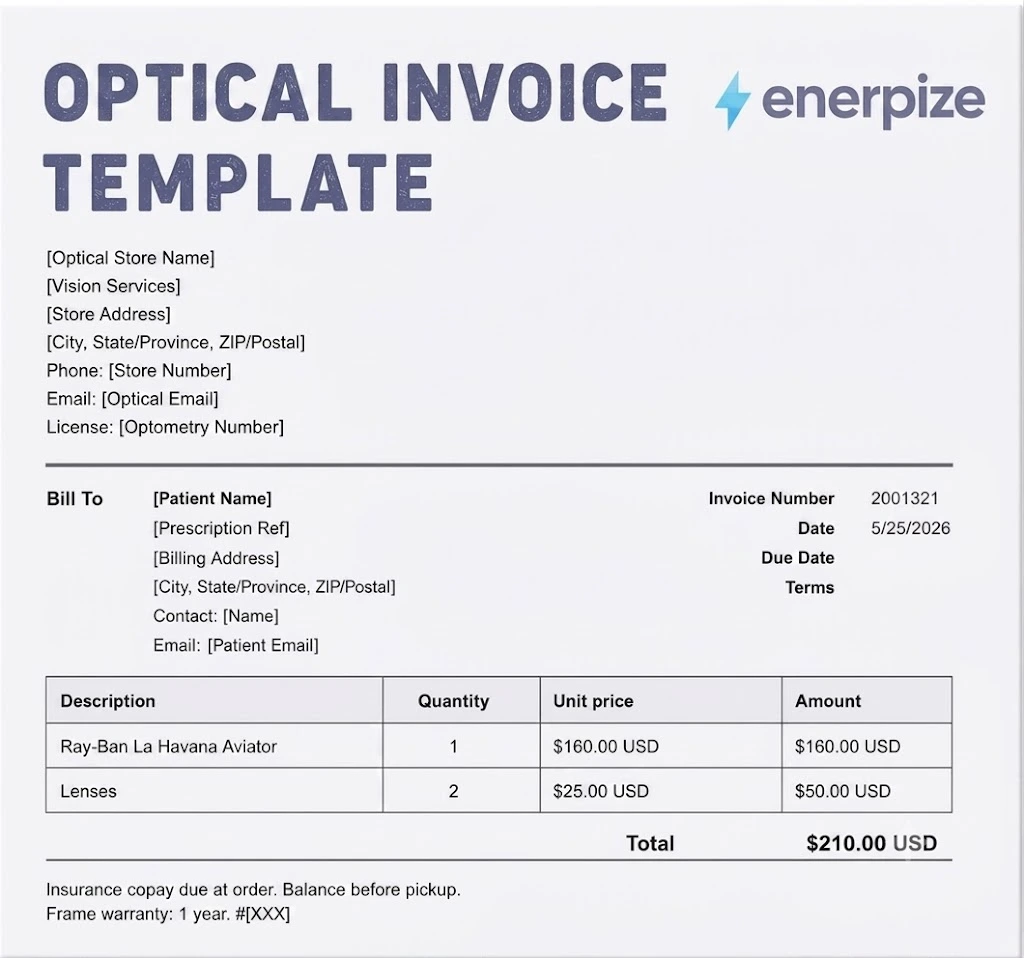
A free optical invoice template is a ready-to-use billing document for optical shops and optometrists to record eye exam fees, frame and lens sales, coating add-ons, and contact lens orders, with the prescription details and tax fields that a standard retail invoice leaves out.


What Is an Optical Invoice?
Walk into any optical shop, pick a frame, get your lenses fitted, pay at the counter, and you will receive a piece of paper before you leave. That piece of paper is doing more work than most people realize.
An optical invoice is the billing document an optical shop issues to a patient after a sale of eyewear products or vision care services. On the surface it looks like any other retail bill. But it carries information that a standard product invoice does not: the patient's prescription details, the pupillary distance (PD) measurement used to position the lenses, the lens Rx parameters per eye (sphere, cylinder, axis, and addition power for progressives), the frame model, color, and size for warranty tracking, and the prescription reference number that links the invoice back to the clinical record.
That last detail matters more than most shop owners appreciate. A patient who needs to submit their spectacle bill for insurance reimbursement or employer medical claims needs that prescription reference on the invoice. Without it, the claim gets flagged. The spectacles are real, the purchase is real, but the paper trail is incomplete.
An optical invoice also has a tax split built into it that a generic retail invoice does not. Eye examination services and eyewear products are not always taxed the same way depending on your jurisdiction. Getting that split wrong on the bill is not just a calculation error. It is the kind of thing that comes up when patients dispute charges or when claims get reviewed.
Skip the manual bill format. Generate your optical invoice directly in Enerpize, free, no credit card required. Start for free.
What to Include in an Optical Bill Format
Most optical bill formats floating around the internet list the same eight generic fields and call it done. Here is the full picture, including the two fields that keep getting left off.
Shop and provider details:
- Optical shop name, address, phone, and email
- Optometrist or dispensing optician name and license number
- Tax registration number where applicable
Patient and transaction details:
- Patient full name
- Billing address and contact number
- Invoice number and invoice date
- Due date and payment terms
Clinical details (the fields most generic templates skip):
- Prescription reference number, linking this invoice to the clinical record
- Rx per eye: sphere (Sph), cylinder (Cyl), axis, and addition power (Add) for bifocal or progressive lenses
- PD (pupillary distance) measurement, binocular or monocular, in millimeters
Product and service lines:
- Frame: brand, model name, color, and size (e.g., "Ray-Ban La Havana Aviator, Black, Size 52")
- Lens type: single vision, bifocal, or progressive
- Lens material: standard, polycarbonate, or high-index (1.56, 1.61, 1.67, 1.74)
- Each coating as a separate line item: AR coating, scratch-resistant, UV protection, blue-light filter
- Contact lenses: brand, modality (daily, monthly, annual), base curve, and box count
- Eye examination fee, listed separately and not bundled with products
- PD measurement charge if billed separately
- Dispensing or fitting charge
Totals and compliance fields:
- Applicable tax rate per line, following your local rules on whether clinical services and optical products are taxed differently
- Subtotal, tax total, and invoice total
- Deposit applied and balance due at pickup
- Warranty period and remake or return policy in plain language
Optical Shop Bill Line Items: A Complete Reference
This table covers every charge category an optical shop bill may carry, what makes each one taxable or potentially exempt, and how to describe it so the patient and any insurance reviewer can understand it at a glance.
Line Item | Example Description | Taxable? | Notes |
|---|---|---|---|
| Eye Examination | Comprehensive eye exam, refraction included | Varies by jurisdiction | Clinical service; check local rules on whether health services attract sales tax or VAT |
| Frame | Ray-Ban Aviator La Havana, Black, Size 52 | Generally yes | Record model, color, and size for warranty claims |
| Single Vision Lenses | SV polycarbonate 1.56, Sph -2.00 Cyl -0.50 Ax 180 | Generally yes | Include full Rx; needed for remake or warranty claims |
| Progressive Lenses | Progressive hi-index 1.67, Add +2.00 | Generally yes | Specify design (standard, premium, freeform) if billed differently |
| AR Coating | Anti-reflective coating, branded | Generally yes | Separate line from lenses; different warranty period applies |
| Scratch-Resistant Coating | Hard coat add-on | Generally yes | Often bundled by labs; unbundle on the bill for transparency |
| Blue-Light Filter | Blue cut lens add-on | Generally yes | Common add-on; list separately so patients can claim it against vision benefits |
| UV Protection | UV 400 coating | Generally yes | Some vision plans require this listed separately for reimbursement |
| PD Measurement | Binocular PD: 63mm | Varies by shop | Billed as a separate line by many independent optical shops |
| Contact Lenses | Acuvue Oasys Monthly, BC 8.4, 6 boxes | Generally yes | Include base curve, brand, and replacement schedule |
| Dispensing Charge | Frame fitting and adjustment | Varies | Separate from exam fee in practices that bill clinical and retail apart |
| Deposit | 50% advance on custom lens order | Not applicable | Show deposit amount, date received, and balance due at pickup |
The tax split that most shop bills get wrong. In many markets, eye examination fees are exempt from sales tax or VAT because they are classified as health care services. Frames, lenses, and coatings are retail products and are typically taxable. Listing the exam fee and the eyewear on the same line and applying one blended rate to the total creates a compliance problem. Keep them on separate lines. Check the tax classification rules that apply in your country or state, and apply them per line.
How to Create an Eye Checkup Bill in 5 Steps
Whether you are running an independent optical shop or managing a small chain, the billing process follows the same sequence every time.
Step 1: Record the clinical details before you start the invoice. Pull the patient name, date of examination, Rx per eye, PD measurement, and prescription reference number from the clinical record. These go into the invoice header. If the patient's name on the invoice does not match the name on the prescription, any insurance or reimbursement claim they submit will be questioned.
Step 2: Add the product lines, each as a separate item. Frame on its own line with model, color, and size. Lenses on their own line with Rx parameters and material. Each coating on a separate line. Contact lenses with base curve and box count. Do not bundle frame and lenses into one line to save space. The moment a patient needs to claim warranty on the frame only, a bundled line creates a dispute.
Step 3: Apply the correct tax treatment per line. Check whether eye examination fees are taxable or exempt in your jurisdiction. Apply the appropriate tax rate to each product line separately. If your tax authority requires clinical services and optical products to be taxed differently, show them as distinct line items with distinct tax treatments.
Step 4: Include the provider's license number and any required registration details. The optometrist or dispensing optician name and license number belong in the invoice header alongside the shop name and address. Many insurance providers and employer reimbursement policies require this field to verify that the purchase was made at a registered optical practice.
Step 5: State the payment terms, deposit details, and warranty. If a deposit was collected at order, show the deposit amount, the date it was received, and the balance due at pickup. Add the frame warranty period and the lens remake window. State both in plain language. One year on frames from the date of purchase and thirty to sixty days for lens remakes due to prescription or manufacturing error is standard across most markets.
Optical Invoice vs. Optical Receipt: What Is the Difference?
The terms get used interchangeably at the counter. They are not the same document.
An optical invoice is issued at the time of order or sale. It is a request for payment. It shows what was ordered, what it costs, what deposit has been collected, and what balance remains due at pickup. For custom lens orders, the patient receives the invoice at order placement and settles the balance when the glasses are ready.
An optical receipt is issued after payment is made in full. It is proof of payment. It carries the same product and Rx details as the invoice, but it also shows the payment method, the amount paid, and a paid notation. This is the document the patient takes home, submits for insurance reimbursement, and keeps in case a warranty claim comes up six months later.
In a well-run optical shop, every patient leaves with both. The invoice is generated at order. The receipt is generated at pickup when the balance is cleared. Your billing system should produce both from the same transaction record without manual duplication.
How Enerpize Handles Optical Shop Billing
Downloading a template gets you started. What it cannot do is update your stock when a frame sells, apply a patient's insurance co-payment automatically, send an alert when their custom lenses are ready, or show you which salesperson closed the most eyewear sales this month.
Enerpize has a dedicated eyewear and optical shop management module built specifically for how optical retail actually works. Here is what that means in practice.
Insurance co-payment on invoices. Enerpize lets you configure insurance companies, co-payment categories, and the rates that apply to each optical product or service. When you create an invoice for a patient covered by a health scheme, Enerpize applies the co-payment split automatically. The invoice shows the patient's portion and the insurer's portion as separate amounts. No manual calculation, no split-sheet workaround.
Inventory linked to every sale. Your product database covers glasses, frames, lenses, and eyewear by SKU. When a frame is added to an invoice, stock is deducted. When lenses are sold, inventory updates. Low-stock alerts fire when a fast-moving lens SKU drops below your set threshold. You stop discovering stockouts at the counter.
Patient Rx history in CRM. Every patient's optical test results, purchase history, Rx per eye, and PD measurement are stored against their profile. When a returning patient comes in for a new frame on the same prescription, the previous Rx is already in the system. You confirm rather than re-enter. The invoice populates faster and the prescription reference number is already there for any insurance documentation.
POS with barcode integration. Walk-in sales move through a barcode-integrated point of sale system. Scan the frame at the counter and the invoice line populates instantly with model, price, and an automatic stock adjustment. For optical shops doing high volume on weekends, this is the difference between a two-minute checkout and a six-minute one.
Delivery date alerts for custom orders. Custom lens orders have a lab turnaround that your customer is waiting on. Set the delivery date in Enerpize when the order goes to the lab. The system sends an SMS notification to the patient when the order is ready for pickup, reducing the calls that tie up your front desk.
Multi-branch oversight for optical chains. If you operate more than one optical location, each branch runs its own stock, invoicing, and CRM through the same Enerpize account. Sales, inventory, and staff performance roll up to a central dashboard. You see the full picture from one login.
The optical invoice template on this page is where billing starts. Enerpize is where it runs.
Ready to move beyond the spreadsheet? Build and send your optical invoices directly in Enerpize, with inventory, insurance, and CRM connected from day one. Start for free.
Common Mistakes in Optical Shop Bills
Small errors on optical bills create large problems downstream, from delayed insurance claims to warranty disputes. These are the ones that come up most often.
Bundling the eye exam fee with product charges on one line. In many jurisdictions, clinical services and retail optical products carry different tax treatments. Combining them into one line and applying a single rate to the total creates a compliance problem. List the exam separately. List the products separately. Check the rules that apply where you operate.
Not recording the deposit and pickup balance clearly. For custom lens orders, the patient pays a deposit at order and settles the balance at pickup. If the invoice does not clearly show the deposit amount received, the date it was collected, and the balance remaining, disputes at pickup are inevitable. State both figures explicitly.
Missing the prescription reference number. The prescription reference links the invoice to the clinical record. Without it, the invoice floats as a retail transaction with no documented clinical basis. For insurance and reimbursement purposes, this gap is a rejection waiting to happen.
Omitting the warranty and remake window. A glasses invoice without a stated warranty period and lens remake cutoff means every remake request becomes a negotiation. Add both in plain language on every invoice. Frame warranty from the date of purchase and a lens remake window for prescription or manufacturing errors are standard terms patients expect to see.
Listing coatings as part of the lens price rather than separate line items. Patients who submit optical invoices to vision insurance plans or employer benefit schemes often need each coating itemized separately for the claim to process. Bundling them saves one line on the invoice and creates friction downstream.
Not including the optometrist's license number. Many insurance providers and employer reimbursement policies require the treating clinician's credentials on the invoice to confirm the purchase was made at a registered practice. A missing license number is a common reason reimbursement requests get sent back for more documentation.
Key Takeaways
- An optical invoice carries clinical details that a generic retail invoice does not, including Rx parameters, PD measurement, and prescription reference number, all of which are required for insurance and reimbursement documentation.
- Eye examination fees and optical products may carry different tax treatments depending on your jurisdiction. List them on separate lines and apply the correct rate to each.
- Each coating, add-on, and accessory should appear as its own line item. Vision plans and employer benefit schemes frequently require itemized add-ons to process claims correctly.
- An optical invoice is issued at order and requests payment. An optical receipt is issued after payment and confirms the transaction. A well-run optical shop produces both from the same record.
- The prescription reference number links the invoice to the clinical record. Without it, insurance and reimbursement reviewers have no documented basis for the clinical need behind the purchase.
- Connecting your optical bill to a live inventory, CRM, and insurance management system eliminates the manual steps that cause billing errors, stock discrepancies, and missed claim documentation.
Frequently Asked Questions
What should an optical shop bill format include?
The bill needs the shop name and tax registration number, optometrist name and license number, patient name and contact details, invoice number and date, prescription reference number, Rx per eye, PD measurement, and a separate line for each product and service with the correct tax treatment per line. For a full field list, see the what-to-include section above.
How do I create an eye checkup bill for free?
Download the optical invoice template on this page in PDF, Word, Excel, or Google Sheets, fill in the shop and patient details, add your Rx and product lines, and apply the correct tax treatment per line. Alternatively, use Enerpize to generate the bill directly from the patient's record without manual data entry.
What is the difference between an optical bill and an optical receipt?
An optical invoice is issued at the time of order and requests payment. An optical receipt is issued after full payment is collected and confirms the transaction. Both carry the same product and Rx details. The receipt also shows the payment method and a paid notation. Patients need the receipt for insurance reimbursement purposes.
Can I use this template for contact lens billing?
Yes. Add contact lenses as a separate line with the brand name, modality (daily, monthly, annual), base curve, and number of boxes. Include the replacement schedule in the product description and the current prescription in the invoice details.
How do I handle insurance co-payment on an optical invoice?
Add an insurance co-payment line showing the insurer's name, the co-payment rate, the amount covered by the insurer, and the patient's balance due. In Enerpize, the co-payment calculation is automatic once you configure the insurance company and rates in the system.
Why do I need to list coatings as separate line items?
Vision insurance plans and employer benefit schemes frequently require each lens enhancement listed separately to process a claim. Bundling coatings into the lens price saves space on the invoice but creates a documentation gap that slows down or blocks reimbursement for your patients.
What is the difference between an optical invoice and a standard retail invoice?
A standard retail invoice records what was sold and what it cost. An optical invoice does that and also records the prescription behind the purchase, the clinical measurements used to produce the eyewear, and the provider credentials that confirm the sale happened at a registered optical practice. That additional layer of documentation is what makes an optical bill usable for insurance claims and medical reimbursement. For a broader look at what to include on an invoice, see our complete guide.
How do I create an optical invoice that works across different countries?
Use an invoicing and billing software that supports multiple currencies, configurable tax rates, and customizable fields. The core clinical fields on an optical invoice, including Rx details, PD measurement, and prescription reference, are universal. The tax treatment per line will vary by country. Build the template around the universal fields and configure the tax rules for each market separately.
Start invoicing your optical shop for free in Enerpize. Inventory, insurance co-payment, patient CRM, and POS all connected from day one. No credit card required Start for free.
About the Author
Omar El Bahr is a Senior Digital Growth Specialist at Enerpize, where he leads SEO, content strategy, and organic growth across international markets. He is a Forbes Communications Council contributor and has written for Entrepreneur on business communication and digital strategy.
Disclaimer
The information on this page is provided for general informational purposes only and does not constitute legal, tax, or financial advice. Tax classifications for optical products and clinical services vary by country and jurisdiction and are subject to change. Enerpize does not warrant that this content is complete, current, or applicable to your specific circumstances. For compliance decisions, consult a registered tax professional or accountant in your market.