

Posted on 17 August 2026
Interior Design Invoice Template: Free Download Word, Excel, PDF, Google Docs & Sheets
- The interior design invoice template available in Word, PDF, and Google Docs, free to download with no sign up required
- Keeps design fees and FF&E procurement in two separate tables instead of one blended list
- Built with country specific tax fields for sales tax in the US, VAT in the UK, GST in Australia, and GST/HST in Canada, all in one interior design invoice template
- Calculates the design fees subtotal, the procurement subtotal with markup, and the total due automatically in Excel
An interior design invoice template is a pre-formatted billing document that separates what you charged for your design expertise from what you charged for the furniture, fabric, and fixtures you sourced, so the client can see exactly what they are paying for and you get paid for both without confusion.


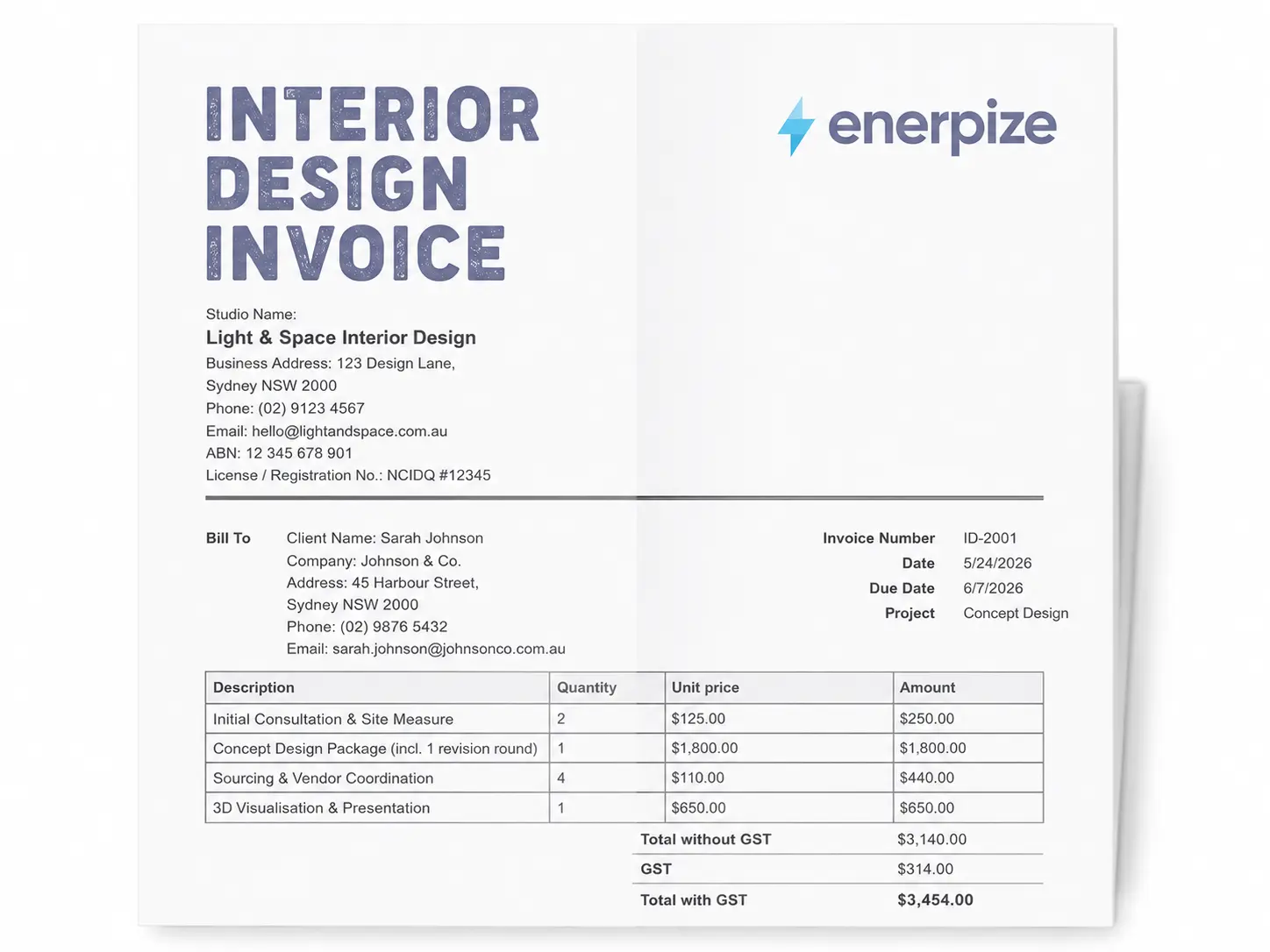
What Is an Interior Design Invoice Template
Picture the last time you finished a client walkthrough. The mood boards are approved, the sofa has shipped, and the only thing standing between you and getting paid is a blank invoice you have to build from scratch again. That is the moment an interior design invoice template earns its keep.
At its core, it is the document you send after a consultation, a design phase, or a furniture delivery to formally request payment. It is not the same as a quotation, which you send before the work starts to set expectations, and it is not a purchase order, which is what you send to a vendor to place an order in the first place. A quotation promises a number. A purchase order commits you to a vendor. This document collects on work already delivered. Some designers know the same document as an interior design bill format, especially outside North America, but the structure underneath is identical no matter what you call it.
Looking at an interior design invoice example side by side with a quotation usually makes the difference click. A quotation is a promise. An invoice, whatever you call it, is a record of what was actually delivered and what is now owed.
Here is where most designers get tripped up. Interior design work almost never involves a single type of charge. You have hourly consultation time, a flat design fee, and then a pile of furniture and materials you procured on the client's behalf, often with a markup attached. Cramming all of that into one generic invoice format is how designers end up with client questions like "why does this line item cost more than what I saw in the store," which is really a markup disclosure problem wearing an invoicing costume. A well built one solves that before it becomes an awkward phone call.
If you want to start sending polished invoices to your design clients today, Enerpize gives you a free way to do it with the fee and procurement structure already built in. Start free with Enerpize
What to Include in an Interior Design Invoice Template
A design invoice that actually gets paid on time has a rhythm to it. Miss a field and you will either chase a client for missing details or eat the cost of a dispute later. Here is what belongs on every interior design invoice template, no matter which format you use, and whether you think of it as an interior designer invoice template or an interior design bill format.
- Studio name, logo, address, and license or professional registration number, since ASID, NCIDQ, and most state licensing boards expect you to be identifiable on every billing document you send
- Client name, billing address, and project or site address, kept separate since they are rarely the same address
- A unique invoice number and both the issue date and payment due date
- Project name, project phase, and a purchase order or project code if your client's accounting team requires one
- A dedicated design fees section listing hourly or flat fee work by phase
- A dedicated FF&E procurement section listing furniture, fabric, fixtures, and materials with vendor reference, net cost, markup percentage, and client price shown separately
- Retainer or deposit already collected, shown as a deduction against the total rather than buried in a note
- The applicable tax type and rate for your country, plus the tax amount broken out on its own line
- Payment terms, accepted payment methods, and any late fee policy
- Signature lines if you are using the invoice to confirm a change order or milestone approval
Most free downloads treat the FF&E line and the design fee line the same way a grocery receipt treats produce and hardware, as though the tax and disclosure rules are identical. They are not, which is exactly why the next two sections matter. If it helps to see one filled in first, an interior design invoice sample with real numbers in every field is exactly what the Enerpize version above shows you, before you touch a blank line yourself.
What the Enerpize Interior Design Invoice Template Includes
I built this one differently on purpose, so let me walk you through why.
Most free invoice templates you will find online treat interior design like a flat service business, one table, one tax line, done. But design work is not flat. You bill for your time and expertise on one hand, and you procure physical goods on the other, and in almost every country we cover, those two things are not taxed the same way and should not be disclosed the same way either. So the Enerpize interior design invoice template keeps Design Fees and FF&E Procurement as two distinct tables from the start, not two columns crammed into one.
Transparent Markup on Every Procurement Line
Inside the procurement table, every line shows net vendor cost, markup percentage, and client price side by side. That is not decoration. It is what lets you hand a client a transparent breakdown the moment they ask about markup, instead of scrambling to reconstruct your math after the fact. Many professional bodies, including ASID's Code of Ethics and Professional Conduct, expect member designers to disclose their markup practices to clients, and a template that hides the math does not help you meet that standard.
An Adaptable Tax Field for Global Studios
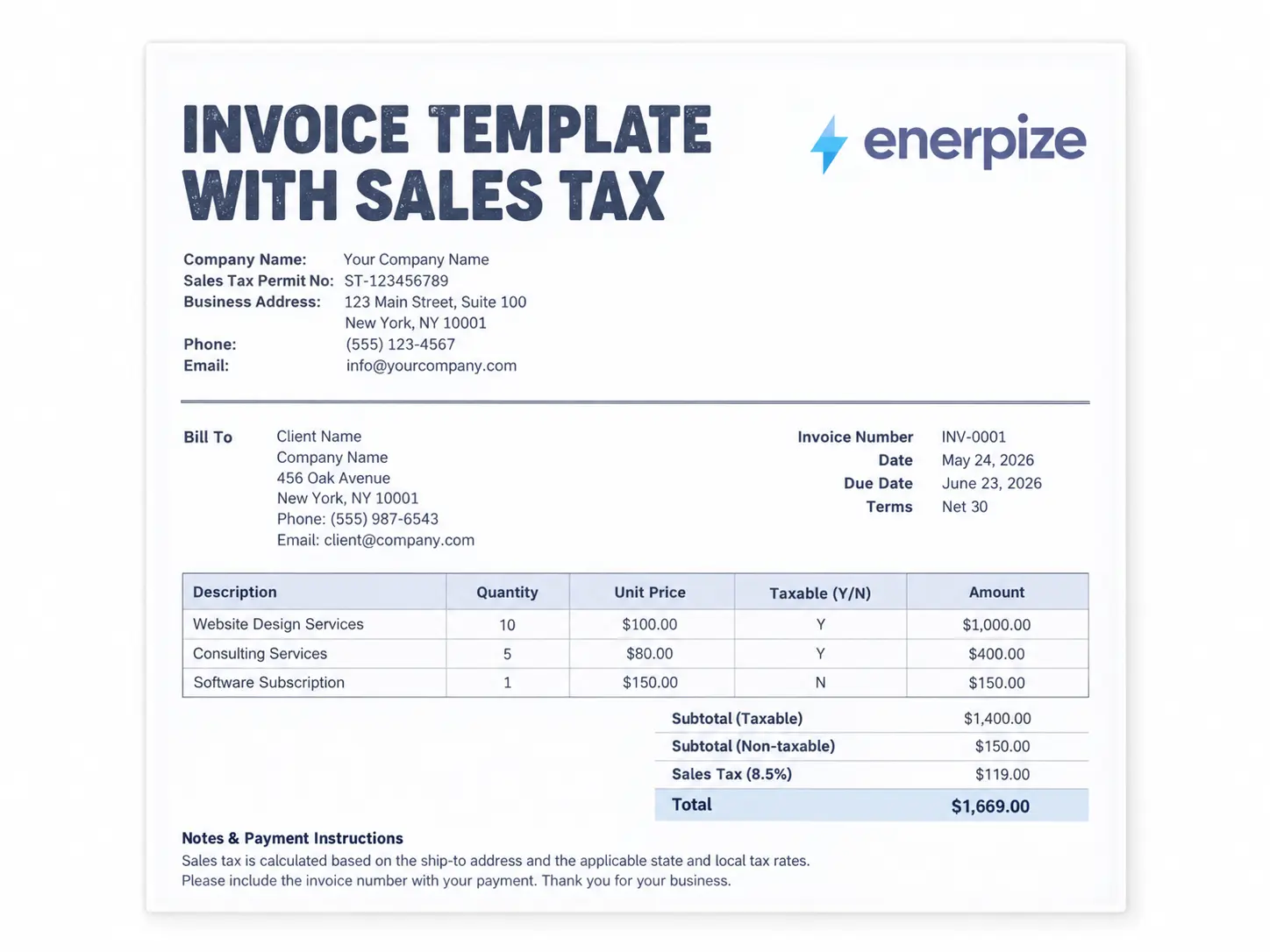
The tax field is adaptable rather than fixed. Instead of a hardcoded "Sales Tax" label that only works if you happen to be billing a US client, the template lets you set the tax type to Sales Tax, VAT, GST, or GST plus HST and enter the matching rate, so the same interior design invoice template works whether your studio bills in Chicago, London, Sydney, or Toronto.
Retainer Tracking Built Into the Totals Block
There is also a retainer line built into the totals block, because interior design billing runs on deposits far more than most consulting invoice work does. If you collected fifty percent up front, that amount deducts automatically from the balance due instead of living in a separate spreadsheet you have to reconcile by hand, and if a client wants to see how their retainer has been drawn down over several invoices, a statement of account gives them that running picture without you rebuilding it from scratch each month.
Managing It in Real Invoicing Software
And if you would rather manage this inside real invoicing software instead of filling in a static file every time, that is exactly what Enerpize is built for. You can use a price list for FF&E items you source repeatedly so you are not re-pricing the same fabric swatch on every job, and you can convert a design proposal straight into an invoice once a client approves it instead of retyping every line.
How Enerpize Handles Interior Design Invoicing
Here is the part a downloadable file can never do for you: connect what you actually paid a vendor to what you billed a client, automatically, on the same project.
Purchases Module: Connecting Vendor Cost to Client Billing
Enerpize's Purchases module tracks purchase orders and supplier invoices for every piece of furniture, fabric, or fixture you source, which means your markup on a procurement line is provable against a real vendor invoice instead of just asserted on a piece of paper. If a client ever asks to see the underlying cost, you are not digging through email threads to find it.
Sales Module: Recurring Billing and Self-Service Payments
On the billing side, the Sales module handles recurring invoicing for retainer clients, so a monthly design fee goes out on schedule instead of relying on you to remember it during a busy install week, and your client can approve estimates and pay invoices through a self-service portal rather than emailing back and forth. If you manage the whole project, not just the billing, inside Enerpize, from assigning interior designers to a job through tracking progress and following up with clients, the Interior Design Services Management Software side of the platform is built to carry that whole workflow, with invoicing as one connected piece of it rather than a separate tool you copy numbers into.
1099-NEC Tracking for Subcontractors
For studios paying subcontractors, drafters, or installers as 1099 workers in the US, keeping a 1099-NEC on file for anyone you pay more than six hundred dollars in a year saves you a scramble every January, and it pairs naturally with the same project records your interior design invoices already live in.
Curious what that looks like end to end for your own studio? Start free with Enerpize and connect your first project in a few minutes. Start free with Enerpize
Country Specific Tax Rules for Interior Design Invoices
This is the part most guides skip entirely, and it is exactly where designers get burned. Design fees and procured furniture are not always taxed the same way, and treating them as one blended line item is how a studio ends up owing tax it never collected.
United States
Most interior designers hit their first invoicing headache the moment a project involves both a design fee and a piece of furniture, because the two do not always get taxed the same way. In most US states, design and consulting services are not subject to sales tax, but the furniture, fixtures, and materials you procure on a client's behalf usually are, since they count as tangible personal property. That means a single invoice can legitimately have one line item that is tax free and another right below it that is not, and if you are billing cost plus, the tax applies to the marked up price, not your wholesale cost.
If you are paying contractors, upholsterers, or freelance drafters more than six hundred dollars in a calendar year, you will need a completed W9 on file and will typically issue them a 1099-NEC at year end. For the general federal rules on reporting nonemployee compensation, the IRS small business and self employed tax center is the authoritative source, since sales tax itself is set at the state level and varies by where you and your client are located.
United Kingdom
If your design studio's taxable turnover crosses the VAT registration threshold, currently ninety thousand pounds, you are required to register for VAT and charge it on both your design fees and any furniture or materials you procure for the client, generally at the standard twenty percent rate. Once registered, every interior design invoice needs to show your VAT registration number, the VAT rate applied, and the VAT amount broken out separately from the net total, not just folded into a single tax line. This trips up a lot of design studios that grow quickly through a few large residential projects and cross the threshold mid year without adjusting their template. HMRC's guidance on VAT record keeping and invoicing sets out exactly what a valid VAT invoice needs to contain, and it is worth checking the current threshold there directly since it is reviewed periodically.
Australia
Once you are registered for GST, which is compulsory once your turnover passes seventy five thousand Australian dollars, you charge a flat ten percent on both design services and procured goods. The detail most templates miss is the tax invoice threshold. Any invoice totaling eighty two dollars and fifty cents or more including GST legally has to be a full tax invoice, showing your ABN, the words Tax Invoice, a GST breakdown, and the date, not a simplified receipt. Below that threshold you have more flexibility, but almost no interior design invoice clears that amount once you add even one line item of furniture, so in practice nearly every invoice you send needs the full format. The ATO's guidance on tax invoices lays out the exact required fields.
Canada
GST/HST rules for interior designers depend on the province, since some provinces charge GST alone at five percent and others charge a combined HST that runs up to fifteen percent. You are required to register once your revenue passes thirty thousand dollars in a single calendar quarter or across four consecutive quarters, the small supplier threshold. Design fees and any furniture, fabric, or fixtures you procure and resell to the client are both taxable supplies, so the same rate applies to both line types, unlike the US where the two can differ. The CRA's GST/HST for businesses guide is the authoritative reference for current rates by province and registration rules.
How to Fill Out Your Interior Design Invoice Template
Once the fields make sense, filling one out takes minutes, not the twenty or thirty most designers spend rebuilding a document from scratch every time.
Step 1: Add your studio and client details
Fill in your studio name, address, and license or professional registration number at the top, then add the client's name, billing address, and project site address. If you are working from an interior designer invoice template you plan to reuse, save this part once so only the project details need to change next time.
Step 2: Set the invoice number, dates, and project phase
Assign a unique invoice number, set the issue date and payment due date, and note which project phase this invoice covers, whether that is concept, design development, procurement, or installation.
Step 3: Fill in the design fees table
List each design service or phase with hours or a flat quantity, your rate, and whether it is billed hourly or as a flat fee. This section should stand completely separate from procurement.
Step 4: Fill in the FF&E procurement table
Add each furniture, fabric, or fixture item with the vendor reference, net cost, and markup percentage, so the client price calculates on its own and your markup stays documented rather than implied. This is where the interior design invoice template excel version earns its keep, since Excel does the markup and subtotal math for you instead of you tallying it by hand.
Step 5: Apply retainer, tax, and totals
Deduct any retainer or deposit already collected, set your tax type and rate for your country, and confirm the total due reflects design fees plus procurement plus tax minus the retainer.
Step 6: Add terms and send
Note your payment terms, accepted payment methods, and any notes the client should see, then send the invoice or collect a signature if it doubles as a change order approval.
Key Takeaways
- An interior design invoice template, or an interior design bill format if that is the term you search for, should never blend design fees and FF&E procurement into one undifferentiated list, since the two are billed, and often taxed, differently.
- Markup transparency is not just good practice, it lines up with what professional bodies like ASID expect from member designers when they bill cost plus.
- In the US, design services are frequently untaxed while the furniture you procure usually is not, so check your state's rules before assuming one tax rate covers the whole invoice.
- The UK, Australia, and Canada each apply VAT, GST, or GST/HST to both design fees and procured goods, but the registration thresholds and invoice formatting requirements differ by country.
- A retainer deducted directly on the invoice, rather than tracked in a side spreadsheet, keeps your balance due accurate and your bookkeeping cleaner.
- Whether you use a free interior design invoice template or invoicing software, the fields that matter most are the ones that separate what you did from what you sourced.
Frequently Asked Questions
What should an interior design invoice include?
At minimum, your studio details, client and project details, a unique invoice number, separate sections for design fees and FF&E procurement, the applicable tax type and rate, any retainer applied, and your payment terms. Splitting design fees from procurement is what most generic invoice formats, and most interior design bill format examples floating around online, tend to miss.
How do interior designers typically charge and bill clients?
Most studios use one of a few models: an hourly rate for consultation and design time, a flat design fee for a defined scope, a percentage of the total project cost, or cost plus billing where furniture and materials are marked up over net vendor cost. Whatever model you pick, write your fee structure into your contract before the project starts, not just onto the interior designer invoice template at the end, so the client already knows how the number was built. Many studios combine a flat design fee with cost plus procurement on the same document.
How do you write an invoice for an interior designer?
Start with your studio and client details, then separate what you are billing into design fees and procurement so each is itemized on its own. Add your tax type and rate, deduct any retainer already collected, and total the balance due. If you are new to this, an interior designer invoice template with those sections already built saves you from missing a field, and comparing your draft against an interior design invoice sample is a quick way to catch anything you left out.
Should interior designers disclose furniture markup to clients?
Yes, and it is worth doing on the invoice itself rather than leaving it to a verbal explanation. Showing net cost and markup percentage side by side on your interior design invoice, rather than only the marked up client price, is the clearest way to avoid a dispute later, and it reflects what professional bodies like ASID expect from members who bill cost plus.
Is Excel or Word better for tracking FF&E procurement costs on an invoice?
An interior design invoice template excel version is generally the better choice for procurement heavy invoices, since Excel calculates your markup, subtotal, and tax automatically as you fill in line items, where a Word document leaves you doing that math by hand. Search for an interior design invoice template excel download specifically if procurement is a big part of your billing, and keep a Word version on hand for simpler, design fee only invoices where there is less to calculate.
Do I need to charge sales tax, VAT, or GST on interior design services?
It depends on your country and, in the US, your state. Design and consulting time is often untaxed in the US while procured furniture usually is not, while the UK, Australia, and Canada generally apply VAT, GST, or GST/HST to both design fees and procured goods once you are registered. Check the country specific section above for the current rates and thresholds.
How should interior designers bill for retainers and deposits?
Collect the retainer up front, note it clearly on the project details, and deduct it directly from the total due on the final interior design invoice rather than tracking it separately. This keeps the balance the client owes accurate at a glance and avoids the confusion of a retainer that only shows up in your own records.
About the Author
Omar El Bahr is a Senior Digital Growth Specialist at Enerpize, where he leads SEO, content strategy, and organic growth across international markets. He is a Forbes Communications Council contributor and has written for Entrepreneur on business communication and digital strategy.
Ready to send your first interior design invoice the easy way? Download the free interior design invoice template above, or start free with Enerpize and skip the blank document entirely, no credit card required.
Disclaimer: This page is for general informational purposes only and is not tax or legal advice. Tax rates, thresholds, and invoicing requirements change and vary by jurisdiction, so confirm current rules with a licensed accountant or your local tax authority before filing.