

Posted on 6 September 2026
Free Singapore Invoice Template Download: GST, UEN & IRAS Compliant (Excel, Word, PDF)
- Available in Word, Excel, PDF, and Google Sheets, free to download with no sign up required
- Built with separate, clearly labeled fields for your UEN and your GST registration number, since they are not always the same number
- Covers GST registered invoices, non-GST invoices, and zero-rated export invoices in one template
- Calculates the net amount, GST at 9 percent, and the total payable automatically in the Excel version
A Singapore invoice template is a ready-made billing document that lists the UEN of the business issuing it, the goods or services supplied, and the amount payable in Singapore dollars, with GST registered businesses required to label it a Tax Invoice and show GST charged at the current rate of 9 percent.


What Is a Singapore Invoice?
Ask five business owners in Singapore what a tax invoice is, and at least two will just say "an invoice." Fair enough, most days it does not matter. IRAS treats these as two different documents though, and mixing them up during a GST audit is not a fun conversation to have.
An invoice is the general term. It is the bill you send after delivering goods or services, and it asks for payment. A tax invoice is a specific, more formal version of that same document. IRAS requires it whenever you are GST registered and your customer is GST registered too, since your customer needs it to claim input tax on their own GST return. It has to carry the words "Tax Invoice," your GST registration number, the GST rate applied, and the GST amount shown as its own line rather than folded into the total.
Then there is the simplified tax invoice. If the total payable, GST included, comes to S$1,000 or less, IRAS lets you skip the full field list. A shorter version works instead: your business name, address, and GST registration number, the invoice date, an identifying number, a description of what was sold, the total including GST, and a line stating that the price includes GST. Handy for smaller, one off sales where a full tax invoice would be overkill.
If what you actually searched for was a tax invoice template Singapore GST-registered businesses can hand straight to a client, that full version above is the one you want, not the simplified one.
A receipt is a different document again. It confirms that payment was received. It does not replace either kind of invoice, and it should never be issued in place of one when a customer needs proof for their own input tax claim. Neither does a quotation, which comes before any of this, while you and a client are still agreeing on price rather than billing for work already done. Our quotation template covers that earlier stage if that is what you are actually after.
If your business is not GST registered, none of the tax invoice rules apply to you. You still need a proper invoice with your UEN, a sequential invoice number, and a clear description of what you sold. You just leave GST out of it completely. Our guide on what an invoice is and how it works covers the fundamentals if you want the wider picture beyond Singapore specifically.
Want a Singapore invoice template that already separates these fields correctly? Start Free with Enerpize, no credit card required.
What to Include in a Singapore Invoice Template
A blank invoice with your logo on top gets you through maybe one transaction. After that, someone asks for your UEN, or a customer's finance team sends the invoice back because the GST is not broken out, and you are rebuilding the document from scratch.
Here is the complete field list a Singapore invoice template needs, and honestly, the full answer to most of the Singapore invoice requirements people end up searching for once they actually sit down to bill a client.
| Field | Why It Matters |
|---|---|
| UEN | Your permanent, government issued business identifier. Local companies get one the moment they register with ACRA, and it never changes even if the business name does. You can look up any registered UEN for free through the government's UEN portal. |
| GST Registration Number | Only applies once you are GST registered. Sometimes identical to your UEN, sometimes formatted differently, for example M21234567K. Required on every tax invoice you issue. |
| Invoice Number | Sequential, with no gaps. Missing numbers are one of the first things an auditor notices. |
| Invoice Date | The date the document is issued. |
| Due Date | When you expect payment. Not an IRAS requirement, but leaving it off is the fastest way to get paid late. |
| Customer Name and Address | Needed for your customer to process the invoice on their end. |
| Description of Goods or Services | Specific enough that anyone reading it later understands what was sold. |
| Quantity and Unit Price | Per line item, before GST. |
| GST Rate | 9 percent for standard rated supplies, 0 percent for zero rated supplies, or marked exempt where that applies. |
| GST Amount | Shown separately from the net amount, never folded in. |
| Total Amount Payable | Net amount plus GST, in Singapore dollars. |
| Payment Terms | Net 7, Net 30, due on receipt, whatever you have agreed with the customer. |
The GST amount is the field that trips people up most. IRAS allows two acceptable ways to calculate it. You can apply 9 percent to each line item and add the results together, or add up the net amounts first and apply 9 percent once to the total. Both are fine on their own. What is not fine is switching between the two methods from one invoice to the next, since the rounding comes out slightly differently each way, and a customer comparing invoices side by side will eventually ask why.
If you came here after typing "Singapore invoice sample" rather than "template," the table above is essentially that. Fill it in once with real numbers and you have a working example of the standard Singapore invoice format for both GST registered and non-GST businesses.
GST on Singapore Invoices: Rates, Registration, and Who Needs What
Singapore's GST rate has sat at 9 percent since 1 January 2024, up from 8 percent the year before. Registration becomes compulsory once your taxable turnover passes S$1,000,000 in a 12 month period, whether you are looking back at the last 12 months or forward at the next 12. Below that line, registration is a choice, not a requirement.
That single number determines almost everything else about how a business invoices. Here is what changes depending on where yours sits.
GST Registered Businesses
Once registered, every standard rated sale needs a tax invoice, issued within 30 days of the time of supply according to IRAS's own invoicing guidance. You charge 9 percent, show it separately, and file a GST F5 return every quarter reporting what you collected and what you paid on business purchases. IRAS requires GST registered businesses to keep both issued and received tax invoices for at least five years, and missing a filing deadline brings an immediate $200 penalty from IRAS, with another $200 for every completed month the return stays outstanding, up to a cap of $10,000.
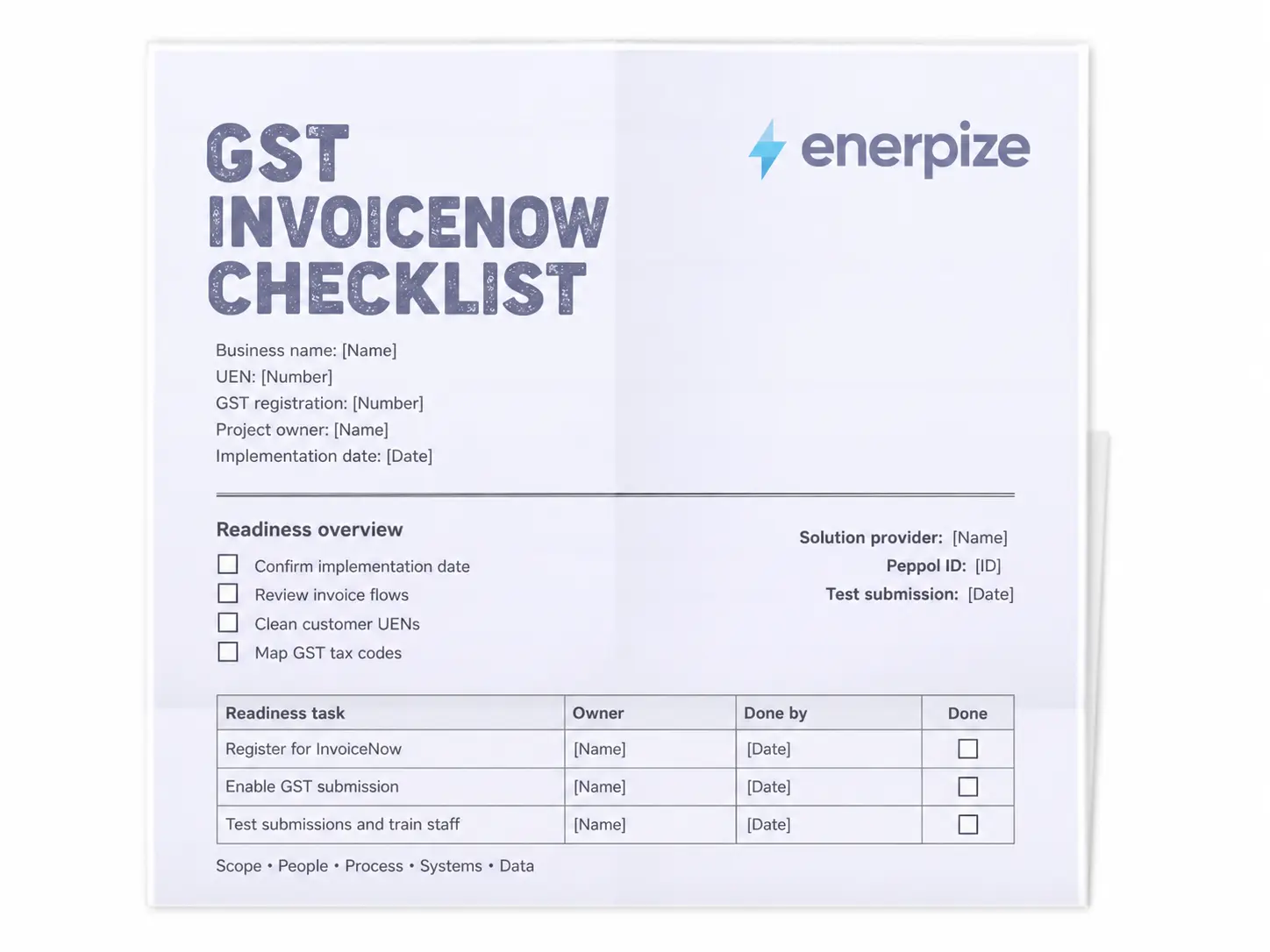
There is also a newer requirement worth knowing about if you are newly registered or about to be. IRAS is rolling out the GST InvoiceNow requirement in phases, asking GST registered businesses to transmit their invoice data straight to IRAS through the InvoiceNow network alongside issuing the invoice itself. The rollout began with early voluntary adopters in November 2025, expanded to new voluntary GST registrants from April 2026, and is set to reach every GST registered business by April 2031. It is a separate filing step from producing the invoice document itself, run through IRAS's GST InvoiceNow requirement page and IMDA's InvoiceNow program, so it is worth checking which phase currently applies to your business rather than assuming it does or does not yet.
Non-GST Registered Businesses and Sole Proprietors
If your turnover sits under S$1,000,000 and you have not registered voluntarily, you skip GST completely. No "Tax Invoice" wording, no GST line, no GST F5 filing to worry about. You still need a proper invoice though, carrying your UEN, a sequential invoice number, and a clear description of what you sold. For a sole proprietor, that UEN usually comes from the ACRA business registration itself rather than a separate company number.
Voluntary registration is still on the table below the threshold. Some businesses register anyway because it lets them claim input tax on what they buy, and because a GST registration number reads as more established to larger clients. The catch is a minimum two year commitment once you register, so it is worth thinking through properly before ticking that box.
Cross-Border and Export Invoices
Selling to a customer outside Singapore, or providing an international service, usually qualifies for zero rating under the GST Act. You still issue a proper invoice and still note the GST treatment, you just charge 0 percent instead of 9. The upside is you can still claim input tax on the costs behind that sale, even though no output tax was charged on it.
Foreign currency invoices need a bit more care. If you are billing in USD or another currency, IRAS wants the Singapore dollar equivalent shown as well, so the GST figure is calculated against a value in SGD rather than the foreign amount alone. This is where exporters and freelancers working with overseas clients trip up most often, since it is easy to forget the SGD conversion until the GST return is actually due. If you also bill clients in the UK, the VAT treatment runs on different rules entirely, and our UK invoice template walks through what changes there. Australia runs a consumption tax system fairly close to Singapore's, just at a different rate and under different thresholds, and our Australian GST invoice template lays out that comparison if you invoice clients there too. Between GST registered, non-GST, and export invoicing, that covers pretty much every version of a Singapore invoice template a growing business ends up needing.
What the Enerpize Singapore Invoice Template Includes
We built this template starting from the actual IRAS checklist rather than a generic invoice layout, then worked backward to figure out what a Singapore business actually fills in every single time.
Your UEN and GST registration number get their own space. They are not the same number for every business, and treating them as interchangeable is exactly how an invoice ends up bounced back by a customer's finance team. Both fields sit clearly labeled at the top, separate from each other.
The description field expects an actual description. Not a project code, not an internal reference number, just what was sold, written in words a customer or an auditor can understand without asking you to explain it.
The due date calculates itself. Set your payment terms once, Net 30, Net 14, whatever you use, and the Excel version works out the due date from the invoice date automatically. One less date to get wrong on a Friday afternoon.
The GST math runs in the background. Type in the quantity and unit price, and the sheet calculates the line amount, applies GST at whatever rate you set, and rolls everything up into a net amount, a GST amount, and a total payable. Selling something zero rated? Change the rate on that one line and the totals adjust with it automatically.
Every format you actually need is included. Word, Excel, PDF, and Google Sheets, all free to download, with no account required to grab a copy.
Tax Invoice vs Simplified Tax Invoice vs Receipt vs Credit Note
| Document | Purpose | Shows GST Separately | When You Use It |
|---|---|---|---|
| Tax Invoice | Requests payment and supports the customer's input tax claim | Yes | Standard rated B2B sales once you are GST registered |
| Simplified Tax Invoice | Requests payment for smaller sales | GST included in the total, stated as included | Total payable of S$1,000 or less |
| Receipt | Confirms payment was received | Not required | After payment, for the customer's own records |
| Credit Note | Corrects an earlier invoice or reduces what is owed | Yes | Returns, pricing errors, or discounts applied after the fact |
Whichever one you are issuing, the rule stays the same. The document has to match what actually happened, in the amount that actually happened, or it is not worth the PDF it is printed on.
How to Fill Out the Singapore Invoice Template
Step 1: Add your business details
Company name, address, UEN, and GST registration number if you have one. This block does not change from invoice to invoice, so get it right once and reuse it.
Step 2: Number the invoice
Keep it sequential. INV 2026 001, INV 2026 002, and so on. Gaps in the sequence are one of the first things an auditor flags during a review.
Step 3: Set the invoice date and due date
The invoice date is today, or whenever you are issuing it. The due date follows your payment terms. Net 30 means 30 days from the invoice date, not 30 days from whenever the customer decides to pay.
Step 4: Fill in your customer's details
Name and address, at minimum. If the customer is GST registered too, note their GST registration number, since they will want it recorded on their end for their own claim.
Step 5: List what you are selling
One line per item or service, with a description someone unfamiliar with the deal could still understand on its own.
Step 6: Add quantity, unit price, and GST rate per line
Nine percent for a standard rated sale, zero for an export or an international service, or marked exempt where that applies.
Step 7: Check your totals
Net amount, GST amount, total payable. If the sheet is built with formulas, this step takes ten seconds. If the math was done by hand, this is exactly where mistakes creep in.
Step 8: Add payment details and send it
Bank account, PayNow, or whatever you accept. Note the invoice number in the payment reference field so it is easy to match up once the money lands.
Skip the manual version. Generate a Singapore invoice template automatically inside Enerpize and reuse your customer and item details every time. Start Free with Enerpize, no credit card required.
How Enerpize Supports Invoicing for Singapore Businesses
A template gets today's invoice out the door. What happens once a business is sending twenty of them a month, in two currencies, to clients who all pay on different schedules?
To be upfront about it, Enerpize does not have Singapore specific tax compliance built into the product. There is no automatic InvoiceNow submission, no UEN validation against the government registry, and no built in GST F5 filing. What Enerpize does handle is the everyday invoicing work sitting around that compliance layer, which is usually where the time actually goes once volume picks up.
Multi-Currency Invoicing for Cross-Border Trade
Singapore does a lot of business outside Singapore. Enerpize supports more than 135 currencies, so a business billing clients in USD, EUR, or any other currency can issue invoices in that currency while keeping a clean Singapore dollar set of books behind the scenes. Useful for exactly the kind of cross-border invoicing covered earlier in this Singapore invoice template guide.
Recurring Invoices and a Client Portal
If a client gets billed every month, a recurring invoice sets the schedule once and sends itself from then on without anyone having to remember. Clients also get a portal where they can view their invoices, check their statement, and pay online, rather than the usual back and forth over whether last month's invoice ever arrived.
Custom Fields for UEN and Business Details
Every business needs slightly different fields on its invoice. Enerpize's custom fields let a business add its UEN, GST registration number, or any other detail permanently to the invoice layout, so it appears automatically on every invoice from then on rather than being typed in by hand each time.
Whether a business runs a consulting practice, a retail store, or a services firm billing clients across borders, the underlying invoicing work looks the same. Get the numbers right, get the document out, get paid without chasing. If consulting is closer to what your business does, our consulting service management software page goes further into how that fits together for firms billing by retainer or by project.
Key Takeaways
Six things worth remembering from everything above, if you only have a minute before you go build your own Singapore invoice template.
- A tax invoice is not the same as a regular invoice. IRAS requires the tax invoice version, with your GST registration number and GST shown separately, once you are GST registered and selling to another GST registered business.
- Singapore's GST rate has been 9 percent since 1 January 2024, and registration becomes compulsory once your taxable turnover passes S$1,000,000.
- Your UEN and your GST registration number are not always the same number. Both belong on your invoice, clearly labeled.
- Sales of S$1,000 or less, GST included, qualify for a simplified tax invoice with a shorter field list.
- Exports and international services are usually zero rated at 0 percent GST rather than exempt, and you can still claim input tax on the costs behind them.
- Keep every invoice and tax invoice, along with the supporting records, for at least five years. IRAS can ask for them well after the transaction is finished.
Related Templates
UK Invoice Template
Kenya Invoice Template
Freelance Invoice Template
Credit Note Template
Receipt Template
Blank Invoice Template
FAQs
What must a Singapore invoice include?
At minimum, your business name and UEN, an invoice number, the date, a description of what you sold, and the amount payable. If you are GST registered, add your GST registration number, the words "Tax Invoice," and the GST rate and amount shown separately from the net total.
What is the difference between an invoice and a tax invoice in Singapore?
An invoice is the general term for a bill. A tax invoice is a specific version IRAS requires once you are GST registered and selling to a GST registered customer, carrying your GST registration number and the GST amount as its own line, since the customer needs it to support their own input tax claim.
Do I need to charge GST if my business is not GST registered?
No. If your taxable turnover is under S$1,000,000 and you have not registered voluntarily, leave GST off your invoices completely. You still need a proper invoice with your UEN and a clear description of what was sold.
What is a simplified tax invoice and when can I use one?
It is a shorter version of the tax invoice, usable when the total payable, GST included, is S$1,000 or less. It only needs your business name, address, and GST registration number, the invoice date, an identifying number, a description, the total including GST, and a line stating that GST is included.
What is a UEN, and is it the same as a GST registration number?
Your UEN is your permanent business identification number, assigned when you register with ACRA or another government agency. Your GST registration number is issued separately once you register for GST, and while it is sometimes identical to your UEN, that is not guaranteed, so both fields belong on your invoice.
What is InvoiceNow, and am I required to use it?
InvoiceNow is a government e-invoicing network run by IMDA. Under the GST InvoiceNow requirement, GST registered businesses are being brought onto it in phases between November 2025 and April 2031, transmitting invoice data straight to IRAS alongside the invoice itself. Check IRAS's InvoiceNow page to see which phase currently applies to your business.
How long do I need to keep Singapore invoice records?
At least five years, according to IRAS, for both the tax invoices you issue and the ones you receive from suppliers. That applies even if you later deregister from GST or close the business entirely.
Can I use this Singapore invoice template in Excel with automatic GST calculation?
Yes. The Excel version calculates the line amount from quantity and unit price, applies GST at whatever rate is set per line, and rolls everything up into a net amount, a GST amount, and a total payable, all with working formulas rather than numbers you would otherwise type in by hand.
Generate accurate Singapore invoices with the GST math done for you. Start Free with Enerpize, no credit card required.
Disclaimer
This page is for general information only and is not tax or legal advice. Confirm your GST and invoicing obligations with IRAS or a qualified advisor before relying on it for compliance.
About the Author
Omar El Bahr is a Senior Digital Growth Specialist at Enerpize, where he leads SEO, content strategy, and organic growth across international markets. He is a Forbes Communications Council contributor and has written for Entrepreneur on business communication and digital strategy.