

Posted on 29 December 2025
Exit Interview Template Word, PDF & Excel
- The exit interview template is available in Word, Excel, PDF, Google Docs, and Google Sheets
- It captures structured, honest employee feedback on resignation reasons, management experience, compensation, and workplace satisfaction.
- Uses a clear mix of open-ended questions, contributing-factor checklists, and performance rating scales for balanced insights.
- Ideal for HR teams, managers, and SMEs seeking to improve retention, culture, and employee experience through actionable exit data.


What is the Exit Interview Template?
An exit interview template gathers feedback from employees who are leaving an organization. Its primary purpose is to understand why employees resign, what their experience was like while employed, and what the organization can improve moving forward.
This employee exit interview template is designed to capture both emotional and factual insights. It combines reflective, open-ended questions with measurable evaluation criteria covering training, management relationships, compensation, benefits, workload, and overall satisfaction. When used consistently, an exit interview form template becomes a long-term improvement asset rather than a one-time administrative step.
What Does the Exit Interview Template Contain?
Timeline of the decision
This open-ended question captures when the employee first began considering leaving the organization. It helps identify whether disengagement developed gradually over time or resulted from a sudden change in circumstances. Understanding this timeline allows organizations to pinpoint early warning signs and assess whether intervention opportunities were missed.
Factors checklist
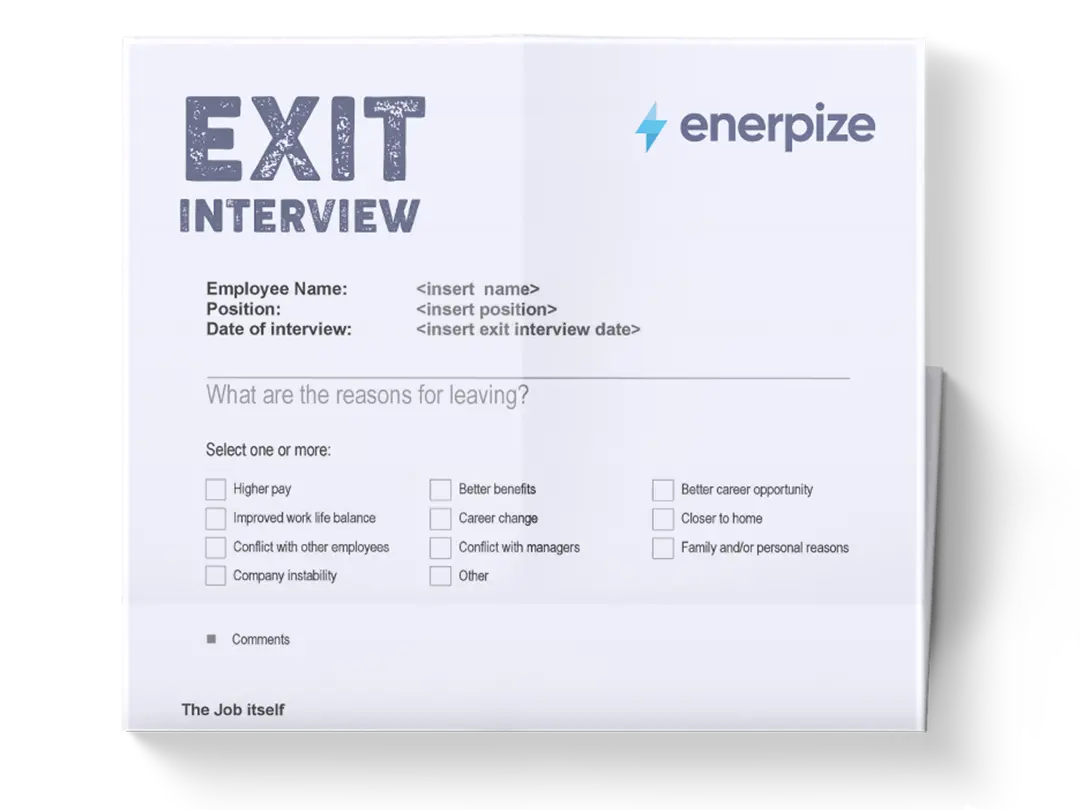
This section provides a structured list of potential contributing factors, allowing employees to select all that apply. By covering areas such as salary, job advancement, management dissatisfaction, benefits, and personal reasons, the checklist ensures consistent data collection while still acknowledging that resignations are often driven by multiple overlapping causes.
Incident investigation
This section is designed to surface any specific event or issue that directly triggered the resignation. It helps separate long-term dissatisfaction from isolated incidents, offering clarity on whether the decision was reactive or cumulative in nature.
Problems explanation
Employees are given space to explain challenges they encountered while performing their role. These responses highlight operational, managerial, or environmental obstacles that may have impacted performance, engagement, or job satisfaction.
Positive feedback collection
This section captures aspects of the employee’s experience that they found enjoyable or valuable. Identifying strengths helps organizations preserve effective practices, team dynamics, or cultural elements worth maintaining.
Dissatisfaction areas
Employees describe what they found least enjoyable about their experience without being limited to predefined categories. This encourages honest, nuanced feedback that may not fit into structured checklists.
Brand perception
This question measures how departing employees view the organization as an employer. Their willingness—or reluctance—to recommend the company provides insight into employer brand health.
Long-term relationship
This section assesses whether the employee would consider returning in the future, indicating residual goodwill and potential for boomerang hiring.
Rating scale
A standardized Poor-to-Excellent rating scale evaluates training, management relationships, teamwork, compensation, benefits, work–life balance, workload, and overall satisfaction, enabling consistent comparison and trend analysis across exit interviews.
How to Use the Exit Interview Template
1- Begin with the timing question
Ask the employee to complete the section about when they began considering leaving. This establishes context before discussing reasons or outcomes.
2- Complete the contributing factors checklist
Instruct the employee to select all applicable factors related to their resignation. Encourage honesty and clarification if “Other” is selected.
3- Explore triggering events
Have the employee answer whether a specific issue prompted the resignation and, if applicable, whether it was discussed internally.
4- Document role-related challenges
Use the problem-related question to understand operational, managerial, or workload barriers encountered during employment.
5- Capture positive and negative experiences
Ask the employee to complete both enjoyment-related questions to balance constructive criticism with strengths worth retaining.
6- Assess employer advocacy and rehire openness
Review responses regarding company recommendation and future reapplication to gauge reputation impact.
7- Complete the evaluation table
The employee rates predefined experience areas using the Poor–Excellent scale and may add comments for clarification.
8- Finalize with additional comments
Allow space for any feedback not previously captured before collecting the completed template.
Related Templates
Employment Separation Agreement Template
Performance Improvement Plan Template
Importance of the Exit Interview Template
Reveals the true drivers behind employee turnover
An exit interview questions template gives organizations direct access to the employee’s perspective at the point of departure—often the only moment when candid feedback is most likely.
By asking structured yet open-ended questions about timing, contributing factors, and triggering events, the template helps distinguish between surface-level reasons (such as compensation or relocation) and deeper systemic issues, such as management quality, workload imbalance, or lack of growth opportunities. Over time, repeated patterns across completed exit interviews provide reliable evidence of where retention efforts are breaking down.
Creates consistency and reduces bias in feedback collection
Without a standardized employee exit interview template, feedback quality often depends on who conducts the interview or how questions are framed. This template removes that variability by ensuring every departing employee responds to the same core questions and evaluation criteria.
The inclusion of a fixed rating scale for training, relationships, compensation, and workload enables fair comparison across roles, departments, and time periods, supporting more objective analysis.
Improves leadership accountability and management effectiveness
Sections addressing unresolved issues, manager relationships, and internal discussions highlight whether employees felt heard before deciding to leave. This data is critical for identifying leadership gaps, communication breakdowns, or escalation failures.
When reviewed responsibly, exit interview findings can guide targeted management coaching and structural improvements rather than reactive or anecdotal decision-making.
Strengthens organizational learning and continuous improvement
The template transforms employee departures into learning opportunities. Insights gathered can inform policy changes, onboarding improvements, training investments, and benefits adjustments. Over time, this feedback loop helps organizations evolve based on real employee experience rather than assumptions.
Protects the employer's reputation and future hiring efforts
Questions about recommendation and reapplication intent provide an early signal of how former employees may speak about the organization externally. Monitoring this feedback helps safeguard employer brand perception in competitive talent markets.
Who Can Use the Exit Interview Template?
Human Resources Teams
HR professionals can use this exit interview form template as a standardized tool to capture, store, and analyze departure feedback across the organization. It supports trend analysis, internal reporting, and strategic workforce planning without requiring complex HR software.
Small and Medium-Sized Businesses (SMEs)
For SMEs without dedicated people analytics resources, this template offers a practical, low-effort way to understand why employees leave and what needs attention. Even a small number of completed exit interviews can reveal high-impact insights when collected consistently.
Department and Team Managers
Managers can use aggregated, anonymized findings to understand team-level challenges, improve leadership behaviors, and address issues that may be contributing to avoidable turnover.
Business Owners and Founders
Founders and owners benefit from unfiltered feedback about company culture, workload expectations, and management practices. The template helps bridge the gap between leadership perception and employee reality.
Organizations Across All Industries
Because the template focuses on universal employment factors—training, relationships, compensation, workload, and satisfaction—it is suitable for use in corporate, nonprofit, educational, healthcare, retail, and industrial environments.
Companies Focused on Retention and Culture Improvement
Any organization aiming to reduce turnover, improve employee experience, or build a feedback-driven culture can use this exit interview template as a foundational tool.