

Posted on 7 June 2026
Free Employee Contract Template (Word, PDF & Google Docs)
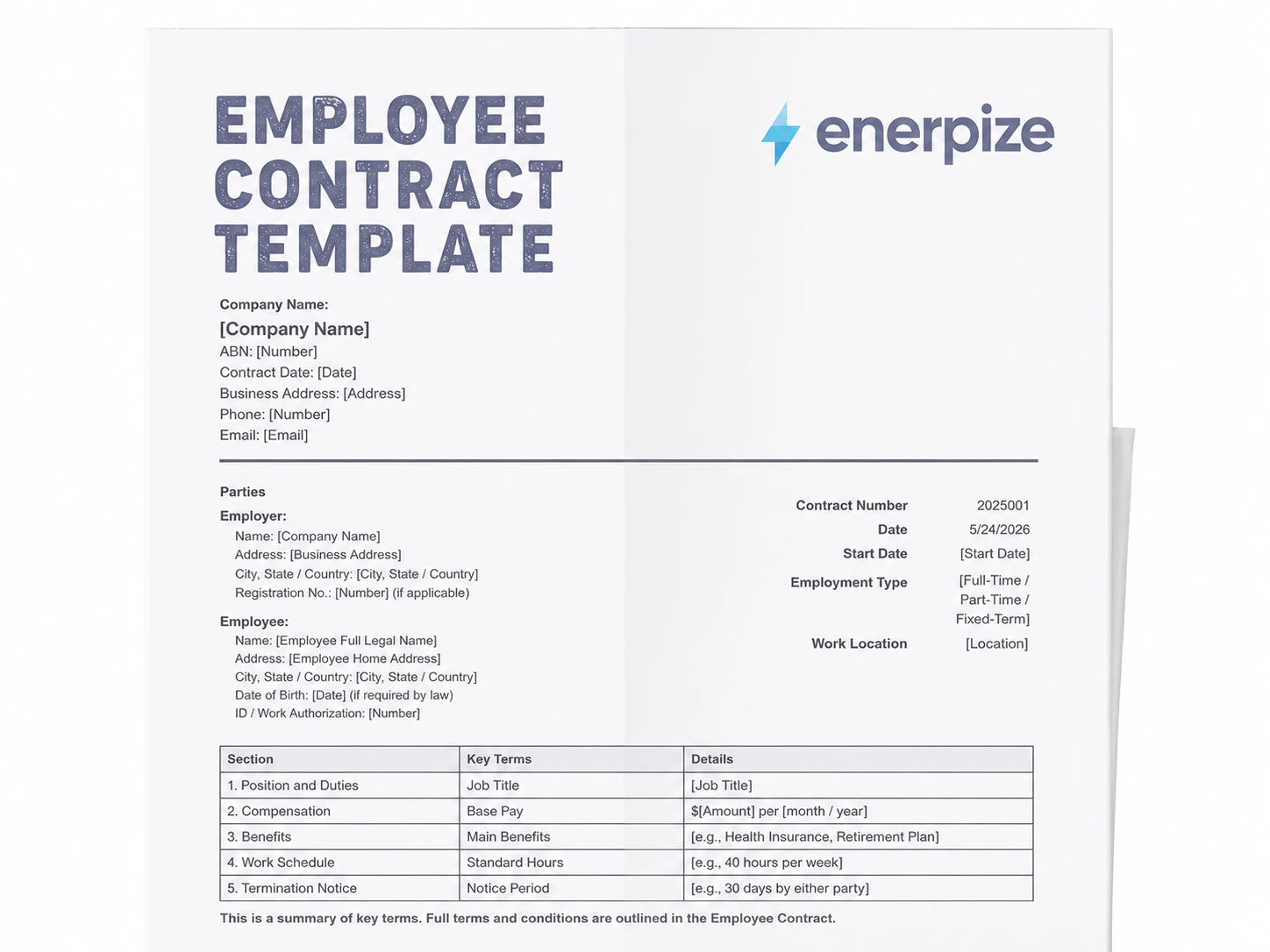
- Documents job title, compensation, duties, probationary period, confidentiality, and termination terms in one self-contained agreement.
- Covers compliance requirements for the three most common hiring jurisdictions: United States, United Kingdom, and Australia.
- Includes standalone confidentiality and intellectual property clauses so the contract works without a separate NDA exhibit.
- Free employee contract template available in Word, PDF, Google Docs, Excel, and Google Sheets.
An employee contract template is a structured written agreement used by employers to formalize the terms of employment before a new hire begins work, covering pay, duties, leave entitlements, and exit conditions in a single signed document.


One bad hire costs an average of 30% of that employee's annual salary. But a hire without a written contract? That costs far more. When a 2025 court ruling ended with a $9.3 million penalty against a staffing agency for misclassifying over 1,000 workers, the message was impossible to ignore: the paperwork is not a formality. It is protection. This free employee contract template gives you a legally structured starting point in Word, PDF, and Google Docs, whether you are hiring your first employee in Ohio, your tenth in Manchester, or scaling a team in Sydney.
What Is an Employee Contract?
An employee contract is a written agreement between an employer and an employee that documents the terms of the employment relationship before work begins. It covers the job title, compensation, working hours, leave entitlements, confidentiality obligations, and the conditions under which either party can end the arrangement.
A written employee contract is not legally required in every country. But in every country, having one in writing is significantly better than not having one. Verbal agreements can be legally binding in some jurisdictions, but they are nearly impossible to prove when something goes wrong and extremely costly to dispute when they do.
Contracts are just the beginning. Once your employee is signed on, Enerpize automates payroll, tracks attendance, and manages contracts end to end so nothing falls through the cracks. Start for free.
What to Include in an Employee Contract Template
Every employee contract should document eight core elements. Missing any one of them is where disputes begin.
Job Title and Duties
Define the role precisely. Include the job title, the department, the reporting line, and a summary of primary responsibilities. Vague duty clauses are one of the most common sources of post-hire disagreement, particularly when employees are later asked to take on work outside what they understood the role to involve.
This gap appears in many real-world contracts. The reference employment agreement used in developing this template defined the CFO position by pointing to company bylaws and whatever the CEO assigns, with no self-contained duties clause. That is an executive agreement. A general-use template needs the duties written directly into the document.
Compensation and Payment Schedule
State the salary or hourly rate, the pay frequency (weekly, bi-weekly, or monthly), and confirm that all amounts are subject to applicable tax deductions. If the role includes commission or performance bonuses, document the calculation method here or attach it as a separate schedule. Discretionary bonuses are not enforceable even when verbally promised, which is worth stating clearly.
Employment Type and Start Date
Specify whether the role is full-time, part-time, fixed-term, or temporary. Include the start date. If fixed-term, include the end date. This section determines which legal defaults apply in the employee's jurisdiction and how termination rules are triggered.
Work Schedule and Location
State the normal working hours and the designated work location, whether onsite, remote, or hybrid, and note that reasonable additional hours may be required when the role demands it. For remote or hybrid roles, this section should also specify which office, if any, the employee is expected to report to and how often, since ambiguity here is a common source of later disagreement, especially for distributed teams already addressed in the Governing Law section.
Benefits and Leave Entitlements
List any benefits the employee is entitled to: health insurance, retirement contributions, paid time off, sick leave, and public holidays. Specify whether benefits begin immediately or after a probationary period. Do not simply say "subject to company policy." Write the entitlements into the contract.
Probationary Period
Most employers include a probationary period of 30 to 90 days. During this time, performance expectations are evaluated and either party can typically end the relationship with reduced notice, depending on the jurisdiction. The reference executive contract we reviewed had no probation clause at all, which works for senior leadership but creates risk for general hires.
Confidentiality
Require the employee to keep proprietary information, including client data, internal processes, pricing, and trade secrets, confidential during and after employment. Specify what counts as confidential and how long the obligation continues after employment ends.
This clause must live inside the main contract body. A common mistake, visible in real executive agreements, is outsourcing confidentiality entirely to a separate NDA exhibit that is never attached. A general-use template cannot afford that gap.
Intellectual Property Ownership
State that any work created during employment and within the scope of the employee's duties belongs to the employer. This includes software, content, designs, processes, and any other output generated on company time. Include a carve-out for pre-existing personal IP that the employee brings into the role, documented before signing.
Code of Conduct
Require the employee to comply with company policies, procedures, and any code of conduct communicated by the employer, whether documented in this contract, an employee handbook, or a separate policy manual. Referencing external policy documents here, rather than restating them in full, keeps the contract itself shorter while still making compliance contractually binding.
Termination and Notice Period
Define how either party can end the relationship, the required notice period, and the grounds for immediate termination without notice. Include what happens to accrued leave and any severance entitlements. The notice obligation should be reciprocal. Many contracts require the employee to give four weeks' notice while allowing the employer to terminate with one week. Employees should check this before signing.
Governing Law
Specify which country or state's laws govern the contract. This is especially important for remote employees working in a different jurisdiction from the employer, a situation that is increasingly common and almost never addressed in basic templates.
Which Employee Contract Type Do You Actually Need?
Here is the honest version of this question, because most guides just list the types without helping you choose.
At-Will Employment Contract
Use this if you are hiring in the United States and want the flexibility to end the employment relationship at any time, for any lawful reason, without requiring a formal cause. At-will is the default in 49 US states. Montana is the only exception.
At-will employees can also resign at any time without penalty. A written at-will contract still documents compensation, duties, and confidentiality. It simply removes the obligation to justify termination beyond lawful grounds. If your business operates in retail, pharmacy, or any sector with high staff turnover, this is usually the right structure.
Fixed-Term Employment Contract
Use this when the role has a defined end date: a seasonal position, a project-based hire, or a cover for parental leave. Both parties agree to the duration upfront. Ending the contract before the agreed date may trigger severance obligations depending on the contract terms, so termination clauses need more precision here than in an at-will arrangement.
Construction companies, law firms handling large projects, and medical clinics covering specialist leave are the most common users of this structure.
Part-Time Employee Contract
Use this when the role involves fewer hours than a standard full-time schedule. The contract should clearly define expected hours per week, confirm which benefits apply (if any), and specify whether hours are fixed or variable. Retail businesses and gyms with large part-time workforces need this documented precisely to avoid disputes over benefit eligibility.
Temporary Employee Contract
Use this for short-term or project-based work with a clear end condition, either a date or a deliverable. Temporary workers may be hired directly or through a staffing agency. If hiring directly, a written contract protects both parties and avoids the classification ambiguity that turns into litigation. This is the structure where misclassification risk is highest.
Employee Contract Compliance by Country
The three markets where this template is most searched are the United States, the United Kingdom, and Australia. Each has different legal defaults, and your contract must meet the minimum standards of the jurisdiction where your employee works.
United States
Most US employment relationships default to at-will, meaning either party can end the arrangement at any time for any lawful reason. That is the default in 49 states. Montana is the only exception. There is no federal law requiring a written employee contract, but the absence of one is almost always a problem when disputes arise.
Two federal frameworks shape every US employment relationship. The Fair Labor Standards Act governs minimum wage, overtime, and working hours. The Equal Employment Opportunity Commission guidelines prohibit discrimination in hiring, compensation, and termination based on protected characteristics including race, sex, age, disability, and national origin. Both apply regardless of whether a written contract exists.
The federal minimum wage sits at $7.25 per hour, but that number is a floor, not a standard. Many states set significantly higher minimums. California, New York, and Washington are well above the federal baseline. The Department of Labor's state wage and hour resources give you the current minimum for every state in one place. Always check before you finalize compensation terms in any employee contract.
The biggest legal exposure for US employers right now is misclassification. The IRS worker classification guidelines apply a 20-factor behavioral and financial control test to determine whether a working arrangement is employment or independent contracting. The label on the contract is not what matters. What matters is the actual relationship. If the employer controls how the work gets done, sets the hours, provides the equipment, and requires exclusivity, that is employment. Use this employee contract, not an independent contractor agreement.
United Kingdom
UK employers are legally required under the Employment Rights Act 1996 to provide every employee and worker with a written statement of employment particulars on or before their first day. This is the Section 1 statement, and it must cover the job title, pay rate, working hours, holiday entitlement, notice period, and sick pay arrangements. It is not optional. It is a day-one legal obligation.
A full employee contract goes further than that minimum. It adds confidentiality obligations, intellectual property ownership, termination procedures, and any role-specific terms the Section 1 statement does not cover. ACAS, the Advisory, Conciliation and Arbitration Service, publishes free written statement templates for both employees and workers. Those are a useful compliance reference to keep alongside whatever contract you draft.
The UK does not recognize at-will employment. That concept does not exist here. Employees who have been continuously employed for two years gain statutory protection against unfair dismissal under the Employment Rights Act, meaning termination must follow a fair process with documented reasons. Getting that process wrong is expensive. The ACAS Code of Practice on Disciplinary and Grievance Procedures sets out what a fair process looks like. Employment tribunals take it as the benchmark.
Statutory minimum notice periods are set by law: one week per completed year of service, rising to a maximum of 12 weeks. Your contract can offer more than that. It cannot offer less. The UK government's employment contract guidance outlines what every written statement must include and what additional terms are commonly added in full contracts.
Australia
In Australia, the Fair Work Act 2009 sets the floor for every employment relationship through the National Employment Standards. The NES covers 11 minimum entitlements that no employer can contract below, regardless of what the employee agrees to in writing. Those entitlements include a maximum of 38 ordinary hours per week, a minimum of four weeks of annual leave per year, a minimum of 10 days of personal and carer's leave per year, parental leave rights, public holiday entitlements, and redundancy pay where applicable.
On top of the NES, most Australian employees are covered by a Modern Award specific to their industry or occupation. Modern Awards set minimum pay rates, penalty rates for evenings and weekends, and allowances that apply to that role. Your employee contract must meet or exceed those Award conditions. An employee cannot sign away their Award entitlements, and the contract cannot require them to do so. If there is a conflict between what the contract says and what the Award requires, the Award wins. Use the Fair Work Commission's award finder to confirm which Award applies to your hire before you set the compensation terms.
The Australian Government provides a free Employment Contract Builder specifically for businesses hiring under the Fair Work system. It is worth using as a cross-reference before you finalize any contract for an Australian-based hire. The Fair Work Ombudsman also runs a dedicated small business helpline for employers who need guidance on minimum conditions before issuing a contract.
The Hidden Risk: Worker Misclassification
Some business owners stumble into this one. Others make a deliberate calculation and assume the risk will never catch up with them. The 2025 case of Chavez-Deremer v. Medical Staffing of America suggests otherwise.
A US staffing agency was fined $9.3 million for misclassifying over 1,000 nurses as independent contractors. Healthcare workers are statistically the most commonly misclassified category in the US workforce. The National Employment Law Project estimates that between 10 and 30% of employers currently misclassify at least some of their workers.
The problem is not limited to healthcare. Construction companies misclassify site workers as subcontractors. Retail chains misclassify seasonal staff. Gyms misclassify personal trainers as independent operators. Law firms use contractor arrangements for roles that look and function exactly like employment.
The IRS does not care what the contract says the arrangement is. It looks at the actual working relationship. If the employer controls how the work is done, not just what gets delivered, that is an employee relationship regardless of what the document calls it.
If you are using this template, you have already made the right call: this is an employee contract for someone who works for your business. Use an independent contractor agreement for everyone else. When in doubt, consult an employment attorney before signing either document.
What Employees Should Check Before Signing
Every template page on the internet is written for the employer. This section is not.
Before you sign any employee contract, check these five things.
Your job title and duties should match what you discussed during the interview process. If the contract describes a significantly broader scope of work than the role you applied for, ask for written clarification before signing. Once signed, that broader scope becomes your obligation.
Your compensation terms should state your exact salary or hourly rate, the payment frequency, and whether any bonus or commission is guaranteed or discretionary. A discretionary bonus is not enforceable, even if a manager promised it verbally.
The notice period should be reciprocal. If you are required to give four weeks' notice to resign, the employer should be held to the same standard when terminating you. Check both sides of that clause before assuming they match.
The non-compete clause, if present, should be reasonable in scope, geographic area, and duration. Courts in many US states, and in the UK, will not enforce overly broad non-competes. But defending against one in the meantime is still expensive and stressful.
The intellectual property clause sometimes extends to work created outside of working hours. If you have a side project, freelance practice, or creative business that predates this role, make sure the IP clause does not accidentally assign ownership of your personal work to the employer. Document your pre-existing IP before signing and attach it to the contract as a named exclusion.
Contracts signed. Now automate everything after. Enerpize links employee contracts directly to payroll, attendance, and HR management so your team runs on one system from day one. Start for free.
How Enerpize Handles Employee Contracts Beyond the Template
Downloading a template is the starting point. What happens after the contract is signed is where most growing businesses lose control of their HR operations.
Enerpize includes a full Contracts module within its HR management software, built specifically for SMBs managing employees across multiple roles, departments, and locations. Here is what the system does that a Word document cannot.
Automated Contract Generation
Enerpize generates contracts with all essential personal, employment, and salary details pre-filled from your employee database. You set the template once. The system produces consistent, compliant contracts for every new hire without manual re-entry.
Probation Tracking
Set the probation period inside the contract. Enerpize tracks it automatically and sends renewal or action reminders before the period closes. No spreadsheet. No missed deadlines.
Contract Status Management
Active, terminated, expired, or pending: every contract has a live status you can filter, search, and act on with a single click. Supersede, renew, or cancel contracts without chasing email threads.
Salary Component Integration
Custom earning components (overtime, transport allowance, bonuses) and deduction components (insurance, tax, loan installments) are set inside the contract and flow automatically into payroll runs. No manual handoff between HR and finance.
Payroll and Attendance Linkage
Once a contract is live, payroll runs pull from attendance data directly. Working hours, delays, and absences are validated against the contract terms before each pay run is generated. For businesses with multiple departments or locations, this removes the single biggest source of payroll error.
Yes, absolutely. One sentence with six links crammed into it serves nobody. Here is the rewritten version with a short dedicated paragraph for each industry:
Document Storage
Attach the signed contract PDF, employee photo, and any supporting documents directly to the employee record. Everything is searchable and access-controlled by role.
How Different Industries Use Enerpize Contracts
Medical Clinics
Doctors, nurses, and clinical support staff operate under strict confidentiality obligations from day one. Medical clinic managers use Enerpize to generate contracts with patient data protection clauses built in, track probation periods for new clinical hires, and store signed agreements alongside staff credentials and license documentation in one place.
Pharmacies
Pharmacist turnover and shift-based staffing make contract consistency a real operational challenge. Pharmacy owners use Enerpize to standardize contracts across multiple staff roles, link salary components directly to shift patterns, and run payroll without manually reconciling hours against what the contract says.
Law Firms
Fixed-term engagements and client-facing roles require non-solicitation clauses that hold up. Law firm managers use Enerpize to maintain a clear record of every contract status, flag renewals before they lapse, and ensure departing staff cannot claim their obligations were never documented.
Retail Businesses
High part-time and seasonal headcount means contract volume is a constant pressure. Retail store managers use Enerpize to generate consistent contracts at scale, automate probationary period tracking across large teams, and connect contract terms directly to commission and payroll calculations without a manual handoff.
Gyms and Fitness Clubs
Personal trainer turnover is among the highest of any sector. Gym and fitness club operators use Enerpize to keep at-will contracts standardized, document commission structures for membership-based sales targets, and ensure every trainer on the floor has a signed agreement on file.
Construction Companies
Project-based hiring and subcontractor misclassification risk make written contracts non-negotiable in construction. Construction company managers use Enerpize to issue fixed-term contracts tied to project timelines, allocate labor costs to specific cost centers, and maintain a clean paper trail for every worker on site.
Who Should Use an Employee Contract Template
Small and Medium-Sized Businesses
SMBs hiring without in-house legal teams need a structured starting point that covers the legal basics without the cost of drafting from scratch. This template provides that foundation, with guidance to adapt it to your jurisdiction.
Medical Clinics, Pharmacies, and Healthcare Providers
Healthcare employees are the most commonly misclassified workers in the US. Nurses, pharmacists, and clinical support staff are frequently treated as contractors when their working arrangements clearly qualify as employment. The confidentiality and IP clauses in this template are especially important for clinical roles, where patient data and proprietary treatment protocols must be protected from day one.
Law Firms and Consulting Practices
Fixed-term and project-based contracts dominate in professional services. Non-solicitation clauses protecting client relationships are not optional in these sectors. A lawyer or consultant who leaves and takes your client list with them is a documented risk, and the contract is your first line of defense.
Retail and POS Businesses
Part-time and temporary contracts dominate retail operations. At-will arrangements and clearly defined probationary period clauses are the most commercially important sections for high-turnover retail environments. Linking the contract terms to a payroll template helps ensure commission-based staff are compensated accurately from the start.
Gyms and Fitness Businesses
Membership-based businesses with high trainer turnover benefit from standardized at-will contracts with clear commission documentation. Personal trainers who operate as de facto employees but are contracted as independent operators represent significant classification risk. The misclassification section of this template addresses that directly.
Construction Companies
Fixed-term project hires and subcontractor misclassification risk are both high in construction. Site workers hired for the duration of a project need written fixed-term employee contracts if they function as employees under the IRS test or equivalent standards in their jurisdiction. Using the wrong document structure is exactly what led to the $9.3 million penalty in the 2025 healthcare case, and construction faces identical exposure.
Startups Hiring Their First Employees
Early hires have access to the most sensitive information: your product roadmap, your client relationships, your pricing strategy. A written contract from day one is not bureaucracy. It is the first operational discipline that separates a business from a group of people with a shared idea.
HR Managers Standardizing Documentation
Using a consistent template across all hires reduces internal inconsistency and strengthens compliance as the organization grows. It also makes audits significantly easier when regulators ask for documentation of employment terms.
How to Use the Employee Contract Template
Step 1: Download in Your Preferred Format
Choose Word, PDF, or Google Docs based on how you plan to edit and share the document. The Word version allows the most flexibility for customization.
Step 2: Complete the Agreement Introduction
Enter the start date, both parties' full legal names and addresses, and the governing jurisdiction. This section establishes who is entering the contract and which laws apply.
Step 3: Define the Position and Duties
Fill in the job title and a clear description of primary responsibilities. Be specific. The gap between "performs duties as assigned" and a precise duty description is where most post-hire disputes originate.
Step 4: Select the Employment Type
Indicate whether the role is full-time, part-time, fixed-term, or temporary. If fixed-term, enter the start and end dates.
Step 5: Enter Compensation and Benefits
Record the salary or hourly rate, payment frequency, and any applicable benefits. Note whether benefits are subject to a probationary period and document that period explicitly.
Step 6: Add the Confidentiality and IP Clauses
Review the confidentiality section and confirm it reflects what your business considers proprietary. Confirm the IP clause assigns ownership of work created during employment to the employer. If the employee has pre-existing IP they want to protect, document it as a named exclusion before signing.
Step 7: Set the Notice Period and Termination Terms
Define the required notice period for both parties and the grounds under which immediate termination is permitted. Check that the notice obligation is reciprocal.
Step 8: Specify Governing Law
Select the applicable state or country law. For remote employees or businesses operating across multiple jurisdictions, this clause matters more than most people realize.
Step 9: Have Both Parties Sign
The contract becomes legally binding once both the employer and employee have signed and dated it. Keep a signed copy on file for both parties. If using Enerpize, attach the signed PDF directly to the employee's contract record in the system.
Related Templates
Job Description Template Google Docs
Employee Weekly Report Template
Employment Separation Agreement Template
Key Takeaways
- An employee contract documents employment terms before work begins and protects both parties when disputes arise, regardless of whether local law requires a written agreement.
- The terms "employee contract" and "employment agreement" describe the same document. The difference is audience and search behavior, not legal substance.
- Worker misclassification is a growing legal risk: a 2025 US court ruling resulted in a $9.3 million penalty for misclassifying over 1,000 healthcare workers as contractors.
- Compliance requirements differ by country: the US defaults to at-will employment, the UK requires a written statement from day one under the Employment Rights Act 1996, and Australia mandates National Employment Standards minimums under the Fair Work Act 2009.
- Employees should review job duties, compensation terms, notice period reciprocity, non-compete scope, and IP clauses before signing any contract.
- Enerpize's Contracts module automates contract generation, probation tracking, and payroll integration so the operational work that follows a signed contract does not become a manual burden.
Frequently Asked Questions
What is the difference between an employee contract and an employment agreement?
There is no legal difference. Both terms describe the same document: a written agreement setting out the terms of the employment relationship. "Employment agreement" is used more often in formal legal and corporate contexts. "Employee contract" is the term most commonly searched by small business owners and HR teams. The document itself is identical.
Is a verbal employment contract legally binding?
In many jurisdictions, yes. Verbal agreements can be legally binding, but they are nearly impossible to prove and extremely costly to dispute. A written employee contract eliminates ambiguity by documenting what both parties agreed to before work begins. The cost of not having one in writing almost always exceeds the cost of drafting one.
Can an employer change an employee contract without the employee's consent?
No. Any change to a legally binding employee contract requires mutual written consent. Unilaterally changing pay, duties, or hours without agreement can constitute a breach of contract and, in the UK and Australia, may amount to constructive dismissal, which is a legally actionable claim.
What happens if an employer breaches an employee contract?
The affected employee can seek damages to recover financial losses caused by the breach. In serious cases, breach of contract claims proceed to employment tribunal in the UK, the Fair Work Commission in Australia, or civil court in the US. A written contract with clear terms makes the breach easier to establish and the remedy easier to calculate.
Do independent contractors need an employee contract?
No. Independent contractors should be covered by an independent contractor agreement. Using an employee contract for a contractor, or an independent contractor agreement for someone who functions as an employee, contributes to misclassification risk. That risk carries tax penalties, unpaid benefits liability, and potential litigation. If there is any uncertainty about the classification, consult an employment attorney before drafting either document.
What is at-will employment and does it mean I do not need a written contract?
At-will employment means either party can end the relationship at any time for any lawful reason. It does not mean a written contract is unnecessary. At-will employees still benefit from a contract that documents pay, duties, benefits, and confidentiality terms. The contract also confirms the at-will status in writing, which is legally important in many US states.
What is the minimum notice period required in an employee contract?
This varies by jurisdiction. In the UK, the statutory minimum is one week for employees with more than one month of service, rising to one week per year of service up to 12 weeks. In Australia, notice periods under the NES range from one to four weeks depending on continuous service. In the US, there is no federal minimum for at-will employees, though most written contracts specify two to four weeks as standard practice.
Your template is ready. Your HR system should be too. Enerpize automates contracts, payroll, and attendance for growing businesses across 50+ industries. Start for free.
About the Author
Omar El Bahr is a Senior Digital Growth Specialist at Enerpize, where he leads SEO, content strategy, and organic growth across international markets. He is a Forbes Communications Council contributor and has written for Entrepreneur on business communication and digital strategy.
Disclaimer: This template is provided for informational purposes only and does not constitute legal advice. Employment laws vary by jurisdiction. Consult a qualified employment attorney before finalizing any employment contract for use in your business.