Supermarket Business in Nigeria: How to Start It, Run It and Keep the Profit


Opening or running a shop? Track every day's sales by cash, POS and transfer with a free retail daily sales report.
No credit card required.
It's 6:40 a.m. in Bodija, Ibadan.
Adunni rolls up the shutters of a shop that didn't exist six weeks ago. Rice and garri on the left. Detergent and toothpaste on the right. A generator humming at the back, already worried about the diesel bill.
By 9 p.m. she'll have served a few hundred customers.
By the end of the month she'll face a harder question.
Did any of it make money?
This guide follows Adunni Mart, a fictional mini-mart, through its first month in business. Every number is worked out line by line, so you can swap in your own and see where your supermarket business in Nigeria stands.
Quick answer: A supermarket business in Nigeria makes money on volume, not markup. In our worked example, a mini-mart selling ₦6 million a month at a 20% gross margin keeps ₦206,400 after rent, diesel, staff and stock losses. That's 3.44% of sales. The shops that last control three things every day: stock, cash and payroll.
At a Glance
- Startup budget lines: rent, shelving, refrigeration, opening stock, power backup, POS hardware and software, registration, and a cash buffer.
- Margin reality: a 20% gross margin became 3.44% net once Adunni Mart paid for the month (Example 1).
- VAT in 2026: basic food is zero-rated, and shops with turnover of ₦100 million or less and fixed assets of ₦250 million or less don't charge VAT at all.
- Staff cost: a cashier on ₦90,000 a month costs the shop ₦100,800 (Example 3).
- Daily habit: close every till by payment method before you lock up (Example 4).
- Stock losses: frozen goods held 12.2% of stock value but caused 58.3% of the shortage (Example 5).
What a Supermarket Business in Nigeria Involves
Think of a supermarket as a pipe. Goods flow in from distributors, sit on your shelves for a few days, and flow out through the till.
Your profit is whatever leaks out of the pipe in your favor. Your losses are whatever leaks out against you.
That's why running one is less about selling and more about control. Retail management, at this size, is mostly the management of small leaks. Most owners start at one of three sizes.
| Format | What it sells | Who runs the floor |
|---|---|---|
| Mini mart | Provisions, staples, drinks and household basics for one street or estate | The owner, one or two cashiers and a storekeeper |
| Neighborhood supermarket | Everything above plus frozen, toiletries and more brands per shelf | A supervisor, several cashiers, stock staff and security |
| Hypermarket | Many departments, often with fresh food, electronics and household goods | Managers per department and a full back office |
What it isn't: an open-market stall with a roof. A supermarket sells at fixed, labeled prices, issues receipts and is expected to keep records. That's what lets customers trust it, and what lets the tax authority find it.
How to Start a Supermarket in Nigeria
Most guides stop at "find a location and stock your shelves." The steps below are in the order that saves you money. For company registration and tax IDs in full detail, see our guide on how to start a business in Nigeria.
1- Check the Street Before You Sign the Lease
Stand outside the shop at 8 a.m., 1 p.m. and 7 p.m. on a weekday and a Saturday. Count people, count competitors and note what they run out of.
Tip: the gap on a competitor's shelf is a free market survey.
2- Budget by Line, Not by Lump Sum
"How much do I need?" has no single answer, because rent and stock vary block by block. Price each line separately: rent, shelving and counters, refrigeration, opening stock, generator or inverter, POS hardware and software, registration and permits, and a buffer for the first three months of running costs.
Tip: opening stock is usually the biggest line. Start narrow and deep on fast movers rather than wide and thin.
3- Register the Business and Get the Right Approvals
Register with the Corporate Affairs Commission, get your Tax ID and apply for your state and local government trading permits. What else you need depends on what you sell: NAFDAC approval if you package or produce your own food, such as bread, NAFDAC listing for imported food and drinks, and a local government liquor license if you sell alcohol.
Tip: ask your local government office for its permit list before you renovate. Some inspections happen before opening day.
4- Plan for Power Before You Plan for Shelves
Freezers don't care that the grid is down. If you'll sell frozen or chilled goods, your generator or inverter is part of your stock protection, not just your lighting.
Tip: price diesel per week, not per month. Adunni Mart spends ₦130,000 every two weeks.
5- Open Supplier Accounts With Credit Terms
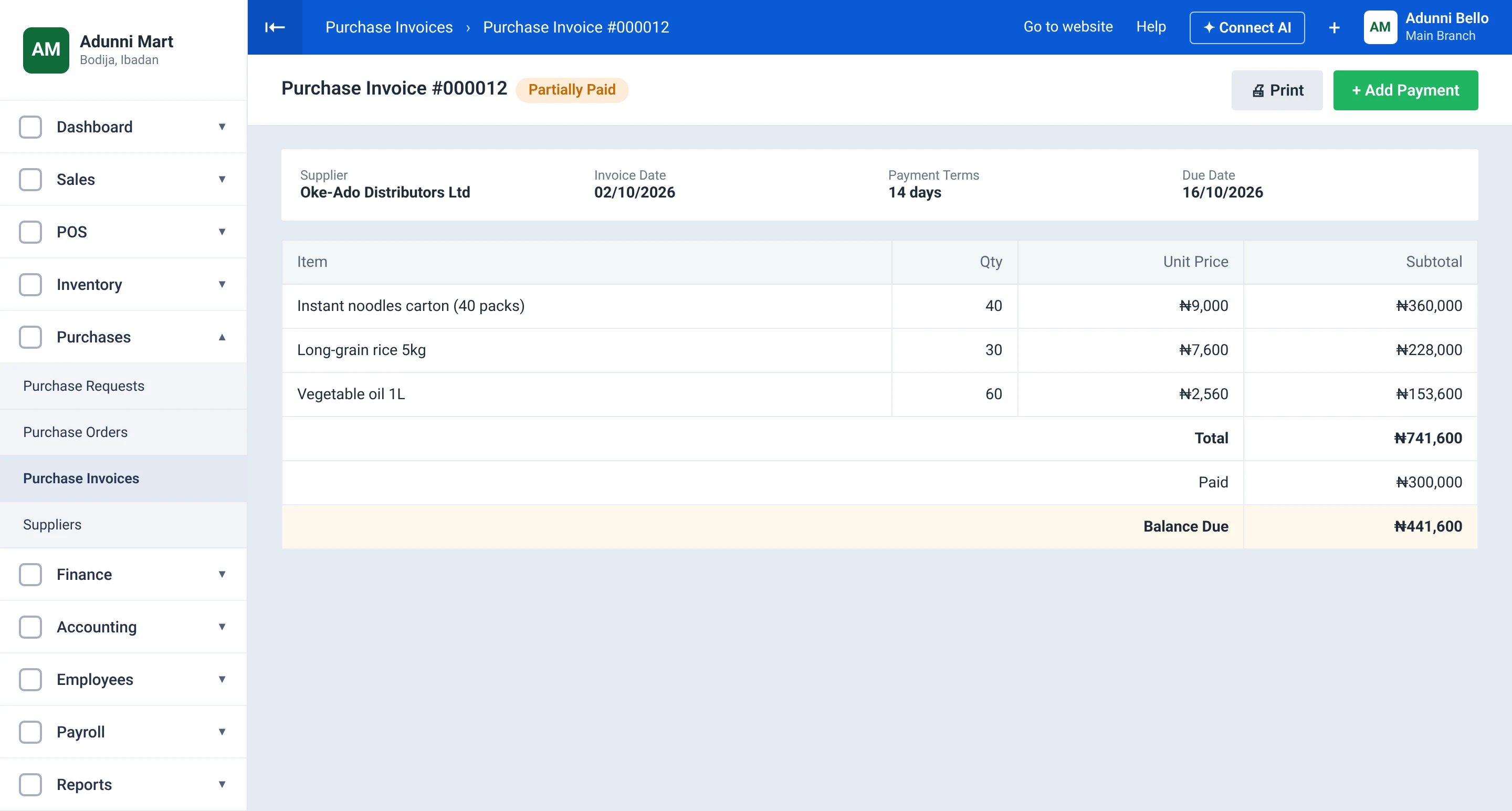
Buy from distributors who will give you time to pay once you've proven yourself. Adunni Mart's distributor gives 14 days, which means a carton of noodles can be sold before it's paid for.
Tip: record every supplier bill with its due date on the day the goods arrive.
6- Set Up Your Systems Before Opening Day
Load every product with its price, tax rate and barcode. Give every cashier their own login. Count your opening stock. Doing this after you open means doing it while customers wait.
When you start a supermarket this way, opening day is about customers, not data entry.
Tip: print a test receipt for a basket with food and non-food items, and check the tax lines before your first real sale.
Is a Supermarket Business Profitable in Nigeria?
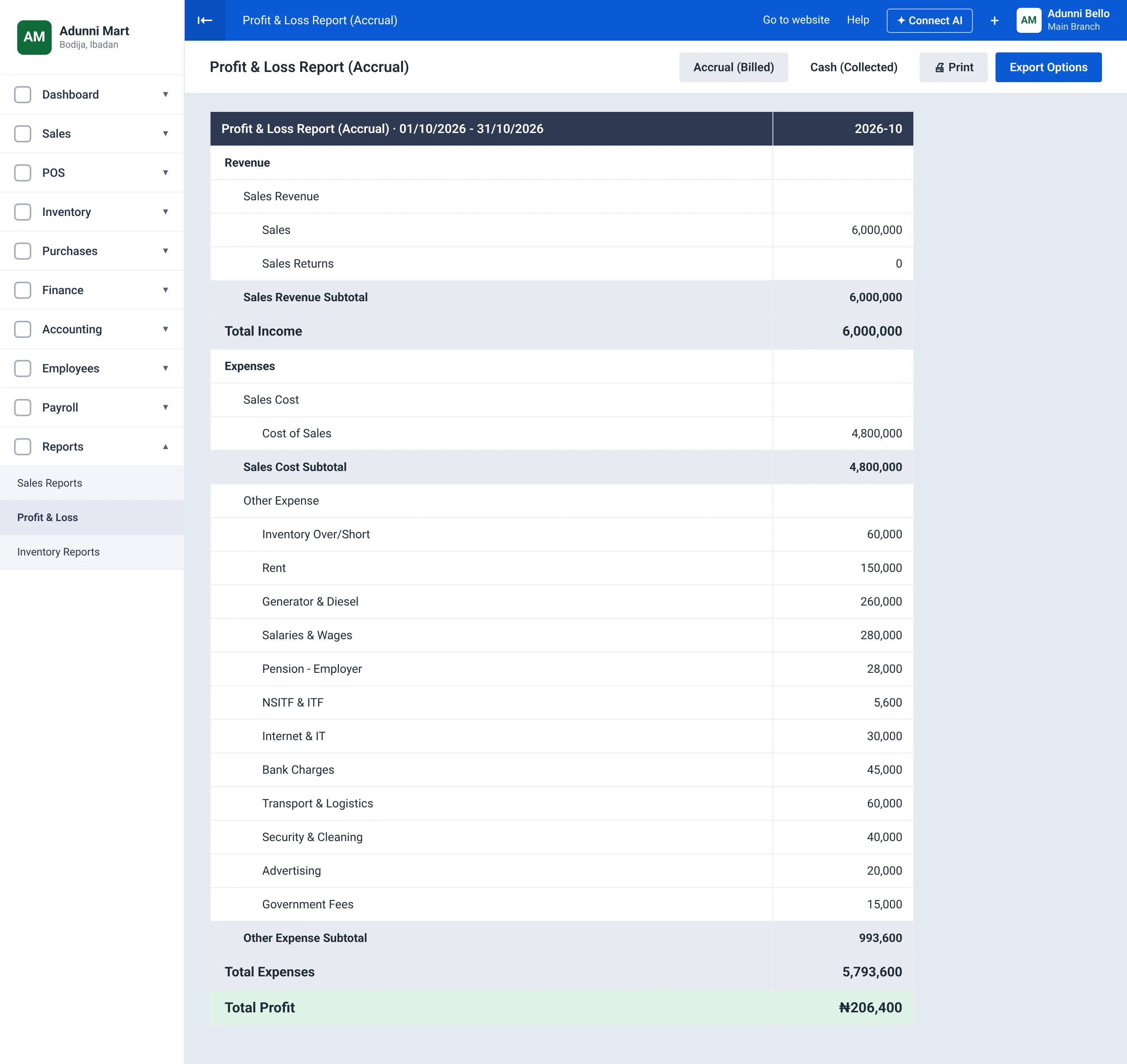
Yes, when the numbers are watched. Here's how a small supermarket business in Nigeria looks after one full month: Adunni Mart's October 2026, built from her own records.
Example 1: Adunni Mart, October 2026, from sales to profit
Bars are drawn to scale against sales. Sample data for a fictional business.
| Running cost | October |
|---|---|
| Staff (₦280,000 salaries plus pension, NSITF and ITF) | ₦313,600 |
| Generator and diesel | ₦260,000 |
| Rent | ₦150,000 |
| Transport and logistics | ₦60,000 |
| Bank and POS charges | ₦45,000 |
| Security and cleaning | ₦40,000 |
| Internet and software | ₦30,000 |
| Advertising | ₦20,000 |
| Permits and levies (monthly share) | ₦15,000 |
| Total running costs | ₦933,600 |
Read that bar chart again. Of every ₦100 a customer hands over, ₦80 goes straight back to the distributor. Of the ₦20 left, about ₦16.56 pays for the shop to exist. Adunni keeps ₦3.44.
So what? Diesel alone (₦260,000) is bigger than the month's profit. A week of bad power or a 1% rise in shrinkage can wipe out a month.
A supermarket doesn't live on its margin. It lives on what's left of the margin after rent, diesel, staff and stock losses.
One more thing the numbers tell her. ₦6 million a month is ₦72 million a year, which keeps Adunni Mart under the ₦100 million small company line for tax. More on that in the rules section below.
Supermarket Profit Margins by Category
A 20% blended margin hides a lot. Here's how Adunni Mart's October sales and gross profit split by shelf, using her own markups.
| Category | Sales | Share of sales | Gross margin | Gross profit |
|---|---|---|---|---|
| Staples | ₦2,400,000 | 40% | 12% | ₦288,000 |
| Beverages | ₦1,200,000 | 20% | 20% | ₦240,000 |
| Household | ₦900,000 | 15% | 26% | ₦234,000 |
| Toiletries | ₦750,000 | 12.5% | 30% | ₦225,000 |
| Frozen | ₦750,000 | 12.5% | 28.4% | ₦213,000 |
| Total | ₦6,000,000 | 100% | 20% | ₦1,200,000 |
Staples bring in 40% of sales but only 24% of gross profit. They're the reason people walk in. Toiletries and household goods are the reason the shop pays its bills.
Use staples to bring people in, and the shelves next to them to make your margin.
Worked Examples: The Numbers Behind a Day at the Till
Example 2: One Receipt, Two VAT Rates
Since January 1, 2026, basic food items such as rice, beans and garri are zero-rated, while most other goods still carry 7.5% VAT. So one basket can carry two rates. This example shows a shop above the small company line, which has to charge VAT. Prices include VAT.
SAMPLE RECEIPT
VAT inside a price is the price × 7.5 ÷ 107.5. Detergent at ₦2,500 holds ₦174.42 of VAT. Rice holds none.
Now put one flat 7.5% line under the whole basket, the way many shops still do. The receipt shows ₦1,758.14 of VAT. That's ₦1,179.07 too much on one basket, and your VAT return is wrong on every sale.
So what? The tax rate belongs on the product, not on the receipt. And Adunni Mart, at ₦72 million a year, charges no VAT at all while it stays under the small company line.
Example 3: What a ₦90,000 Cashier Really Costs
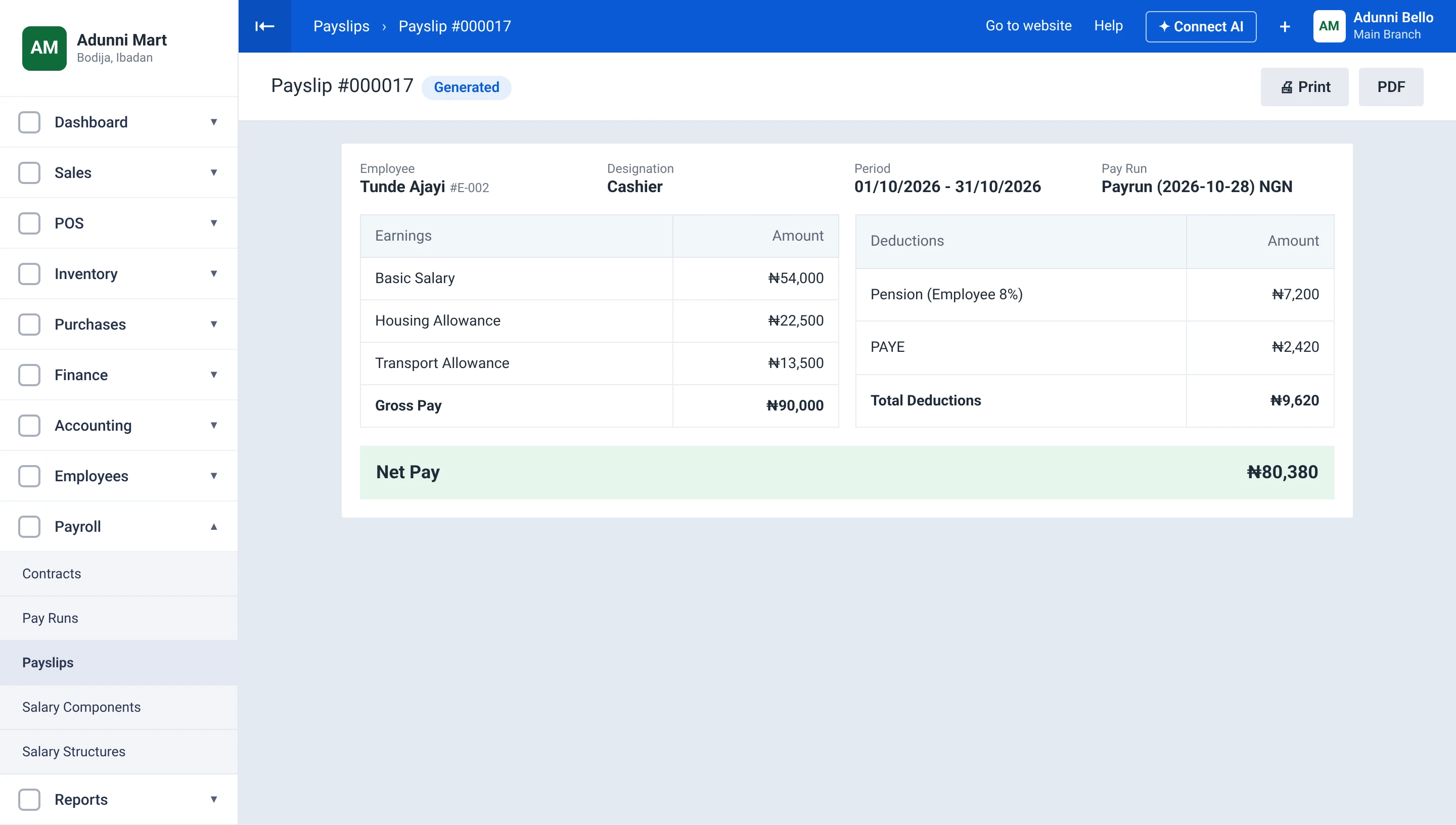
Tunde, Adunni's cashier, earns ₦90,000 a month: ₦54,000 basic, ₦22,500 housing and ₦13,500 transport. Here's his month from both sides.
| Line | Monthly |
|---|---|
| Gross pay | ₦90,000 |
| Employee pension (8%) | −₦7,200 |
| PAYE | −₦2,420 |
| Net pay to Tunde | ₦80,380 |
| Employer pension (10%) | ₦9,000 |
| NSITF (1%) | ₦900 |
| ITF (1%, set aside monthly) | ₦900 |
| Total cost to the shop | ₦100,800 |
How the PAYE works: ₦90,000 × 12 is ₦1,080,000 a year. Take off his ₦86,400 pension and his taxable income is ₦993,600. The first ₦800,000 is taxed at 0%, and the remaining ₦193,600 at 15%, which is ₦29,040 a year or ₦2,420 a month. This assumes he claims no other reliefs, such as rent relief.
So what? Budget staff at gross pay plus 12%, not at the number you agreed in the interview.
Example 4: The End-of-Day Close
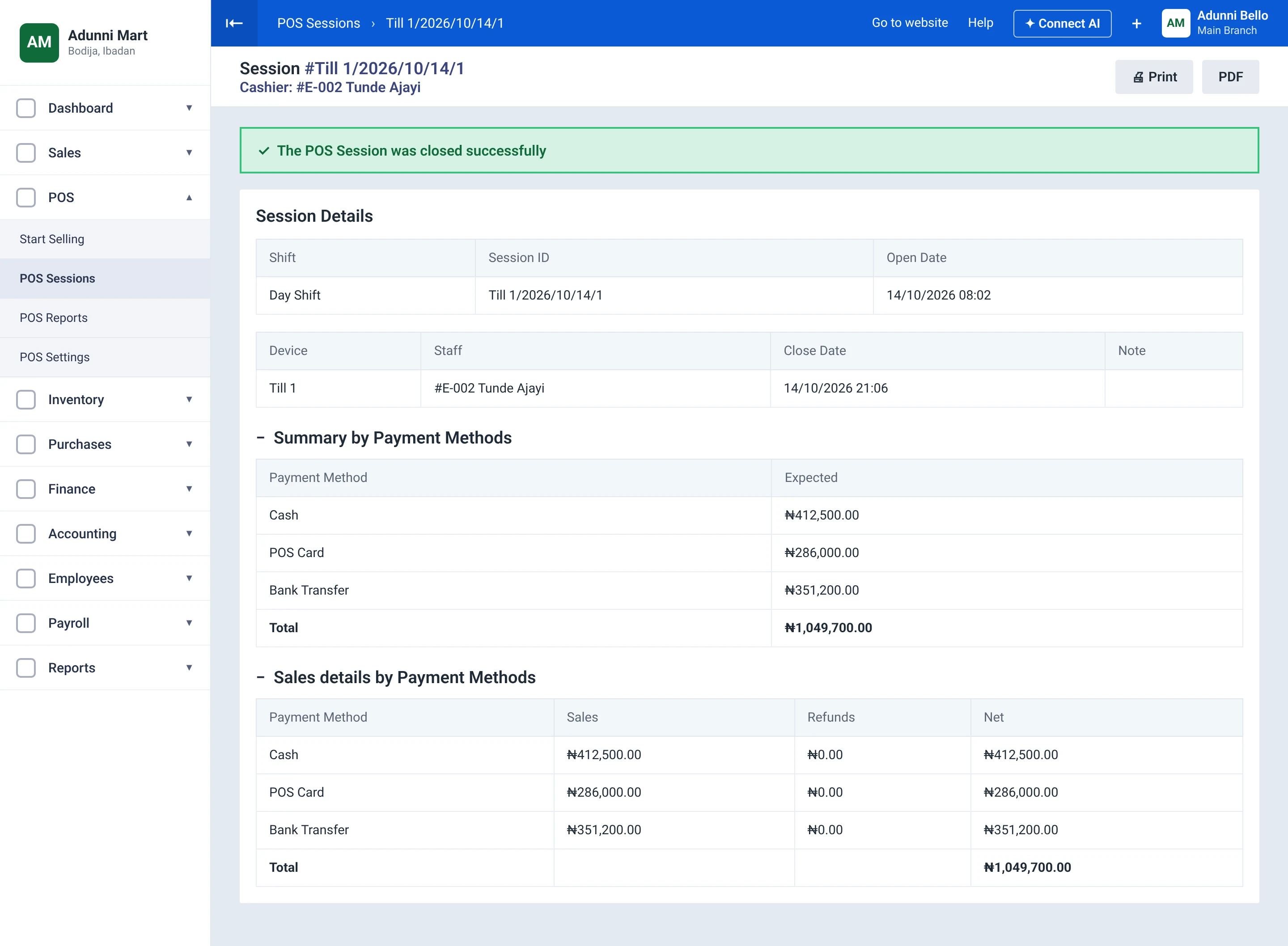
Adunni Mart takes money three ways: cash, POS card and bank transfer. On October 14, Tunde's session showed these expected totals. Adunni then counted the drawer, checked the POS terminal settlement and opened the bank app.
Cash
Expected ₦412,500
Counted ₦419,000
+₦6,500 over
POS card
Expected ₦286,000
Settled ₦286,000
Matches
Bank transfer
Expected ₦351,200
In bank ₦344,700
−₦6,500 under
The day's total is ₦1,049,700 either way. Nothing is missing. But two rails are wrong by exactly the same amount in opposite directions.
That pattern almost always means one thing: a customer paid ₦6,500 in cash, and the cashier keyed it as a transfer. Adunni found the receipt, corrected the payment method, and both rails balanced.
So what? Check each payment method on its own, not just the day's total. A total that balances can still hide errors that will confuse your bank reconciliation for weeks. Our guide on how to track POS transactions shows how to match terminal settlements to your bank statement.
Example 5: Shrinkage by Section
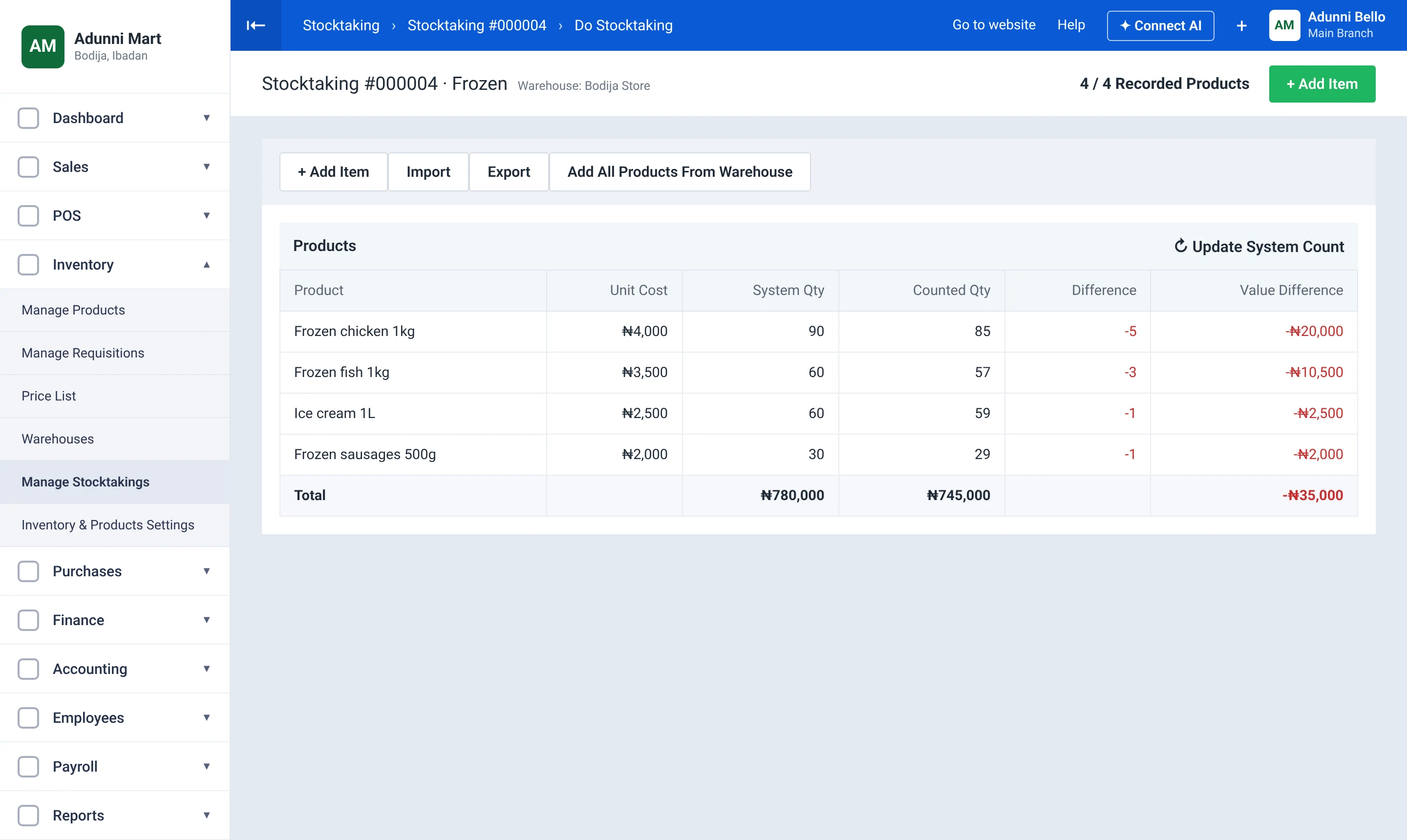
At the end of October, Adunni and Musa, her storekeeper, counted every section and compared the counts with the system, valued at cost.
| Section | System value | Counted value | Shortage | Shortage % |
|---|---|---|---|---|
| Staples | ₦2,640,000 | ₦2,635,000 | ₦5,000 | 0.19% |
| Beverages | ₦1,850,000 | ₦1,838,000 | ₦12,000 | 0.65% |
| Toiletries | ₦1,120,000 | ₦1,112,000 | ₦8,000 | 0.71% |
| Frozen | ₦780,000 | ₦745,000 | ₦35,000 | 4.49% |
| Total | ₦6,390,000 | ₦6,330,000 | ₦60,000 | 0.94% |
That ₦60,000 is the stock shortage line in Example 1. Overall, 0.94% doesn't sound like much.
Look closer. Frozen holds 12.2% of the stock value but caused 58.3% of the shortage. That's not a theft problem across the shop. It's one freezer, one supplier delivery or one power cut.
So what? A single shrinkage number tells you that you lost money. Counting by section tells you where.
Inventory Control for a Supermarket
Good inventory control answers two questions before a customer does: what's about to run out, and what's about to expire.
Reorder point formula
Reorder point = (average daily sales × supplier lead time in days) + safety stock
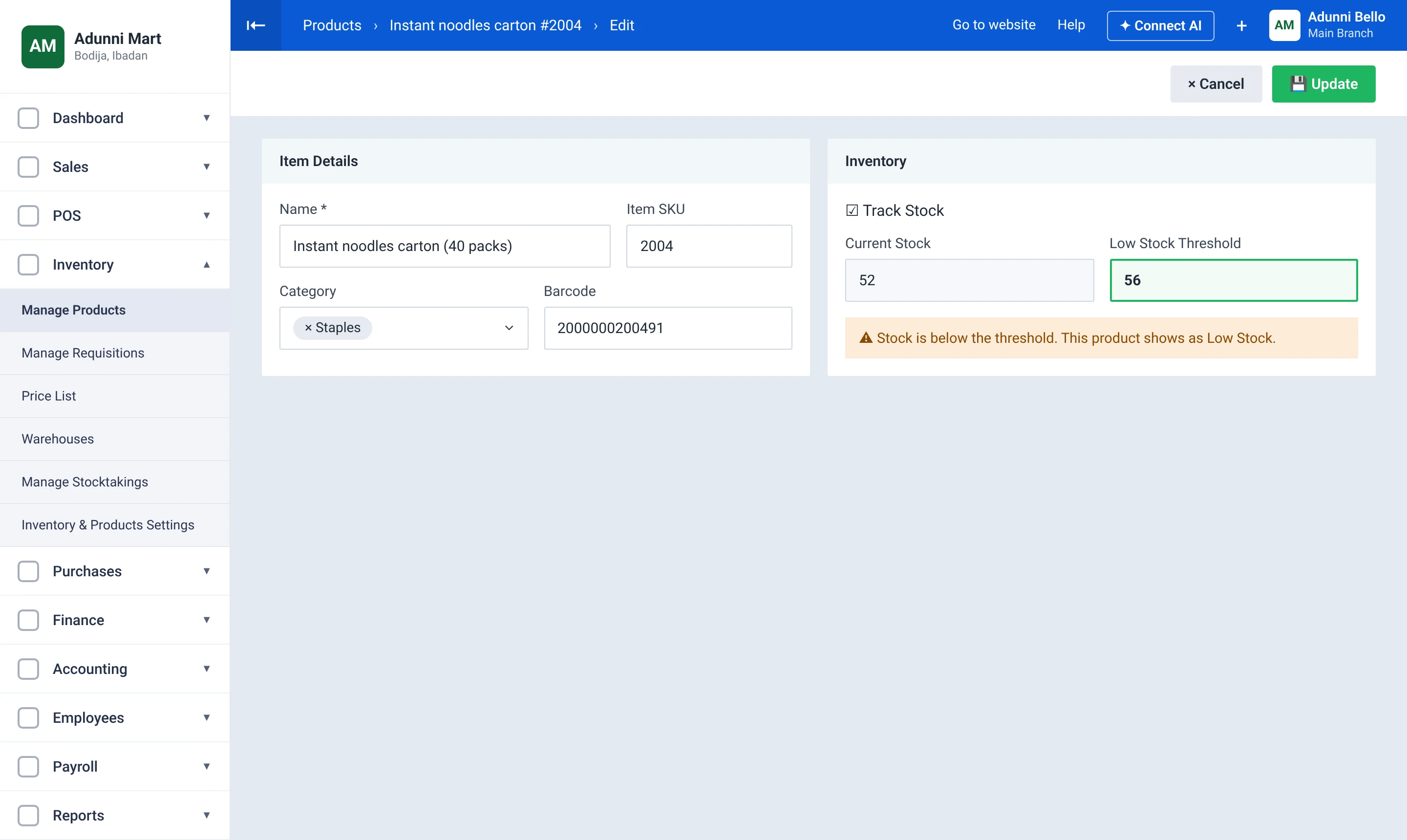
Instant noodles cartons: (14 a day × 3 days) + 14 = reorder at 56 cartons
Adunni sells 14 cartons of noodles a day, and her distributor delivers three days after she orders. She keeps one day's sales as a buffer. When stock drops to 56, she orders. Wait until 20 and she'll be out before the truck arrives.
Three more inventory control habits that pay for themselves:
- First in, first out: move older stock to the front when you restock. Expired goods are pure loss.
- Section counts on a rotation: count one section a week instead of everything once a year.
- Receive against the order: count deliveries against what you ordered before the driver leaves.
How to Keep Daily Sales Records
Every sale needs the same fields: date and time, items and quantities, price, tax, payment method and cashier. If you sell on credit, add the customer's name and balance.
Then close the day the same way every time: count the drawer, match POS settlements and transfers, record expenses paid in cash, and note anything unusual. Our retail daily sales report template gives you those columns if you're still on paper or a spreadsheet.
So what? Sales records are the only proof of your turnover. They decide whether you stay under the small company line, and they're what the tax authority will ask for.
Common Mistakes
✗ One VAT rate on everything
Why it matters: food is zero-rated, so a flat rate overcharges customers and misstates your return. Fix: set the tax rate on each product.
✗ Cashiers sharing one login
Why it matters: every shortage becomes nobody's fault. Fix: one user and one session per cashier per shift.
✗ Counting stock once a year
Why it matters: by then you can't tell when or where the loss happened. Fix: count one section a week.
✗ Paying staff from the drawer
Why it matters: no payslip means no record of PAYE or pension, and the cash count never balances. Fix: run a monthly pay run and pay from the business account.
✗ Mixing shop and personal money
Why it matters: you can't see real profit, and your turnover looks bigger or smaller than it is. Fix: one business account and recorded drawings.
How Enerpize Helps You Start and Run a Supermarket
Everything above is possible with a notebook, a calculator and a lot of evenings.
The question is whether you want to spend the evenings. Here's how Adunni Mart runs on Enerpize, from the week before opening to the first month-end.
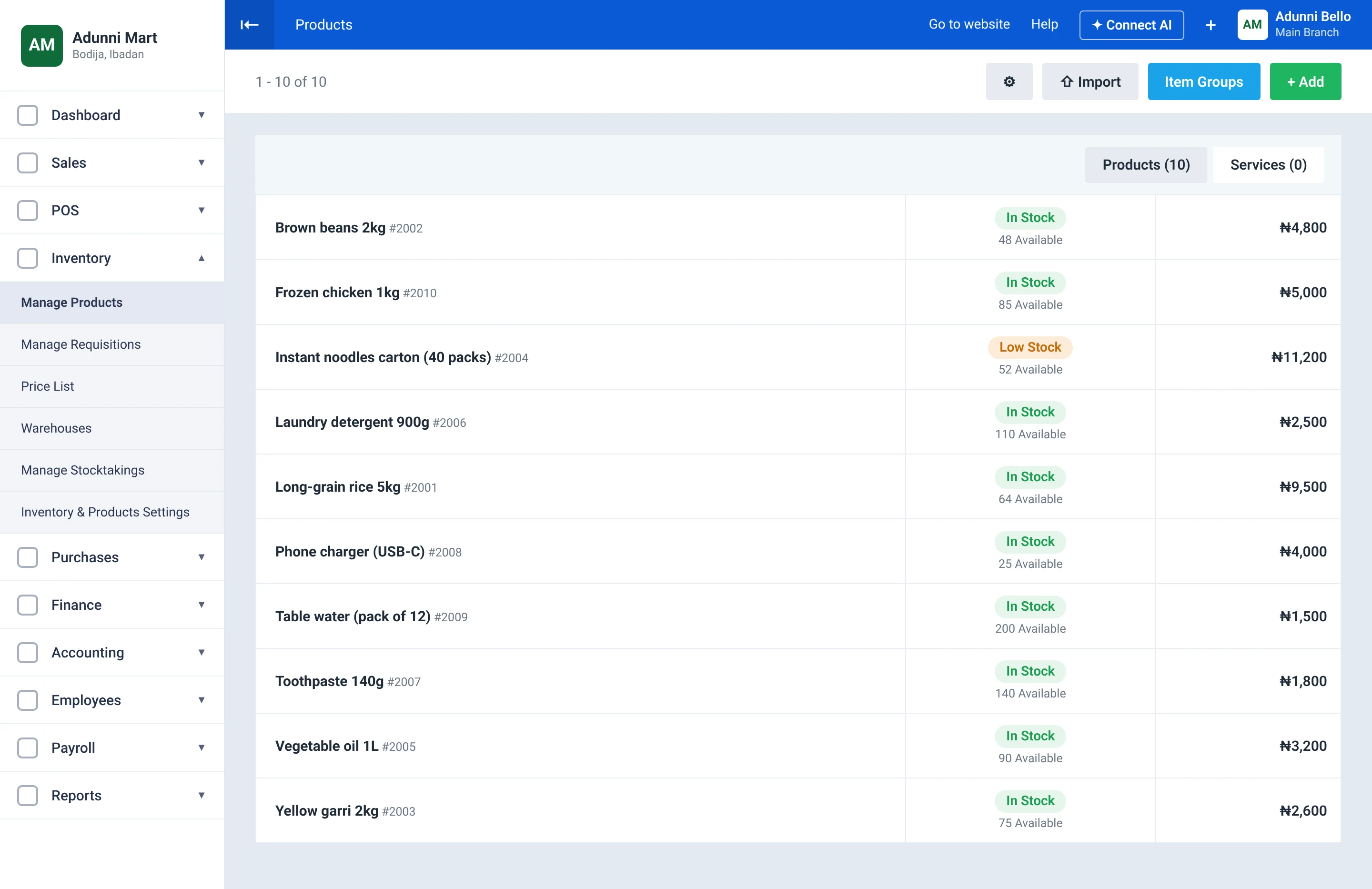
Set Up Products, Prices and Tax Rates Before Opening Day
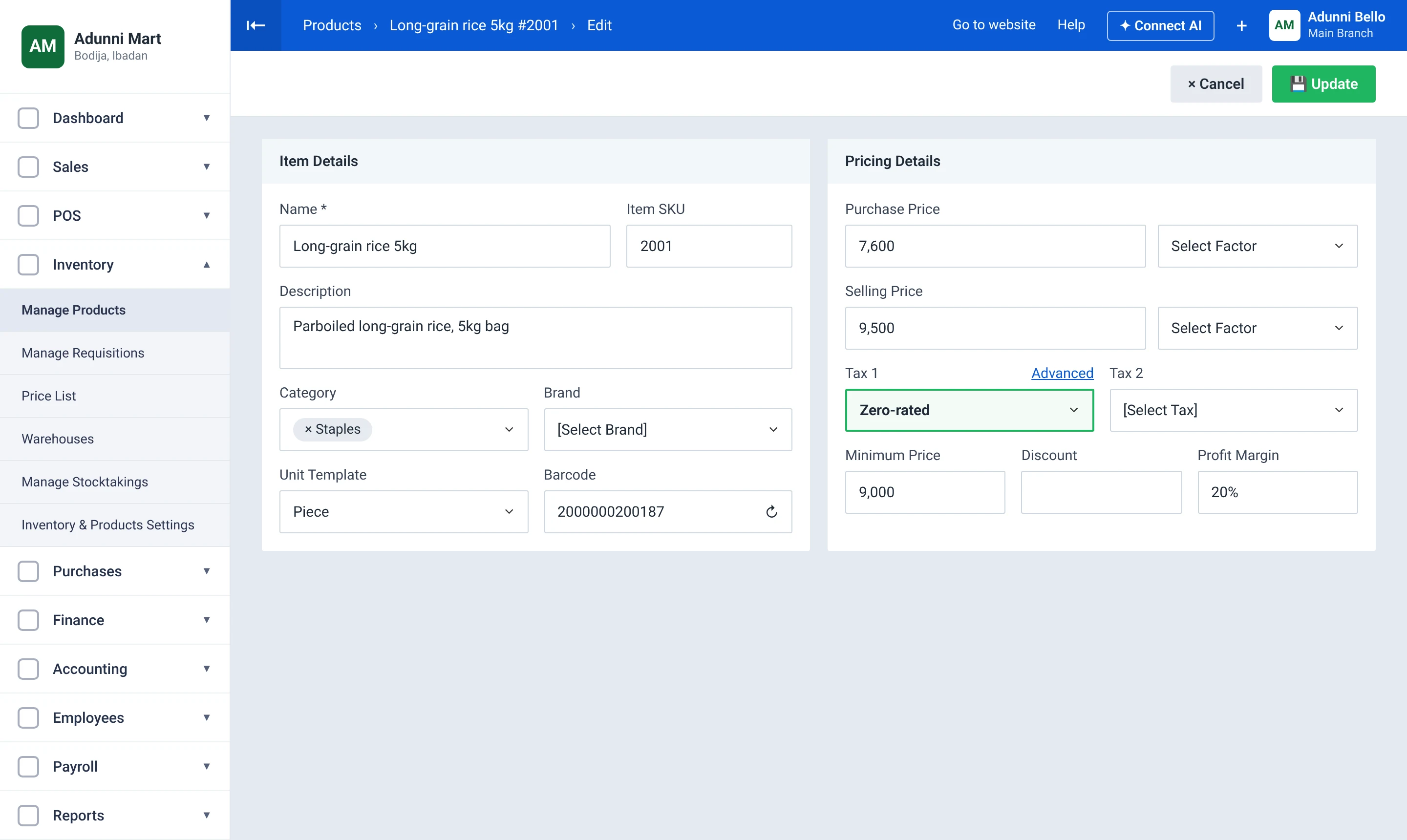
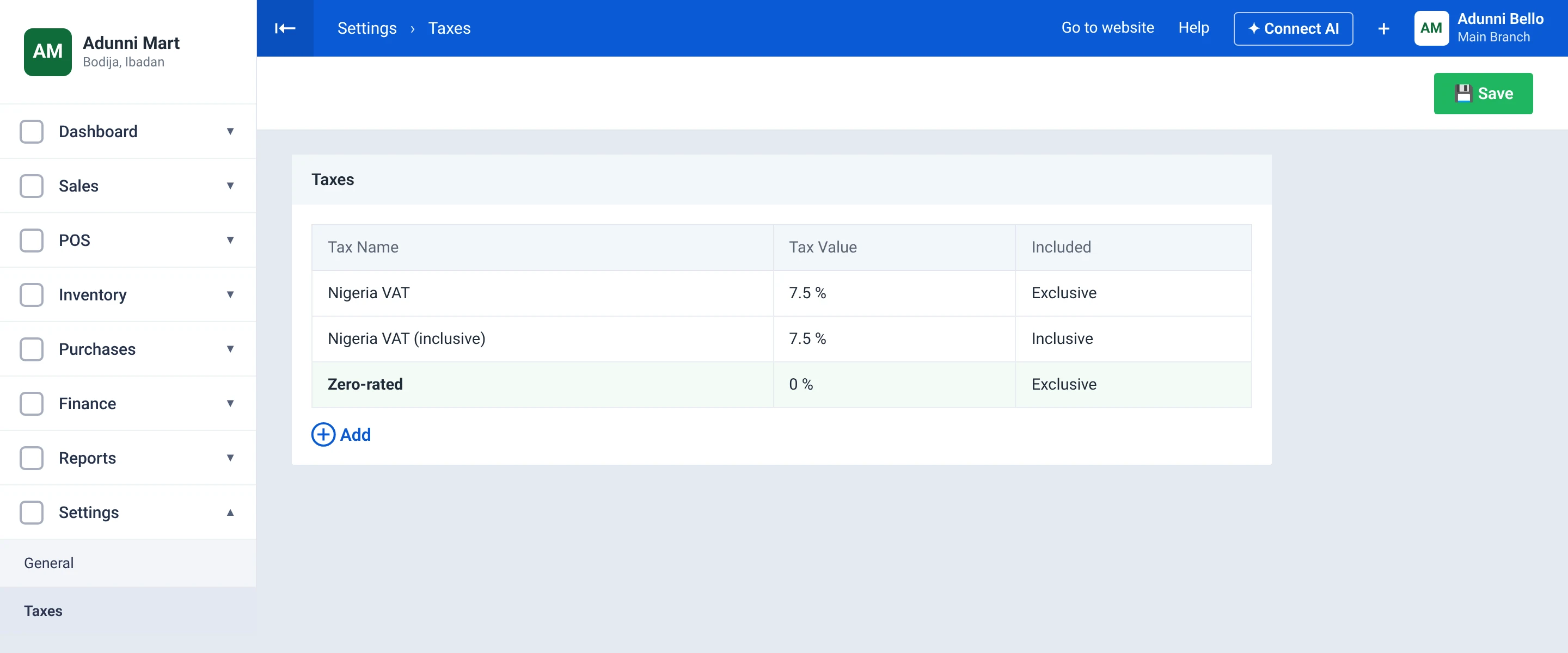
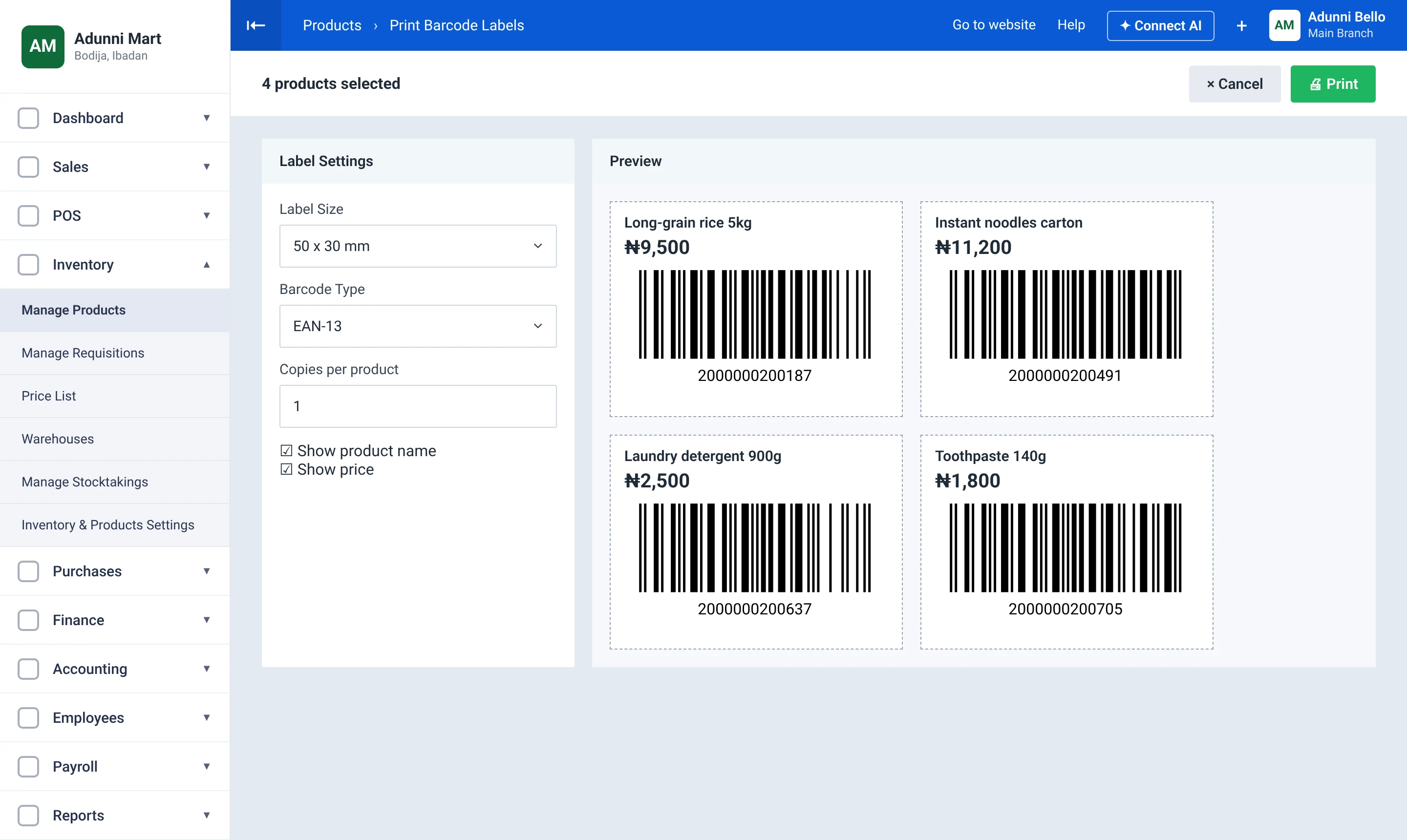
Each product gets a selling price, purchase price, category, barcode and up to two tax fields. Rice is set to zero-rated, detergent to VAT. Taxes can be set as exclusive or inclusive of the price, so shelf prices stay the same price customers pay. You can also print barcode labels for items that arrive without one. See how it fits together for retail stores.
Load Opening Stock and Suppliers
Import your opening count, then see every product's stock level at a glance. Restocking runs through purchase orders and supplier invoices, so a 14-day credit balance sits on the supplier's account with its due date.
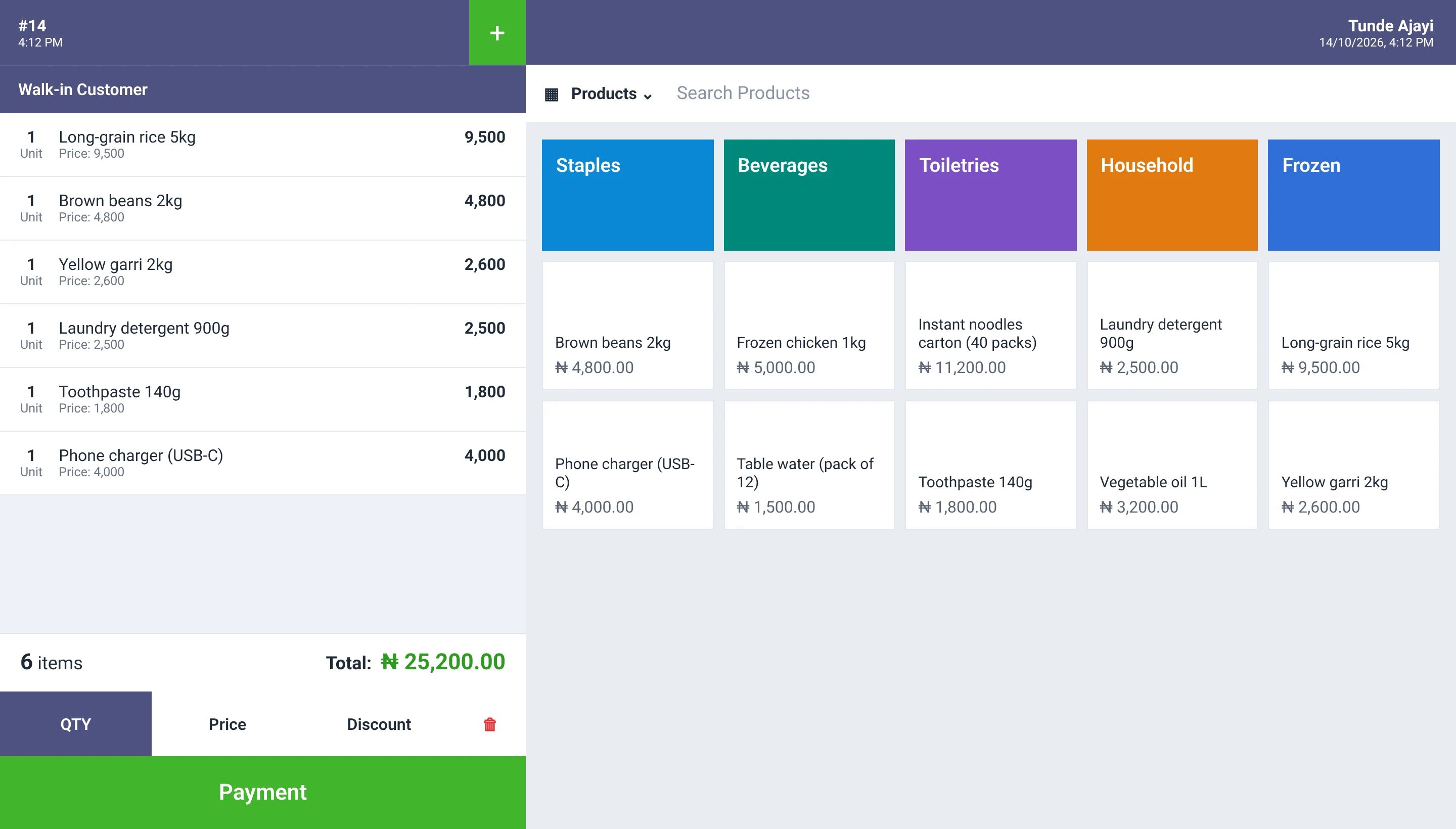
Give Every Cashier Their Own Till Session
Each cashier logs in to the POS with their own user and opens a session for the shift. When the session closes, it shows the expected totals by payment method, which is exactly what you need for the end-of-day close in Example 4.
Catch Stock Problems Early
Every sale reduces inventory as it happens, and products below their threshold show as low stock, so the reorder point from the noodles example works without anyone watching the shelf. When you count, stocktaking compares counted quantities with the system and records the difference.
Pay Staff From the Same Books
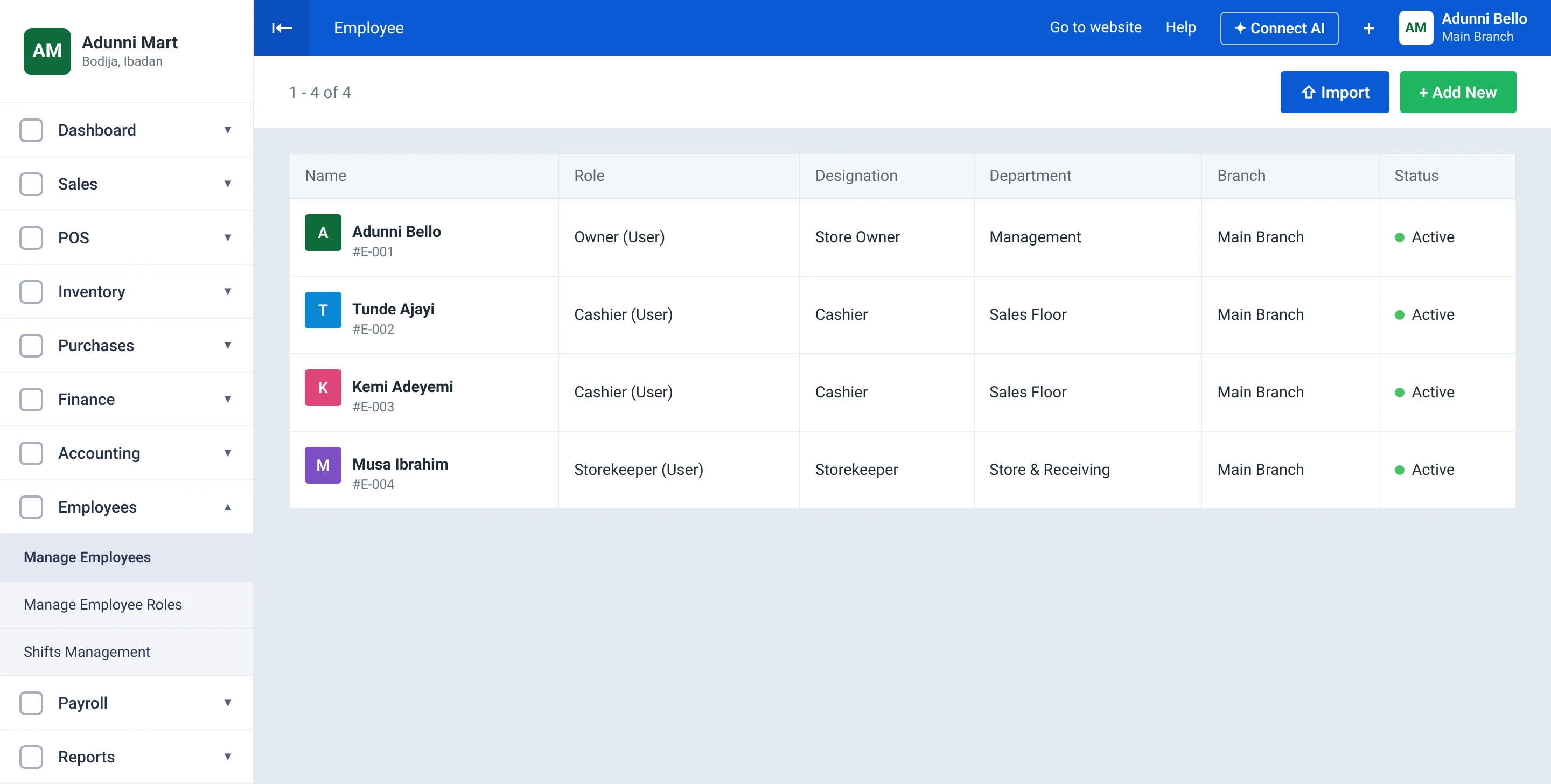
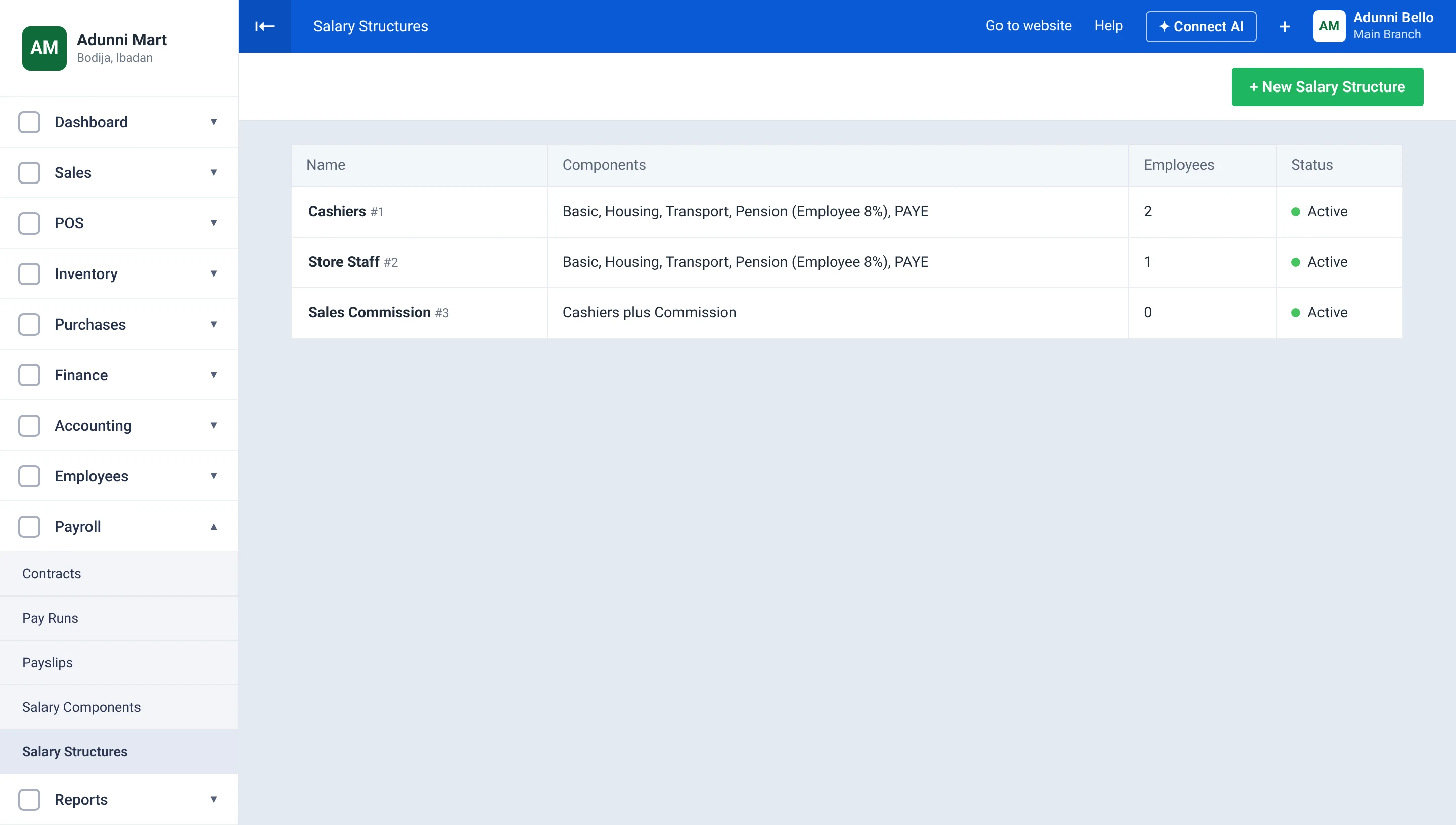
Payroll runs from salary structures you define. Components such as basic, housing, transport, pension and PAYE are configurable to support Nigerian payroll rules, and commission can be added as an earning. Each month's pay run produces payslips, and the cost lands in the same books as the sales.
See Profit Every Month
Rent, diesel and transport go in as expenses against the right cash account. Because sales, cost of goods, stock shortages, wages and expenses share one ledger, the profit and loss report for October is ready on November 1.
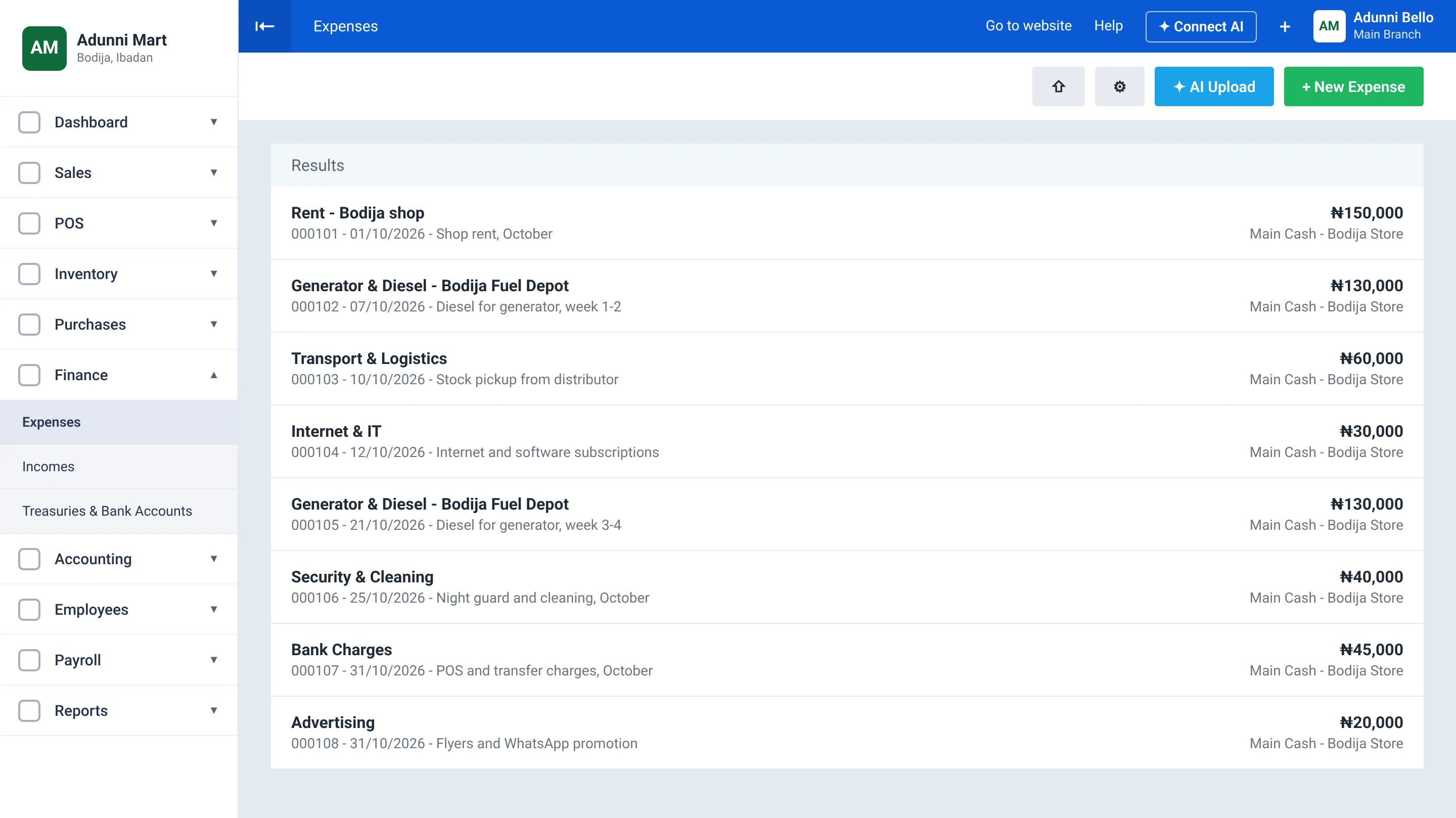
Screens show sample data for a fictional business.
Set up your products, tax rates and cashier logins before opening day.
No credit card required.
Nigeria Rules a Supermarket Must Follow in 2026
Software keeps the records. The rules decide which records you need. Four tax laws took effect on January 1, 2026, and the federal tax authority is now the Nigeria Revenue Service (NRS). This is general information, so check the details with your accountant.
VAT and the Small Company Test
Under the Nigeria Tax Act 2025, VAT stays at 7.5% and basic foodstuffs move from exempt to zero-rated, according to Forvis Mazars. A small business, with turnover of ₦100 million or less and fixed assets of ₦250 million or less, is exempt from registering for, charging and filing VAT. Both conditions must be true, and the same small company test gives 0% company income tax. For a supermarket business in Nigeria, that line is worth tracking every month.
What to add:
- A tax rate on every product, zero-rated or 7.5%
- A monthly running total of turnover
- Monthly VAT returns by the 21st once you're above the line
Practical note: the exemption isn't automatic. You still need a Tax ID, records that prove your turnover, and annual returns.
PAYE
The first ₦800,000 of yearly taxable income is taxed at 0%, then bands run from 15% to 25%, according to DLA Piper. You deduct PAYE from each salary and remit it to the tax authority of the state where your employee lives, by the 10th of the following month.
What to add:
- Each employee's taxable pay and reliefs
- A payslip for every month
Practical note: deduct the employee's pension before you calculate PAYE, as Example 3 does.
Pension, NSITF and ITF
Employers with three or more employees must contribute at least 10% of monthly pay to pension, and employees at least 8%, according to PenCom. Employers also pay at least 1% of monthly payroll to the NSITF Employees' Compensation Scheme, and employers with five or more staff or ₦50 million turnover pay 1% of annual payroll to the ITF by April 1 of the following year.
What to add:
- Pension components on every payslip
- Monthly employer cost lines for pension, NSITF and ITF
Practical note: the national minimum wage is ₦70,000 a month, and the law applies it to establishments with 25 or more workers. Paying at least that anyway helps you keep good staff.
E-Invoicing
The NRS is rolling out e-invoicing in phases. Large taxpayers went first, medium taxpayers (₦1 billion to ₦5 billion turnover) went live on July 1, 2026, and businesses with turnover under ₦1 billion are scheduled to go live on July 1, 2027, according to KPMG.
What to add:
- Numbered, complete invoices and receipts now, so the switch is easy later
Practical note: Enerpize keeps the invoice, payroll and tax records these rules expect. It doesn't file returns with the NRS or your state tax authority, and it doesn't submit invoices to the NRS e-invoicing platform for you.
Who Needs This
If you run, or plan to start a supermarket business in Nigeria at any size, one of these will sound familiar.
The First-Time Mini Mart Owner
You've saved, found a shop near an estate and you're about to buy stock. Set your prices, tax rates and opening count before the first customer walks in.
The Provision Store Moving to Barcodes
You've run on memory and a notebook for years. Now there are two cashiers and you can't be at the till all day. Per-cashier sessions show you who sold what.
The Two-Branch Neighborhood Supermarket
Your second shop is doing well, maybe. Section counts and monthly profit per branch tell you whether it really is.
The Supermarket Adding Frozen Foods
Frozen goods carry good margins and big risks. Example 5 shows why that section needs its own weekly count.
Key Takeaways
- In a supermarket business in Nigeria, margins are thin: a 20% gross margin became 3.44% net for Adunni Mart. Watch running costs as closely as sales.
- Diesel (₦260,000) cost more than the month's profit (₦206,400). Plan power before shelves.
- Food is zero-rated in 2026. A flat 7.5% on our ₦25,200 basket overstated VAT by ₦1,179.07.
- A ₦90,000 cashier costs ₦100,800 a month. Budget gross pay plus 12%.
- Close every till by payment method. Matching opposite gaps usually mean a mis-keyed sale.
- Count by section. Frozen caused 58.3% of the shortage with 12.2% of the stock.
Frequently Asked Questions
How much does it cost to open a supermarket in Nigeria?
The cost to start a supermarket in Nigeria depends on your city, shop size and stock range. Budget each line separately: rent, shelving and counters, refrigeration, opening stock, power backup, POS hardware and software, registration and permits, and three months of running costs as a buffer.
Is a supermarket business profitable in Nigeria?
It can be, on volume. In our worked example, a mini-mart with ₦6 million in monthly sales and a 20% gross margin keeps ₦206,400, or 3.44%, after costs. Shrinkage, diesel and staff costs decide whether you're on the right side of that line.
What is a good profit margin for a supermarket?
Margins differ by shelf. In our example, staples earned 12% and toiletries 30%, for a 20% blend. Net margin after running costs is a small fraction of that, so track both every month.
What is the difference between a mini mart and a supermarket?
A mini mart serves one street or estate with provisions and household basics, usually with the owner on the floor. A supermarket carries more categories, such as frozen and toiletries, and needs supervisors and several tills.
What licenses do I need to open a supermarket in Nigeria?
Business registration with the Corporate Affairs Commission, a Tax ID, and state and local government trading permits. Depending on what you sell, you may also need NAFDAC approval for food you package yourself, NAFDAC listing for imported food and a liquor license for alcohol.
Do supermarkets in Nigeria charge VAT on food?
Since January 1, 2026, basic food items such as rice, beans and garri are zero-rated, so no VAT is charged on them. Most other goods carry 7.5%. Small companies with turnover of ₦100 million or less don't charge VAT.
How do I keep daily sales records for my supermarket?
Record every sale with its items, price, tax, payment method and cashier. At closing, count cash, match POS settlements and transfers, and record cash expenses. A daily sales report or POS session report keeps it consistent.
How can I reduce losses in a supermarket?
Give each cashier their own login, count stock one section at a time, rotate stock first in, first out, check deliveries against orders and protect frozen goods with reliable power.
It's 9 p.m. in Bodija again.
Adunni closes Tunde's session. Cash, POS and transfers each match. The frozen count is done for the week. October's profit and loss report is already waiting for her in the morning.
She rolls the shutters down.
This time she knows the answer to the question.
Run your first month-end with sales, stock and payroll in one system.
No credit card required.
About the Author
Omar El Bahr is a Senior Digital Growth Specialist at Enerpize, where he leads SEO, content strategy, and organic growth across international markets. He is a Forbes Communications Council contributor and has written for Entrepreneur on business communication and digital strategy.
Disclaimer: Adunni Mart is a fictional business, and all figures are sample data. Tax and payroll rules are general information as of November 2026, not tax advice. Check the details with your accountant.
Related Articles
 Sales
What Is an Invoice and What Does it Look Like? A Complete Guide
Read more Sales
Pos Tracking: Definition and How to Do
Read more Sales
Is There a POS System That Connects Directly to Inventory and Accounting Without Add-Ons?
Read more Sales
What Business Platform Handles Sales Orders, Invoicing, Customer Accounts, and Inventory in One Place?
Read more Sales
What is Invoice Management: A Comprehensive Guide
Read more Sales