

Posted on 4 August 2026
Free 1099-MISC Template: Word, Excel, PDF, and Google Sheets Download
- Available in Word, Excel, PDF, and Google Sheets, free to download with no signup required
- Covers rents, royalties, medical payments, and attorney proceeds across all 18 boxes in one structured document
- Includes the new 2026 IRS boxes for cash tips and overtime compensation before most accounting software catches up
- Flags automatically in Excel and Google Sheets once a payment crosses its own category threshold, $10 for royalties, $600 or $2,000 for everything else
A 1099-MISC template is a structured version of the IRS's miscellaneous information form that lets a business record, sort, and calculate reportable payments across several different categories.


What Is Form 1099-MISC?
Ask five business owners what a 1099-MISC is for and you will probably get five different half right answers. Rent. Royalties. That one weird box for attorneys. All of them are correct, which is exactly why this form causes more confusion than almost any other IRS document a small business will touch. Form 1099-MISC is the IRS's catch all for miscellaneous income, officially titled Miscellaneous Information, and it covers payments that do not fit anywhere else on the 1099 family tree.
If your business paid $600 or more in rent, prizes, medical payments, or gross proceeds to an attorney during 2025, or $10 or more in royalties, you likely need to file a 1099-MISC. Starting with 2026 payments, most of those thresholds jump to $2,000 under the One Big Beautiful Bill Act, though royalties stay right where they have always been.
One thing this form is not used for anymore. Contractor payments. If you are paying a freelancer or independent contractor for services, that goes on Form 1099-NEC instead, a separate form the IRS reintroduced back in 2020 specifically to pull nonemployee compensation off the 1099-MISC.
Tired of sorting rent, royalty, and attorney payments into the right box every January? Register free with Enerpize
What the Enerpize 1099-MISC Template Includes
Rents, royalties, medical payments, attorney proceeds. Five categories, five thresholds, one form. That is the part of 1099-MISC that trips people up, not the form itself, but keeping five different payment types straight across a full year before they all land on the same filing deadline.
The Tracker Handles the Category Split for You
Select a payment category from the dropdown in the Excel version and the threshold, the box number, and the reportable amount all fill in on their own. A $25 royalty payment and a $3,000 attorney payment sit correctly side by side without anyone doing the box lookup by hand.
Expenses Categorized From the Start
Enerpize's Expenses Management module carries that same category logic further than a spreadsheet can. Custom expense categories let a business tag a rent payment, a royalty, or a legal fee the moment it is entered, and those categories carry through to reports without anyone rebuilding them at tax time. The AI Expense Capture feature pulls the amount, date, vendor, and tax details straight from an uploaded invoice or receipt, which matters most for a form like this one, since attorney proceeds and medical payments usually arrive as invoices rather than recurring line items.
The Same Payment Lives in the Books Too
Those categorized expenses do not sit in isolation. Chart of Accounts mirrors every entry automatically into the general ledger, so the same rent payment tracked for 1099-MISC purposes is also sitting in the books where it belongs, with nothing re entered twice. Where a business pays several vendors under one category, several landlords or several outside counsel, Cost Centers lets those payments be split and reported by department or vendor rather than lumped into a single total.
None of that replaces the tracker. It is what the tracker is quietly assuming happens upstream, categorized, recorded, and traceable back to source, so filling out Boxes 1 through 18 in January becomes a summary of the year rather than a reconstruction of it.
Form 1099-MISC vs Form 1099-NEC
This is the single most searched question about 1099-MISC, and for good reason. The line between the two forms is thin on paper and easy to cross in practice.
| Document | Reports | Threshold | Recipient |
|---|---|---|---|
| Form 1099-MISC | Rents, royalties, medical payments, attorney proceeds, other miscellaneous income | $600 (most categories), $10 for royalties | Landlords, licensors, medical providers, attorneys |
| Form 1099-NEC | Nonemployee compensation for services performed | $600 for 2025, $2,000 for 2026 onward | Independent contractors, freelancers |
The test that actually settles it is simple. Was the payment for a service someone performed for your business, like consulting or freelance design? That is 1099-NEC. Was it a payment for something else entirely, rent for office space, a royalty on intellectual property, a settlement paid through an attorney? That is 1099-MISC. If you also pay contractors alongside your rent and royalty obligations, our contractor invoice template keeps that side of the paperwork consistent with what ends up on the 1099-NEC.
Who Gets a 1099-MISC?
Landlords who received $600 or more in rent for commercial space, equipment, or machinery. Authors and licensors who earned $10 or more in royalties. Medical providers, physicians, clinics, and health care suppliers who received $600 or more for services. Attorneys and law firms on the receiving end of gross proceeds tied to legal settlements, regardless of how the underlying case was structured.
Payments to most corporations are the exception here, with medical and legal payments being the notable carve out, those still require a 1099-MISC even when the recipient is incorporated. If you are collecting rent from a tenant and want a clean paper trail alongside the 1099, our rent receipt template covers the payment side of that relationship. Landlords who received $600 or more in rent for commercial space, equipment, or machinery. Construction businesses renting equipment on a job often have both a 1099-MISC obligation to the equipment owner and an AIA style payment application running for the project itself.
What Is New on the 2026 Form 1099-MISC
The IRS's December 2026 revision of Form 1099-MISC changed more than most people expect from a form that has looked roughly the same for years. Three boxes moved, one disappeared entirely.
Box 13a now reports cash tips. Box 13b carries a Treasury Tipped Occupation Code. Box 14 reports overtime compensation. All three tie to the qualified tips and qualified overtime deductions introduced under the One Big Beautiful Bill Act, the same mechanism behind the equivalent changes on Form 1099-NEC.
Here is the part almost nobody has caught yet. Excess golden parachute payments, which used to sit in Box 14 on the old form, are gone from 1099-MISC entirely. That reporting now lives exclusively on Form 1099-NEC. If your business has ever reported an excess golden parachute payment on a 1099-MISC before, that box simply is not there anymore starting with this revision.
New boxes, a missing box, and five payment categories to keep straight. Register free and let the system do the sorting. Register free with Enerpize
1099-MISC Box by Box Breakdown
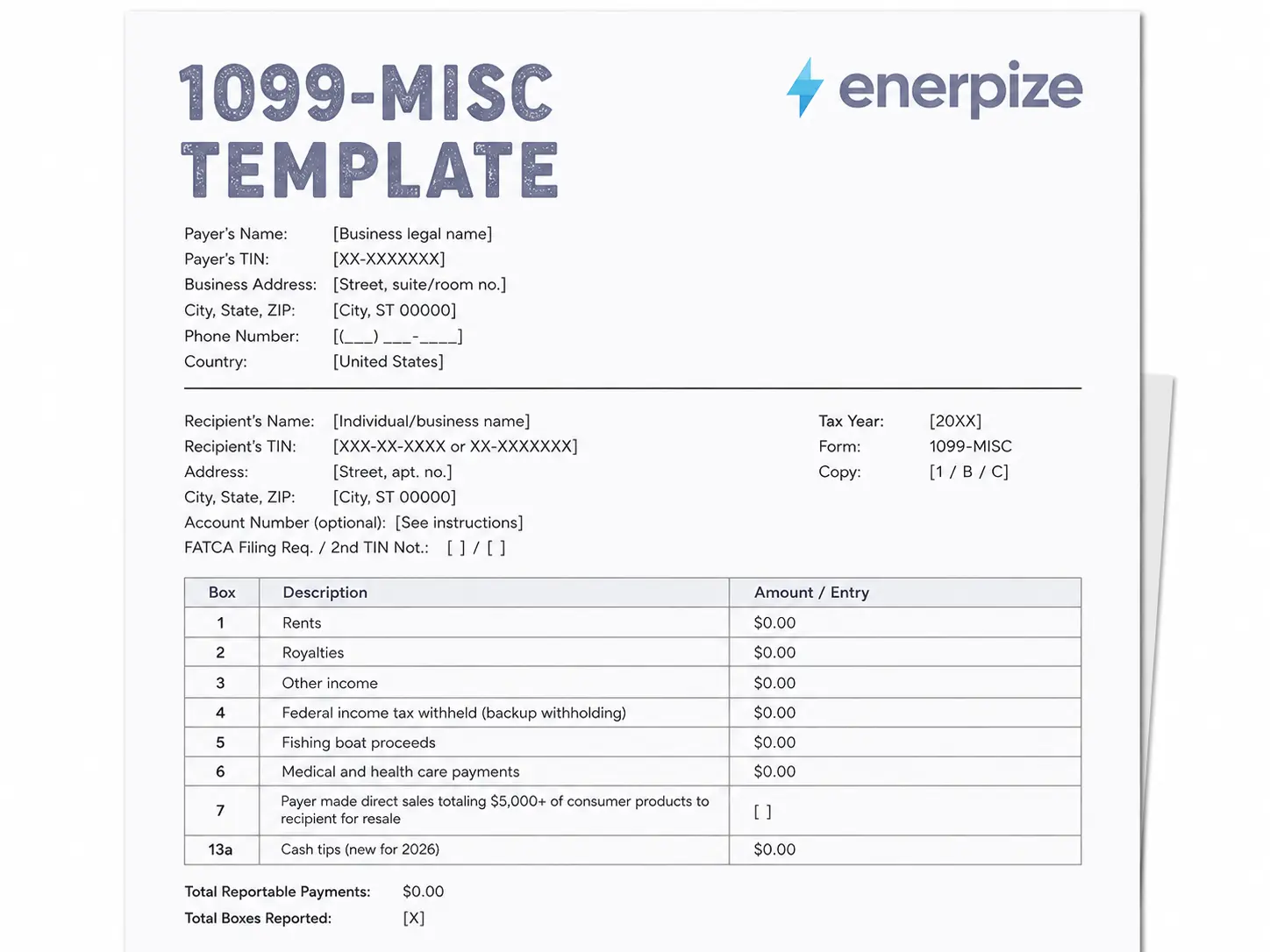
Box 1 covers rents. Box 2 covers royalties. Box 3 is the true catch all, other income that does not fit anywhere else, prizes, awards, and similar payments. Box 4 reports backup withholding. Box 5 covers fishing boat proceeds. Box 6 is medical and health care payments. Box 7 is a checkbox for direct sales of $5,000 or more in consumer products for resale. Box 8 covers substitute payments in place of dividends or interest. Box 9 is crop insurance proceeds. Box 10 reports gross proceeds paid to an attorney. Box 11 covers fish purchased for resale. Box 12 handles Section 409A deferrals. Boxes 13a, 13b, and 14 are the new tips, occupation code, and overtime boxes. Box 15 covers nonqualified deferred compensation. Boxes 16 through 18 handle state tax withheld, the payer's state number, and state income.
The $600 vs $2,000 Threshold
For 2025 payments, most 1099-MISC categories use the familiar $600 threshold, rents, other income, medical payments, crop insurance, and gross proceeds to an attorney all fall under it. Starting with 2026 payments, that threshold rises to $2,000 under the One Big Beautiful Bill Act, then adjusts for inflation in the years after.
Royalties are the one category that does not move. Whether it is 2025 or 2026, the royalty threshold stays at $10. If you are tracking a mix of categories, that single exception is exactly the kind of detail a spreadsheet with a hardcoded threshold will get wrong.
How to Fill Out a 1099-MISC
Here's the box by box process, cross checked against the IRS instructions.
Step 1: Collect a completed Form W-9 before the first payment
Ask for this before any rent, royalty, or attorney payment goes out. The W-9 gives you the recipient's legal name, address, and taxpayer identification number.
Step 2: Enter payer information
Your business name, address, and taxpayer identification number go in the payer fields at the top of the form.
Step 3: Enter recipient information
Pull the recipient's name, address, and taxpayer identification number directly from their W-9.
Step 4: Identify the payment category and matching box
Rent goes in Box 1. Royalties go in Box 2. Medical payments go in Box 6. Attorney proceeds go in Box 10. Match the payment to its box before entering an amount.
Step 5: Enter the amount in the correct box
Report the total for that category and calendar year. If cash tips, a tipped occupation, or overtime compensation apply, complete Boxes 13a through 14 as well.
Step 6: Complete the state boxes if applicable
Boxes 16 through 18 cover state tax withheld, the payer's state identification number, and state income, needed if your state participates in combined federal and state filing.
Step 7: Distribute the copies
Copy A goes to the IRS. Copy B goes to the recipient. Copy 1 goes to the state tax department if required. Copy C stays in your own records.
How to File and Where to Send Each Copy
Deadlines on 1099-MISC differ depending on which box you are reporting. Copy B to the recipient is due January 31 across the board. Copy A to the IRS follows a different clock, the end of February if filing on paper, March 31 if filing electronically, a longer window than the 1099-NEC gets.
Businesses filing ten or more information returns in total, counting every 1099 and W-2 combined, are required to file electronically through the IRS system. Paper filing stays available below that threshold, but Copy A has to be the official scannable version, not a home printed copy.
Form 1096 acts as a paper transmittal summary when mailing paper 1099 forms. Electronic filers skip it entirely. Recipients who get a 1099-MISC generally report rent and royalty income on Schedule E, while medical payments and other trade or business income tend to land on Schedule C.
Penalties for Late or Missing 1099-MISC Filings
The IRS scales these penalties the same way it does across the 1099 family, small if you catch it fast, steep if you do not. A form filed within thirty days of the deadline carries the smallest penalty. Wait past August 1, or fail to file altogether, and the number climbs sharply. Intentional disregard carries no cap at all.
The recipient's obligation to report that income does not go away just because a 1099-MISC never showed up in their mailbox. That only makes your side of the paperwork incomplete, and incomplete paperwork is exactly what triggers the penalty in the first place. Keeping a running, categorized total throughout the year is what prevents the January scramble, which is the entire premise behind the tracker built into this template.
Key Takeaways
- Form 1099-MISC reports rents, royalties, medical payments, and attorney proceeds, five separate categories each with their own box and threshold.
- Royalties keep a flat $10 threshold regardless of tax year, while most other categories move from $600 in 2025 to $2,000 in 2026.
- Contractor payments never belong on a 1099-MISC. Those go on Form 1099-NEC instead.
- The December 2026 revision adds cash tips, a tipped occupation code, and overtime compensation, and removes excess golden parachute payments entirely.
- Copy B is due to the recipient by January 31, but Copy A to the IRS has a later deadline than the 1099-NEC, the end of February on paper or March 31 electronically.
- Filing ten or more information returns in total requires electronic filing through the IRS system rather than paper.
Frequently Asked Questions
What is a 1099-misc used for?
It reports miscellaneous payments a business makes outside of employee wages or contractor compensation, most commonly rent, royalties, medical payments, and gross proceeds paid to an attorney.
What is the difference between a 1099-misc and a 1099-nec?
A 1099-MISC covers rents, royalties, medical payments, and attorney proceeds. A 1099-NEC covers payments to independent contractors and freelancers for services performed. The two forms are not interchangeable.
Who gets a 1099-misc?
Landlords receiving $600 or more in rent, anyone receiving $10 or more in royalties, medical providers paid $600 or more, and attorneys receiving gross proceeds from legal settlements.
What is the 1099-misc threshold for 2025 and 2026?
Most categories use a $600 threshold for 2025 payments, rising to $2,000 for 2026 payments and later under the One Big Beautiful Bill Act. Royalties stay at $10 in both years.
What is 1099-misc box 3 for?
Box 3 is Other income, the catch all box for miscellaneous payments that do not fit rents, royalties, medical payments, or any of the form's other specific categories.
Do I need a W-9 before issuing a 1099-misc?
Yes. Collecting a completed Form W-9 before the first payment gives you the recipient's legal name, address, and taxpayer identification number, all required fields on the 1099-MISC.
What happens if I file a 1099-misc late?
The IRS charges a penalty that increases the longer the delay runs, starting small for filings within thirty days of the deadline and rising sharply after August 1 or for intentional disregard.
About the Author
Omar El Bahr is a Senior Digital Growth Specialist at Enerpize, where he leads SEO, content strategy, and organic growth across international markets. He is a Forbes Communications Council contributor and has written for Entrepreneur on business communication and digital strategy.
Disclaimer: This template is provided for informational purposes only and does not constitute tax, legal, or accounting advice. It should not be construed as compliant with IRS regulations, state tax law, or any other regulatory requirement for your specific situation. This template is not a substitute for professional counsel, and you are strongly advised to consult a qualified tax professional or attorney licensed in your jurisdiction before using or adapting it.
This template is provided on an "as is," "with all faults," and "as available" basis. Enerpize expressly disclaims all warranties of any kind, whether express, implied, statutory, or otherwise, including but not limited to warranties of merchantability, fitness for a particular purpose, or non-infringement.
Enerpize does not warrant or make any representations concerning the accuracy, completeness, or reliability of this template, the information in this article, or any results from its use. Enerpize is not affiliated with, endorsed by, or sponsored by the IRS. Always confirm current instructions against the official IRS Form 1099-MISC before filing.