

Posted on 11 August 2026
California Lease Agreement: Free Download PDF, Word, & Google Docs
- Downloads as a free California lease agreement PDF, Word document, or Google Doc, no sign up required
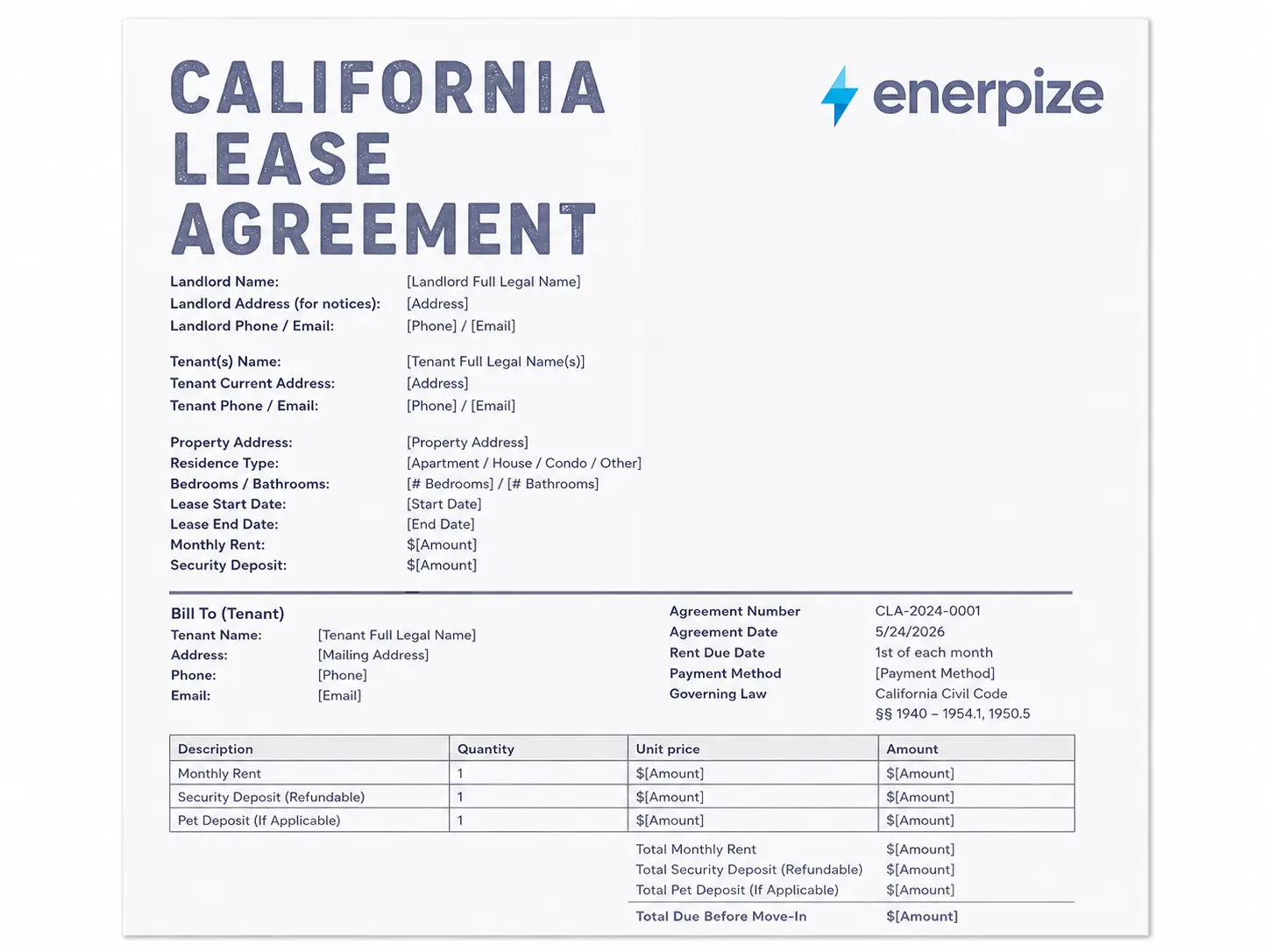
- Covers the landlord and tenant details, the property, the term, the rent, and the security deposit in one document
- Built with the disclosures California actually requires on every lease, including Megan's Law and the bed bug notice
- Structured so the security deposit cap, the entry notice, and the late charge language reflect current law instead of an outdated form
A California lease agreement is a legally binding contract that sets the rent, the term, and the disclosures a landlord must give a tenant renting a home in the state.


What Is a California Lease Agreement
Ask a landlord in Sacramento and a landlord in San Diego what belongs in a lease, and you will get two different answers shaped by two different rent boards. Ask California law the same question, and the answer holds steady no matter which city you are in. A lease is the one document that says who agreed to what, and when, before anyone had a reason to disagree.
This document is the California residential lease agreement landlords and tenants use for a house, apartment, condo, or duplex. It sets the term, the rent, the security deposit, and the responsibilities each side carries once the keys change hands. It draws from California Civil Code Sections 1940 through 1954.1 and Section 1950.5, the same sections that cover everything from habitability to how a deposit gets returned.
A lease for more than one year has to be in writing to be enforceable, under California's Statute of Frauds. Anything a year or shorter can technically be a spoken agreement. Try proving what you agreed to a year ago without anything on paper, though, and you start to see why almost nobody actually does it that way. A written lease agreement California courts and tenants alike can point back to protects everyone the way a smoke detector does. You barely think about it until the one day you really need it to have been there. The California DRE keeps its own plain language guide to leases if you want a second source beyond this page.
Some people call this document a rental agreement California landlords and tenants use interchangeably with lease, and California law does not draw a hard line between the two terms. What matters is what the document says, not what you call it. Renting a house or an apartment falls under our residential lease agreement template, while leasing out office or retail space calls for a commercial lease agreement instead, since California treats the two very differently once a dispute lands in court. Licensed California REALTORS also work from their own California Association of Realtors Residential Lease Agreement form, known as the RLMM, for their own transactions.
Want to track this lease once it is signed, the rent, the renewal date, and the security deposit deadline, without another spreadsheet? Start free with Enerpize
What the Enerpize California Lease Agreement Template Includes
A template is only as good as the law it was built against. Ours was built against the law as it stands right now, not as it stood a few years ago.
Built Around the 2024 Security Deposit Change
This document reflects Assembly Bill 12, effective July 1, 2024, which folded every kind of deposit, pet deposit, key fee, cleaning fee, all of it, into one capped number. One month's rent for most landlords, two months for a small landlord who owns two or fewer rental properties totaling four or fewer units. That cap applies the same way whether the unit is furnished or not, which is a real change from the old rule that let landlords charge more for a furnished place. A lease still running on the pre-2024 furnished and unfurnished split is quoting a number that is no longer the law.
Covers the July 2025 Photo Requirement
For any tenancy that starts on or after July 1, 2025, California law requires the landlord to photograph the unit's condition at or before move in. This template includes that requirement as a standard step, not an afterthought bolted on later.
Gets the Late Charge Right
California has no statutory late fee. This template does not pretend otherwise. It frames the late charge the way the law actually treats it, as a reasonable estimate of the landlord's real costs from a late payment, not a flat percentage pulled from a template built for a different state.
Every clause ties back to the section of the Civil Code it comes from, so you are never guessing where a rule came from or whether it still holds. If you need something broader than a state specific document, the lease agreement template covers the same core clauses without the California citations attached.
California Landlord Tenant Law You Need to Know
Every California lease agreement lives inside Civil Code Sections 1940 through 1954.1, whether the parties realize it or not. The sections below cover what actually comes up: deposits, disclosures, entry, charges, and how the whole thing ends. None of this replaces reading your own California lease agreement line by line, but it tells you what the law requires regardless of what the document in front of you says.
Security Deposits in California
Here is the number that changed and still trips people up. As of July 1, 2024, the total security deposit, however it is labeled, cannot exceed one month's rent. A small landlord, someone who owns no more than two rental properties totaling no more than four units, can charge up to two months' rent. That is it. No separate pet deposit stacked on top. No extra charge for a waterbed. Every fee that used to live outside the deposit now lives inside the cap.
Once the tenant moves out, Civil Code Section 1950.5 gives the landlord 21 days to return the deposit, minus lawful deductions, along with a written itemized statement of anything withheld. Normal wear and tear does not count as damage, and a landlord who withholds in bad faith can be on the hook for up to twice the amount wrongfully kept.
Two more changes worth knowing. A landlord cannot charge a tenant a fee just for paying the deposit by check, as of January 1, 2025. And if a landlord charges a servicemember a higher deposit because of credit history or credit score, the landlord has to hand over a written explanation of why, and the amount, before the lease is signed. UC Berkeley Student Legal Services keeps a plain language tip sheet on what to check before you sign, deposit rules included, if you want a tenant focused source alongside this page.
Required Disclosures in California
California asks more of a lease than most states. Two disclosures belong in every single lease, not just the ones that meet some age or history trigger. The Megan's Law notice has to appear in every residential lease, pointing tenants to the Department of Justice website where registered sex offender information is public. The bed bug disclosure also has to appear in every lease, covering identification, prevention, and the tenant's duty to report a suspected infestation in writing.
Beyond those two, several more disclosures kick in depending on the property. Lead based paint for anything built before 1978. Asbestos for anything built before 1979. A mold disclosure if the landlord knows of a mold condition, paired with the state's informational booklet on dampness and mold. A flood hazard disclosure if the landlord knows the property sits in a flood zone. A death on the premises disclosure if someone died there in the last three years, excluding deaths from HIV or AIDS. Add in demolition permits, methamphetamine contamination, periodic pest control, and military ordnance locations, and the list of things a California landlord actually has to hand over before signing gets long fast.
Landlord Entry in California
Unlike a state that leaves entry notice entirely up to the lease, California actually writes a number into the statute. Twenty four hours' written notice is presumed reasonable for entry to make repairs, show the unit, or handle other lawful business, and that entry should happen during normal business hours unless the tenant agrees otherwise. No notice is required for a genuine emergency.
That presumption is not automatic proof of reasonableness in every situation, but it is the number both sides can rely on when nothing unusual is going on. Put it in the lease anyway. A number in writing settles more arguments than a number everyone just assumes. The California Apartment Association publishes its own member lease forms built around these same entry and disclosure rules, if you want to see how a large industry group handles the same requirements.
Late Charges and Rent Increases
This is where California breaks from a lot of other states. There is no statutory late fee amount and no mandatory grace period written into the Civil Code. A late charge only holds up if it is a reasonable, good faith estimate of the actual cost the landlord would incur from the late payment, written into the lease, and not structured as a penalty. Charge a flat number with no basis in real cost, and a tenant can challenge it as unenforceable.
Rent increases work differently once a tenancy is underway. Most covered properties fall under the Tenant Protection Act, which caps annual increases at 5 percent plus the change in the regional Consumer Price Index, or 10 percent, whichever is lower, with no more than two increases in any 12 month period. Some properties are exempt, including housing built in the last 15 years and certain single family homes. Local rent control ordinances can add further limits on top of the statewide cap. Once rent starts coming in on schedule, a rent receipt template documents each payment. California law does not require receipts, but they save arguments later if a dispute over payment history comes up.
Ending a Lease in California
A month to month tenancy ends differently depending on who is ending it and how long the tenant has been there. The tenant needs to give 30 days written notice, full stop. The landlord's notice period depends on tenure: 30 days if the tenant has been there less than a year, 60 days if a year or more. If the property falls under the Tenant Protection Act or a local just cause ordinance, the landlord also has to state a qualifying reason once the tenant has occupied the unit for 12 months, or 24 months if an adult occupant was added partway through.
A California month to month lease agreement that tries to skip these notice periods does not hold up just because the lease says otherwise. The statute controls, not the paperwork. LA County's Department of Consumer and Business Affairs breaks down these termination timelines in plain language if you want another source to compare against.
Once the lease is signed, the unit, the renewal date, and the rent do not have to live in your memory. Start free with Enerpize
How to Fill Out a California Lease
Filling this out in the right order keeps you from circling back later to fix something you rushed the first time.
Name the Landlord and Tenant
Start with full legal names, not nicknames, for the landlord and every adult tenant. Include a mailing address for the landlord and a way to reach whoever manages the property day to day.
Describe the Property and Set the Term
Enter the property address, note whether it is a house, apartment, or condo, and pick the term. A one year lease is common, though plenty of landlords and tenants prefer the flexibility of a month to month arrangement instead.
Set the Rent and the Security Deposit
Enter the monthly rent and the due date. For the deposit, stay inside the current cap: one month's rent, or two months if you qualify as a small landlord. Note how and when the deposit will be returned.
Add the Required Disclosures
This is the step people rush, and California punishes rushing here more than most states do. Include the Megan's Law notice and the bed bug disclosure on every lease, then add lead based paint, mold, flood hazard, asbestos, or any of the other conditional disclosures that apply to your specific property.
State the Entry, Late Charge, and Photo Terms
Write in the 24 hour entry notice standard. Set the late charge as a reasonable estimate tied to actual cost, not a flat number pulled from habit. If the tenancy starts on or after July 1, 2025, note that move in photographs are required.
Sign and Store Copies
Both parties sign, and the landlord has to give the tenant a copy of the signed lease within 15 days. Keep a copy on both sides. It is the document everyone comes back to the first time something goes wrong.
How Enerpize Handles California Rental Properties
A signed lease is the start of the relationship, not the end of the paperwork. Once you have one in hand, the real work is keeping track of it. Which unit, which tenant, when the rent is due, when the lease renews.
Units, Rent, and Renewals in One Place
Enerpize's Property Management module organizes your units by type, tracks each unit's upcoming and past reservations, and applies flexible pricing if you run anything with seasonal demand. Rent invoicing and late charge tracking happen automatically once the lease terms are entered, so nobody is manually checking whether a late charge is even reasonable to apply yet. Renewal dates and maintenance tasks live in the same system instead of three separate spreadsheets.
What This Template Does Not Do
None of that replaces the lease itself. Enerpize does not draft, store, or manage the lease document for you, and this template is not a substitute for that. What it does is take everything that happens after signing, the rent, the renewal, the maintenance ticket, and put it somewhere you can actually find it again. If you manage property outside California too, the Texas residential lease agreement template covers that state's own required disclosures, which look nothing like California's.
See how a signed California lease turns into tracked rent, renewal reminders, and organized units. Start free with Enerpize
Key Takeaways
- California caps the total security deposit, however it is labeled, at one month's rent for most landlords, or two months for a small landlord who owns two or fewer rental properties totaling four or fewer units. That cap took effect July 1, 2024, and applies whether the unit is furnished or not.
- Two disclosures belong in every California lease regardless of the property's age or history: the Megan's Law notice and the bed bug disclosure. Everything else, lead paint, mold, flood hazard, asbestos, only applies if the property meets a specific trigger.
- Landlord entry requires 24 hours' written notice, presumed reasonable for repairs, inspections, or showings, during normal business hours unless the tenant agrees otherwise.
- California sets no statutory late fee. A late charge only holds up if it reflects a reasonable, good faith estimate of the landlord's actual cost from the late payment rather than a flat percentage.
- For any tenancy starting on or after July 1, 2025, the landlord must photograph the unit's condition at or before move in.
- This California lease agreement template downloads free in Word, PDF, and Google Docs, built around current law rather than the pre-2024 deposit rules still showing up in older templates.
Frequently Asked Questions
What is a California lease agreement?
A California residential lease agreement is a legally binding contract that sets the rent, the term, and the disclosures a landlord must give a tenant renting property in the state. It draws mainly from California Civil Code Sections 1940 through 1954.1 and Section 1950.5.
Is there a security deposit cap in California?
Yes. As of July 1, 2024, the total deposit cannot exceed one month's rent for most landlords, or two months' rent for a small landlord who owns two or fewer rental properties totaling four or fewer units. The cap applies whether the unit is furnished or not.
Does California law require notice before a landlord enters?
Yes. Twenty four hours' written notice is presumed reasonable for entry to make repairs, conduct an inspection, or show the unit, and entry should happen during normal business hours unless the tenant agrees otherwise.
What disclosures are required in a California lease?
At minimum, the Megan's Law notice and the bed bug disclosure, both required in every residential lease regardless of the property's age. Depending on the property, add lead based paint, mold, flood hazard, asbestos, death on the premises, or other conditional disclosures.
What Is the Penalty for Breaking a Lease in California
A tenant who breaks a fixed term lease early is generally responsible for the remaining rent until the landlord rents the unit again, though the landlord has a legal duty to make a reasonable effort to find a new tenant rather than let the loss run indefinitely.
What Are Legal Reasons to Break a Lease in California
Legal grounds include an uninhabitable property the landlord will not fix, active military orders, and documented domestic violence, sexual assault, human trafficking, stalking, or elder abuse, each of which lets a tenant end the lease early without the usual penalty.
Is a California month to month lease agreement legal?
Yes. A month to month tenancy is fully enforceable, and the tenant can end it with 30 days written notice. The landlord's notice period is 30 or 60 days depending on how long the tenant has lived there, and a qualifying reason may be required under the Tenant Protection Act.
Is This Template Free to Download?
Yes. This lease agreement California landlords and tenants can both download free in Word, PDF, and Google Docs, with no sign up required.
About the Author
Omar El Bahr is a Senior Digital Growth Specialist at Enerpize, where he leads SEO, content strategy, and organic growth across international markets. He is a Forbes Communications Council contributor and has written for Entrepreneur on business communication and digital strategy.
Disclaimer
This template is for general informational purposes only and is not legal advice. California landlord tenant law changes over time, so confirm current requirements against the California Civil Code or with a licensed California attorney before you sign anything.