

Posted on 22 July 2026
Free Financial Plan Template Download: Excel, Word, PDF & Google Sheets and Docs
- Available in Word, Excel, PDF, Google Docs, and Google Sheets, free to download with no sign-up required
- Covers financial goals, cost forecasts, revenue forecasts, break-even analysis, profit and loss, cash flow, balance sheet, and risk assessment in one structured document
- Built with country-specific sections for the US, Australia, and New Zealand, so the numbers you're tracking actually match the authority you report to
- Includes a full SWOT-style risk assessment most financial plan templates skip entirely
A financial plan template is a structured document that lays out a business's financial goals, forecasts its costs and revenue, and shows whether the numbers actually hold together over time.


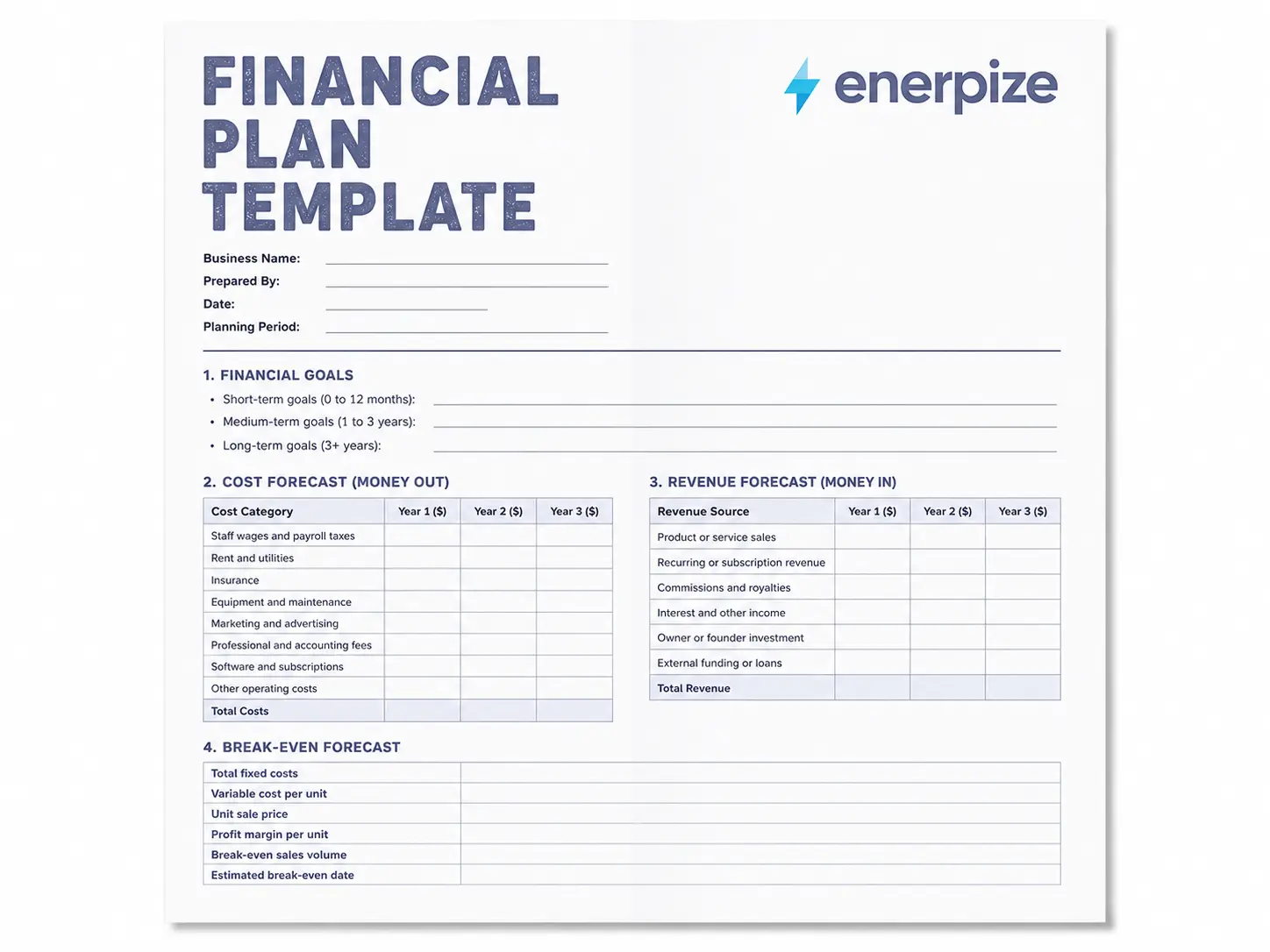
What Is a Financial Plan Template?
Strip away the jargon and a financial plan template does one job. It forces you to write down what you expect to earn, what you expect to spend, and whether the gap between the two keeps the lights on.
Most business owners already have pieces of this in their head. They know roughly what rent costs. They have a feel for slow months versus busy ones. The problem is a feeling isn't a plan. A feeling doesn't survive contact with a lender asking for three years of projections, or a slow quarter that eats through savings faster than anyone expected.
A proper financial plan template pulls every piece of that mental math into one document. Financial goals. Cost forecasts. Revenue forecasts. A break-even calculation that actually tells you the date, not just the concept. Profit and loss projections. Cash flow. A balance sheet. And, if it's built properly, an honest look at the risks sitting around all of it.
Want your financial plan built from real numbers instead of guesses? Start for free.
Financial Plan vs. Business Plan vs. Financial Projection
People use these three terms like they're interchangeable. They're not, and mixing them up is how founders end up handing an investor the wrong document.
A business plan is the whole story. Market, product, team, strategy, and yes, the financial plan sits inside it as one chapter. A financial plan is narrower. It's the numbers chapter, standing on its own: goals, forecasts, costs, revenue, cash flow. A financial projection is narrower still. It's a single forecast, usually revenue or profit over a defined period, built to answer one specific question rather than the whole financial picture.
| Document | What it answers | Standalone or part of something bigger |
|---|---|---|
| Business plan | What is this business and how does it work | Standalone, contains a financial plan inside it |
| Financial plan | Can this business afford to run, and does it hit its goals | Can stand alone or sit inside a business plan |
| Financial projection | What will one specific number look like in the future | Usually one component of a financial plan |
If someone asks you for a financial plan and you send them a single revenue projection, you've sent them a fraction of what they asked for. Know which one you're being asked for before you start filling in numbers.
What to Include in a Financial Plan Template
A template that only covers revenue and costs is half a plan. Here's what a complete one actually needs.
| Section | Why it matters |
|---|---|
| Financial goals | Anchors every forecast that follows to an actual target instead of a vague hope |
| Cost forecast | Every start-up and ongoing cost, broken out by category, across multiple years |
| Revenue forecast | Every income stream, separated so you can see what's actually driving growth |
| Break-even forecast | The point where income finally covers costs, calculated, not guessed |
| Profit and loss forecast | Revenue minus costs, ideally shown as pessimistic, realistic, and optimistic scenarios |
| Cash flow forecast | Timing of money in and out, which is a different problem than profitability |
| Balance sheet forecast | What the business owns against what it owes |
| Risk assessment | An honest look at strengths, weaknesses, opportunities, and threats, each with an action attached |
| Funding considerations | Whether the business needs outside money, how much, and on what terms |
Skip any one of these and the plan has a blind spot. Skip cash flow and a profitable business can still run out of money. Skip risk assessment and the plan reads like a fantasy instead of a forecast.
What the Enerpize Financial Plan Template Includes
Most financial plan templates online stop at cost and revenue tables. Ours doesn't, because a plan that stops there hasn't actually told you anything about whether the business survives its first eighteen months.
A Three Year Forecast, Not a Single Year Snapshot
The Enerpize financial plan template includes a full three year cost and revenue forecast. Most free templates give you twelve months and call it done. Twelve months tells you if you can survive this year. It doesn't tell you if the business actually works.
Three years of forecasting forces you to think past the first stretch of adrenaline and into the part where the novelty wears off and the numbers have to hold up on their own. Year one is usually optimistic by default, everyone's forecast looks decent in year one. Year three is where the truth shows up, when growth assumptions either compound the way you hoped or quietly fall apart.
A Break-Even Section That Actually Calculates the Date
It includes a break-even section that walks through the real calculation, not just the concept. Fixed costs against variable costs. Profit margin per unit. Total fixed costs divided by that margin to find your break-even sales volume. Then a shortcut built specifically for service businesses that bill hourly instead of per unit, because most break-even guides online are written for product businesses and quietly ignore anyone who bills by the hour.
Most templates mention break-even in a single line and move on. This one gives you the actual method, so you walk away with a date, not just a definition.
Profit and Loss, Cash Flow, and Balance Sheet Built to Reconcile
It includes profit and loss, cash flow, and balance sheet forecasts built to sit side by side, so the numbers reconcile with each other instead of living in three separate spreadsheets that never quite agree.
This matters more than it sounds like it should. A business can be profitable on paper and still run out of cash, because profit and loss doesn't care about timing and cash flow cares about nothing else. A balance sheet can look healthy while the cash flow underneath it is quietly falling apart. When all three are structured to reference the same categories and the same time periods, you catch that kind of thing before it becomes a crisis instead of after.
A Risk Assessment Most Templates Skip Entirely
Here's the part most templates skip entirely: a structured risk assessment. Strengths, weaknesses, opportunities, and threats, each with a "what we'll do about it" column next to it.
A financial plan that only shows optimistic numbers isn't a plan. It's a pitch. Ours makes room for the version where things don't go perfectly, because that's the version that actually happens most of the time. Every business has a weakness it doesn't want to write down and a threat it would rather not think about. Writing it down doesn't make it more likely to happen. It just means you've already decided what you'll do when it does, instead of figuring that out in the middle of the emergency.
Country Specific Sections for the US, Australia, and New Zealand
It also carries country specific sections for the United States, Australia, and New Zealand, because a financial plan that ignores which tax authority you report to isn't finished yet, it's just started.
A generic template built for no country in particular ends up useless for every country in particular. The categories you track, the reporting periods you plan around, and what a lender actually wants to see all shift depending on whether you're answering to the IRS, the ATO, or the IRD. Building those differences into the template from the start means you're not stripping out irrelevant sections or bolting on missing ones after the fact.
How to Use the Financial Plan Template
Step 1: Set Your Financial Goals First
Before a single number goes into a cost table, write down what you're actually trying to achieve. Short term, medium term, long term. Every forecast after this point should trace back to one of these goals.
Step 2: Build the Cost Forecast
List every cost the business carries, start-up and ongoing. Wages, rent, insurance, equipment, marketing, professional fees, subscriptions. Spread it across three years. Underestimating here is the single most common way a financial plan falls apart later.
Step 3: Build the Revenue Forecast
List every income stream separately. Product sales, service revenue, recurring subscriptions, commissions, interest, owner investment, external funding. Don't lump it all into one line. You need to see which stream is actually carrying the business.
Step 4: Run the Break-Even Calculation
Separate fixed costs from variable costs. Work out your profit margin per unit. Divide fixed costs by that margin to find your break-even sales volume, then translate that into a date.
Step 5: Build Profit and Loss, Cash Flow, and Balance Sheet Forecasts
These three connect to each other. Profit and loss tells you if the business is making money. Cash flow tells you if that money arrives in time to pay the bills. The balance sheet tells you what's actually left once everything is accounted for.
Step 6: Complete the Risk Assessment
Work through strengths, weaknesses, opportunities, and threats honestly. For each one, write down what the business will actually do about it. This step is the one most people skip, and it's the one that saves a business when a threat actually shows up.
Step 7: Note Your Funding Considerations
Based on everything above, decide whether the business needs outside funding, how much, and what form it should take.
Ready to stop rebuilding this plan by hand every quarter? Start for free.
How Enerpize Connects Your Financial Plan to Your Operations
A financial plan template is a starting point. The problem is what happens after you fill it in. Most businesses build the plan once, save it somewhere, and never update it, because updating it means manually re-entering numbers from six different places. By the time anyone checks the plan against reality, the plan is already out of date.
Enerpize closes that gap by connecting the plan to the actual financial data the business generates every day.
Accounting That Feeds the Plan Directly
Enerpize Accounting Software tracks revenue, expenses, and profit and loss automatically as transactions happen, instead of waiting for someone to update a spreadsheet at month end. Every income entry, every journal transaction, feeds into reports you'd otherwise be rebuilding by hand every time you wanted to check your plan against reality.
Chart of Accounts Built for Real Comparison
The Chart of Accounts automatically categorizes every account into Assets, Liabilities, Expenses, and Revenue, then mirrors every transaction into a general ledger. That's the same structure your balance sheet forecast is built on. When the categories match, comparing forecast to actual isn't a research project, it's a glance.
Expense Tracking Without the Manual Entry
Expenses Management lets you scan receipts, automate approvals, and track budgets in real time, with AI extracting the amount, date, vendor, and tax details straight from the receipt. That's the cost forecast section of your financial plan, except it's updating itself instead of waiting for someone to type it in.
Cost Centers That Show You Where the Money Actually Goes
Cost Centers let you assign income, expenses, and profit to specific departments, products, or employees, then generate reports that show exactly where the plan and the reality are diverging. If your cost forecast said marketing would run twelve thousand a year and cost centers show it's already at nine thousand by month four, that's not a surprise you want to discover at year end.
Asset Management for the Balance Sheet You Actually Have
Asset Management tracks every fixed asset from acquisition to disposal, calculating depreciation automatically using GAAP-aligned Straight-Line, Declining Balance, and Units of Production methods. Your balance sheet forecast has an assets line. This is what keeps that line honest instead of estimated.
Work Orders for Project-Based Financial Planning
If the business runs on projects rather than steady monthly revenue, Work Orders let you set a project budget upfront, then automatically track spend against it as invoices and expenses come in. That's your cost forecast and your revenue forecast, tied to the actual project instead of a generic monthly average.
None of this replaces the thinking a financial plan requires. What it replaces is the manual re-entry that quietly kills most financial plans within six months of being written.
Financial Plan Template for Businesses in the United States
US small businesses building a financial plan generally do it for one of two reasons: raising funding or keeping the business honest against its own goals.
For US businesses, keep a few things in mind. The IRS expects your financial records to support whatever you file, so the categories in your cost and revenue forecast should roughly track the categories you'll use on your tax return. If you're seeking a Small Business Administration loan, lenders will want to see your break-even analysis and cash flow forecast specifically, not just a profit and loss projection. Build those two sections properly rather than treating them as an afterthought.
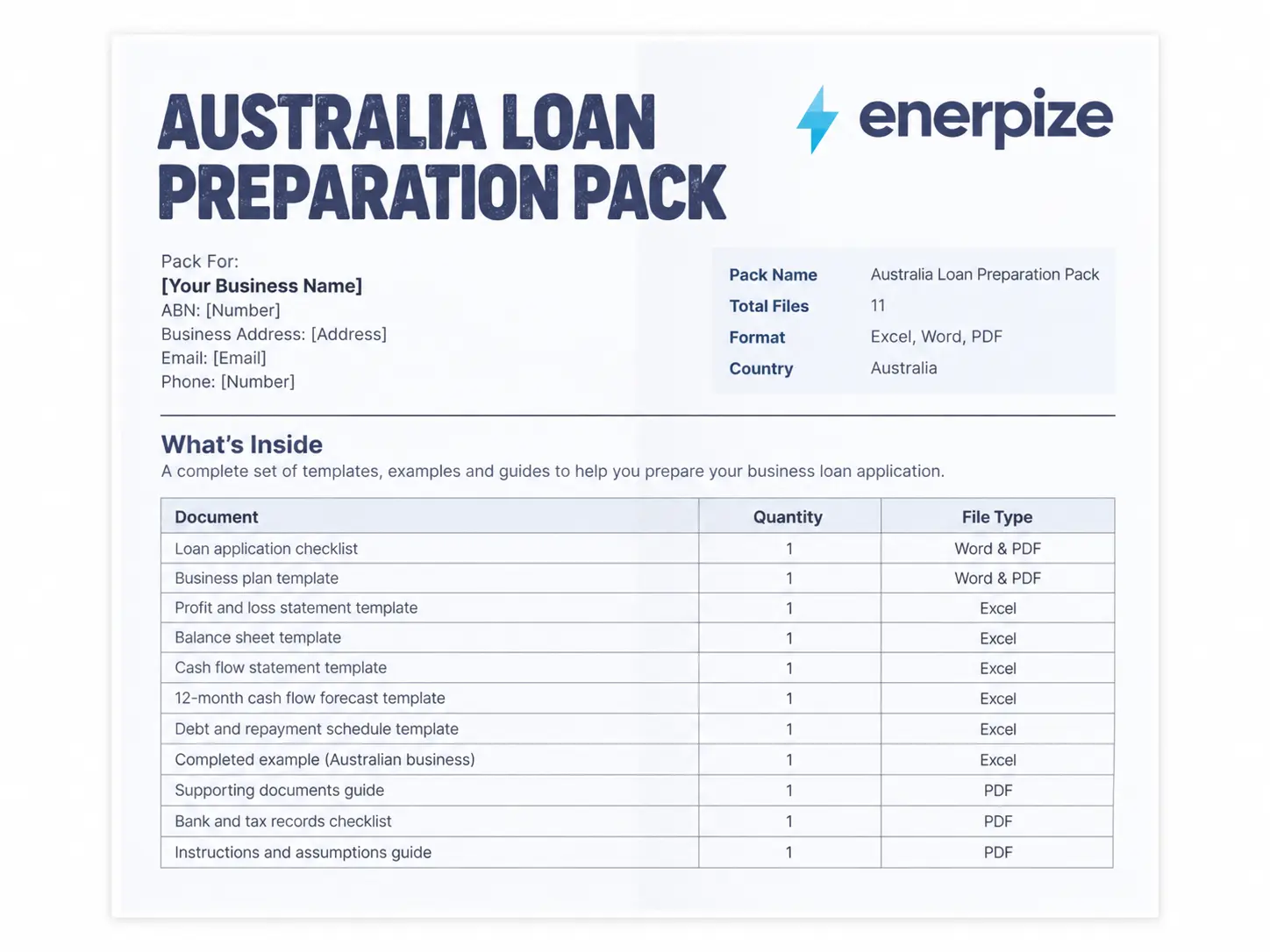
Financial Plan Template for Businesses in Australia
Australian small businesses have a government-run resource specifically for this, and it's worth knowing it exists. The Australian government's business.gov.au site provides a set of financial tools and templates covering start-up costs, balance sheets, profit and loss statements, cash flow statements, and budgeting, all built around the same components covered in this template.
For Australian businesses, the categories in your cost and revenue forecast should align with what you'll eventually report for GST purposes if you're registered, and your profit and loss forecast should be structured in a way that maps cleanly to what the ATO expects come tax time. If you're using the financial plan to support a loan application or attract investment, Australian lenders typically want to see the cash flow forecast broken down by month for at least the first year, not just annual totals.
Financial Plan Template for Businesses in New Zealand
New Zealand publishes one of the more complete government-backed financial plan templates available anywhere, through business.govt.nz. It walks through cost forecasts, revenue forecasts, break-even analysis, profit and loss, cash flow, and balance sheet forecasting in a single document, and specifically recommends attaching a detailed one year forecast to a three to five year summary rather than relying on annual figures alone.
For New Zealand businesses, that three year forecast horizon is worth adopting even if you're not using the government template directly. It's the standard local investors and lenders expect to see. If you're a start-up without trading history yet, base your revenue forecast on market research rather than a single guess, and where possible, show pessimistic, realistic, and optimistic versions so the plan reflects an honest range rather than one number pulled out of thin air.
Financial Planning for Startups vs. Existing Small Businesses
A startup financial plan template and a small business financial plan template are answering different questions, even though they use the same structure.
A startup has no trading history. Every number in the revenue forecast is an estimate built from market research, competitor pricing, and a guess at how fast customers will show up. The break-even date matters enormously here, because it's usually the number investors care about most. When does this business stop burning cash and start generating it.
A small business financial plan template with actual trading history has a different job. The forecasts should be grounded in what actually happened last year, adjusted for what's changing this year. A new hire, a price increase, a new location. The plan isn't proving the business can work, it's proving the owner understands where the business actually stands right now.
Both versions use every section covered above. The difference is what the numbers are built from: research and assumption for a startup, actual performance for an existing business.
Whichever stage you're at, download the template and put real numbers behind it. Start for free.
Key Takeaways
- A financial plan template covers financial goals, cost and revenue forecasts, break-even analysis, profit and loss, cash flow, balance sheet, and risk assessment, not just a single spreadsheet of numbers.
- A financial plan, a business plan, and a financial projection are three different documents. Know which one you're actually being asked for before you start filling anything in.
- The break-even calculation should produce an actual date, not just a concept. Fixed costs divided by profit margin per unit gets you there.
- A risk assessment belongs inside every financial plan. A plan with only optimistic numbers is a pitch, not a plan.
- The United States, Australia, and New Zealand each have their own reporting expectations, and a financial plan built without them in mind is only half finished.
- A financial plan that isn't connected to your actual accounting data goes stale within months. The forecast and the reality need to be checked against each other regularly, not once a year.
FAQs
What should a financial plan template include?
A complete financial plan template covers financial goals, a cost forecast, a revenue forecast, break-even analysis, profit and loss forecast, cash flow forecast, balance sheet forecast, and a risk assessment. Funding considerations round it out if the business expects to need outside capital.
What's the difference between a financial plan and a business plan?
A business plan covers the entire business: market, product, team, and strategy, with the financial plan sitting inside it as one section. A financial plan stands on its own and focuses only on the numbers: goals, forecasts, costs, revenue, and cash flow.
Is a financial plan template free to use?
Yes. The Enerpize financial plan template is free to download in Word, Excel, PDF, Google Docs, and Google Sheets, with no sign-up required.
What is a one page financial plan template?
A one page financial plan template condenses a full financial plan down to its essential numbers: goals, a cost and revenue snapshot, the break-even date, and a cash flow summary. It's meant to be reviewed quickly and often, not to replace the detailed plan behind it.
How do I calculate a break-even date using a financial plan template?
Separate fixed costs from variable costs, calculate the profit margin per unit by subtracting variable cost from sale price, then divide total fixed costs by that margin to find your break-even sales volume. Divide that volume by your production or service capacity to estimate the date.
Do startups and small businesses use the same financial plan template?
They use the same structure, but the numbers come from different places. A startup's forecasts are built from market research and assumptions. An existing small business's forecasts are grounded in actual trading history from the previous year.
Does a financial plan template work for businesses outside the US, Australia, and New Zealand?
Yes, the core structure of the template, goals, cost and revenue forecasts, break-even, profit and loss, cash flow, and balance sheet, applies to any business anywhere. The country specific sections simply flag what US, Australian, and New Zealand businesses should keep in mind for their local reporting requirements.
Should a financial plan include a risk assessment?
Yes. A financial plan without a risk assessment only shows the version where everything goes right. A SWOT-style risk assessment, strengths, weaknesses, opportunities, and threats, each paired with an action, is what turns an optimistic forecast into an honest one.
About the Author
Omar El Bahr is a Senior Digital Growth Specialist at Enerpize, where he leads SEO, content strategy, and organic growth across international markets. He is a Forbes Communications Council contributor and has written for Entrepreneur on business communication and digital strategy.
Disclaimer: This template and article are provided for general informational purposes only and do not constitute financial, tax, or legal advice. Consult a qualified accountant or financial advisor before making decisions based on your financial plan.