

Posted on 9 July 2026
Free Legal Invoice Template Download: Excel, Word, PDF & Google Sheets and Docs
- Available in Word, Excel, PDF, Google Docs, and Google Sheets, free to download with no signup required
- Covers hourly billing, flat fees, retainers, and contingency arrangements in one structured document
- Built with trust and retainer account tracking so law firms can show clients exactly where their money went
- Calculates service subtotal, expense subtotal, and total amount due automatically in Excel and Google Sheets
A legal invoice template is a pre-formatted billing document that law firms and solo practitioners use to bill clients for legal services, itemizing billable hours, flat fees, retainer draws, or contingency amounts alongside case expenses.


What Is a Legal Invoice Template?
Picture this. A client hires you for a contract dispute. Three months pass. You've drafted motions, sat through two depositions, negotiated with opposing counsel twice, and fielded a dozen phone calls at odd hours. Then it's time to send the bill.
If that bill lands as a vague lump sum with no breakdown, you've just handed your client a reason to question your fees instead of a reason to pay them on time. A legal invoice template exists to prevent exactly that scene.
At its core, a legal invoice template is the document a law firm sends a client to request payment for legal work performed. It's not the engagement letter that sets the terms. It's not the retainer agreement that establishes the fee structure. It's the itemized bill that says, plainly, here is what we did, here is how long it took or what it cost, and here is what you owe.
Every law firm eventually needs one of these, whether you're a solo practitioner handling wills and contracts or a firm running twelve active matters at once. The format has to flex across four very different billing models: hourly work billed by the tenth of an hour, flat fees for a defined scope, retainers drawn down over time, and contingency fees tied to a settlement outcome. A generic invoice template built for a plumber or a freelance designer doesn't hold up under that weight. Legal billing carries its own vocabulary. Matter numbers. Trust accounts. Bar numbers. Billable increments. A legal invoice template has to speak that language natively, not bolt it on as an afterthought.
Want your legal invoices generated automatically from time entries and trust balances instead of built by hand every billing cycle? Start free with Enerpize
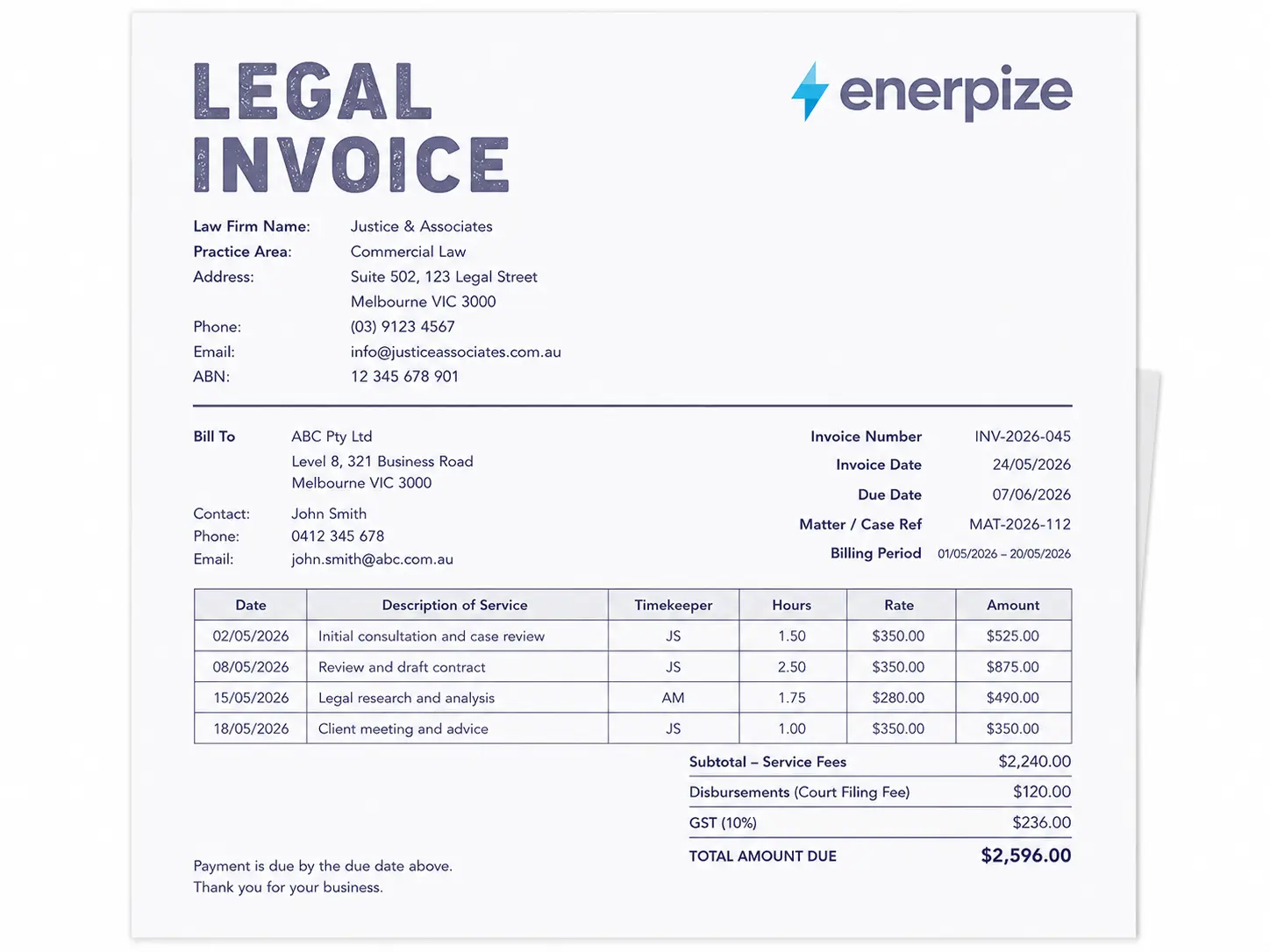
What to Include in a Legal Invoice Template
Most free templates floating around online give you a name field, a date, one description line, and a total. That's enough to bill a single flat-fee matter. It falls apart the moment you're tracking multiple timekeepers, itemizing court costs, or drawing down a client's trust balance.
Here's every field a complete legal invoice template needs, and why it matters.
| Field | Why It Matters |
|---|---|
| Invoice Number | Sequential reference for tracking, disputes, and accounting reconciliation |
| Issue Date | When the invoice was generated |
| Payment Due Date | Separate from issue date, sets a clear deadline |
| Billing Period | The date range the invoice covers, not just a single date |
| Matter / Case Name and Number | Ties the invoice to a specific engagement, especially critical for firms running several matters per client |
| Responsible Attorney | Who owns the matter, useful for larger firms with multiple lawyers on one file |
| Billing Arrangement | Hourly, flat fee, retainer, or contingency, stated up front |
| Bar / License Number | Establishes the invoice came from a licensed practitioner |
| Line-Item Date | The specific date each service was performed |
| Timekeeper | Which lawyer or paralegal performed the work, relevant when rates differ by seniority |
| Hours and Rate | The two numbers that multiply into every fee on an hourly invoice |
| Itemized Expenses | Court filing fees, deposition transcripts, travel, copying, expert witness fees, listed separately from service fees |
| Trust or Retainer Balance | Opening balance, amount drawn this period, and remaining balance |
| Payment Terms | Due date, accepted methods, and late fee terms if applicable |
The two fields that separate an amateur legal invoice from a professional one are the expense breakdown and the trust account summary. Lump legal fees and court costs into one number and you've made it impossible for a client to see what they're actually paying for. Leave the trust balance off entirely and a retainer client has no way to know when they need to replenish it before running out mid-case.
Types of Legal Invoice Templates
Not every law firm bills the same way, and a template that only handles one billing model will fail you the moment a client wants a different arrangement. Here's how the four main types work.
Hourly / Billable Hours Invoice
This is the standard for most litigation and general practice work. Every task gets logged against a specific date, timekeeper, and duration, usually tracked in tenth-of-an-hour increments (six minutes each). The invoice multiplies hours by rate for each line item, then totals it. A firm with multiple lawyers on one matter needs the timekeeper column so the client can see who did what and at what rate, since a senior partner's hour and a junior associate's hour rarely cost the same.
Flat Fee Invoice
Used when the scope of work is defined upfront. Drafting a will, handling an uncontested divorce, reviewing a standard contract. The invoice states the agreed amount for the service with a description of what was completed. No hours, no rate breakdown, just the fixed price the client agreed to before work began.
Retainer Invoice
The client pays an upfront amount that the firm draws against as work is performed. The invoice for a retainer arrangement needs an account summary showing the opening balance, what was drawn this period, and what's left. If the balance drops below an agreed minimum, an evergreen retainer clause triggers a replenishment request right on the invoice itself, so the client sees it coming instead of getting surprised by a request for more funds.
Contingency Fee Invoice
Common in personal injury and some employment cases. The firm only gets paid if the case succeeds, taking an agreed percentage of the settlement or award. The invoice documents the amount recovered, the percentage owed to the firm, and any expenses the firm is reimbursed for separately from the contingency fee itself.
What Enerpize's Legal Invoice Template Includes
We didn't start this template from a blank page. We pulled apart the generic legal invoice templates already circulating online, the ones with a single quantity and unit price field borrowed straight from a product invoice, and found the same gaps over and over.
Here's what most of them are missing, and what we built in instead.
Hours and Rate, Not Generic Quantity
Most free legal invoice templates use a leftover product-invoice structure: quantity times unit price. That works for selling office chairs. It doesn't work for billing legal time. Our template replaces that with a proper hours-and-rate structure on every line, with the amount calculating automatically, similar to how our AIA G702/G703 template handles progress billing against a schedule of values rather than a flat quantity field.
A Separate Expenses Table
Court filing fees and deposition costs are not the same category as attorney time, and mixing them into one line item destroys the client's ability to audit the bill. We built a standalone itemized expenses section with its own subtotal, sitting apart from the service fees subtotal.
A Real Trust and Retainer Account Summary
This is the single most commonly missing feature across the templates we reviewed. Ours shows opening balance, amount applied to the current invoice, closing balance, and a replenishment trigger date, right on the invoice, not buried in a separate spreadsheet nobody checks until the balance hits zero.
Matter-Level Detail, Not Just a Case Number
A bare case number tells the client nothing. Our template adds matter name, responsible attorney, and billing arrangement type, so a firm running several files for the same client can invoice each one without ambiguity.
Billing Period as Its Own Field
Not just an issue date. A clear start and end date for the work covered, matching how retainer and monthly-billing clients actually expect to see their invoices structured.
Available in Word, Excel, PDF, Google Sheets, and Google Docs. No frozen panes to fight with in Excel, and every calculation on the spreadsheet version runs as a live formula so changing an hour or a rate updates the total instantly.
See the difference a properly structured legal invoice template makes. Start free with Enerpize
Legal Invoice vs. Retainer Statement vs. Trust Statement
These three documents get confused constantly, even inside law firms. Here's the difference.
| Document | Purpose | Shows Trust Balance? | Requests Payment? |
|---|---|---|---|
| Legal Invoice | Bills the client for services rendered and expenses incurred | Sometimes, if retainer-funded | Yes |
| Retainer Statement | Confirms the retainer amount received and the terms it will be drawn against | Yes, opening balance | No, it's a receipt of funds held |
| Trust Statement | Periodic accounting of all trust account activity for a client, required under most bar rules | Yes, full ledger detail | No, it's a compliance record |
A legal invoice can include trust balance information as a summary, but it isn't a substitute for the detailed trust ledger a bar association may require a firm to produce. Keep the two separate in your recordkeeping even when they appear side by side on the same invoice.
How to Use the Enerpize Legal Invoice Template
Step 1: Fill in Firm and Matter Details
Enter your firm name, address, contact information, and bar or license number. Assign a sequential invoice number and set the issue date, payment due date, and billing period. Add the matter name, matter number, and responsible attorney.
Step 2: Enter Client Information
Add the client's name, address, and contact details. If billing a business client, include the appropriate contact person so the invoice reaches the right desk instead of sitting in a general inbox.
Step 3: Log Services Rendered
For each entry, record the date, a clear description of the task, the timekeeper's initials, hours worked, and the rate. Let the amount calculate automatically. Vague descriptions like "phone call" invite disputes. "Telephone conference with opposing counsel to schedule deposition" doesn't.
Step 4: Itemize Expenses Separately
List court filing fees, deposition costs, travel, and any other disbursements in the dedicated expenses table, each with its own date and description. Keep this subtotal separate from the service fees subtotal.
Step 5: Apply Trust or Retainer Funds
If the client has an active retainer, show the opening balance, the amount applied to this invoice, and the closing balance. Flag if replenishment is needed before the balance runs out.
Step 6: Calculate the Total
Add the service subtotal and expense subtotal, apply any discount, calculate tax where applicable, subtract any retainer funds applied, and arrive at the total amount due.
Step 7: Set Payment Terms and Send
State the due date, accepted payment methods, and any late fee policy. Send the invoice promptly after the billing period closes rather than letting it sit, since delayed invoicing is one of the most common causes of delayed payment.
Tired of rebuilding this from scratch every billing cycle? Enerpize generates legal invoices straight from logged time entries and trust balances. Start free with Enerpize
How Enerpize Connects Legal Billing to Your Entire Practice
A standalone invoice template answers one question: what does the client owe right now. It doesn't tell you whether the retainer is running low, which lawyer is actually assigned to the file, whether the case has closed, or what the firm's overall profitability looks like once the fees come in. That's where Enerpize's law firm management tools pick up where the template leaves off.
Manage Your Firm's Finances
Enerpize automates your firm's bookkeeping and accounting behind the invoice. You invoice clients for legal advice and services, track payments as they come in, and pull profit and loss reports to see what the firm actually nets once expenses are accounted for. Every invoice generated ties back into the books automatically instead of sitting in a folder disconnected from your actual financial picture.
Maintain Client and Case Records
Every client's information, history of legal advice, and payment record lives in one place. You can run periodic follow-ups by phone or email, set appointments and interview dates for case discussions, and pull up a client's full history before a call instead of digging through old emails. When it's time to invoice, the details are already there. Nothing gets rebuilt from scratch.
Assign Lawyers and Consultants to Clients
Staff roles and authorizations get set based on job responsibilities, and clients get linked to a specific lawyer with defined tasks. You can view individual staff activity records and filter performance reports by employee. This is what makes matter-level and timekeeper-level invoice itemization actually workable at scale, instead of someone manually cross-referencing who worked on what.
Manage Case Files and Track Finances
Every new case gets its own file with a budget and a running record of expenses. Add revenues, expenses, and every client invoice tied to that file, and determine the firm's profitability the moment a case closes. This is the mechanism behind the expense pass-through and total-due logic sitting on the invoice itself.
Run an All-in-One Financial Accounting System
Financial operations post as auto-journals behind the scenes, and a complete chart of accounts shows every balance and transaction across the firm. Advanced reporting gives you a real picture of the firm's financial position. For retainer and trust invoicing specifically, this means a retainer draw posts to the correct ledger account automatically instead of relying on a manual trust reconciliation spreadsheet that someone forgets to update.
Every stage of a legal engagement generates a document. The engagement letter. The time entry. The invoice. The trust ledger. The payment record. In Enerpize, those documents are linked, so pulling up any single invoice shows the full matter history sitting behind it, not just a number on a page.
Legal Invoice Template for Law Firms in the United States
Legal billing in the US runs almost entirely on state bar rules, and those rules exist for a reason. Fee disputes are one of the most common sources of complaints filed against attorneys, and a poorly itemized invoice is often exhibit A.
What US Law Firms Need to Know
The American Bar Association's Model Rules of Professional Conduct, Rule 1.5, requires that a lawyer's fee be reasonable and sets out the factors used to judge reasonableness, including the time and labor required, the novelty of the questions involved, and the fee customarily charged for similar work. Most state bars adopt a version of this rule, and a detailed, itemized invoice is your best evidence that a fee was earned fairly if a client ever disputes it.
If your firm holds client funds in a trust account, commonly called an IOLTA account, those funds are subject to strict recordkeeping requirements under state bar rules. An invoice that shows a retainer draw without a corresponding, reconcilable trust ledger entry is a compliance risk, not just a billing inconvenience. If you also handle time-based work for contractors or consultants across your practice, the same hours-and-rate discipline applies there too, which is exactly what our contractor invoice template is built around.
Sequential invoice numbering matters here too. It's not a regulatory requirement in most states, but it mirrors the kind of clean audit trail that makes responding to a fee dispute, or an IRS inquiry into the firm's income, considerably less painful.
Legal Invoice Template for Law Firms in the United Kingdom
UK solicitors operate under one of the more detailed regulatory frameworks for client money in the world, and it shapes how a legal invoice needs to look.
SRA Accounts Rules and VAT
The Solicitors Regulation Authority's Accounts Rules govern how client money is held and accounted for. A solicitor drawing fees from money held on a client's behalf must give the client a bill or other written notification of costs before transferring any client money from a client account to make that payment. That makes the invoice itself part of the compliance chain, not just a billing courtesy.
Most UK solicitors' invoices also need to address VAT. If your firm is VAT-registered, invoices to clients must show VAT separately and clearly, since VAT invoices carry specific formatting requirements under HMRC rules distinct from a simple bill.
Client account interest is another wrinkle. Under the SRA Accounts Rules, firms need clear policies on how interest earned on client money is handled, and that policy should be referenced or reflected in client communications, invoices included, when relevant.
Legal Invoice Template for Law Firms in Canada
Canadian legal billing is regulated provincially, through each province's law society, rather than at the federal level, which means the specific rules a firm follows depend on where it practices.
Trust Accounting and Provincial Law Society Rules
Every Canadian law society, from the Law Society of Ontario to the Law Society of British Columbia, imposes trust accounting rules that require detailed records of money held in trust for clients, along with a monthly three-way reconciliation comparing bank balances, client ledgers, and internal records. An invoice that draws against a client's trust balance needs to tie cleanly to those trust records, since law societies conduct spot audits and trust shortfalls are treated as serious professional conduct matters, not simple bookkeeping errors.
Since trust accounting rules vary by province, a firm operating across more than one jurisdiction needs to check the specific reconciliation and disclosure rules where it practices rather than assuming they're identical. Firms billing on retainer often run into the same replenishment tracking need as consulting practices, which is part of why our consulting invoice template uses the same account-balance structure we built into this one.
GST or HST also applies to most legal services in Canada, and the applicable rate depends on the province where the service is supplied, so a legal invoice template used across multiple provinces needs a flexible tax field rather than a single hardcoded rate.
Legal Invoice Template for Law Firms in Australia
Australian legal billing sits under one of the more prescriptive costs disclosure regimes in the common law world, and it starts well before the first invoice ever goes out.
Legal Profession Uniform Law Costs Disclosure
Under the Legal Profession Uniform Law, which applies in New South Wales, Victoria, and other participating states, law firms must give clients written costs disclosure as soon as practicable after instructions are received, covering how fees will be calculated, an estimate of total legal costs, and the client's right to dispute those costs. Invoices issued afterward need to be consistent with that original disclosure, since a bill that departs materially from what was disclosed upfront can itself void the costs agreement.
Legal costs in Australia are also subject to GST at the standard rate, and firms need to clearly show GST on invoices in line with Australian Taxation Office requirements for tax invoices. For firms operating in states not covered by the Uniform Law, equivalent state-based legal profession legislation applies, so it's worth confirming the specific costs disclosure and billing rules in your state before finalizing an invoice template. If your firm's proof-of-payment process needs tightening once an invoice is settled, our receipt template closes that loop cleanly.
Key Takeaways
- A legal invoice template needs an hours-and-rate structure, not a generic quantity-and-price field borrowed from a product invoice.
- The most commonly missing fields across free templates are a separate expenses table and a trust or retainer account summary.
- Four billing models exist: hourly, flat fee, retainer, and contingency, and a usable template needs to handle all four.
- In the US, ABA Model Rule 1.5 ties fee reasonableness directly to how clearly a fee is itemized and documented.
- In the UK, the SRA Accounts Rules require a bill before client funds can be transferred out of a client account, making the invoice part of the compliance chain itself.
- In Canada and Australia, trust accounting and costs disclosure rules mean an invoice has to align with records and disclosures made well before the bill is ever sent.
Frequently Asked Questions
What is a legal invoice template?
A legal invoice template is a pre-formatted billing document that law firms and solo practitioners use to bill clients for legal services. It itemizes billable hours, flat fees, retainer draws, or contingency amounts, along with case-related expenses, so both the firm and the client have a clear record of the work performed and the amount owed.
What is the difference between an attorney invoice template and a lawyer invoice template?
Functionally, none. Attorney invoice template, lawyer invoice template, and legal invoice template all describe the same type of document. The terminology varies by region and by habit. US firms tend to say attorney invoice or law firm invoice template more often, while lawyer invoice template shows up more frequently in searches from the UK, Canada, and Australia.
What should a lawyer invoice template include for hourly billing?
An hourly lawyer invoice template needs a date, timekeeper, hours, and rate for every entry, with the amount calculated automatically. It should also separate service fees from itemized expenses and show a subtotal for each before arriving at the total due.
Do law firms need to itemize expenses separately from fees on an attorney invoice template?
Yes. Mixing court filing fees, travel, and other disbursements into the same line as attorney time makes it difficult for a client to see what they're actually being billed for, and it complicates a firm's own expense tracking. A properly built attorney invoice template keeps these as two distinct subtotals.
How does a retainer invoice work on a legal invoice template?
A retainer invoice shows the client's opening retainer balance, the amount drawn against it during the current billing period, and the remaining balance. If the balance drops below an agreed minimum under an evergreen retainer arrangement, the invoice should flag that replenishment is needed.
Can I use a legal invoice template for a contingency fee case?
Yes, though the structure differs from an hourly invoice. A contingency fee invoice documents the amount recovered, the agreed percentage owed to the firm, and any expenses reimbursed separately from that percentage, rather than showing hours and rates.
Is a legal invoice template the same as a trust statement?
No. A legal invoice bills the client and requests payment, and it may summarize trust activity relevant to that invoice. A trust statement is a more detailed, periodic accounting of all trust account activity for a client, and most bar and law society rules require it as a separate compliance record, not just a line on an invoice.
What tax fields does a lawyer invoice template need for international use?
It depends on the country. US invoices typically show state and local sales tax where applicable. UK invoices need VAT shown separately for VAT-registered firms. Canadian invoices need GST or HST depending on the province. Australian invoices need GST at the standard rate. A template built for international use needs a flexible tax field rather than one hardcoded rate.
About the Author
Omar El Bahr is Senior Digital Growth Specialist at Enerpize, a cloud ERP platform serving 40,000+ SMBs across Australia, Kenya, and global markets. He covers organic growth strategy, professional services billing systems, and SMB finance workflows. Forbes Communications Council contributor.
Disclaimer: This article is for general informational purposes only and does not constitute legal or tax advice. Billing rules vary by state, province, and country, and by individual bar or law society. Consult a licensed professional or your local regulatory body before finalizing your firm's billing practices.