

Posted on 6 August 2026
Letter of Intent Template: Free Word, PDF and Google Docs Download
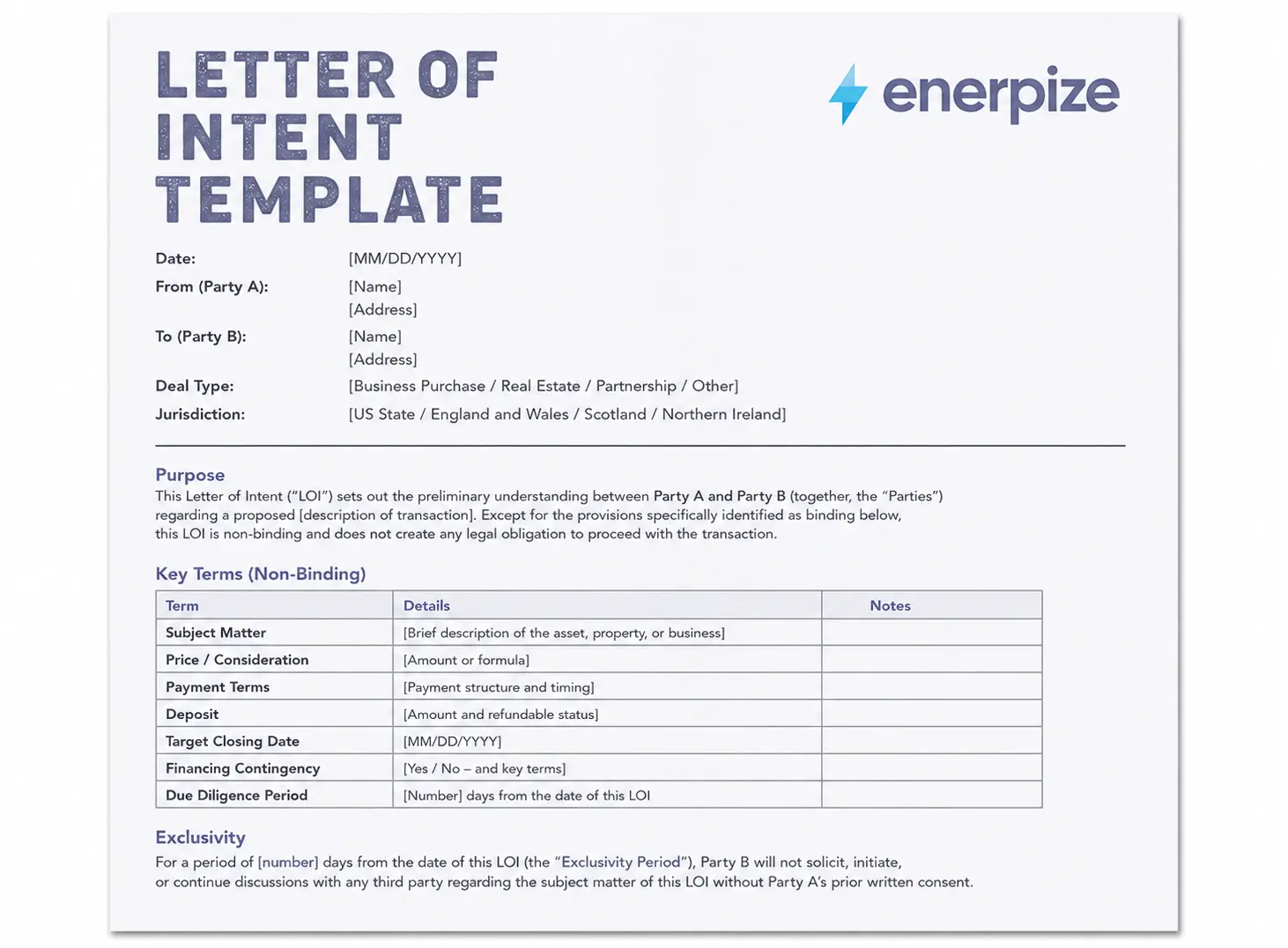
- Available in Word, PDF, and Google Docs free to download with no sign up required, built for business purchase, real estate, and partnership transactions
- Includes a binding and non-binding clause table instead of a single toggle, so confidentiality, exclusivity, and governing law are clearly separated from the commercial terms
- Covers both the United States and United Kingdom, with jurisdiction specific fields for governing law
- Structured with fillable fields for exclusivity period, due diligence access, deposit terms, and an expiration date in one document
A letter of intent template is a pre-formatted document that outlines the preliminary terms of a proposed business deal, real estate purchase, or partnership before a formal, binding contract is drafted and signed.


What Is a Letter of Intent?
A letter of intent, usually shortened to LOI, is the document that sits between a handshake and a contract. It puts the broad strokes of a deal in writing, price, structure, timeline, without locking either side into the full legal weight of a signed agreement. Once you have seen one letter of intent example, the pattern is easy to recognize in the next one, since the shape of the document barely changes even though the numbers inside it do.
Most business owners run into a letter of intent template at one of three moments. Buying or selling a business. Negotiating a commercial lease or property purchase. Forming a partnership or joint venture with another company. In every one of those cases, the LOI does the same job. It confirms that both sides are serious, sets out what they currently agree on, and creates a framework for the real negotiation that follows.
Here is the part that trips people up. An LOI is not a contract, and most of it is not meant to be enforced the way a contract is. But parts of it usually are. Confidentiality clauses, exclusivity periods, and who pays which costs during negotiation are commonly binding even while the price and deal structure stay open. That split, binding in parts and non-binding in others, is the single most misunderstood thing about this document, and it is where a badly written letter of intent template causes real problems later.
A quick note on terminology before moving on. Some people search for a letter of interest instead of a letter of intent, and in the business transaction context the two terms are generally used interchangeably. This article and the linked LOI template use letter of intent throughout, since that is the more common phrasing for business, real estate, and partnership deals.
Want the deal terms from your letter of intent to carry straight into a tracked proposal instead of a second document? Start free with Enerpize
What the Enerpize Letter of Intent Template Includes
Most letter of intent templates online give you one paragraph that says something like "this letter is non-binding" and leave it at that. That single sentence is doing a lot of legal work for one line of text, and it is not enough.
We built ours around a binding and non-binding clause table instead.
A Clause Table, Not a Blanket Statement
Rather than one blanket statement, the Enerpize letter of intent template lists each clause separately, commercial terms, confidentiality, exclusivity, due diligence access, costs, governing law, and marks whether it is binding or non-binding, with a plain English note next to each one. That is a meaningfully different approach from a single toggle buried in a paragraph. It matches how lawyers on both sides of a deal actually think about a letter of intent, not as one document that is either binding or not, but as a set of clauses that each carry their own weight.
Fillable Fields for Exclusivity and Due Diligence
The template also covers exclusivity as its own fillable field with a defined period, not a sentence dropped into the middle of a paragraph. Due diligence gets the same treatment. Deposit terms are separated from the purchase price so a refundable deposit is not confused with the final consideration.
Built for US and UK Governing Law
Because we built this for both the United States and the United Kingdom, the governing law field is written to work with a US state or an England and Wales, Scotland, or Northern Ireland jurisdiction without needing a second version of the document.
That is the differentiator. Not a longer letter of intent template, a more precisely structured one, where the parts that matter legally are separated from the parts that are still open for negotiation.
What to Include in a Letter of Intent
A letter of intent sample you find online usually gives you the shape of the document without the specific fields that make it usable for a real deal. Here is what a complete one needs.
| Field | Why It Matters |
|---|---|
| Parties | Full legal names and addresses of both sides |
| Purpose | What kind of transaction is being proposed |
| Key Terms | Price, structure, or consideration, specific to the deal type |
| Conditions | Due diligence, financing, or approvals the deal depends on |
| Exclusivity | A defined period preventing the other side from negotiating elsewhere |
| Confidentiality | Protection for information exchanged during negotiation |
| Binding Status | Which clauses are binding and which are not, itemized, not blanket |
| Governing Law | The jurisdiction whose law applies if a dispute arises |
| Expiration | A date after which the letter of intent lapses |
| Signatures | Both parties confirming their intent |
The field most letter of intent samples skip is the itemized binding status. Most give you one sentence near the bottom that says the letter is non-binding, full stop. That is not accurate for most real transactions, and it can leave a party without protection on the parts that actually needed it, like confidentiality or exclusivity.
A short letter of intent example helps make this concrete. Picture a two page LOI for a small business acquisition. The first page covers price, structure, and timeline, all clearly marked non-binding. The second page covers confidentiality, a sixty day exclusivity period, and governing law, all marked binding. That split across two pages of the same document is exactly what an itemized approach looks like in practice, and it is the piece a plain paragraph statement cannot capture.
How to Write a Letter of Intent
Writing a letter of intent is not complicated once you know what order to put things in, and knowing how to write a letter of intent well mostly comes down to sequence, not legal skill. Here is the order that works for a business purchase, a real estate deal, or a partnership.
State the Parties and the Purpose
Name both sides in full, with their legal addresses, and state plainly what the letter proposes. A vague opening line is where a lot of letters of intent go wrong, since it leaves room for one side to argue later that the scope was never actually agreed.
Describe the Transaction
Lay out what is being bought, leased, or formed. For a business purchase, that means the target company and what is included, assets, stock, or both. For real estate, the property address and the type of interest being acquired. For a partnership, the structure and each party's proposed contribution.
List the Key Commercial Terms
Price, payment structure, deposit, and timeline all go here. Keep this section clearly labeled as proposed and non-binding, since these are the terms most likely to shift once due diligence and negotiation actually happen.
Add Conditions
State what the deal depends on. Financing approval, a due diligence period, board or third party consents. Conditions protect both sides from being pushed toward a deal before the facts are confirmed.
Mark Binding and Non-Binding Clauses
This is the step most templates skip, and it is the one that matters most. Confidentiality, exclusivity, costs, and governing law are commonly binding. The commercial terms usually are not. State this itemized, not as one blanket sentence.
Set an Expiration Date
A letter of intent without an expiration date can sit open ended for months, which helps nobody. Give it a clear lapse date unless it is extended in writing or replaced by a formal agreement.
Sign
Both parties sign, confirming their agreement to whichever clauses were marked binding. This does not commit either side to completing the deal, only to the binding clauses themselves.
Draft the letter of intent, then move the confirmed terms straight into a business proposal without retyping them. Start free with Enerpize
Types of Letters of Intent
A letter of intent template is not one document. The fields that matter shift depending on what is actually being negotiated.
Business Purchase
A business purchase letter of intent, sometimes just called a business purchase LOI, covers the target company, whether the deal is a stock purchase or an asset purchase, purchase price and payment structure, a due diligence period, and often a consulting or non-compete arrangement for the outgoing owner. For an asset purchase specifically, our bill of sale template documents the actual transfer once the deal closes, separate from the letter of intent that got the negotiation started. Our business proposal template and business plan template are natural next steps once the terms in the letter of intent firm up into a formal proposal.
Real Estate
A real estate letter of intent names the property, the proposed purchase price or lease terms, financing contingencies, and an inspection period. Commercial and residential deals use largely the same structure, though commercial leases add renewal options and common area maintenance terms that a residential letter of intent does not need.
Partnership or Joint Venture
A partnership letter of intent sets out each party's proposed contribution, ownership or profit split, and governance structure before the parties draft a full partnership agreement.
Is a Letter of Intent Legally Binding?
The short answer is that most of a letter of intent is not binding, but specific clauses inside it usually are, and that distinction matters more than the short answer suggests.
The commercial terms, price, structure, timeline, are typically written as proposals only, subject to a Definitive Agreement that has not been signed yet. Neither party is obligated to complete the deal on those terms, or at all.
Confidentiality, exclusivity, cost allocation, and governing law are a different story. These clauses are commonly drafted to be binding even in an otherwise non-binding letter of intent, because they protect something real during the negotiation period itself, not the eventual deal. If you sign a letter of intent with an exclusivity clause and then negotiate with someone else during that window, the fact that the rest of the letter was non-binding will not help you.
This is exactly why an itemized binding and non-binding clause table matters more than a single sentence. A blanket "this letter is non-binding" statement does not accurately describe what is actually happening in most real letters of intent.
Letter of Intent Legal Considerations in the US and UK
The general shape of a letter of intent is similar in both countries, but the legal weight behind specific words is not, and this is the section most letter of intent templates skip entirely.
United States
US courts generally look at the actual language and conduct of the parties to decide whether a letter of intent, or parts of it, were meant to be binding. Courts have found parties liable for failing to negotiate in good faith even under a nominally non-binding letter of intent, particularly where one side relied on it to their detriment. For a business purchase specifically, the SBA's guidance on buying an existing business is a useful starting point for understanding what due diligence period and financing contingencies typically belong in the letter of intent stage.
United Kingdom
UK law puts significant weight on the phrase "Subject to Contract" at the top of a letter of intent. Its presence is one of the strongest signals to an English court that the parties did not intend to be bound until a final agreement was signed. Statements made in or around a letter of intent can also trigger a claim under the Misrepresentation Act 1967 if they turn out to be inaccurate, which is why UK letters of intent are typically more conservative about what gets stated as fact versus what is qualified as a current understanding.
Data protection is worth a separate mention for UK deals specifically. If a letter of intent involves sharing personal data during due diligence, UK GDPR and the Data Protection Act 2018 still apply, regardless of whether the letter itself is binding. That obligation does not pause just because the commercial terms are marked non-binding.
If your business is negotiating across both countries at once, do not assume the same wording carries the same legal weight in each. It does not.
Letter of Intent vs Memorandum of Understanding vs NDA
These three get confused constantly, and the confusion usually surfaces at the worst possible time, mid negotiation.
| Letter of Intent | Memorandum of Understanding | NDA | |
|---|---|---|---|
| Purpose | Outlines proposed terms for a specific deal | Records a shared understanding, often broader or ongoing | Protects confidential information only |
| Typically binding | Partially, itemized by clause | Usually non-binding | Fully binding |
| Deal specific | Yes | Sometimes | No |
| Used before | A Definitive Agreement | A formal partnership or collaboration agreement | Any negotiation involving sensitive information |
A letter of intent is deal specific and usually the step right before a Definitive Agreement. A memorandum of understanding, often shortened to MOU, tends to be broader, used for ongoing relationships rather than one transaction. An NDA does one job only, protecting information, and is frequently signed alongside or incorporated into an LOI rather than replacing it. If you are not sure which of the three you actually need, the deciding question is usually whether you are negotiating one specific transaction with a price attached, which points to a letter of intent, or a general working relationship with no single deal at its center, which points to an MOU instead.
How Enerpize Supports Businesses and Law Firms After the Letter of Intent
A letter of intent gets the terms of a deal onto paper. It does not track what happens once both sides start acting on it, and that gap is where a lot of firms lose the thread between a signed letter and a closed deal.
Enerpize for Law Firms
If your firm is handling the letter of intent on behalf of a client, Enerpize's law firm management software keeps the case file, the client's contact history, and the billing for that matter in one place. Once a letter of intent moves into due diligence and definitive agreement drafting, the case record already has the client's details and prior correspondence attached, instead of starting a new file from scratch.
Enerpize for the Business Itself
For the business on either side of the deal, once a letter of intent's terms firm up, the natural next step is a formal proposal or contract. Our business proposal template carries the terms forward without retyping them, and if the deal involves bringing on new staff or transferring an existing team, our employee contract template and offer letter template cover that step separately.
Keep every stage from letter of intent to signed deal in one system instead of scattered documents. Start free with Enerpize
Key Takeaways
- A letter of intent template is not one document. A business purchase, real estate deal, and partnership each need different key terms, even though the overall structure is similar.
- Most letter of intent samples give you a single blanket non-binding statement. A real letter of intent usually has specific clauses, confidentiality, exclusivity, costs, governing law, that are binding even while the commercial terms are not.
- In the United States, courts look at actual language and conduct to decide what was binding. In the United Kingdom, the phrase Subject to Contract carries real legal weight, and misrepresentation law applies to statements made during negotiation.
- A letter of intent, a memorandum of understanding, and an NDA are three different documents. Confusing them is one of the most common mistakes in early deal negotiation.
- An expiration date keeps a letter of intent from sitting open ended for months with no resolution either way.
- What happens after the letter of intent, due diligence, a business proposal, a formal contract, matters as much as the letter itself.
Frequently Asked Questions
What is a letter of intent?
A letter of intent is a document that outlines the proposed terms of a deal, business purchase, real estate transaction, or partnership, before a formal, binding contract is drafted. Most of it is non-binding, but specific clauses inside it commonly are.
Is a letter of intent legally binding?
Partially, in most cases. The commercial terms, price and structure, are usually non-binding and subject to a later Definitive Agreement. Clauses like confidentiality, exclusivity, and governing law are commonly binding even within an otherwise non-binding letter.
What should a letter of intent include?
Full details of both parties, the purpose of the transaction, key commercial terms, any conditions the deal depends on, an itemized statement of which clauses are binding, governing law, an expiration date, and signatures.
How long should a letter of intent be?
Most run one to three pages. Long enough to cover the key terms and binding clauses clearly, short enough that both sides can review it without needing a lawyer to summarize it first. A real estate letter of intent or partnership letter of intent tends to run shorter than a business purchase one, simply because there are fewer moving financial pieces to itemize.
What is the difference between a letter of intent and a memorandum of understanding?
A letter of intent is specific to one proposed deal and typically leads into a Definitive Agreement. A memorandum of understanding tends to be broader and is often used for ongoing relationships rather than a single transaction.
Is a letter of intent the same as an NDA?
No. An NDA protects confidential information only. A letter of intent covers the proposed terms of an entire deal, though it commonly includes a binding confidentiality clause alongside the non-binding commercial terms.
Do letter of intent requirements differ between the US and UK?
Yes. US courts weigh the actual language and conduct of the parties. UK law gives significant weight to the phrase Subject to Contract, and misrepresentation law can apply to statements made during negotiation in a way that has no exact US equivalent.
What happens after a letter of intent is signed?
The parties typically move into due diligence, then negotiate and sign a Definitive Agreement, such as a purchase agreement, lease, or partnership agreement, that replaces the letter of intent entirely.
About the Author
Omar El Bahr is a Senior Digital Growth Specialist at Enerpize, where he leads SEO, content strategy, and organic growth across international markets. He is a Forbes Communications Council contributor and has written for Entrepreneur on business communication and digital strategy.
Disclaimer
This article and template are for general informational purposes only and are not legal advice. Whether specific clauses in a letter of intent are binding depends on wording, jurisdiction, and conduct, so have it reviewed by a qualified attorney or solicitor before you sign one.