

Posted on 13 August 2026
Lien Waiver Form Template: Free Download Word & PDF
- Available as a free, editable Word and PDF template, no sign-up required to download
- Covers all 4 waiver types: conditional and unconditional, each tied to a progress payment or a final payment
- Built with dedicated fields for retention, disputed amounts, and change order work that most generic forms leave out
- Includes state-specific sections for California, Texas, Florida, and Missouri, the 4 states where getting the wording wrong can make a waiver unenforceable
A lien waiver form is a signed document where a contractor, subcontractor, or supplier gives up their right to file a lien against a property in exchange for payment they have received or are about to receive.


What Is a Lien Waiver Form?
Picture this. A subcontractor finishes wiring a house, sends an invoice, and gets a check two weeks later. From the property owner's side, that check does not actually prove much on its own. What proves the subcontractor got paid, and will not turn around and file a claim against the house for the exact same work, is a lien waiver.
A subcontractor lien waiver works exactly the same way as one signed by the general contractor, just one level down the payment chain. That is really the whole idea behind a lien waiver. It works like a receipt, except instead of confirming you bought a coffee, it confirms a contractor gave up their legal right to place a lien on a property because they were compensated for the labor or materials they provided. A property owner who pays a general contractor has no guarantee that the general contractor actually paid every subcontractor and supplier down the chain. Lien waivers are how everyone in that chain proves the money actually landed where it was supposed to.
Three different parties usually touch this document before a project wraps up. The property owner wants proof before releasing funds. The general contractor wants proof from every subcontractor and supplier before passing payment up the chain. And if a construction loan is involved, the lender often wants copies too, since an unresolved lien can hold up a refinance or a sale long after the actual work is finished.
By the time a lien waiver gets signed, a project has usually already gone through a construction quote and one or more work orders defining exactly what was agreed to and performed. The lien waiver is the last document in that chain, not the first.
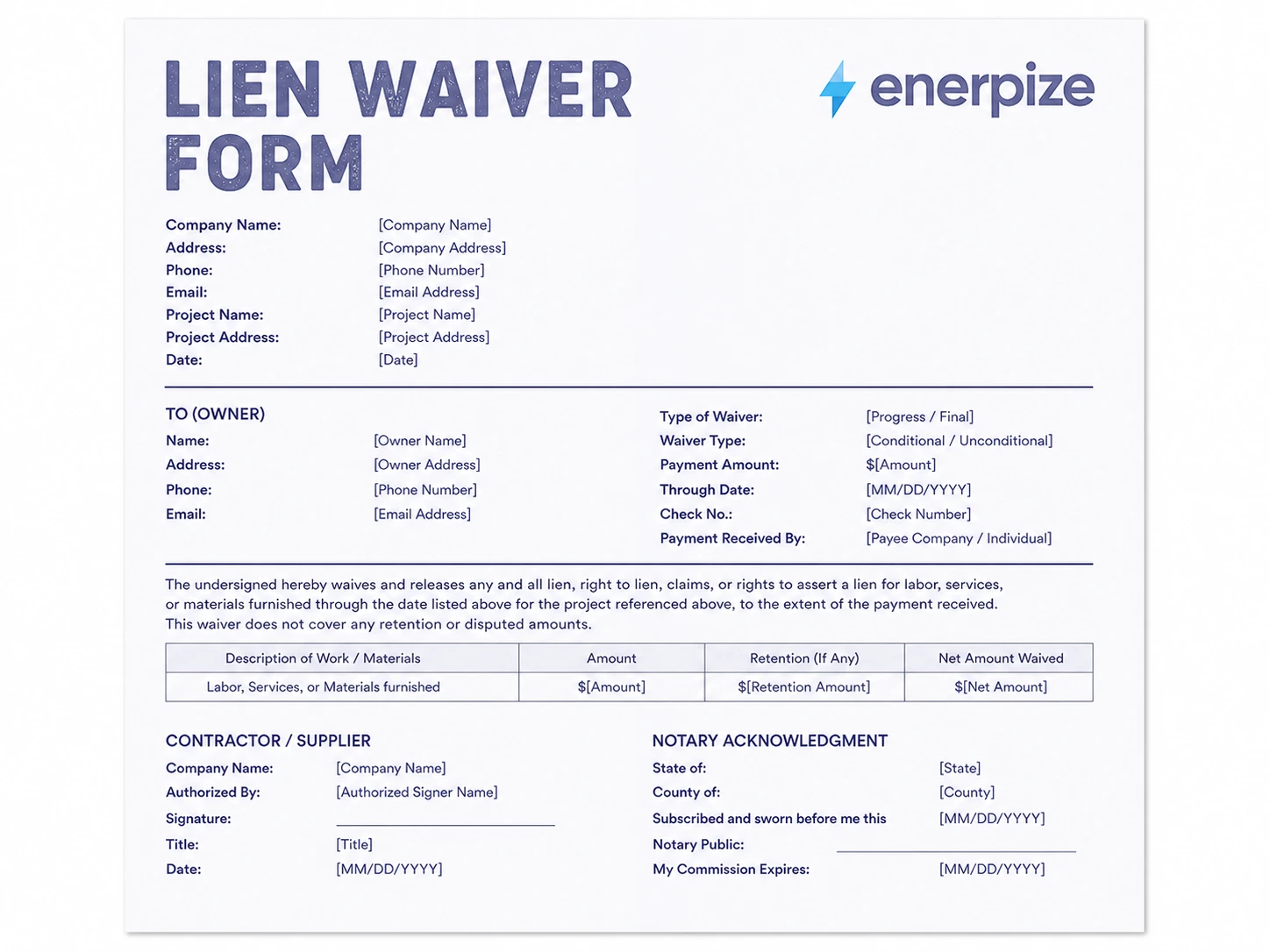
So what is a lien waiver in practice, beyond the definition? It is a short, standardized document, usually one page, that lists the project, the parties, the payment amount, and a release of lien rights tied to that specific payment. Some states leave the wording up to you. Others, like the 4 covered later in this template, spell out almost the exact sentence structure you have to use.
The lien waiver meaning gets muddled sometimes because people use "lien waiver" and "lien release" as if they are the same thing, and they are not, more on that shortly. For now, the important part of the lien waiver definition to hold onto is this. A lien waiver is signed before or at the moment of payment, and it only ever covers work that has actually been done. Sign it too early, for work that has not happened yet, and in several states the waiver simply will not hold up.
Skip the blank page. Enerpize gives you every field already built out, plus a place to track the invoice each waiver is tied to. Start free with Enerpize
The 4 Types of Lien Waiver Forms
Every lien waiver you will ever sign falls into one of exactly 4 buckets, and figuring out which one you need comes down to two questions. Have you actually been paid yet? And is this a progress payment or the very last one on the job? Get either answer wrong and you have either signed away rights you meant to keep, or handed over a waiver nobody can actually use.
Answer those two questions and you land on one of these. A conditional waiver and release on progress payment is the most commonly requested version on any job with more than one payment, since it protects you until the check clears without holding up the payment process. An unconditional waiver and release on progress payment works the same way, just after the money has already landed instead of before. A conditional lien waiver only takes effect once the payment is actually verified, usually meaning the check has cleared the bank. That is the whole point of it. You are telling the payer, "I will give up my lien rights, but only once the money is really in my account." An unconditional lien waiver skips that protection entirely. It becomes binding the second you sign it, whether or not you have actually been paid, which is exactly why so many contractor associations warn people never to sign one before the funds have cleared.
The progress versus final distinction is a little more straightforward. A partial lien waiver, more commonly called a progress waiver, covers a single payment on a job that is still ongoing. There will be more invoices and more waivers to come, with a partial lien waiver protecting you until the rest of the contract is paid out. A final lien waiver, or final waiver of lien, covers the very last payment and closes out the project's lien exposure entirely, aside from anything you specifically carved out as an exception. Signing an unconditional waiver and release on final payment is usually the very last paperwork step on a job, right after the funds have posted, and it is worth double checking the amount one more time before you sign it.
Here is the detail most generic templates skip. None of these 4 forms automatically release retention. If your contract holds back 10 percent of every payment until substantial completion, that 10 percent stays yours unless the waiver specifically says otherwise. The same goes for disputed change order amounts. A well-built lien waiver always has a dedicated place to exclude both, and the template further down this page does exactly that.
Lien Waiver Form vs. Lien Release Form
Ask five people on a job site to explain the difference between a lien waiver and a lien release, and you will probably get five different answers, half of which contradict each other. Here is the actual distinction.
A lien waiver gets signed before any lien has been filed. It is preventative. You sign it at the time of payment specifically so that a lien never becomes necessary in the first place. A lien release form, on the other hand, comes into play after a lien has already been filed against a property. Its whole job is to cancel that lien once the underlying debt gets paid.
Some people search for a mechanics lien waiver instead of a lien waiver, which is really just another name for the same document tied to a mechanic's lien claim. To make things more confusing, some states just do not use the term "lien waiver" at all. California officially calls its version a "waiver and release," which is part of why so many people end up searching for a lien release form when what they actually need is a lien waiver.
It helps to see all 4 related documents side by side, since a construction project can touch every single one of them at different points.
| Document | When it's used | Effect |
|---|---|---|
| Lien Waiver | Exchanged at the time of payment, before any lien is filed | Releases the right to file a lien for the amount paid |
| Lien Release | After a lien has already been filed against the property | Removes an existing, already filed lien |
| Mechanic's Lien | Filed when a contractor was not paid for work or materials | Places a legal claim directly against the property |
| Notice of Intent to Lien | Sent as a warning before actually filing a lien | Gives the owner a chance to pay before a lien gets recorded |
If you remember nothing else from this section, remember this. A mechanic's lien is the actual claim. A notice of intent to lien is the warning shot before that claim gets filed. A lien waiver is what prevents the claim from ever needing to exist. And a lien release form is what removes it after the fact, once someone finally pays up.
Beyond State Law: When Your Lender or Owner Requires Its Own Form
State law is not the only thing dictating what your lien waiver needs to say. Once a construction loan or a government funding source gets involved, the lender or the agency behind the money often has its own required format, regardless of which state the project sits in.
Fannie Mae is a good example. Renovation loans that Fannie Mae backs come with a model lien waiver document, Form 3739, that lenders can require contractors to use on top of whatever the state itself expects. It even includes a built-in contractor's affidavit listing every subcontractor and supplier paid on the job, which most state-level forms do not ask for at all.
The USDA's Rural Utilities Service does something similar for rural construction projects it finances, using its own Form 224. Public universities and government agencies frequently have their own versions too, built around whatever their legal counsel has approved rather than a generic state template.
This part is easy to miss. State law sets the floor, not the ceiling, and whoever is financing the project, public or private, can layer its own paperwork requirements right on top of it.
If you are working on a renovation loan, a USDA-financed project, or a public institution's job site, checking with the lender or owner before you assume a standard state waiver will work can save you a signature that gets rejected and sent right back to you.
The safest habit, honestly, is to ask the question early. "Does this project require a specific lien waiver format beyond the state's?" takes ten seconds to ask a project manager or loan officer, and it is a lot faster than resubmitting paperwork a week before a payment deadline.
What the Enerpize Lien Waiver Form Template Includes
This lien waiver template is built to cover the entire decision tree, not just a single form.
Every Waiver Type, Not Just One
Every version of this lien waiver template starts with the same 4 forms covered above, conditional and unconditional, progress and final, each one built with a dedicated field for retention and a dedicated field for disputed amounts. That sounds small until you actually need it. The moment you sign a waiver that does not carve out retention, you have technically waived money you have not been paid yet, and that is not a mistake you want to discover halfway through a project.
Statutory Language for California, Texas, Florida, and Missouri
The California, Texas, Florida, and Missouri sections do not just describe those states' rules in a paragraph and leave you to translate that into your own wording. They give you the actual statutory language, including California's required check-clearing clause and the bold, all-caps warning Texas law requires on every unconditional waiver. Get the wording wrong in a statutory state and the waiver itself can be unenforceable, so this lien waiver template builds the correct language in rather than leaving it to guesswork.
A Lower-Tier Waiver Tracking Log
There is also a lower-tier waiver tracking log built directly into the template. If you are a general contractor collecting waivers from ten different subcontractors and suppliers, that log is the difference between knowing exactly who still owes you a signed waiver and finding out three weeks later that one never came in.
Available as Word, PDF, or Print
Whether you need a printable lien waiver form to sign by hand on a job site or a lien waiver form pdf to attach to an email, this template works either way. Fill it out digitally in Word, save it as a PDF, and print it if a wet signature is what your general contractor expects.
Download the full lien waiver template as an editable Word file, fill in the blanks that apply to your project, and you are done. No sign-up, no watermark, and no missing fields you find out about after you have already sent the waiver off to a general contractor.
Every field, every state, one download. Get the complete lien waiver template with all 4 forms and the California, Texas, Florida, and Missouri sections built in. Start free with Enerpize
State by State Lien Waiver Requirements
Twelve states in the US require lien waivers to follow specific statutory wording, and using anything else can leave you with a document that will not actually hold up. California, Texas, Florida, and Missouri make up 4 of those states, and if your project sits in one of them, use that state's section below instead of a generic waiver. Every other state can safely use the standard conditional and unconditional forms described above.
California Lien Waiver Requirements
Need a California lien waiver form? The wording is not really up to you to decide. California writes the exact language into law. Under Civil Code Sections 8132, 8134, 8136, and 8138, any waiver used on a California job has to follow one of the four statutory forms substantially word for word, or it can be challenged later. The California Contractors State License Board publishes all four versions directly, and the conditional waiver form spells out something a lot of contractors miss. The release only becomes effective once the check, properly endorsed, has cleared the bank. In plain terms, signing a conditional waiver the moment you are handed a check does not waive anything yet. It only takes effect once that check actually clears, which is exactly why California contractors lean on conditional waivers for progress payments and save the unconditional version for after the funds have safely landed.
Texas Lien Waiver Requirements
Filling out a Texas lien waiver form? Check the date on your prime contract before you check anything else. Texas gives contractors two different sets of statutory language depending on when that underlying contract was signed. Waivers tied to a prime contract executed after January 1, 2021 follow the current wording in Texas Property Code Section 53.284 and, thanks to Texas House Bill 2237, no longer need to be notarized. Waivers tied to older contracts still fall under the pre-2021 rules, which did require a notary. That split catches a surprising number of subcontractors off guard when they reuse a saved waiver from a job that started years earlier. Older contracts still require a notarized lien waiver, so check your contract date before assuming you can skip that step. The safest habit is to check the date the prime contract was signed before picking a waiver, not the date you happen to be filling it out.
Florida Lien Waiver Requirements
A Florida lien waiver form does not need to follow any specific script, but one Florida rule trips people up more than any other. Florida's construction lien law lives in Florida Statute Section 713.20, and it says a lien right can never be waived in advance. You cannot ask a subcontractor to sign away lien rights before they have actually furnished labor or materials, and any waiver that tries to do that is unenforceable outright. Florida also allows a claimant to release just part of what they are owed, as to a specific dollar amount or a specific date, which is exactly what a conditional progress waiver is built for. Florida does not require notarization for a standard lien waiver, but plenty of general contractors on public and bonded jobs still ask for one anyway, so check your contract before assuming you can skip it.
Missouri Lien Waiver Requirements
A Missouri lien waiver form usually does not need special wording, except for one very specific, very strict exception. Missouri's statute refers to this as an unconditional, final lien waiver, though most people on a job site just call it a final waiver of lien. Missouri backs its lien waiver rules with an actual deadline and a real penalty, something most other states leave vague. Under Missouri Revised Statutes Section 429.016, once a claimant on a residential job has been paid in full, they have to execute an unconditional, final lien waiver and cannot unreasonably sit on it. If a written request comes in and the claimant does not provide that waiver within five calendar days, Missouri law presumes them liable for slander of title, plus a five hundred dollar statutory penalty. That is a specific, enforceable timeline you will not find written into most other states' lien waiver statutes, and it is exactly why Missouri contractors and title companies treat unconditional final waivers as a same week task, not a someday task. The rule applies specifically to residential real property, so commercial jobs in Missouri follow a separate, less prescriptive set of expectations.
How Enerpize Handles Construction Payments and Retention
Every lien waiver in this template carves out retention specifically, because that money almost never gets released along with the rest of the payment. Enerpize's construction company management software builds that same distinction directly into the invoice. When you generate a construction invoice in installments or as a lump sum, retention discounts get calculated and shown as their own line item, calculated on the total after tax, so the number sitting in your accounting system is the exact number that should stay unwaived on the matching lien waiver.
The same project record that generates the invoice also holds the site address, budget, and profitability reports for that job, and a statement of account can confirm the running total across every payment on the job, so when a subcontractor or supplier asks which payment a waiver is tied to, you are not digging through email threads to confirm it. Labor hours and costs get allocated to the project automatically too, which matters on jobs where a lien waiver's exceptions field needs to reflect work that was performed but not yet billed. Enerpize also lets you assign cost centers to each project, so retention held back across dozens of invoices on the same job rolls up into one clear number instead of scattered line items you have to reconcile by hand. When it comes time to sign the unconditional final waiver at the end of a job, you already know exactly how much retention is sitting there waiting to be released, instead of asking your bookkeeper to dig through six months of invoices first.
None of that replaces the legal review a lien waiver still needs, but it does mean the dollar amount you type onto the waiver and the dollar amount in your books are always the same number.
How to Fill Out a Lien Waiver Form
Filling out a lien waiver is not complicated once you know what belongs where. Here is the order that keeps you from missing anything.
1. Identify every party involved
Start with the claimant, meaning whoever is giving up their lien rights, the party who hired them, and the property owner. In a subcontractor lien waiver situation, that usually means listing yourself, the general contractor who hired you, and the owner of the property, even though you likely never spoke to the owner directly.
2. Add the property and project details
Write out the full project address and a short description of the job. Vague project descriptions are one of the most common reasons a lien waiver gets sent back for corrections. Most general contractors expect a lien waiver to arrive attached to your AIA-style payment application, not as a separate email three days later.
3. Choose the right waiver type
Go back to the decision table near the top of this page. Conditional or unconditional, progress or final, pick the one that actually matches your situation rather than whatever form happened to be sitting in your inbox from the last job.
4. Enter the payment amount and the through date
The through date matters more than people realize. It defines exactly which work is covered by the waiver. Work performed after that date is not released, even if it was part of the same overall contract.
5. List your exceptions
Retention, disputed change orders, and anything furnished after the release date all belong in the exceptions field. Leave this blank and you may be waiving money you have not actually received yet.
6. Sign, date, and notarize if your state requires it
Double check whether your project is in California, Texas, Florida, or Missouri before you sign. If it is, use that state's exact wording rather than a generic version, and confirm whether notarization applies.
Ready to stop rebuilding this from scratch every time? Download the lien waiver template once, and reuse it for every job, every state, every payment. Start free with Enerpize
FAQ
What is a lien waiver form?
A lien waiver, sometimes called a mechanics lien waiver, is a signed document where a contractor, subcontractor, or supplier gives up their right to file a lien against a property in exchange for payment already received or about to be received. It works like a receipt that specifically protects the property owner and general contractor from a double payment claim.
Conditional vs. Unconditional Lien Waiver: What Is the Difference?
A conditional lien waiver only takes effect once payment has actually cleared. An unconditional lien waiver takes effect the moment you sign it, whether or not you have been paid. Signing an unconditional waiver before funds clear is one of the riskiest mistakes a contractor can make on a job.
Do lien waivers need to be notarized?
Most states do not require a notarized lien waiver for a standard progress or final payment. A small number of exceptions exist, including Missouri's specific residential final waiver and older Texas contracts signed before 2021, both covered in the state sections above. When in doubt, check your contract as well as your state's rules.
What is the difference between a lien waiver and a lien release?
A lien waiver is signed before a lien is filed, and it prevents one from becoming necessary. A lien release is signed after a lien has already been filed, and it cancels that lien once the underlying debt is paid.
Can I sign an unconditional lien waiver before I am paid?
You can, but you should not. An unconditional waiver is enforceable the moment you sign it. If the check bounces after that, you have already given up your lien rights and you still have not been paid, which leaves you with far fewer options to recover the money.
What happens if I use the wrong type of lien waiver form?
You risk waiving rights to money you have not received, or signing a document that gets rejected because it does not match your state's required wording. In statutory states like California and Texas, an incorrectly worded waiver can be challenged and thrown out entirely. Keeping a lien waiver form pdf on hand for each of the 4 types saves you from scrambling to rebuild one under deadline pressure.
Which states require a specific statutory lien waiver form?
Twelve states currently require lien waivers to follow specific statutory wording: Arizona, California, Florida, Georgia, Massachusetts, Michigan, Mississippi, Missouri, Nevada, Texas, Utah, and Wyoming. This template covers California, Texas, Florida, and Missouri in full detail.
Key Takeaways
- A lien waiver, also called a final waiver of lien when it covers the last payment on a job, is signed at the time of payment, before any lien is filed, and it releases a contractor's right to place a lien on the property for that specific payment.
- There are 4 types of lien waivers: conditional and unconditional, each tied to either a progress payment or the final payment.
- An unconditional lien waiver is enforceable the moment you sign it, so never sign one before a payment has actually cleared.
- Twelve states, including California, Texas, Florida, and Missouri, require lien waivers to follow specific statutory wording.
- Retention and disputed amounts are never automatically covered by a lien waiver unless the form specifically excludes them.
- A lien waiver and a lien release are different documents. A waiver prevents a lien, while a release cancels one that has already been filed.
About the Author
Omar El Bahr is a Senior Digital Growth Specialist at Enerpize, where he leads SEO, content strategy, and organic growth across international markets. He is a Forbes Communications Council contributor and has written for Entrepreneur on business communication and digital strategy.
Disclaimer: This template and the information on this page are for general informational purposes only and do not constitute legal advice. Lien waiver requirements vary by state and by project, so&