

Posted on 9 August 2026
Non Disclosure Agreement Template: Free Word, PDF, & Google Docs Download
- Available in Word, PDF, and Google Docs, free to download with no sign up required
- Covers mutual, unilateral, and employee non disclosure agreement formats in one structured document
- Built with country specific legal fields for the United States, United Kingdom, India, and Australia
- Includes a quick reference block, a term length toggle, and an electronic signature clause so you are not editing clause numbers by hand
A non disclosure agreement template is a pre-formatted legal document that defines what information two parties must keep confidential, who is bound by that duty, and what happens if either side breaks it.


What Is a Non Disclosure Agreement?
A non disclosure agreement, often shortened to NDA, is a contract that stops one or both sides of a business conversation from repeating what they just heard. Think of it as a locked door you install before you let someone into the room. You are not telling them the room is off limits. You are telling them what happens if they walk out and describe the furniture to a stranger.
Some people call it a confidentiality agreement. Others call it a confidential disclosure agreement, or simply an NDA agreement. Same document, different name, same job. It shows up before a business sale, an investor pitch, a new hire's first week, or a vendor contract, anywhere one party is about to hand over something they cannot afford to see repeated.
Here is the difference between an NDA and the two documents people most often confuse it with.
| Document | Restricts sharing information | Restricts working for a competitor | Typical duration |
|---|---|---|---|
| Non disclosure agreement | Yes | No | 2 to 5 years, or indefinite for trade secrets |
| Non-compete agreement | No | Yes | Varies by state or country, often 1 to 2 years |
| Confidentiality clause inside an employment contract | Yes, but scoped to that one contract | No, unless a separate non-compete clause is added | Tied to the length of employment plus a survival period |
An NDA protects information. A non-compete restricts where someone can work next. People bundle the two together, but they do two different jobs, and a court will read them differently if a dispute ever lands in front of a judge.
Keep every contract, including signed NDAs, attached to the right employee, client, or vendor record. Start free with Enerpize
Types of Non Disclosure Agreements
Not every conversation needs the same kind of NDA. Pick the wrong one and you either overprotect a one-way conversation or leave yourself exposed in a two-way one.
Mutual Non Disclosure Agreement
A mutual non disclosure agreement, sometimes called a two-way NDA, applies when both sides are handing sensitive information to each other. Two companies discussing a joint venture, a merger, or a co-development deal both need protection, so both sides sign as discloser and recipient. If you only protect one direction, the other party has no obligation to keep your side of the conversation quiet. This is common groundwork before a business agreement or a partnership agreement gets drafted, since both sides need to speak freely before the real terms are on the table. If you only protect one direction, the other party has no obligation to keep your side of the conversation quiet.
Unilateral Non Disclosure Agreement
A unilateral non disclosure agreement protects one direction only. You are pitching an idea to an investor. You are the only one revealing anything. The investor has nothing confidential to hand back, so only you need protection. This is the simplest version of the agreement, and it is the one most people picture when they search for a basic NDA template.
Employee Non Disclosure Agreement
An employee non disclosure agreement protects a company's internal information from being carried out the door when someone leaves. It covers client lists, pricing structures, source code, and anything the employee touches during their time on payroll. Most companies fold this into the offer letter or the employment contract itself, but a standalone version matters when someone needs access to sensitive material before their start date, during an interview for a highly sensitive role, or as a contractor rather than a full employee.
What to Include in an NDA Template
A short paragraph promising confidentiality is not an NDA. It is a wish. Here is every field a document needs to actually function as one.
| Field | Why it matters |
|---|---|
| Disclosing party and receiving party | Names the two sides and who owes the duty of confidentiality to whom |
| Effective date | Marks when the confidentiality clock starts |
| Definition of confidential information | Sets the boundary of what is actually protected |
| Exclusions | Carves out information that was already public, already known, or independently developed |
| Permitted disclosure | Names who inside the receiving party's team is allowed to see the information |
| Term and survival period | States how long the agreement runs and how long the duty continues after it ends |
| Return or destruction clause | Requires the receiving party to hand back or delete the material on request |
| Remedies clause | States that injunctive relief is available, not just money damages |
| Governing law | Sets which state or country's courts and laws apply to a dispute |
| Signature block | Confirms both parties agreed and creates a dated record |
Miss the exclusions clause and you have written an agreement that could theoretically stop someone from repeating information that was already on the front page of a newspaper. Miss the survival period and your protection quietly expires the day the deal falls apart, right when you need it most. If you want to see how these fields read inside a real, fully executed non disclosure agreement sample rather than a blank shell, the United States section further down links to one filed on the public record.
What the Enerpize NDA Template Includes
I built this template around a problem I kept running into myself. Most NDA templates hand you either a blank legal shell with no guidance, or a fully executed institutional document so specific to one company that half of it needs deleting before it applies to you.
A Structure That Sits Between the Two Extremes
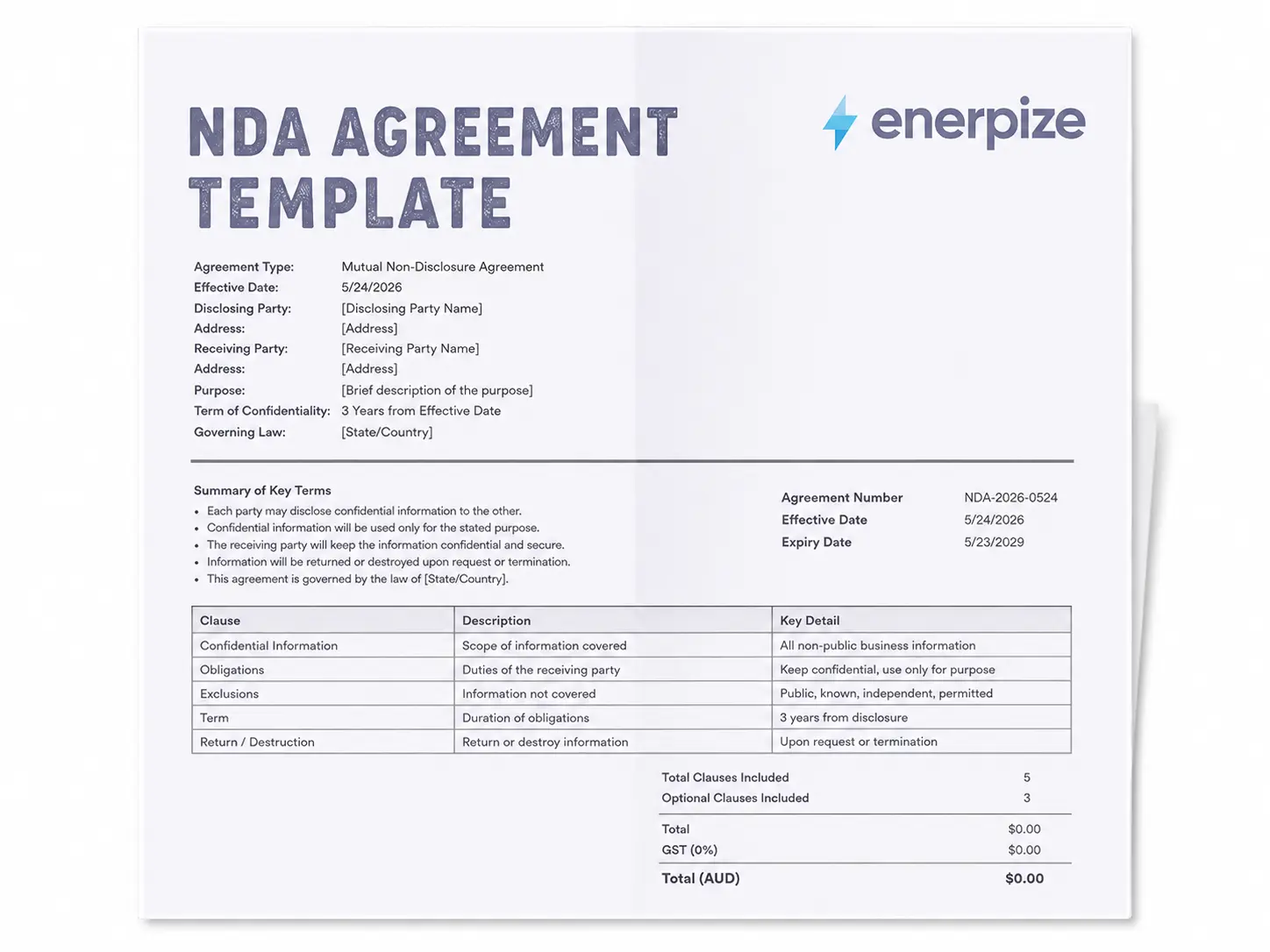
The Enerpize non disclosure agreement template sits in between. It opens with a quick reference block so you can see the parties, the agreement type, the term, and the governing law in one glance instead of hunting through numbered clauses.
A Real Choice Between Mutual and Unilateral
It gives you a real choice between a mutual and a unilateral structure at the top of the page, with a plain instruction telling you which one fits your situation, instead of forcing you to rewrite half the document if you picked wrong.
A Residual Knowledge Carve Out
It includes a residual knowledge carve out, the clause that protects information an employee retains in ordinary memory rather than something they deliberately copied to get around the agreement. Most templates skip this entirely, and it is the clause that ends up mattering most in employee disputes.
Built-In Compliance and Signature Clauses
It also carries the Defend Trade Secrets Act whistleblower notice required in United States employee and contractor agreements that reference trade secrets, an electronic signature clause so the document holds up when signed through an e-signature platform, and an optional non-solicitation clause you can delete if you do not need it. Every optional section is flagged so you know exactly what to keep and what to remove before you send it.
How to Use the NDA Template
Filling out a non disclosure agreement template should take minutes, not an afternoon lost in legal jargon. Work through these six steps in order and you will have a signed agreement ready to send by the end of the process.
Step 1: Choose Mutual or Unilateral
Decide whether both sides are disclosing information or only one. This single choice determines how the rest of the document reads, so make it first.
Step 2: Fill in the Parties
Enter the full legal name, entity type, and address for both the disclosing party and the receiving party. Use the exact registered business name, not a trading name, especially if this agreement might ever need to be enforced in court.
Step 3: Define the Purpose
Write one sentence describing why the information is being shared. A vague or missing purpose makes it harder to argue later that a specific disclosure fell inside or outside the agreement's scope.
Step 4: Set the Term
Pick a fixed term of two to five years for most business discussions, or an indefinite term tied to trade secret status if you are sharing source code, formulas, or anything that should never become public.
Step 5: Review the Optional Clauses
Decide whether you need the non-solicitation clause, the arbitration clause, or a notary block. Delete whatever does not apply rather than leaving placeholder text in a signed document.
Step 6: Sign and Distribute
Collect signatures from both parties, either handwritten or through an electronic signature platform, and send each side a fully executed copy for their records.
Once it is signed, store it where the rest of your business records live. Start free with Enerpize
Non Disclosure Agreement Template for the United States
In the United States, NDAs sit inside a patchwork of state contract law, with one important federal layer on top. The Defend Trade Secrets Act, passed in 2016, gives businesses a federal path to sue over trade secret theft and requires that any NDA referencing trade secret protection include a whistleblower immunity notice. Leave that notice out of an employee or contractor NDA and you weaken your position if a dispute over retaliation or whistleblowing ever comes up.
Duration matters here too. Courts across most states will enforce an NDA with a defined term more readily than one with no end date at all, unless the information genuinely qualifies as a trade secret, in which case an indefinite term tied to trade secret status tends to hold up better. For a real example of how a US company structured a filed employee NDA, the SEC's public filing database includes an executed employee confidentiality agreement filed as part of a company's SEC disclosures, a useful reference for how these documents look once signed and on record.
Non Disclosure Agreement Template for the United Kingdom
UK NDAs are contracts like any other, enforceable under standard contract law, but they carry one restriction most people miss. The UK's whistleblowing and workplace protection framework means an NDA cannot be used to stop someone from reporting illegal activity, discrimination, or harassment to a regulator or the police, regardless of what the agreement says. Any UK employee NDA that tries to silence that kind of disclosure risks being unenforceable on that point, even if the rest of the agreement is valid.
Standard contract limitation periods also apply. Under the Limitation Act 1980, most contract claims in England and Wales must be brought within six years of the breach, which is worth keeping in mind when setting a survival period for confidentiality obligations. For official guidance on how confidentiality and data protection obligations interact in the UK, the Information Commissioner's Office publishes current guidance for businesses handling confidential and personal information.
Non Disclosure Agreement Template for India
NDAs in India are governed by the Indian Contract Act of 1872, one of the oldest pieces of commercial legislation still actively enforced in Indian courts today. For an NDA to hold up, it needs the same basic ingredients as any valid contract under the Act, a lawful offer, acceptance, consideration, and free consent from both sides.
The clause worth watching is Section 27 of the Act, which voids any agreement that restrains someone from practicing a lawful trade, profession, or business. This mostly affects non-compete style restrictions bundled into an NDA rather than the confidentiality obligation itself, but if your agreement leans too far into restricting where someone can work next, that portion of the document risks being struck down even if the confidentiality clause stands. The full text of the governing law is available through the official Indian Contract Act, 1872, published on India's national legislative database.
Non Disclosure Agreement Template for Australia
Australian NDAs are enforceable contracts under common law, and the country's competition and consumer protection framework adds a layer most templates from other countries do not account for. Confidentiality obligations need to be reasonable in scope and duration to hold up if challenged, similar to the standard applied to restraint of trade clauses more broadly in Australian courts.
IP Australia, the government body responsible for intellectual property rights in the country, provides an official non disclosure agreement contract generator as a starting reference point for businesses drafting their own confidentiality terms under Australian law.
How Enerpize Connects Confidentiality to Your Hiring and Contract Workflow
A signed NDA sitting alone in an email inbox is not a system. It is a starting point that someone has to remember exists.
Enerpize's employee management and contracts module keeps signed agreements attached directly to the employee, client, or vendor record they belong to, so the confidentiality history for any relationship is visible the moment you open that record, not buried in a separate folder somewhere. When an employee's contract renews or a vendor relationship expands, the confidentiality terms travel with the record instead of getting lost in an old email thread nobody can find six months later.
This matters most for businesses that handle confidential information as a core part of the job. Law firms are a clear example. A firm juggling client case files, outside counsel, and paralegal onboarding needs confidentiality documentation tied to each client and each case, not floating loose in someone's downloads folder. Enerpize links each client record to the staff assigned to it, tracks case related documents in one place, and keeps a record of who has access to what, so when a new case opens or a new hire starts, the confidentiality paperwork is part of the same workflow instead of a separate manual step someone has to remember.
See how Enerpize keeps employee, client, and vendor documents organized in one place. Start free with Enerpize
Key Takeaways
- A non disclosure agreement template only works if it matches the situation, mutual for two-way conversations, unilateral for one-way pitches, and a dedicated employee version for staff and contractors.
- The exclusions clause and the survival period are the two sections most templates get wrong, and both directly affect whether the agreement holds up in a dispute.
- United States NDAs involving trade secrets need the Defend Trade Secrets Act whistleblower notice to stay fully compliant with federal law.
- UK NDAs cannot be used to block whistleblowing disclosures about illegal activity, discrimination, or harassment, regardless of what the agreement states.
- Indian NDAs are governed by the Indian Contract Act of 1872, and any clause restricting future employment risks being void under Section 27 of that Act.
- A signed NDA only protects you if it is actually attached to the right record and easy to find again when you need it.
Frequently Asked Questions
What is a non disclosure agreement?
A non disclosure agreement is a contract that requires one or both parties to keep specified information confidential and sets out what happens if that duty is broken.
What is the difference between a mutual and a unilateral NDA?
A mutual NDA protects information flowing in both directions between two parties. A unilateral NDA protects information flowing in one direction only, typically from a business to an investor, contractor, or potential partner.
Is a non disclosure agreement legally binding?
Yes, provided it meets the basic requirements of a valid contract in the relevant jurisdiction, including a lawful purpose, clear terms, and consent from both parties.
What happens if someone breaks an NDA?
The party that broke the agreement can face legal action, including a court order to stop further disclosure and a claim for damages caused by the breach.
How long should an NDA last?
Most business NDAs run two to five years. Agreements protecting trade secrets are often written to last indefinitely, tied to how long the information remains a genuine secret rather than a fixed date.
Do I need a lawyer to sign an NDA?
Not to sign one, but it is worth having a lawyer review an NDA before you sign it, particularly if it includes a non-compete or non-solicitation clause layered on top of the standard confidentiality terms. Starting from a well structured non disclosure agreement template makes that review faster, since a lawyer is checking your specific terms rather than rebuilding the document from scratch.
About the Author
Omar El Bahr is a Senior Digital Growth Specialist at Enerpize, where he leads SEO, content strategy, and organic growth across international markets. He is a Forbes Communications Council contributor and has written for Entrepreneur on business communication and digital strategy.
Disclaimer: This template and the information on this page are provided for general informational purposes only and do not constitute legal advice. Review any agreement with a qualified attorney before signing.