

Posted on 6 August 2026
Partnership Agreement Template: Word, PDF and Google Docs Free Download
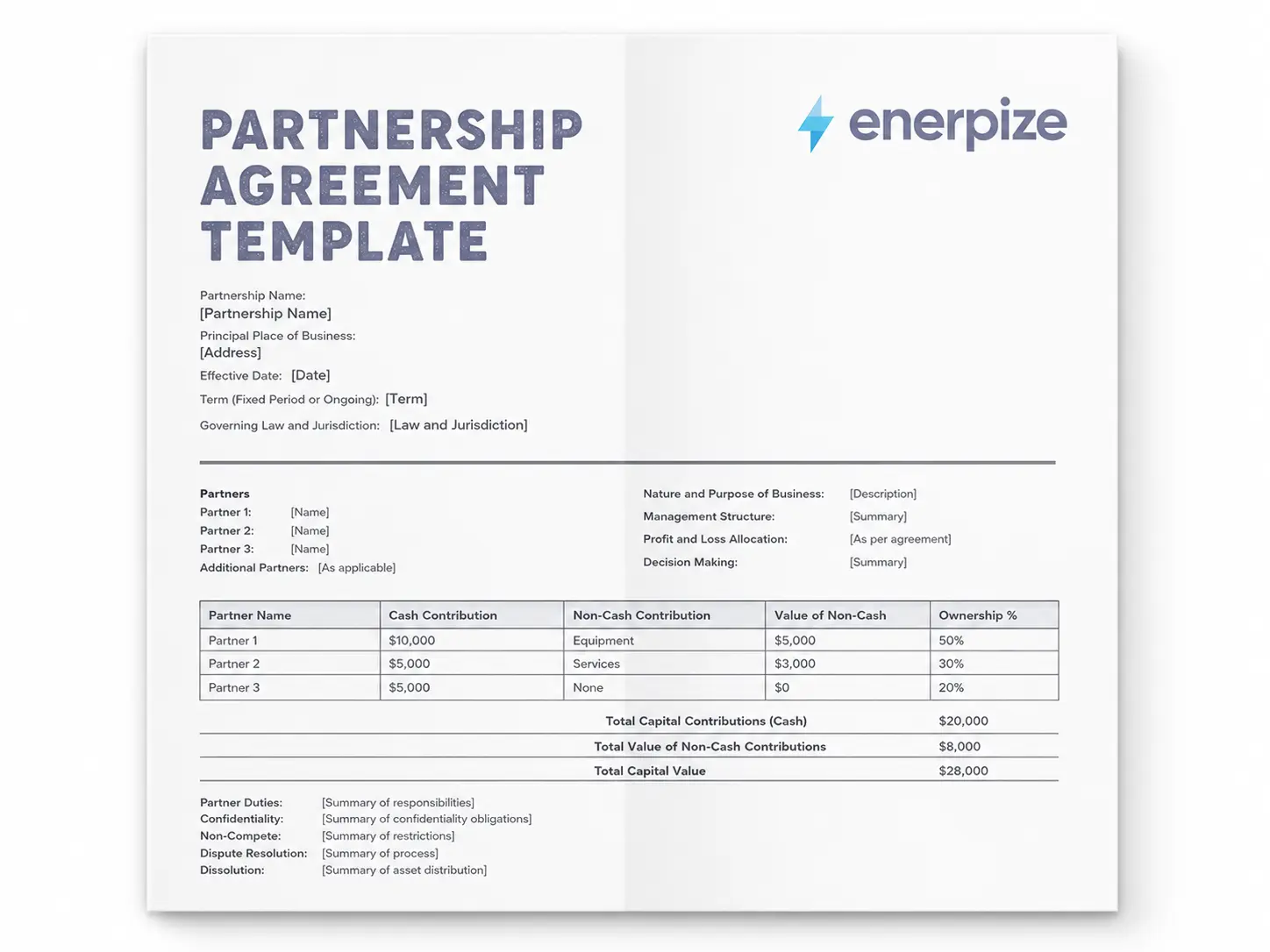
- Available in Word, PDF, and Google Docs free to download with no sign up required, built to scale from two partners to any number of partners
- Includes a capital contributions schedule, a buyout valuation table with three methods to choose from, and a decision making table by threshold
- Covers the United States, United Kingdom, Australia, and South Africa in one place, since partnership law is not the same in any two of them
- Structured with fillable fields for tax matters representative, dispute resolution timelines, and dissolution distribution order
A partnership agreement template is a pre-formatted legal document that sets out how two or more people will own, run, and eventually exit a business together, before any of that gets decided informally and badly.


What Is a Partnership Agreement?
A partnership agreement is the document that answers the questions partners always mean to discuss and usually do not, until the business is worth arguing over. Who owns what percentage. Who decides what, and how many partners have to agree. What happens if one partner wants out, or dies, or stops showing up.
Without one, state or national default law decides these things for you, and default law is written for the general case, not your business. In the United States, most states apply the Uniform Partnership Act or Revised Uniform Partnership Act by default. In the United Kingdom, the Partnership Act 1890 fills the gap. Australia and South Africa each have their own default rules too. None of them are likely to match what you and your partners actually intended.
Here is the part people skip past. A partnership agreement is not required by law in most places to start a business with a partner. You can form a partnership with a handshake and it is still legally a partnership. The agreement is what protects you once the handshake stops being enough, and in a business with more than one owner, that day comes for almost everyone eventually.
Most people searching for a business partnership agreement are already past the handshake stage. They have a real business, a real disagreement brewing, or a real opportunity in front of them, and they need the terms written down before the next step. If you are still shaping what that business actually looks like, our business plan template is a useful document to work through alongside this one, since a partnership agreement works best once the partners already agree on what they are building.
Want partner capital contributions and profit splits tracked automatically instead of buried in a signed PDF? Start free with Enerpize
What the Enerpize Partnership Agreement Template Includes
Most partnership agreement templates online are written for exactly two partners and fall apart the moment you add a third. Name fields are hardcoded into the prose. Signature blocks assume "Partner A" and "Partner B." Add a partner later and you are rewriting the whole document instead of adding a row.
We built ours around scale first.
A Capital Contributions Schedule, Not a Paragraph
The capital contributions section in the Enerpize partnership agreement template is a schedule, not a paragraph. Add a partner, add a row. Each row tracks cash contributed, non-cash contributed, the value of that non-cash contribution, and the resulting ownership percentage, so the math behind who owns what is visible instead of buried in someone's head.
Three Buyout Valuation Methods, Not One
The buyout section is the other piece most templates get wrong. Most give you one valuation method, usually just the capital account balance, and call it done. Ours gives you three options side by side, capital account, independent appraisal, or an agreed formula based on earnings, so partners pick the method that actually fits the business instead of inheriting whatever a generic template assumed.
A Decision Making Table by Threshold
We also built in a decision making table that separates ordinary business decisions from the ones that actually matter, admitting a new partner, amending the agreement, taking on debt above a set threshold, each with its own approval requirement instead of one blanket voting rule for everything.
That is the differentiator. Not a longer partnership agreement template. One that scales with the partnership instead of needing to be rebuilt every time it grows.
What to Include in a Partnership Agreement
A generic partnership contract sample gives you the shape of the document. It does not give you the specific mechanics that keep a real business partnership agreement out of a dispute two years in, once the initial excitement of starting the business has worn off and the actual day to day decisions start testing what the partners agreed to.
| Field | Why It Matters |
|---|---|
| Partnership Name and Purpose | Identifies the business and its scope |
| Partners and Capital Contributions | Names, addresses, and what each partner put in, cash or otherwise |
| Ownership Percentage | Drives profit and loss allocation |
| Management and Decision Making | Which decisions need majority, supermajority, or unanimous approval |
| Tax Matters Representative | The partner responsible for dealing with tax authorities |
| New Partner Admission | The consent required to bring someone new in |
| Withdrawal and Buyout Terms | Notice period, valuation method, and payment terms |
| Non-Compete and Confidentiality | Restrictions that survive a partner leaving |
| Dispute Resolution | The steps before anyone goes to court |
| Dissolution | The order assets get distributed if the partnership ends |
The two fields most partnership agreement templates skip or shortchange are the tax matters representative and the buyout valuation method. Skip the first and nobody knows who is supposed to sign the return. Shortchange the second and a partner leaving becomes a fight about what the business is actually worth, at the exact moment nobody wants to be negotiating.
Types of Partnership Agreements
A partnership agreement template is not one document. The structure changes depending on how much liability each partner is actually taking on.
General Partnership
In a general partnership, every partner shares management and carries personal liability for the business's debts. This is the most common structure because it is the simplest to set up, and it is exactly why the agreement matters most here, since every partner's personal assets are on the line for decisions any partner makes on the business's behalf.
Limited Partnership
A limited partnership has at least one general partner who manages the business and carries full liability, and at least one limited partner who contributes capital but stays out of day to day management. Limited partners' liability is capped at what they invested, which is the entire point of using this structure.
Limited Liability Partnership
A limited liability partnership protects each partner from being personally liable for another partner's mistakes or malpractice. This structure shows up most often in professional services, accounting firms, law firms, and similar practices, where one partner's error should not put every other partner's house on the line.
50/50 Partnership
A 50/50 partnership agreement splits ownership and profit equally between two partners. It sounds simple and it is the one structure where the decision making table above matters the most, since an even split means there is no natural tiebreaker built into the ownership percentages. Without a defined process for breaking a deadlock, a 50/50 partnership agreement can leave two equal partners stuck exactly when a decision needs to get made fast.
Common Mistakes in a Business Partnership Agreement
A few mistakes show up constantly in a business partnership agreement, and most of them are avoidable with a bit more specificity up front.
Vague language is the biggest one. A clause that says decisions will be made "fairly" or contributions will be valued "reasonably" is not actually a rule, it is a future argument waiting to happen. Every clause in a general partnership agreement should be specific enough that two reasonable people could not read it two different ways.
Assuming an equal split by default is another common mistake. Partners rarely contribute equally in time, capital, or risk, even when it feels natural to split everything down the middle. If the split is not explicitly unequal in the agreement, most default rules assume equal ownership regardless of what actually happened.
Skipping the exit terms until someone actually wants to leave is the third mistake, and it is the most expensive one. Valuation disputes get worse, not better, once a partner has already decided to go.
If you want to see what a completed one actually looks like before drafting your own, reviewing a partnership agreement example or a partnership agreement sample from a source you trust can help confirm you have not missed a clause, though a sample from a single jurisdiction will not necessarily match your own state or country's default rules.
How to Write a Partnership Agreement
Writing a partnership agreement is mostly a matter of sequence. Get the order right and the rest follows.
Name the Partners and the Business
Start with full legal names, addresses, the partnership name, and a plain description of what the business actually does. Vague purpose language is one of the most common gaps in a partnership contract sample, and it creates real ambiguity later about what falls inside or outside the partnership's scope.
Document Capital Contributions
List what each partner is putting in, cash, property, equipment, or expertise, and assign a value to anything that is not cash. This is what determines ownership percentage, so get it in writing before memory becomes the only record of who contributed what. If the contributions and the funding behind them are complex enough to need their own breakdown, our financial plan template covers that in more depth than a single schedule inside the partnership agreement can.
Set the Decision Making Rules
Decide what needs a simple majority, what needs a supermajority, and what needs every partner to agree. Admitting a new partner and amending the agreement itself should sit at the higher end of that scale. Whatever threshold you choose, write down the actual votes when a major decision gets made. Our meeting minutes template is built for exactly this, a dated record showing who voted for what, which matters more than most partners expect once a decision gets questioned later.
Assign Roles and Responsibilities
Write down who is actually doing what. Sales, finance, operations, client relationships. A general partnership agreement that skips this section relies on partners just knowing, which works fine until it does not.
Plan for Withdrawal and Buyout
Set a notice period, choose a valuation method, and define payment terms before anyone actually wants to leave. Doing this while everyone is still getting along produces a fairer outcome than negotiating it during an exit. If a departing partner's buyout includes transferring specific business assets rather than a cash payout, our bill of sale template documents that transfer separately from the partnership agreement itself.
Add Dispute Resolution and Dissolution Terms
Define a path from disagreement to resolution, negotiation, then mediation, then arbitration or court, and set the order in which assets get distributed if the partnership ends. Both of these read as boilerplate until the day they are the only thing standing between partners and a messy split.
Turn a signed partnership agreement into tracked capital accounts and profit splits without re-entering the numbers. Start free with Enerpize
Partnership Agreement vs LLC Operating Agreement vs Joint Venture Agreement
These three get confused constantly, partly because the documents look similar and partly because the businesses that need them often look similar too.
| Partnership Agreement | LLC Operating Agreement | Joint Venture Agreement | |
|---|---|---|---|
| Entity type | Partnership | Limited liability company | Often no separate entity |
| Liability | Personal, unless LLP | Limited by the LLC structure | Depends on structure chosen |
| Duration | Often ongoing | Often ongoing | Usually a single project or fixed term |
| Governs | The partnership itself | The LLC's internal rules | One specific collaboration |
A partnership agreement is for partnerships. An LLC operating agreement is for LLCs, a completely different legal entity with different liability protections, and using one template in place of the other does not just look wrong, it can leave partners without the protection they thought they had. A joint venture agreement usually covers a single project or a fixed period rather than an ongoing business relationship, which is the main thing that separates it from a partnership agreement even when the two documents share several of the same clauses.
Partnership Agreement Requirements by Country
Partnership law is not uniform across these four countries, and this is the section most partnership agreement templates skip entirely.
United States
Most states default to the Uniform Partnership Act or Revised Uniform Partnership Act when no written agreement exists, and every partnership must file Form 1065 annually to report income, deductions, and each partner's share, even though the partnership itself generally does not pay federal income tax. The IRS page on Form 1065 confirms this pass through structure directly.
United Kingdom
The Partnership Act 1890 still governs partnerships across England, Wales, Scotland, and Northern Ireland when no written agreement exists, and its default position is that every partner gets an equal share of profits and capital regardless of what they actually contributed. That default rarely matches real world arrangements, which is exactly why UK partnerships write their own agreements. If you are entering the partnership as part of a larger business proposal, working through our business proposal template first can help clarify the terms both partners are actually agreeing to before the legal language gets drafted.
Australia
Partnership law in Australia is set at the state level, not federally, so the specific act that governs your partnership depends on where the business is based, the Partnership Act 1891 in South Australia and Tasmania, the Partnership Act 1958 in Victoria, and similar state specific legislation elsewhere. Business.gov.au confirms this state by state structure and is worth checking against your specific state before finalizing an agreement.
South Africa
South Africa has no dedicated Partnerships Act. Partnerships are governed by common law instead, built around an agreement between the partners, a shared goal of making a profit, and a contribution from each partner. The South African Revenue Service recognizes three partnership types specifically, general or ordinary partnerships, anonymous or sleeping partnerships, and commanditarian partnerships, each with different implications for liability and tax.
If your partners are spread across more than one of these countries, do not assume one governing law clause covers everyone fairly. It usually favors whichever partner's jurisdiction gets named, and the partner who did not choose that jurisdiction is the one who ends up negotiating from a weaker position if a dispute actually reaches that point.
How Enerpize Supports Partnerships After the Agreement Is Signed
A partnership agreement gets the terms in writing. It does not track whether those terms are actually being followed once the business is running, and that gap is where partnerships drift from what they signed. Most disputes we hear about do not start as a disagreement about the agreement itself. They start as a disagreement about numbers, whose capital contribution was actually larger, whose expenses were actually business related, which is exactly the kind of thing that stops being a disagreement once it is tracked automatically instead of argued about from memory.
Enerpize Accounting
Every partner's capital account, the number this whole agreement is built around, lives in Enerpize Accounting as an actual ledger entry, not a static number from the day the agreement was signed. Contributions, profit allocations, and distributions post automatically instead of getting reconciled by hand once a year.
Enerpize Cost Centers
If partners are responsible for different parts of the business, sales, operations, a specific product line, Cost Centers lets you track profitability by partner area instead of only at the partnership level. That matters when the agreement ties responsibilities to specific partners but the accounting has historically only shown the business as a whole.
Enerpize Asset Management
When a partner contributes equipment or property instead of cash, Asset Management tracks the value of that contribution over its actual lifecycle, using GAAP aligned depreciation methods, rather than leaving it as a fixed number written into the agreement on day one and never revisited.
Enerpize Expenses Management
Shared costs between partners are one of the most common sources of friction in a partnership, and Expenses Management with AI powered receipt capture keeps those costs categorized and visible as they happen, instead of surfacing as a disagreement at the end of the quarter.
Keep capital accounts, cost centers, and shared expenses connected to the partnership agreement you actually signed. Start free with Enerpize
Key Takeaways
- A partnership agreement template needs to scale past two partners. Most free ones do not, and rewriting a document every time you add a partner is a sign the template was wrong from the start.
- The two fields most templates get wrong are the tax matters representative and the buyout valuation method. Both matter more at the exact moment nobody wants to be figuring them out from scratch.
- A partnership agreement, an LLC operating agreement, and a joint venture agreement are three different documents for three different structures. Using the wrong one can leave partners without the protection they assumed they had.
- Partnership law genuinely differs across the United States, United Kingdom, Australia, and South Africa. A single governing law clause does not make those differences disappear.
- A 50/50 partnership agreement needs a defined tiebreaker more than any other structure, since an even split has no natural way to break a deadlock.
- Connecting the agreement's terms to real accounting, capital accounts, cost centers, and shared expenses, keeps a partnership operating the way it was actually written to operate.
Frequently Asked Questions
What is a partnership agreement?
A partnership agreement is a legal document that sets out how two or more partners own, manage, and eventually exit a business together, including capital contributions, profit sharing, decision making, and what happens if a partner leaves.
Is a partnership agreement legally required?
No, not in most places. A partnership can legally exist on a verbal agreement or simply by two or more people running a business together for profit. Without a written agreement, default state or national law decides the terms instead, which rarely matches what partners actually intended.
What should a partnership agreement include?
At minimum, the partners' names and contributions, ownership percentages, decision making rules, a tax matters representative, terms for admitting new partners, a withdrawal and buyout process with a chosen valuation method, and a dissolution process.
What is the difference between a partnership agreement and an LLC operating agreement?
A partnership agreement governs a partnership. An LLC operating agreement governs a limited liability company, a different legal entity with different liability protections for its owners. The two documents are not interchangeable.
How do profits get split in a 50/50 partnership?
Equally, by definition, but a 50/50 partnership agreement should still define a tiebreaker process for decisions, since an even ownership split has no built in way to resolve a deadlock between two equal partners.
What happens if a partner wants to leave?
The partnership agreement should define a notice period, a valuation method for the departing partner's share, and payment terms. Without these set in advance, a partner's exit typically turns into a negotiation over what the business is worth at the worst possible time to be negotiating it.
How is a partnership agreement different from a joint venture agreement?
A partnership agreement usually governs an ongoing business relationship. A joint venture agreement usually covers a single project or a fixed period, even though the two documents often share similar clauses around contributions and profit sharing.
Do partnership agreement rules differ by country?
Yes, significantly. Default partnership law in the United States, United Kingdom, Australia, and South Africa are each based on different legislation or, in South Africa's case, common law rather than a dedicated act. A partnership agreement should account for the specific jurisdiction the partners are actually operating in.
About the Author
Omar El Bahr is a Senior Digital Growth Specialist at Enerpize, where he leads SEO, content strategy, and organic growth across international markets. He is a Forbes Communications Council contributor and has written for Entrepreneur on business communication and digital strategy.
Disclaimer
This article and template are for general informational purposes only and are not legal advice. Partnership law varies by jurisdiction and changes over time, so have your agreement reviewed by a qualified attorney before you sign it.