

Posted on 8 July 2026
Free Roofing Invoice Template Download: Excel, Word, PDF & Google Sheets and Docs
- Available in Word, Excel, PDF, Google Docs, and Google Sheets, free to download with no sign-up required
- Covers labor hours, materials, equipment rental, transportation and disposal, insurance claim details, and warranty terms in one structured document
- Built with country-specific fields for GST (Australia), VAT (UK and South Africa), and sales tax (US) invoicing in one template
- Calculates labor subtotal, materials subtotal, tax, and balance due automatically in the Excel version
A roofing invoice template is a pre-formatted billing document that records the labor performed, the materials used, and the total owed for a roofing job.


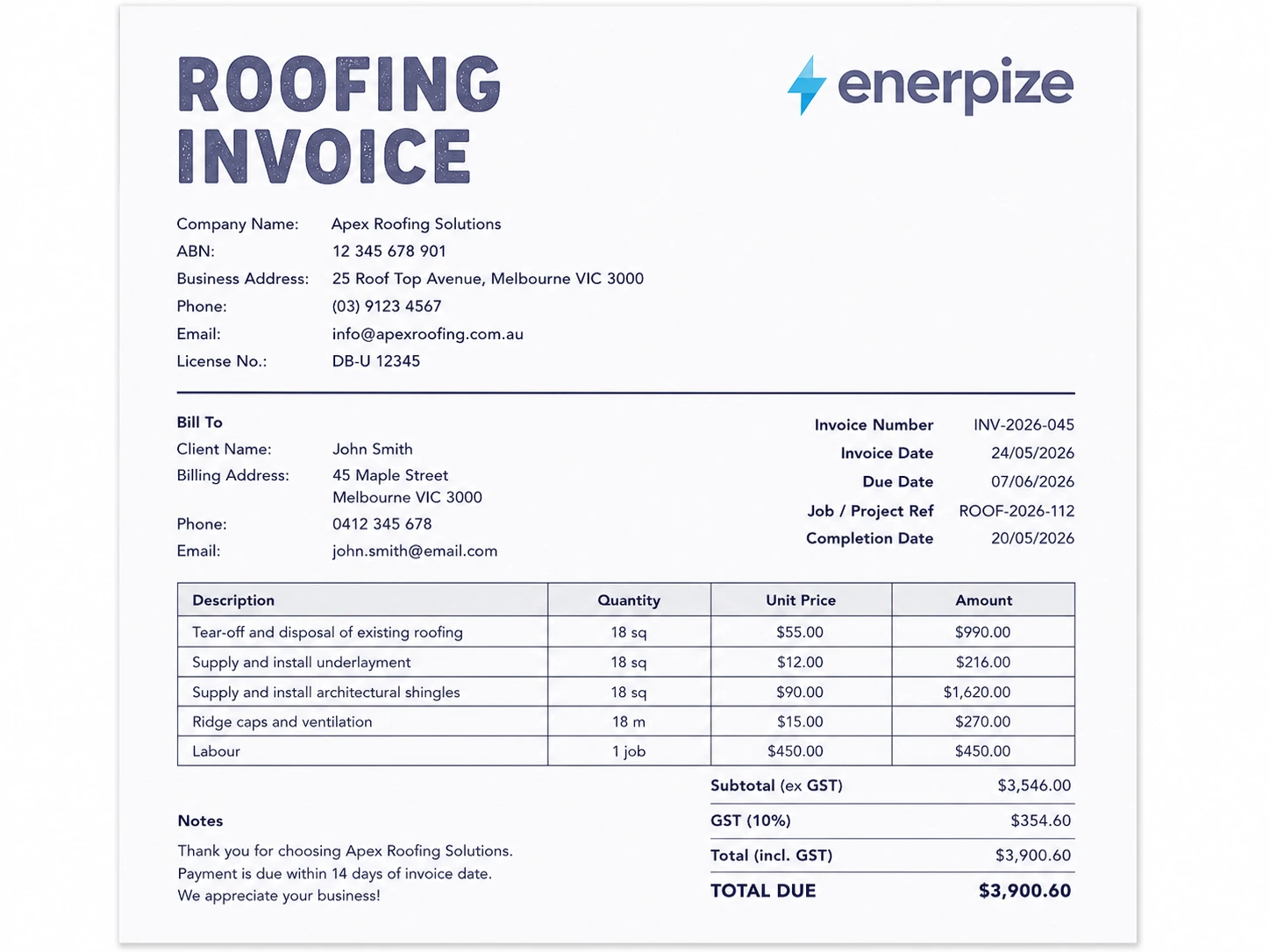
What Is a Roofing Invoice Template?
Picture the last roof you replaced. The tear-off, the two dumpster loads of old shingles, the crew standing around at 7 a.m. drinking gas station coffee before the sun got too hot to work in. All of that labor, all of that material, all of it has to turn into one clean piece of paper the homeowner actually understands and pays.
That's the job of a roofing invoice template. It's not the quote you gave before the work started, and it's not a handwritten receipt scribbled on the back of a business card. It's the formal bill, the one that says here's what we did, here's what it cost, and here's when we need to get paid.
A roofing job rarely looks like a simple service call. You've got squares of shingles, rolls of underlayment, flashing kits, a crew that worked six hours instead of the four you quoted because the old deck was rotted through in two spots nobody saw from the ground. A generic invoice template built for a plumber or a landscaper won't hold that kind of detail. Even our own construction invoice template, built for general contracting work, doesn't carry the squares-based pricing or insurance claim fields roofing specifically needs. Roofing needs its own structure, one that separates labor from materials, tracks the job by squares the way every roofer already thinks about pricing, and leaves room for the insurance paperwork when a storm claim is involved.
Stop rebuilding this invoice from scratch every job. Generate it automatically in Enerpize, with labor, materials, and insurance details already structured for you. Start for free.
What to Include in a Roofing Invoice Template
Most free templates floating around online give you a name field, a total, and a signature line. That gets you paid for a small patch job. It does not get you paid cleanly for a full tear-off, and it definitely does not hold up if the homeowner's insurance company starts asking questions six weeks later.
Here's what an invoice built for real roofing work actually needs.
| Field | Why It Matters |
|---|---|
| Invoice Number | Sequential reference for your books and for matching against the estimate |
| Issue Date | When the invoice was created |
| Completion Date | When the work actually wrapped, separate from the issue date |
| Contractor License Number | Proof you're a licensed operator, which several states require on the invoice itself |
| Bill To (Client Details) | Name, address, phone, and email of the person paying |
| Job Site Address | The property where the work happened, since it's not always the billing address |
| Project or Job Reference | Ties the invoice back to the estimate and the job file |
| Labor Line Items | Description of the work, squares covered, hours or quantity, rate, amount |
| Materials Line Items | Shingles, underlayment, flashing, unit, quantity, unit price, amount |
| Equipment Rental | Lift rental, dump trailer, or any equipment billed separately |
| Transportation and Disposal | Hauling and dump fees for the old roofing material |
| Subtotal | Labor plus materials before tax |
| Tax | Sales tax, GST, or VAT depending on where you operate |
| Insurance Claim Number | For jobs billed through a homeowner's insurance policy |
| Policy Number | Cross-reference for the insurer's file |
| Deductible Applied | What the homeowner owes directly versus what the insurer covers |
| Warranty Terms | Workmanship warranty length and manufacturer warranty reference |
| Payment Terms | Due date, accepted payment methods, late fee policy |
| Signatures | Contractor and client, both dated |
The two fields nobody else seems to think about are the squares column and the insurance claim block. Every roofer prices in squares. Almost no invoice template built for general contractors gives you a place to put that number, which means you end up bolting it into a description field where it gets lost.
And insurance jobs make up a massive share of residential roofing work in storm-prone regions, yet most templates treat the insurance side as an afterthought instead of a structured part of the document. That's true of most general trade documents too, including our own contractor invoice template, which is why roofing gets a structure of its own here rather than a shared one.
How Roofing Invoices Are Priced: Understanding "Squares"
If you've never worked in roofing, the pricing looks strange at first glance. Nobody bills by the square foot. They bill by the square, which is a 10-foot by 10-foot section of roof, or 100 square feet.
A typical residential roof runs somewhere between 15 and 40 squares depending on the size and pitch of the house. Material and labor costs get quoted per square, and that number moves depending on the roofing material, the pitch, the number of layers being torn off, and how complicated the roofline is. A simple gable roof prices differently than a roof with six valleys, three dormers, and a chimney flashing detail that takes an extra hour to get watertight.
An invoice that only shows a lump sum total hides all of that. An invoice that breaks the job into squares, shows the rate per square, and lists labor separately from materials gives the homeowner something they can actually compare against the original estimate. It also gives you, the contractor, a paper trail if a dispute ever comes up about whether the job matched what was quoted.
What the Enerpize Roofing Invoice Template Includes
Every template we build starts with the same question. What do the top-ranking templates online get wrong, and what does a roofer actually need that none of them bothered to include?
Here's what sets ours apart.
Squares-Based Line Items, Not Generic Quantity Fields
Every competitor template we reviewed uses a plain quantity and unit price column borrowed from a general contractor invoice. Ours has a dedicated squares field sitting right next to hours and quantity, so the invoice matches how you actually price the job instead of forcing you to explain squares in a description box.
A Structured Insurance Claim Section
Storm damage work runs through insurance more often than not, and yet almost no free roofing invoice template gives that process its own space. Ours has a dedicated block for the claim number, policy number, adjuster or insurer name, and the deductible applied, right on the invoice itself, not buried in a notes field where the adjuster has to go hunting for it.
Separated Labor and Materials Tables
Tear-off, underlayment, shingle installation, and crew hours sit in one table. Shingles, flashing, vents, equipment rental, and disposal sit in another. That split matters because labor and material costs move independently. If shingle prices spike or a job runs longer than planned, you can see exactly where the number changed instead of trying to untangle one long combined list.
Warranty Terms as a Real Field, Not an Afterthought
Workmanship warranties and manufacturer warranties get mentioned in a sentence buried at the bottom of most templates, if they're mentioned at all. Ours gives warranty length, manufacturer reference, and start date their own row, because a warranty that only exists in a verbal conversation is not a warranty a homeowner can rely on six years later when a shingle lifts.
Job Site Address Separate From Billing Address
The person paying the bill and the property that got the new roof are not always the same address. Rental property owners, property managers, and out-of-state homeowners need that distinction built in, not assumed.
Behind all of it sits Enerpize, which handles the invoicing, the project cost tracking, and the labor allocation so none of this lives in a spreadsheet you have to remember to update.
See the whole invoice built for you, squares, insurance fields, and all. Start for free.
Roofing Invoice vs. Roofing Estimate vs. Roofing Contract
People use these three words like they're interchangeable. They're not, and mixing them up on paper can cost you a payment dispute down the line.
| Document | Purpose | Legally Binding? | Sent When |
|---|---|---|---|
| Roofing Estimate | A projected cost before work starts | No, it's a projection | Before the job is agreed to |
| Roofing Contract | The formal agreement on scope, price, and terms | Yes | Once the client agrees to proceed |
| Roofing Invoice | The final bill for work completed | Creates a payment obligation | After the job is finished, or at agreed billing milestones |
A roofing estimate can move. If you haven't sent one yet, our quotation template covers that first step, the one before any of this invoice ever gets written. A roof tear-off that reveals rotted decking changes the math, and a good contractor documents that change before finishing the job, not after. The invoice is the one document that has to match reality exactly, because it's what you're actually asking to be paid for.
How to Use the Roofing Invoice Template
Step 1: Fill In Your Business and License Details
Add your company name, address, phone, email, and your contractor license number. Several states require the license number to appear on the invoice, not just the contract, so don't skip it.
Step 2: Add the Client and Job Site Information
Enter the client's billing details under Bill To. If the property being worked on is different from the billing address, which happens often with rental properties, fill in the Job Site Address field separately.
Step 3: Assign the Invoice Number and Dates
Give the invoice a sequential number, add the issue date, and add the completion date. The completion date matters because it's the trigger point most homeowners use to decide when the clock starts on payment.
Step 4: List Labor Line by Line
Break the labor into individual tasks: tear-off, underlayment installation, shingle installation, ridge cap work. Enter the squares covered for each line, the hours or quantity, and the rate.
Step 5: List Materials Separately
Shingles, underlayment, flashing, vents. Enter the unit, the quantity, and the unit price for each. In the Excel version, the amount calculates automatically once you enter quantity and price.
Step 6: Add Equipment and Disposal Charges
If you rented a lift or a dump trailer, or if you're billing separately for hauling and disposal of the old roofing material, add those as their own lines rather than folding them into materials.
Step 7: Complete the Insurance Section If Applicable
If the job is being paid through a homeowner's insurance claim, fill in the claim number, policy number, adjuster or insurer name, and the deductible amount the homeowner owes directly.
Step 8: Confirm Warranty Terms
Enter your workmanship warranty length and reference the manufacturer warranty if one applies, along with the start date. This becomes the record the homeowner points back to if something goes wrong down the line.
Step 9: Set Payment Terms and Collect Signatures
State your payment due window, accepted payment methods, and any late fee policy. Have both the contractor and the client sign and date the invoice. And if a warranty issue or a billing correction comes up after the fact, that's what our credit note template is for, not a reissued invoice.
Roofing Invoices for Insurance Claims
Insurance work runs differently than a straightforward cash job, and treating it like a normal invoice is where a lot of roofers lose time chasing payment.
The adjuster needs to see that the invoiced amount matches the approved scope of work. If your invoice shows a line item the adjuster didn't approve, expect a delay while that gets sorted out, and expect to be the one making the follow-up calls. The deductible is the homeowner's direct responsibility. Everything above that deductible, up to the approved amount, comes from the insurer.
What an Insurance-Billed Roofing Invoice Needs
- The insurance claim number, so the invoice can be matched to the insurer's file instantly
- The policy number
- The adjuster's name or the insurer's name, so there's a direct point of contact if a question comes up
- The deductible amount, clearly separated from the insurer-covered portion
- A scope of work that mirrors the adjuster's approved estimate line for line, so nothing looks like a surprise addition
Storm damage, hail damage, and wind damage claims all move faster when the paperwork is clean from the start. A roofer who hands over a well-structured invoice on day one gets paid faster than one who scrambles to reconstruct the claim details after the adjuster asks for them. Commercial roofing jobs with retention and progress billing follow a similar logic; our AIA G702/G703 template covers that structured payment application process for larger contracts.
How Enerpize Connects Roofing Invoices to Your Entire Operation
A standalone invoice template answers one question: what does the homeowner owe. It does not answer what a busy roofing contractor actually needs to know day to day. Which crew worked which job. Whether the materials on this invoice match what's left in the truck. Whether the retention amount on a commercial roofing contract has been tracked properly. Whether this job is actually profitable once labor hours and material costs are counted against what got quoted.
Retention Discounts on Invoices
Enerpize lets you generate contractor invoices in installments or as a lump sum, with retention discounts calculated and shown clearly on the invoice itself. Retention gets calculated on the total items after tax, which matches how most commercial roofing and construction contracts are structured. When retention is released at the end of a project, it's tracked directly in the system instead of living in a side spreadsheet somebody has to remember to update.
Project-Level Cost Tracking
Add each roofing job as its own project, complete with site address, photos, and budget. Enerpize tracks profitability and cost reports per project, so you know at any point in the job whether your labor and material costs are holding against what you quoted, not just after the final invoice goes out.
Labor Time and Cost Allocation
Every crew member's hours and hourly rate get allocated directly to the project they worked on. Labor costs flow into the project's cost report automatically, so the numbers on your invoice reflect actual time on the roof, not a guess made after the fact.
Flexible Price Lists for Materials
Shingle and material costs shift depending on supplier, order volume, and client agreement. Enerpize supports multiple price lists so you can maintain project-specific material pricing without overwriting your standard rates for other jobs.
Purchase and Supplier Management
Track material suppliers and manage purchase invoices against the project budget in one place. When a stored materials claim needs backup documentation for an insurance job, the purchase record is already sitting in the system.
See how Enerpize handles roofing invoices, project costs, and crew time in one place. Start for free.
Roofing Invoice Template for Businesses in the United States
Roofing in the US runs heavily on insurance-driven demand, particularly in hail and wind corridors across the Midwest and South. A roofing invoice here needs to hold up not just as a bill but as documentation an insurance adjuster and, if it ever comes to that, a small claims court will take seriously.
Most states require contractors to display their license number on official documents, including invoices, not just on the original contract. Sales tax on roofing materials and labor varies significantly by state and, in some cases, by county, so confirm your local rate rather than assuming a flat national figure. You can check your state's specific rate and rules through the Sales Tax Institute's state-by-state guide, since roofing materials and labor aren't always taxed the same way in every state.
For insurance claims, keep the invoice's scope of work aligned exactly with the adjuster's approved estimate. A mismatch between what you invoiced and what was approved is one of the most common reasons payment gets delayed on storm damage jobs.
Roofing Invoice Template for Businesses in the United Kingdom
Roofing contractors operating under the Construction Industry Scheme (CIS) need to account for CIS deductions on invoices where the work falls under that scheme, since HMRC treats payments to subcontractors differently from a standard invoice. You can find the current CIS rules directly on HMRC's Construction Industry Scheme guidance page.
If you're VAT registered, your invoice needs to meet HMRC's VAT invoice requirements, which means showing your VAT registration number, the VAT rate applied, and the VAT amount separately from the net total. A delivery note or a job sheet is not a substitute for a proper VAT invoice if your client wants to reclaim input VAT.
Retention on larger UK roofing and construction contracts is common practice too, so if you're working under a retention arrangement, show the retained amount and the release schedule clearly rather than folding it into a single total.
Roofing Invoice Template for Businesses in Australia
Australian roofing contractors need to include their ABN on every invoice, and if you're GST registered, the invoice becomes a tax invoice the moment the total crosses the threshold set by the Australian Taxation Office's tax invoice requirements. Above that threshold, the invoice needs to clearly state it's a tax invoice, show the GST amount, and include both your ABN and, where relevant, the client's ABN.
Roofing work priced by the square still applies in Australia the same way it does elsewhere, but GST gets calculated on the full invoiced amount, materials and labor combined, so keep that math separate from your US-based cost sheets if you're working from a template built for a different market.
Roofing Invoice Template for Businesses in South Africa
South African roofing contractors need a tax invoice the moment VAT gets involved, and the requirements shift depending on the size of the job. Under the South African Revenue Service's VAT invoice requirements, a full tax invoice is required for supplies above R5,000, showing your VAT registration number, the VAT amount charged, and both supplier and recipient details. Jobs priced between R50 and R5,000 can use an abridged tax invoice instead.
Storm and hail damage claims work through insurers in South Africa much the same way they do elsewhere, so the same discipline applies. Keep the invoiced scope of work matched to what the insurer approved, and keep the deductible clearly separated from the portion the insurer is covering. If SARS ever queries a return, a signed invoice that lines up cleanly with the claim file is what makes that conversation short instead of drawn out.
Retention arrangements on larger commercial roofing contracts are common practice here too, so if you're working under one, show the retained amount and release terms as their own line rather than folding them quietly into the total.
Key Takeaways
- A roofing invoice template needs to separate labor from materials, because the two move independently and homeowners deserve to see where their money actually went.
- Squares-based pricing is standard in roofing but missing from almost every generic invoice template, which forces contractors to bury pricing logic in a description field instead of a proper column.
- Insurance claims deserve a dedicated section on the invoice itself, with claim number, policy number, adjuster details, and deductible clearly separated from the total.
- Warranty terms belong in a structured field, not a sentence at the bottom of the page, since a homeowner needs something concrete to point back to years later.
- Job site address and billing address are not always the same, and a template that assumes they are will cause confusion on rental properties and out-of-state ownership.
- Country rules matter. CIS and VAT apply in the UK, GST and ABN requirements apply in Australia, and license number and state sales tax rules apply across the US.
- The invoice is not the estimate and not the contract. It's the final record of what was actually done, and it needs to match reality exactly.
Frequently Asked Questions
What is a roofing invoice?
A roofing invoice is the formal billing document a roofing contractor sends a client after work is completed. It lists the labor performed, the materials used, and the total amount owed, and it creates the payment obligation the way an estimate or a contract does not.
What should a roofing invoice include?
At minimum, it needs an invoice number, issue and completion dates, contractor license number, client and job site details, separate labor and materials line items, tax, payment terms, and signatures. Insurance jobs need a claim number, policy number, and deductible amount as well.
What is the difference between a roofing invoice and a roofing estimate?
A roofing estimate is a projected cost given before work begins, and it can shift if the job uncovers something the original quote didn't account for, like rotted decking under old shingles. A roofing invoice is the final bill for work actually completed, and it should match what was done, not what was originally projected.
How is roofing priced, and what is a square?
A square is a 10-foot by 10-foot section of roof, or 100 square feet. Roofers price labor and materials by the square rather than by square footage directly, since it's a cleaner unit for estimating shingle bundles, underlayment rolls, and crew time.
Do roofing invoices need to include insurance claim information?
Only when the job is being paid through a homeowner's insurance policy. When it is, the invoice should include the claim number, policy number, adjuster or insurer name, and the deductible amount owed directly by the homeowner, separate from the insurer-covered portion.
Can I use a roofing invoice template in Excel?
Yes, and it's one of the more practical formats for contractors who invoice regularly. The Enerpize Excel version calculates labor subtotal, materials subtotal, tax, and total due automatically once you enter your quantities and rates.
How long should I keep roofing invoice records?
Retention periods vary by country and by tax authority, so check the specific requirement in your jurisdiction. As a general practice, keeping invoices for at least as long as your workmanship warranty is active, plus your local record-keeping requirement, protects you if a dispute or warranty claim comes up years later.
About the Author
Omar El Bahr is a Senior Digital Growth Specialist at Enerpize, where he leads SEO, content strategy, and organic growth across international markets. He is a Forbes Communications Council contributor and has written for Entrepreneur on business communication and digital strategy.
Disclaimer: This template and article are provided for general informational purposes only and do not constitute legal, tax, or accounting advice. Requirements for licensing, tax, and invoicing vary by jurisdiction and change over time, so confirm current rules with a qualified professional or your local tax authority before relying on this template for your business.