

Posted on 10 June 2026
Free Cleaning Invoice Template Download: Word, Excel, PDF & Google Sheets
- The cleaning invoice template is available for download in Word, Excel, PDF, Google Docs, and Google Sheets.
- Itemizes every service performed, labor hours, supplies provided, and applicable taxes so your clients know exactly what they owe and when payment is due.
- Calculates subtotals, tax amounts, and the final balance automatically in the Excel and Google Sheets versions, so you never do the math twice.
- Covers residential cleaning, commercial office cleaning, janitorial services, and independent cleaners in a single template built around real billing scenarios.
A cleaning invoice template is a pre-formatted billing document that records the services performed, costs, applicable taxes, and total amount due for any cleaning job.


What Is a Cleaning Invoice Template?
Most cleaning businesses start with a handwritten note or a basic Word file. That works for one client. It stops working the moment you have five.
A cleaning invoice template gives you a consistent, professional billing document you can fill out and send for every job without starting from scratch. It is not just a format. It is a record. A legally referenceable document that tells your client exactly what was cleaned, what it cost, and when you expect to be paid.
Here is the distinction most people miss.
What Is the Difference Between a Cleaning Bill and a Cleaning Invoice?
A cleaning bill is informal. It shows an amount. It has no sequential number, no legal standing, and often no detail. Clients lose it, dispute it, or conveniently forget it.
A cleaning invoice is a formal commercial document. It carries a unique invoice number, legally required fields depending on your country, and a traceable record you can reference at tax time or in a payment dispute. In the UK, Australia, and Canada, issuing a proper invoice is a compliance requirement, not a preference.
If you are VAT-registered in the UK, your invoice must meet specific HMRC standards. If you operate in Australia with an ABN, the ATO requires a tax invoice for any sale above AUD 82.50. A cleaning bill does not satisfy either requirement. A properly structured cleaning invoice does.
The Enerpize cleaning invoice template works for three audiences: cleaning companies managing multiple crews and client accounts, independent cleaners and self-employed cleaners billing individual clients, and facility managers handling ongoing janitorial contracts.
Start invoicing for your cleaning business. Start for free.
What the Enerpize Cleaning Invoice Template Includes
Most cleaning invoice templates give you a table with four columns and a total at the bottom. Ours goes further.
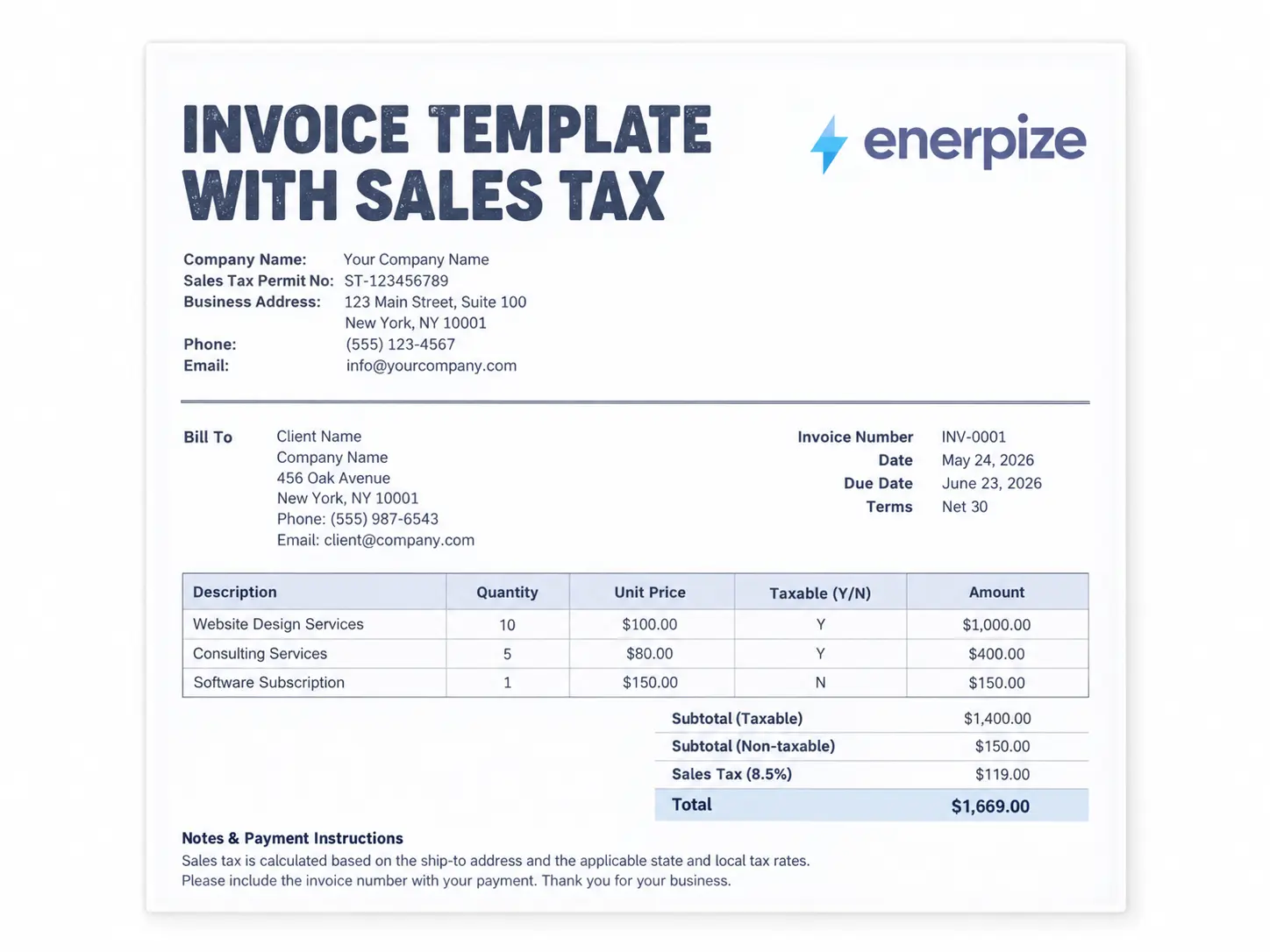
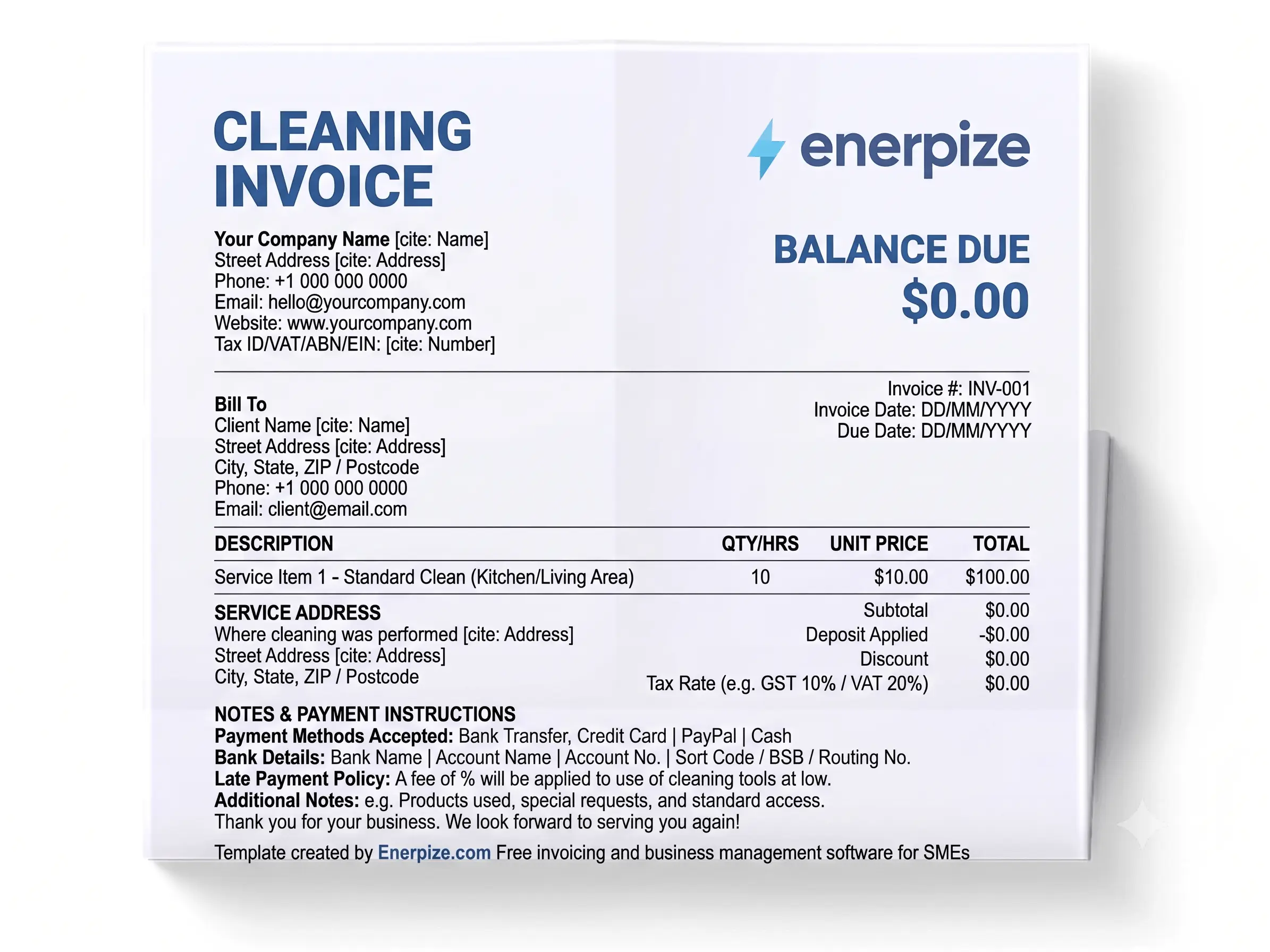
Every field in the Enerpize cleaning invoice template is there for a reason. Here is exactly what you get and what each section captures.
Template Header Fields
| Field | What It Captures |
|---|---|
| Business Name and Logo | Your cleaning company's brand identity at the top of every invoice |
| Business Address and Contact | Phone, email, and website so clients can reach you without searching |
| Tax ID, VAT Number, ABN, or EIN | Required for UK VAT invoices, Australian GST tax invoices, and US tax reporting |
| Client Name | The person or organization being billed |
| Service Address | Where the cleaning actually happened, which is often different from the billing address |
| Invoice Number | A sequential unique number for record-keeping, dispute resolution, and client accounts payable |
| Invoice Date | The date the invoice is issued |
| Due Date | Your payment deadline, with Net 14 as the default but fully configurable |
| Payment Terms | Net 7, Net 14, Net 30, or due on receipt |
Line Item Fields
| Field | What It Captures |
|---|---|
| Service Description | The specific cleaning task: standard clean, deep clean, move-in or move-out clean, carpet cleaning, window cleaning |
| Quantity or Hours | Hours worked, number of sessions, rooms, or square footage depending on how you bill |
| Unit Price | Your hourly rate or flat fee per service |
| Tax Rate | GST for Australia, VAT for the UK, or applicable sales tax for the US and Canada by province |
| Line Total | Quantity multiplied by unit price, auto-calculated in the Excel and Google Sheets versions |
| Cleaning Supplies | Separately itemized when the cleaner provides their own products |
| Add-On Services | Deep clean upgrades, after-hours surcharges, pet hair removal, inside oven or fridge cleaning |
Summary Fields
| Field | What It Captures |
|---|---|
| Subtotal | Total before tax and discounts |
| Deposit Applied | Deposit received and deducted from the balance, shown clearly on the invoice |
| Discount | Loyalty discount for recurring clients or promotional pricing |
| Tax Amount | Applied at the correct rate for your country, displayed as a separate line |
| Total Due | The final amount payable after all deductions and additions |
| Notes | Special requests, products used, areas that needed extra attention, and your late payment policy |
No competitor template lists every field at this level of detail. Most show you a screenshot and a download button. This is what you are actually getting.
How to Fill Out a Cleaning Invoice Template
Filling out your first cleaning invoice takes about three minutes. Every invoice after that takes less.
Here are the eight steps, in order.
Step 1: Add your business information. Enter your company name, address, phone number, email, website, and your tax ID, VAT number, or ABN depending on your country. This goes at the top of the invoice and never changes between jobs.
Step 2: Enter the client's name and the service address. The service address is where the cleaning happened. This is often different from the client's billing address, especially for rental properties, commercial premises, or clients who book cleaning for a second location.
Step 3: Assign a unique invoice number and set the issue date. Use a sequential format like INV-001 or CLN-2026-001. This number is what your client's accounts payable team will reference when they process payment, and it is what you reference if a payment is late.
Step 4: Set your due date and payment terms. Net 14 is standard for most cleaning businesses. For commercial clients, Net 30 is common. For first-time residential clients, due on receipt is reasonable. Whatever you choose, make it visible and specific.
Step 5: List every service you performed as a separate line item. One line per service. Include the description, the quantity or hours, and the unit rate. Do not bundle everything into a single row. Clients who see a detailed breakdown pay faster and dispute less.
Step 6: Add any cleaning supplies or materials charged to the client. If you provided products, list them separately with cost. This protects you if a client questions what they are paying for, and it gives you a record for your own expense tracking.
Step 7: Apply the correct tax rate for your country and calculate the total. The Excel and Google Sheets versions calculate this automatically once you enter the rate. The tax rate goes in as a decimal: 0.10 for GST at 10%, 0.20 for VAT at 20%, 0 if not applicable. A note on the template explains this.
Step 8: Add your notes, payment instructions, and a closing line. Include accepted payment methods, your bank details or PayPal link, your late payment fee policy, and any job-specific notes for the client. A short thank-you at the end costs nothing and builds the relationship.
That is it. Save a copy for your records and send.
Cleaning Invoice Line Items: What to Charge and How to List It
This is where most cleaning invoices fall apart. Either everything gets bundled into one line, which invites disputes, or nothing gets itemized at all, which causes confusion at payment time.
The table below covers the most common cleaning services and charges, how to unit them, and when sales tax applies. This level of detail does not exist on any other cleaning invoice template page.
| Service or Charge | Unit | Taxable | When to Use |
|---|---|---|---|
| Standard cleaning labor | Hours | Varies by state or country | Recurring or one-time general clean |
| Initial deep clean | Flat fee | Varies | First visit or heavy buildup at a new client's property |
| Move-in or move-out clean | Flat fee | Varies | Empty property turnover, includes inside cabinets and appliance wipe-downs |
| Inside oven cleaning | Per item | Varies | Baked-on grease, extra time and degreaser required |
| Inside fridge cleaning | Per item | Varies | Spills, odors, sticky shelves |
| Interior window and sill cleaning | Per window | Varies | Fingerprints, tracks, dust buildup |
| Carpet cleaning | Per room or sq ft | Varies | Deep soil, pet hair, stains |
| Post-construction dusting | Hours | Varies | After renovation or repairs, requires HEPA equipment |
| Cleaning supplies provided | Per visit | Taxable in most US states | When the cleaner brings their own products |
| After-hours or weekend surcharge | Flat fee | Varies | Jobs starting after 6pm or on weekends |
| Pet hair removal surcharge | Per visit | Varies | Pet-heavy homes requiring extra time and specialized products |
| Late cancellation fee | Flat fee | Generally not taxable | Less than 24-hour notice, applied as a separate line |
| Parking, tolls, or mileage | Pass-through | Generally not taxable | Locations outside your standard service area |
A note on US sales tax: In most states, residential cleaning services are exempt. Several states do tax them, including Connecticut, Hawaii, New Mexico, South Dakota, Tennessee, and Texas. If you provide cleaning supplies as part of the service, those materials may be taxable as a product sale in some jurisdictions. Check your state's department of revenue rules before deciding how to handle tax on your invoices. Avalara's state-by-state service taxability guide covers which states tax cleaning services
For clients who book your freelance cleaning services as an independent contractor arrangement, keep each service on its own line. It simplifies your own bookkeeping and removes any ambiguity when clients review what they were charged.
Cleaning Invoice Templates by Service Type
Not every cleaning job bills the same way. Here is how the template adapts to each scenario.
House Cleaning Invoice Template
Residential domestic clients are your most common use case. They book recurring visits, weekly or biweekly, and expect a simple, readable invoice that arrives promptly after each clean.
For a house cleaning invoice template, the key fields are room count or hours worked, whether supplies were included or client-supplied, and whether a deposit was applied for a first-time deep clean. Most residential clients pay on receipt or within seven days. Bill on the day of completion. Waiting a week trains clients to expect delay.
Commercial Cleaning Invoice Template
Commercial clients operate differently. They have accounts payable departments, purchase order numbers, and Net 30 payment cycles built into their processes.
A commercial cleaning invoice template needs the client's purchase order number, the square footage or specific areas covered, the crew size, and the service frequency. Quarterly reconciliation invoices covering a summary of monthly visits are common for office cleaning contracts. Keep every individual visit invoiced separately and issue a summary statement at contract review.
Office Cleaning and Janitorial Invoice Template
Janitorial services go deeper than standard commercial cleaning. A janitorial invoice template often includes consumables replenishment, such as toilet tissue, hand soap, paper towels, and bin liners, listed separately from labor. Some contracts also include a facility condition report attached as supporting documentation. If your janitorial contract includes a service level agreement, reference the SLA on the invoice so both parties have a written record of what was committed.
Self-Employed Cleaner Invoice Template
If you are operating as an independent cleaner or sole trader, your invoice needs to include your personal tax ID. That is a UTR number in the UK, an ABN in Australia, and an EIN or SSN in the US.
It also needs to show clearly whether you are VAT or GST registered. If you are not registered, do not add a tax line. Adding VAT to an invoice when you are not registered is a compliance issue in the UK.
In Canada, self-employed cleaners generating over CAD 30,000 in annual revenue must register for GST and HST. Once registered, every invoice needs your GST or HST registration number. For contractor billing arrangements, the same logic applies: the number goes on the invoice or the invoice is incomplete.
Cleaning Invoice Requirements by Country
Cleaning Invoice Template: United States
There is no federal invoicing standard in the US. But cleaning businesses do need to include their EIN or SSN on invoices for tax reporting purposes. Sales tax on cleaning services varies by state. Residential cleaning is taxable in Connecticut, Hawaii, New Mexico, South Dakota, Tennessee, and Texas, among others. Commercial janitorial services face broader taxability rules depending on the state.
A valid US cleaning invoice needs your business name and address, the client's name, a unique invoice number, the date of issue, a description of services, the total charged, and your preferred payment method. A tax line is included only if your state requires it for cleaning services.
Cleaning Invoice Template: United Kingdom
If your cleaning business turns over more than £85,000 per year, you must register for VAT and issue VAT invoices to every client.
A valid UK VAT invoice must include your business name, address, and VAT registration number. It must show the invoice date, a unique invoice number, the client's name and address, a description of the services, the VAT rate and amount charged per line item, and the total inclusive of VAT. HMRC's VAT rules for charging, reclaiming, and recording set out the full requirements.
If you are a sole trader cleaner below the VAT threshold, a simplified invoice without VAT fields is sufficient. But you still need a unique invoice number and a clear payment due date.
The query "cleaning invoice template UK" sits at position 20 in search with 194 impressions and near-zero clicks. That is a direct gap this page is built to close.
Cleaning Invoice Template: Australia
Australian cleaners registered for GST must issue a tax invoice for any sale above AUD 82.50. The words "Tax Invoice" must appear in the header. The invoice must show your ABN, the GST amount charged or a statement that the price includes GST, and the date of issue.
For cleaning businesses not yet registered for GST, which means annual turnover below AUD 75,000, a standard invoice without GST fields is correct. Do not add a GST line to an invoice if you are not registered. The ATO's tax invoice requirements cover the exact rules.
For Australian cleaning businesses, the Australian GST invoice template on the Enerpize templates library includes the correct header fields, ABN field, and GST calculation row pre-built.
Cleaning Invoice Template: Canada
Canadian cleaning businesses registered for GST and HST must collect and remit the tax. The GST rate is 5% federally. HST rates vary by province: 15% in Nova Scotia, New Brunswick, Newfoundland, and PEI, and 13% in Ontario. Quebec applies QST at 9.975% separately from GST.
A valid Canadian cleaning invoice must include your business name, your GST or HST registration number, the invoice date, a description of services, the total charged, and the GST or HST amount as a separate line. Self-employed cleaners generating over CAD 30,000 annually must register before billing. The CRA's GST and HST guide for businesses is the authoritative reference.
Enerpize handles tax calculations automatically for your country. Start for free.
How Cleaning Businesses Use Enerpize Beyond the Invoice
A cleaning invoice template handles one moment in your billing cycle. The moment the job is done and the number needs to go somewhere.
Everything before that moment, and everything after it, is where most cleaning businesses lose time. Chasing clients for confirmations. Manually updating schedules. Cross-referencing a payment spreadsheet against a calendar. Sending a reminder you already sent last week.
Enerpize is built to remove all of that. Here is how cleaning businesses across residential, commercial, and dry cleaning operations use it.
For Cleaning Companies
Running a cleaning business with multiple crews is a coordination problem as much as it is a billing problem. You are managing visit schedules, client preferences, staff assignments, supply levels, and cash flow at the same time. A static invoice template solves none of that. It just gives you a formatted document at the end.
Enerpize connects the whole operation. Cleaning businesses use it to issue invoices directly from the job record, so there is no manual data transfer between what was done and what gets billed. Payments are collected online via credit card, bank transfer, or PayPal, and every transaction is recorded automatically against the client account.
Client files store the full visit history, contract details, notes, and attachments in one place. When a client calls to ask about a previous visit or dispute a charge, the answer is already there. You are not searching through email threads or handwritten logs.
SMS and email alerts keep clients informed of the next scheduled visit, without any manual follow-up from your team. The online booking portal takes it further: clients schedule their own cleaning appointments through their own portal, and those bookings feed directly into the work order and invoicing queue with no double entry anywhere in the process.
The result is a billing cycle that closes itself. Job completed, invoice generated, payment collected, records updated.
Explore cleaning business management software built specifically for the industry.
For Dry Cleaning Operations
Dry cleaning has a workflow that no standard invoice template is built around. You are not just billing for a service performed at a location. You are managing a physical item that comes in, gets processed across a timeline, and goes back out. The gap between receipt date and delivery date is your entire operational window, and it needs to be tracked.
Static templates cannot do that. They capture the billing moment but ignore everything that leads to it.
Enerpize tracks the full dry cleaning cycle. You set receiving dates and delivery dates per order. Automated status updates go out to clients at each stage, so they know where their items are without calling you. Inventory of cleaning materials and equipment is managed in the same system, with usage tracked per order and stock levels monitored in real time.
Invoices for cleaning and ironing services are generated with taxes and delivery fees included, pulled from the order record rather than typed from scratch. When the order closes, the invoice is ready.
For dry cleaning businesses operating at volume across multiple locations, this removes the administrative layer that usually sits between the service and the payment.
Explore dry cleaning business management built around the operational reality of the industry.
Staff, Inventory, and Reporting in One System
Most cleaning businesses run three systems in parallel: something for scheduling, something for invoicing, and something for payroll. They do not talk to each other. Data gets re-entered at every handoff. Errors compound.
Enerpize collapses all three into one.
On the staff side, each employee is assigned to specific client accounts with full activity logging. Attendance is tracked against expected working hours and shift rules, with the system generating a monthly summary of absences, late arrivals, and early departures automatically. You are not pulling timesheets manually at the end of the month. You are looking at a report that is already built.
On the inventory side, cleaning product consumption is tracked per visit. When stock falls below your set threshold, Enerpize generates a low-inventory alert and you can issue a purchase order to your supplier directly from the system. You do not run out of supplies because you forgot to check a shelf. The system tells you before it becomes a problem.
On the financial side, profit and loss reports, income statements, and expense breakdowns are available in real time. Not at month-end. Not when your accountant asks for them. Now. Every transaction from every crew, every client, and every location feeds into a single chart of accounts that gives you a live view of where your business stands.
For cleaning companies that have grown past the point where a spreadsheet and a template can manage the operation, this is the difference between running the business and being run by it.
Cleaning Invoice Template vs. Cleaning Invoice Software
For a cleaning business billing one or two clients a week, a static template is perfectly sufficient. For a business running multiple crews, managing recurring contracts, and trying to close the books without manually re-entering payment data, software removes the friction that templates cannot.
Here is the practical comparison.
| Feature | Static Template (Word, Excel, PDF) | Enerpize Invoicing Software |
|---|---|---|
| Tax calculation | Manual entry | Automatic by country |
| Invoice numbering | Manual, user-managed | Sequential, auto-assigned |
| Payment tracking | Separate spreadsheet or memory | Real-time dashboard |
| Recurring invoices | Copy and edit each time | Automated on schedule |
| Multi-currency | Manual conversion | Built-in |
| Client database | Separate file | Integrated CRM |
| GST and VAT compliance | User must know the rules | Configurable by country |
| Overdue reminders | Calendar or memory | Automated alerts |
| Download formats | One format per template file | PDF, email, and print from one source |
The tipping point is usually ten or more active clients. Below that, the template handles it. Above that, the manual overhead compounds quickly.
For clients who need a receipt after payment rather than an invoice before it, the receipt template covers that separately.
Key Takeaways
- A cleaning invoice template should itemize every service performed, including labor hours, cleaning supplies, and any add-on charges, so there is no ambiguity at payment time.
- The Enerpize template auto-calculates subtotals, taxes, and totals in the Excel and Google Sheets versions, removing manual arithmetic from the equation.
- UK-based cleaning businesses must apply VAT on their invoices once annual turnover exceeds £85,000, which requires a dedicated VAT invoice format separate from standard invoices.
- Australian cleaners invoicing under the GST system must include their ABN and a "Tax Invoice" header on any invoice above AUD 82.50.
- Independent cleaners and self-employed cleaners benefit from including a unique invoice number on every document to comply with bookkeeping and tax requirements in the US, UK, Australia, and Canada.
- Cleaning invoice software like Enerpize automates the entire billing cycle, from quote to invoice to payment tracking, removing the manual work that static Word or PDF templates require.
Ready to replace your template with automated invoicing? Start for free.
Frequently Asked Questions
What should a cleaning invoice include?
A cleaning invoice should include the business name, address, and contact details, the client's name and service address, a unique invoice number, the invoice date and payment due date, a line-item breakdown of every service performed with description, quantity, rate, and total, the subtotal, applicable taxes based on the country, any discounts, and the final total due. A notes section for payment instructions and special requests rounds out a complete invoice.
What is the difference between a cleaning bill and a cleaning invoice?
A cleaning bill is an informal document showing an amount owed, typically without sequential numbering or legal standing. A cleaning invoice is a formal commercial document with a unique invoice number, legally required fields, and a traceable record for tax purposes. Invoices are required for VAT and GST compliance in the UK, Australia, and Canada.
When should I send a cleaning invoice?
For one-time jobs, send the invoice on the day of completion or the following morning at the latest. For recurring cleaning contracts, send on a fixed schedule aligned with your payment terms: weekly, biweekly, or monthly. For large jobs requiring a deposit, send the deposit invoice before work begins and the final invoice upon completion showing the deposit applied to the balance.
How do I invoice clients for cleaning services if I am self-employed?
Self-employed cleaners should create a sequential invoice for every job and include their personal tax ID: a UTR in the UK, an ABN in Australia, or an EIN in the US. Specify payment terms, keep a copy for records, and apply the correct tax rate if registered. In the UK, VAT registration is mandatory above £85,000 in turnover. In Australia, GST registration is required above AUD 75,000. In Canada, GST and HST registration kicks in above CAD 30,000.
Can I use the cleaning invoice template for commercial cleaning?
Yes. The Enerpize cleaning invoice template works for residential cleaning, commercial office cleaning, and janitorial services. For commercial clients, add the client's purchase order number, specify the square footage or areas covered, and note the service frequency. Commercial cleaning invoices typically use Net 30 payment terms.
Is cleaning service taxable?
It depends on the country and, in the US, on the state. In the UK, cleaning services are subject to VAT at 20% for VAT-registered businesses. In Australia, cleaning services attract GST at 10% for GST-registered businesses. In the US, residential cleaning is taxable in several states including Connecticut, Texas, and South Dakota. In Canada, cleaning services are subject to GST and HST at the applicable provincial rate.
What formats does the Enerpize cleaning invoice template come in?
The Enerpize cleaning invoice template is available in Word, Excel, PDF, Google Docs, and Google Sheets. The Excel and Google Sheets versions auto-calculate totals, taxes, and subtotals. All versions are free to download.
Disclaimer: The templates and country-specific guidance on this page are for general informational purposes only and do not constitute legal, accounting, or tax advice. Tax rules and invoicing requirements vary by jurisdiction and are subject to change. Consult a qualified accountant or tax professional for advice specific to your business.