

Posted on 12 August 2026
Stock Transfer Form Template: Free Download Word & PDF
- Available as a stock transfer form PDF or Word file, free to download with no sign up required
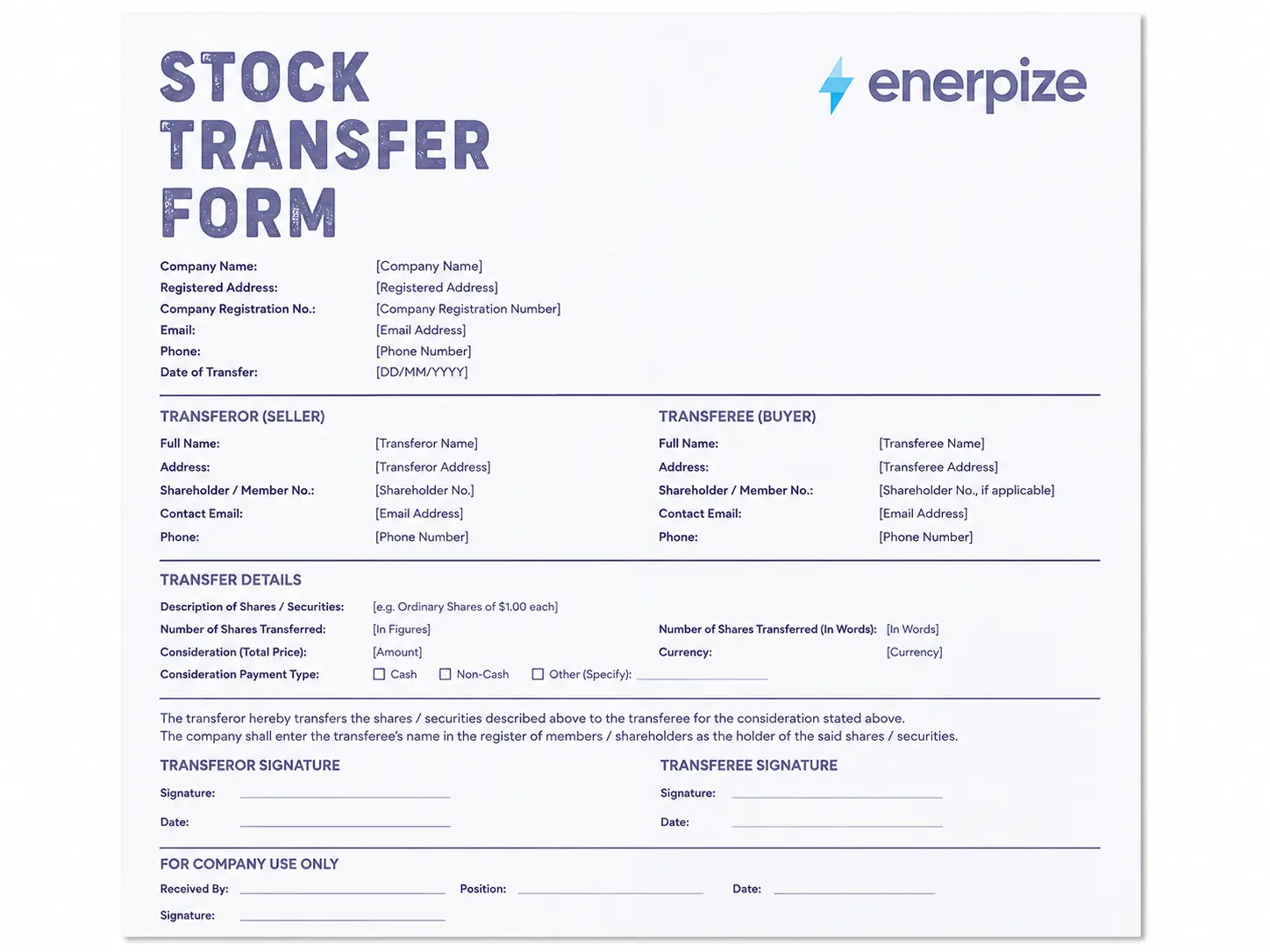
- Covers company details, share class, consideration paid, and transferor and transferee signatures in one template
- Built with country specific stamp duty and exemption fields for the United Kingdom, Ireland, the United States, and Australia in a single document
- Separates cash consideration from non cash consideration and flags exactly which certificate or filing step applies before anyone signs
A stock transfer form is a legal document that records the transfer of share ownership from one shareholder to another, and that a company uses to update its register of members.


What Is a Stock Transfer Form?
Somewhere in almost every company's life, a share changes hands. A cofounder buys out a partner, sometimes with a fresh partnership agreement drawn up alongside it. A parent gifts stock to a child. An investor closes a deal that took four months to negotiate, most of it spent on a letter of intent before either side got near a signature. That one signature lives on a short two page document.
Sometimes it's called a share transfer form instead. In the UK it has a nickname too, the J30, named after the government reference number printed at the bottom of the page. Whatever you call it, the job stays the same. It records who is giving up shares, who is receiving them, how many, and what was paid, then it becomes the paperwork a company relies on to update its register of members.
Search for a sample stock transfer form online and you'll notice something odd. Almost every example is built for one country. A UK solicitor's version assumes the Companies Act 2006. An Irish one assumes Revenue and ROS. Nobody had built a share transfer form template that actually works whichever side of the ocean your company sits on, so we built one.
Track every share transfer alongside the rest of your company's books. Start free with Enerpize
What Information the Form Requires
Every version of this document, regardless of country, asks for roughly the same handful of facts. Miss one and the transfer usually stalls.
- Full name of the company whose shares are being transferred, plus its registration number if you have it
- Full description of the security, meaning the share class and nominal value exactly as it appears on the share certificate
- Number of shares being transferred, written in both words and figures
- Consideration paid, split between cash and anything given in place of cash such as other shares or debt assumed
- Full name and address of the transferor, the person or entity giving up the shares
- Full name and address of the transferee, the person or entity receiving them
- Signature of the transferor, dated, with a witness or broker stamp where one is required
Get any of these wrong and the form usually gets rejected rather than quietly accepted. A blank consideration box is the single most common reason. Write "NIL" if nothing was paid. Never leave it empty.
Share Transfer Rules in the United Kingdom
Search for a UK stock transfer form online and you'll see it called the J30 stock transfer form almost as often as its official name. Both point to the same document, used for fully paid shares under section 770 of the Companies Act 2006, which says a company can only register a transfer once this exact kind of proper instrument has been delivered to it.
Stamp Duty sits at 0.5 percent of the consideration, and it only applies once that consideration passes £1,000. Sign and date the form, and you have 30 days to get any duty owed to HMRC.
Which Certificate Do You Need
If the consideration is £1,000 or less and this isn't part of a larger series of transactions, complete Certificate 1. No duty is due, so the form goes to the company or its registrar, not HMRC.
If the transfer is otherwise exempt, say it's connected to divorce or dissolution of a civil partnership, complete Certificate 2 instead. A gift of shares stock transfer form works the same way here, since gifts are exempt too. Send it to the company, not HMRC.
Consideration is nil? Write "NIL" in the box and skip both certificates entirely.
Where to Send It
Email a scanned copy to HMRC's Stamp Duty mailbox along with any Share Purchase Agreement the consideration references. HMRC aims to process 80 percent of submissions within 15 working days, so give it 20 before you follow up. Only post the form if you genuinely can't submit electronically, and never post original share certificates. HMRC's own Stamp Duty guidance covers edge cases like overseas currency and deferred consideration in more depth than we can here.
Share Transfer Rules in Ireland
Ireland runs a nearly identical instrument under its own Companies Act 2014, but the numbers change. Revenue sets Stamp Duty on Irish share transfers at 1 percent, twice the UK rate, calculated on whichever is higher out of the consideration paid or the market value of the shares.
Nil Rate Categories and Exemptions
Transfers where the consideration is €1,000 or less are nil rate. So are a handful of specific situations: a change of trustee, a transfer between a nominee and the beneficial owner, an executor handing shares to a beneficiary, and a transfer to a market maker.
Here's the part that trips people up. A gift of shares stock transfer form is not automatically exempt in Ireland the way it is in the UK. The market value of gifted shares is still chargeable unless one of the categories above applies, so don't assume a gift means nothing is owed.
If a nil rate or exemption declaration applies, send the form straight to the company or its registrar. If none applies, the transfer goes through Revenue's ROS system first, and Revenue issues a stamp certificate that gets attached to the form before it goes anywhere else. Revenue's own guidance confirms the 1 percent rate and walks through the nil rate categories in full.
Share Transfer Rules in the United States
There's no federal stamp tax on private share transfers in the US, so there's no UK style stamped instrument at all. What private companies actually use instead is a stock power form, sometimes called an assignment separate from certificate. It's a short document the seller signs authorizing the company's secretary to record the transfer on the company's books, kept separate from the physical certificate rather than endorsed onto the back of it.
People search for this under a few different names: a stock power, a transfer of stock ownership form, or a stock ownership transfer form. They're all pointing at the same short document.
Where US rules actually bite is gift tax, not stamp duty. Give away more than $19,000 in shares to one person in 2026, or $38,000 for a married couple gift splitting, and the giver, not the recipient, has to file IRS Form 709, even if no tax ends up due because of the lifetime exemption.
Before signing, check the company's bylaws and any shareholders' agreement for transfer restrictions like a right of first refusal. A stock power form alone doesn't override them. The IRS gift tax FAQ is worth bookmarking if shares are moving as a gift rather than a sale.
Share Transfer Rules in Australia
Australia calls this an off market transfer form, and the Stamp Duty picture looks nothing like the UK or Ireland. Most states abolished duty on transfers of shares in private companies years ago.
Landholder Duty and ASIC Form 484
The exception is landholder duty, which can still apply if the company's main asset is real property. It's worth checking before you assume nothing is owed.
Completing the transfer only updates the company's internal register. The company still has to separately notify ASIC of the change within 28 days using Form 484, and lodging that form doesn't create the transfer. It just reports one that already happened correctly under the company's constitution. ASIC's own guidance explains the 28 day window and what counts as a beneficial ownership change.
How to Fill Out a Share Transfer Form
Step 1: Confirm the Jurisdiction
Work out which country's law governs the company whose shares are moving. That single fact decides which certificate, duty, or filing section actually applies to you.
Step 2: Complete the Universal Fields
Fill in the company name, share class, number of shares in both words and figures, and consideration paid. Write "NIL" if nothing changed hands. Never leave it blank.
Step 3: Complete the Matching Country Section
Turn to the UK, Ireland, US, or Australia section and complete only that one. The other three don't apply to your transfer, so leave them alone.
Step 4: Sign, Date, and Send It
Every transferor signs and dates the form. Then it goes wherever that country's section says it goes, whether that's HMRC, Revenue's ROS, a corporate secretary, or nowhere at all if an exemption applies.
Step 5: Update the Register of Members
Once the form is accepted, the company updates its own register before anyone treats the transfer as final. Keep a signed copy for that register before the original goes anywhere else.
What the Enerpize Stock Transfer Form Template Includes
Most versions of this document are built for one country and one blank box. Ours isn't.
The template separates cash consideration from non cash consideration, since a straightforward cash purchase and a swap involving other shares or assumed debt aren't actually the same thing, and lumping them into one line loses information a tax authority will ask for later.
It also walks you through the certificate logic instead of leaving you with two blank legal paragraphs and a decision to make alone. Answer a couple of plain questions about the consideration and the situation, and the template tells you whether Certificate 1, Certificate 2, or neither applies before you ever pick up a pen.
And it covers all four countries in a single document. Identify which one governs the company, complete the universal section once, then fill in only the country specific page that actually applies. One stock transfer form download instead of four separate hunts.
How Enerpize Handles Stock Transfers
A stock transfer means two different things depending on which part of the business you're standing in. Everything above this section is about the legal kind, moving ownership of shares from one shareholder to another. There's a second kind that has nothing to do with shareholders at all, and it's the one most operations teams run into every week: moving physical stock from one warehouse to another inside the same company.
If a shareholder sent you here, the template above is what you need. If what actually brought you here is restocking a location or tracking where inventory physically sits, that's not a form you fill in once and file away. It's something Enerpize runs live.
Tracking Stock Across Warehouses
Enerpize's inventory system tracks stock in real time across as many warehouses as the business needs, by serial number, lot, or expiry date, with low stock alerts so a transfer happens before a location actually runs out. Stocktaking is automated on top of that. Counts get compared against registered quantities, adjustments save as you go so a dropped connection never costs a session's work, and every movement is logged by warehouse, timeline, and the employee who handled it.
Purchases That Keep Stock Accurate
Purchases connect straight into the same stock. Quotes convert into supplier invoices, AI extracts the supplier, line items, quantities, and taxes from an uploaded invoice automatically, and stock levels update the moment a purchase is confirmed instead of after someone gets around to entering it.
Manage your inventory, purchases, and stocktaking in one system. Start free with Enerpize
Share Transfer Form vs Other Transaction Documents
This document isn't the only paper a share deal produces, and it helps to know what each one actually does. Most deals start further back than this form. Before anyone shares real numbers there's usually a non-disclosure agreement in place, and if what's actually changing hands is a physical asset rather than shares, a bill of sale is the document you want instead of this one.
| Document | Purpose | Created By | Filed With Government |
|---|---|---|---|
| Stock Transfer Form | Records and legally effects the transfer itself | Transferor | Yes in UK and Ireland via Stamp Duty, no in US and Australia unless duty applies |
| Share Purchase Agreement | Sets the commercial terms of the sale | Both parties, usually with legal advice | No |
| Board Minutes | Records the company's approval of the transfer | The company | No |
| Stock Transfer Certificate | Confirms Stamp Duty has been paid or exempted on the transfer instrument | Tax authority or registrar | Yes |
| Share Certificate | Evidences ownership once the transfer is registered | The company | No |
The form itself is short, usually two pages, and it's what actually moves legal ownership. A share purchase agreement is a longer contract that sets terms like warranties and what happens after completion. Plenty of transfers only need the form. Larger deals often use both.
Key Takeaways
- This document records the transfer of share ownership and is what a company uses to update its register of members, whether you call it a share transfer form, a J30, or something else depending on the country
- Every version asks for the same core facts: company name, share class, number of shares, consideration paid, and signatures from both the transferor and the transferee
- Stamp Duty applies in the UK above £1,000 and in Ireland above €1,000. Below those thresholds, or where an exemption applies, a certificate replaces the tax filing
- The US has no federal stamp tax on private transfers. Companies use a stock power instead, and gift tax rules apply once a gift of shares passes $19,000 to one recipient in 2026
- Australia has largely abolished Stamp Duty on private company share transfers, though landholder duty can still apply, and the company must notify ASIC within 28 days using Form 484
- The Enerpize template covers all four countries in one document, separates cash and non cash consideration, and walks you through the right certificate before you sign anything
Frequently Asked Questions
What is a stock transfer form?
It's the legal document used to move ownership of shares from one shareholder to another. It records the company, the shares, the price paid, and the signatures of both parties, and it's what a company uses to update its register of members.
What's the difference between a J30 and a J10?
The J30 is used for fully paid shares, which covers most transfers. The J10 is used when shares are only partly paid, meaning the transferee takes on responsibility for the amount still owed.
Do I need to pay Stamp Duty on every share transfer?
No. In the UK, Stamp Duty only applies once consideration exceeds £1,000. In Ireland, the threshold is €1,000. Below those amounts, or where a specific exemption applies, you complete a certificate on the back of the form instead and send it straight to the company rather than the tax authority.
How do I fill in a stock transfer form?
Start with the universal fields, meaning company name, share class, number of shares, and consideration. Then complete only the section for the country where the company is registered, since UK, Irish, US, and Australian rules each ask for something different from that point on.
What's the difference between this form and a share purchase agreement?
This form is short and it's what actually moves legal ownership. A share purchase agreement is a longer contract that sets commercial terms like warranties and post completion obligations. Many transfers only need the form. Larger deals often use both.
Is a US stock transfer handled the same way as the UK?
Not quite. The US has no federal stamp tax on private share transfers, so instead of a stamped instrument, private companies use a stock power form, also called an assignment separate from certificate, which authorizes the company's secretary to record the change.
Where do I send a completed form?
In the UK, you email it to HMRC's Stamp Duty mailbox if duty is owed, or straight to the company or registrar if a certificate exemption applies. In Ireland, it goes through Revenue's ROS system, or directly to the company if a nil rate declaration applies.
What happens if a shareholder dies without completing a stock transfer form?
The shares don't disappear, but they can't be transferred by the deceased anymore. In the UK, the legal personal representatives sign in their place once the Grant of Representation is registered. The US equivalent, sometimes searched as a transfer on death stock form, works differently, since many US brokerages let a shareholder name a beneficiary in advance so shares pass without probate at all.
Whether it's a UK Stamp Duty filing or a US gift tax record, Enerpize keeps your accounting accurate everywhere you operate. Start free with Enerpize
About the Author
Omar El Bahr is a Senior Digital Growth Specialist at Enerpize, where he leads SEO, content strategy, and organic growth across international markets. He is a Forbes Communications Council contributor and has written for Entrepreneur on business communication and digital strategy.
Disclaimer: This template and the information above are provided for general guidance only and don't constitute legal or tax advice. Share transfer rules vary by company and jurisdiction, so confirm the details with a solicitor, accountant, or your company's registrar before you rely on this document for an actual transfer.