



Journal Entries in Accounting: Parts, Format, Types and Worked Examples


Recording journal entries by hand? Enerpize creates and balances the entry the moment an invoice, bill or payment is recorded, and posts it straight to your general ledger.
No credit card required.
A client pays you $3,000.
Your bank balance goes up. Simple enough.
But was that $3,000 new revenue, or money the client already owed you from last month's invoice? Get it wrong and you count the same sale twice.
Your books can only tell the difference if someone recorded it the right way the first time. That record is a journal entry.
A journal entry is the first record of a business transaction in your accounting system. It shows the date, the account debited, the account credited, the amounts and a short narration. Under double-entry bookkeeping, total debits must equal total credits, and every entry is later posted to the general ledger.
At a Glance
- What it is: the first, dated record of a transaction, written before anything reaches the ledger.
- The one rule: total debits equal total credits in every entry, with no exceptions.
- The four parts: date, debit account and amount, credit account and amount, narration.
- Where it goes next: general ledger, then trial balance, then financial statements.
- Main types: simple, compound, opening, adjusting, reversing, closing, correcting and recurring.
- In this guide: 8 quick examples, one full month of 12 entries posted to a trial balance, and an 8 question quiz.
What is a Journal Entry?
A journal entry is the first, chronological record of a business transaction. It names the accounts the transaction touches and the amount that moves into or out of each one.
The book that holds these entries is the journal, which is why accountants also call it the book of original entry. Nothing reaches the ledger without passing through it first. As the SUNY open textbook on financial accounting puts it, posting always runs from the journal to the ledger accounts.
Every entry follows double-entry bookkeeping. Each transaction affects at least two accounts, one side is debited, the other is credited, and the two totals match.
A few things a journal entry is not:
- Not an invoice. The invoice is the source document. The journal entry is the accounting record of it.
- Not a ledger entry. The general ledger sorts the same amounts by account. The journal keeps them in date order.
- Not optional. If a transaction changes any account balance, it needs an entry, even when software creates it for you.
Where a journal entry goes next
- Transaction: a sale, bill or payment happens, and the invoice or receipt proves it.
- Journal entry: you record it first, in date order, with equal debits and credits.
- General ledger: each line is posted to its own account, so every account shows a running balance.
- Trial balance: all balances are listed, and total debits must equal total credits.
- Financial statements: the balances become the income statement, balance sheet and cash flow statement.
Parts of a Journal Entry
The four parts of a journal entry are the date, the account debited with its amount, the account credited with its amount, and a narration that explains the transaction.
That four part answer is what most exam questions want. In real books, two more fields make an entry easy to find and easy to audit, so a complete entry carries six:
| Part | What it holds | Harbor Lane example (October 2) |
|---|---|---|
| Date | When the transaction happened, not when you typed it | October 2, 2026 |
| Debit account and amount | The account that increases for assets and expenses, or decreases for the other three types | Equipment, $7,200 |
| Credit account and amount | The other side, so both totals match | Cash, $2,200 and Notes Payable, $5,000 |
| Narration | One line on what happened and why | Purchase of 3 design workstations, part cash, part bank note |
| Reference number | A sequential number to find the entry again | JE 000004 |
| Supporting document | The invoice, receipt or contract that proves it | TechHub invoice 4471 |
What is Not Included in a Journal Entry?
- The supporting documents themselves. They are kept and referenced, not copied in.
- Estimates and forecasts. Only transactions that actually happened get recorded.
- Non financial details such as meeting notes or management decisions.
- Personal comments that do not explain the transaction.
Journal Entries Examples
Here is one example of each common entry type, with the full debit and credit lines. Every entry balances, so check the totals as you read.
1. Simple Entry: Buying Stock on Credit
A store buys 100 printers for $10,000 and will pay the supplier in 30 days. One account is debited and one is credited.
| Date | Account | Debit | Credit |
|---|---|---|---|
| Dec 20, 2026 | Inventory | $10,000 | |
| Accounts Payable | $10,000 |
Narration: Purchase of 100 printers on 30 day terms
2. Compound Entry: One Invoice, Two Costs
A workshop buys $5,000 of raw materials on credit and the supplier adds a $300 delivery charge to the same invoice. Two debits, one credit, and both sides total $5,300.
| Date | Account | Debit | Credit |
|---|---|---|---|
| Dec 29, 2026 | Raw Materials Inventory | $5,000 | |
| Delivery Expense | $300 | ||
| Accounts Payable | $5,300 |
Narration: Raw materials and delivery, supplier invoice on credit
3. Opening Entry: Starting a New Year
A consulting firm carries last year's closing balances into the new year: $15,000 cash, $8,000 owed by clients and $6,000 owed to suppliers. Owner's capital takes the difference, so both sides total $23,000.
| Date | Account | Debit | Credit |
|---|---|---|---|
| Jan 1, 2026 | Cash | $15,000 | |
| Accounts Receivable | $8,000 | ||
| Accounts Payable | $6,000 | ||
| Owner's Capital | $17,000 |
Narration: Balances brought forward from the previous year
4. Adjusting Entry: A Bill That Has Not Arrived Yet
October's electricity is used in October but billed in November. At month end, the business estimates $380 and records it now, so October carries its own cost.
| Date | Account | Debit | Credit |
|---|---|---|---|
| Oct 31, 2026 | Utilities Expense | $380 | |
| Accrued Liabilities | $380 |
Narration: Accrued October electricity, bill not yet received
5. Reversing Entry: Undoing That Accrual
On November 1, the accrual is reversed. When the real $380 bill is paid on November 8, the normal entry goes through and November ends with no electricity cost from October counted twice.
| Date | Account | Debit | Credit |
|---|---|---|---|
| Nov 1, 2026 | Accrued Liabilities | $380 | |
| Utilities Expense | $380 |
Narration: Reverse October electricity accrual
| Date | Account | Debit | Credit |
|---|---|---|---|
| Nov 8, 2026 | Utilities Expense | $380 | |
| Cash | $380 |
Narration: Pay October electricity bill
6. Closing Entries: Resetting the Year
At year end, a design studio has $84,000 of revenue and $61,500 of expenses. Both close to the income summary account, and the $22,500 profit moves to retained earnings.
| Date | Account | Debit | Credit |
|---|---|---|---|
| Dec 31, 2026 | Service Revenue | $84,000 | |
| Income Summary | $84,000 |
| Date | Account | Debit | Credit |
|---|---|---|---|
| Dec 31, 2026 | Income Summary | $61,500 | |
| Operating Expenses | $61,500 |
| Date | Account | Debit | Credit |
|---|---|---|---|
| Dec 31, 2026 | Income Summary | $22,500 | |
| Retained Earnings | $22,500 |
Narration: Close revenue and expenses, transfer the year's profit
7. Correcting Entry: Rent Posted to the Wrong Account
A $1,200 rent payment was posted to Equipment by mistake. Instead of deleting the original, a new entry moves the amount to the right account and leaves a clear trail.
| Date | Account | Debit | Credit |
|---|---|---|---|
| Mar 5, 2026 | Rent Expense | $1,200 | |
| Equipment | $1,200 |
Narration: Correct rent posted to Equipment in error
8. Write Off Entry: A Client Who Will Not Pay
A client owes $750 and the business decides it will never be collected. The receivable is removed and the loss is recognized as an expense.
| Date | Account | Debit | Credit |
|---|---|---|---|
| Jun 30, 2026 | Bad Debt Expense | $750 | |
| Accounts Receivable | $750 |
Narration: Write off uncollectible balance from client account
What are The Types of Journal Entries?
Journal entries can be sorted two ways. By structure, an entry is either simple, with two accounts, or compound, with three or more. By purpose, it falls into one of the types below.
Many guides list six types: opening, transfer, closing, adjusting, compound and reversing. The table below also covers simple, correcting and recurring entries, because anyone using accounting software meets them every month.
| Type | When you use it | Typical entry |
|---|---|---|
| Simple | Any transaction that touches exactly two accounts | Debit Rent Expense, credit Cash |
| Compound | One transaction that touches three or more accounts | Debit Equipment, credit Cash and Notes Payable |
| Opening | First day of a new period, to bring balances forward | Debit asset accounts, credit liabilities and capital |
| Adjusting | Period end, for amounts earned or used but not yet recorded | Debit Depreciation Expense, credit Accumulated Depreciation |
| Reversing | First day of the next period, to cancel an accrual before the real bill posts | The exact opposite of the accrual |
| Closing | Period end, to bring revenue and expense accounts back to zero | Debit Revenue, credit Income Summary |
| Correcting | When a posted entry turns out to be wrong | Debit the right account, credit the wrong one |
| Recurring | The same entry every period for the same amount | Monthly rent or depreciation |
| Transfer | Moving an amount between two accounts inside the business | Debit Payroll Bank, credit Operating Bank |
Entries are also named after the transaction they record. These have their own guides: payroll journal entries, sales journal entries, prepaid expense entries, depreciation entries, intercompany entries and lease accounting entries.
Not sure which one a transaction needs? Work down this list.
Which journal entry do I need? Work down the list and stop at the first yes.
| Question | If yes |
|---|---|
| Is it an everyday sale, bill or payment happening now? | Standard entry: simple with two accounts, compound with three or more |
| Is it the first day of a new period, carrying balances forward? | Opening entry |
| Is it period end, and something was earned or used but not recorded? | Adjusting entry |
| Did you accrue something last period that a real bill will now replace? | Reversing entry, dated the first day of the new period |
| Is it period end, and revenue and expenses must go back to zero? | Closing entry |
| Did you find a mistake in a posted entry? | Correcting entry. Never delete the original |
| Will the same entry repeat every month for the same amount? | Recurring entry, set up once in your software |
Adjusting Entries vs. Journal Entries
People use these terms as if they mean the same thing. They do not, and the ledger adds a third term to the mix.
| Journal entry | Adjusting entry | Ledger entry | |
|---|---|---|---|
| When | On the day the transaction happens | At the end of the period | After the journal entry is posted |
| Triggered by | A source document: invoice, bill, receipt | Something earned or used but not yet recorded | The journal entry itself |
| Organized by | Date | Date, at period end | Account |
| Example | Pay $1,500 rent on October 3 | Record $600 of wages earned but unpaid on October 31 | The $1,500 appears in the Rent Expense and Cash accounts |
Every adjusting entry is a journal entry, but most journal entries are not adjusting entries.
Journal Entry Examples: One Month at a Design Studio
Single examples teach the mechanics. A full month shows how the entries work together.
Harbor Lane Design Studio is a fictional two person studio that opens in October 2026. Here is every transaction it records that month, including two adjusting entries on October 31.
| # | Date and account | Debit | Credit |
|---|---|---|---|
| 1 | Oct 1: Owner invests cash to open the studio | ||
| Cash | $20,000 | ||
| Owner's Capital | $20,000 | ||
| 2 | Oct 2: Buys computer equipment: $2,200 cash, rest on a bank note | ||
| Equipment | $7,200 | ||
| Cash | $2,200 | ||
| Notes Payable | $5,000 | ||
| 3 | Oct 3: Pays October rent | ||
| Rent Expense | $1,500 | ||
| Cash | $1,500 | ||
| 4 | Oct 6: Buys software and supplies on credit | ||
| Supplies Expense | $450 | ||
| Accounts Payable | $450 | ||
| 5 | Oct 10: Invoices Cedar & Pine Co. for a brand project, net 30 | ||
| Accounts Receivable | $5,200 | ||
| Service Revenue | $5,200 | ||
| 6 | Oct 14: Runs a paid design workshop, paid in cash | ||
| Cash | $800 | ||
| Service Revenue | $800 | ||
| 7 | Oct 20: Cedar & Pine Co. pays part of its invoice | ||
| Cash | $3,000 | ||
| Accounts Receivable | $3,000 | ||
| 8 | Oct 24: Pays the supplier for the software and supplies | ||
| Accounts Payable | $450 | ||
| Cash | $450 | ||
| 9 | Oct 28: Pays the first loan installment: $500 principal, $20 interest | ||
| Notes Payable | $500 | ||
| Interest Expense | $20 | ||
| Cash | $520 | ||
| 10 | Oct 31: Pays freelance designer wages | ||
| Wages Expense | $1,200 | ||
| Cash | $1,200 | ||
| A1 | Oct 31: Adjusting: one month of equipment depreciation | ||
| Depreciation Expense | $200 | ||
| Accumulated Depreciation | $200 | ||
| A2 | Oct 31: Adjusting: wages earned in the last week, paid in November | ||
| Wages Expense | $600 | ||
| Wages Payable | $600 |
Twelve entries, and every one balances. Entries 2 and 9 are compound. Entries A1 and A2 are adjusting entries, which is why they share the last day of the month.
Posting the Entries to the Ledger
Next, each line moves to its own account. Each amount shows the entry it came from, so you can trace any balance back to its source.
Cash
| Debit (entry: amount) | Credit (entry: amount) |
|---|---|
| 1: 20,000 | 2: 2,200 |
| 6: 800 | 3: 1,500 |
| 7: 3,000 | 8: 450 |
| 9: 520 | |
| 10: 1,200 | |
| Balance $17,930 |
Accounts Receivable
| Debit (entry: amount) | Credit (entry: amount) |
|---|---|
| 5: 5,200 | 7: 3,000 |
| Balance $2,200 |
Notes Payable
| Debit (entry: amount) | Credit (entry: amount) |
|---|---|
| 9: 500 | 2: 5,000 |
| Balance $4,500 |
Wages Expense
| Debit (entry: amount) | Credit (entry: amount) |
|---|---|
| 10: 1,200 | |
| A2: 600 | |
| Balance $1,800 |
Look at Accounts Receivable. The client was invoiced $5,200 and paid $3,000, so $2,200 is still owed. Revenue was counted once, on October 10, and the payment on October 20 never touched it.
Checking the Trial Balance
List every balance and add up both columns:
| Account | Debit | Credit |
|---|---|---|
| Cash | $17,930 | |
| Equipment | $7,200 | |
| Accounts Receivable | $2,200 | |
| Accumulated Depreciation | $200 | |
| Notes Payable | $4,500 | |
| Wages Payable | $600 | |
| Owner's Capital | $20,000 | |
| Service Revenue | $6,000 | |
| Rent Expense | $1,500 | |
| Supplies Expense | $450 | |
| Interest Expense | $20 | |
| Wages Expense | $1,800 | |
| Depreciation Expense | $200 | |
| Total | $31,300 | $31,300 |
Accounts Payable closes at $0 after the October 24 payment, so it drops off the list. Sample data for a fictional business.
Both sides total $31,300. The studio earned $6,000 of revenue against $3,970 of expenses, so its first month made $2,030 of profit, while cash ended at $17,930.
Profit and cash are different numbers for a reason. The $7,200 of equipment drained cash but only $200 of it became an expense this month.
When the Numbers Do Not Match
When the trial balance will not balance
Say entry 5 was typed with the revenue credit as $2,500 instead of $5,200. The debit side is still right, so the trial balance shows $31,300 of debits against $28,600 of credits.
Check 1, divide by 2: $2,700 ÷ 2 = $1,350. No entry has that amount, so it is not a debit posted as a credit.
Check 2, divide by 9: $2,700 ÷ 9 = $300, a whole number. That points to two swapped digits, and 5,200 typed as 2,500 is exactly that.
Test Yourself
Practice: debit or credit? Pick an answer, then tap to check. All eight come from the Harbor Lane month.
1. The owner puts $20,000 into the business bank account. Which account is debited?
A. Cash B. Owner's Capital C. Service Revenue
Check answer
A. Cash. Cash is an asset and it went up. Owner's Capital is credited.
2. The studio pays $1,500 of rent in cash. Which account is debited?
A. Cash B. Rent Expense C. Accounts Payable
Check answer
B. Rent Expense. Expenses increase with a debit. Cash goes down, so Cash is credited.
3. Software and supplies worth $450 are bought on credit. Which account is credited?
A. Cash B. Supplies Expense C. Accounts Payable
Check answer
C. Accounts Payable. Nothing was paid yet, so the studio owes the supplier. Liabilities increase with a credit.
4. A client is invoiced $5,200, payable in 30 days. Which account is debited?
A. Cash B. Accounts Receivable C. Service Revenue
Check answer
B. Accounts Receivable. No cash arrived yet. What the client owes is an asset, Accounts Receivable.
5. The client pays $3,000 of that invoice. Which account is credited?
A. Service Revenue B. Accounts Receivable C. Cash
Check answer
B. Accounts Receivable. Revenue was recorded when the invoice went out. The payment only reduces what the client owes.
6. The studio repays $500 of loan principal. Which account is debited?
A. Notes Payable B. Interest Expense C. Cash
Check answer
A. Notes Payable. Repaying principal reduces the liability, and liabilities decrease with a debit.
7. Month end depreciation of $200 is recorded. Which account is credited?
A. Equipment B. Cash C. Accumulated Depreciation
Check answer
C. Accumulated Depreciation. Depreciation spends no cash. It builds up in Accumulated Depreciation, which reduces the equipment's book value.
8. Wages of $600 were earned in October but will be paid in November. Which account is credited?
A. Cash B. Wages Payable C. Wages Expense
Check answer
B. Wages Payable. The cost belongs to October, so Wages Expense is debited and the amount owed sits in Wages Payable until payday.
Common Journal Entry Mistakes
Most errors fall into six patterns. The worst ones leave the trial balance perfectly balanced, which is why they survive so long. For the full list of error types, see our guide to accounting errors.
| Mistake | Why it matters | Fix |
|---|---|---|
| Missing transactions | A purchase or payment never reaches the books, so profit and balances are both wrong and nothing looks out of place. | Reconcile cash and bank every week. See omission errors. |
| Swapped digits | $4,500 becomes $5,400. The difference is always divisible by 9. | Run the divide by 9 check. See transposition errors. |
| Wrong account | Rent posted to Equipment inflates assets and hides an expense at the same time. | Use a clear chart of accounts and review new entries. See errors of principle. |
| No narration | An entry with no description is unreadable six months later, even to the person who wrote it. | Write one line: what happened, with whom, and the document number. |
| Deleting instead of correcting | Editing or deleting a posted entry breaks the audit trail. | Post a correcting entry and keep the original. |
| Temporary and permanent accounts mixed up | Revenue and expenses reset to zero each year. Assets, liabilities and equity carry forward. | Close only revenue, expense and drawing accounts at year end. |
How to Prepare Journal Entries?
Every entry, simple or compound, comes out of the same six steps.
1- Start With the Source Document
Find the invoice, bill, receipt or contract. It tells you what happened, when and for how much.
Tip: no document, no entry. If you cannot prove it, do not record it yet.
2- Name the Accounts Involved
Ask what the business gained and what it gave up. Paying rent in cash affects Rent Expense and Cash.
Tip: pick accounts from your chart of accounts instead of inventing new names.
3- Decide Which Side Each Account Goes On
Assets and expenses increase with a debit. Liabilities, equity and revenue increase with a credit. The rules table further down covers every case.
Tip: if both accounts end up on the same side, one of them is wrong.
4- Write the Entry
Enter the date, the debit lines first, then the credit lines, then the narration and reference number.
Tip: date it when the transaction happened, not when you got around to it.
5- Check That It Balances
Add both columns before you post. Equal totals do not prove the entry is right, but unequal totals prove it is wrong.
Tip: a difference divisible by 9 usually means two swapped digits.
6- Post It to the Ledger
Copy each line to its account in the general ledger, or let your software post it automatically.
Tip: reconcile at month end so mistakes surface while the details are still fresh.
Skip the Manual Work. Enerpize logs every transaction, posts it to your general ledger, and includes it in your financial statements, automatically.
No credit card required.
Journal Entry Format
There are two standard ways to lay out the same entry. The numbers never change, only the presentation.
Modern column format
| Date | Account | Debit | Credit |
|---|---|---|---|
| Oct 1 | Cash | $20,000 | |
| Owner's Capital | $20,000 | ||
| Memo: Owner invests cash to open the studio |
Traditional journal format
| Date | Particulars | L.F. | Dr. ($) | Cr. ($) |
|---|---|---|---|---|
| Oct 1 | Cash A/c ...Dr. | 101 | 20,000 | |
| To Owner's Capital A/c | 301 | 20,000 | ||
| (Being cash invested by the owner to start the business) |
The modern column format puts the date, account, debit and credit in separate columns. Debits come first, and credit accounts are indented underneath. This is how accounting software shows entries.
The traditional format is the one taught in many school and professional accountancy courses, including the ICAI Foundation course unit on basic accounting procedures. It has three conventions worth knowing:
- The debited account ends with "Dr."
- The credited account starts with "To" and sits slightly to the right.
- The narration starts with "Being" and sits in brackets under the entry. The L.F. column holds the ledger folio, the page or code where the line was posted.
Want to practice either layout? Download our free journal entry template and record the Harbor Lane month yourself.
What is the Accounting Purpose of Journal Entries?
Journal entries exist so every number in the financial statements can be traced back to a real transaction. They give a business:
- A complete, date ordered history of what happened.
- Balanced books, because every entry balances before it is posted.
- An audit trail from each statement line to its source document.
General Journal vs. Special Journals
Businesses that record by hand often split the journal into special journals for transactions that repeat all day. These are the four usually meant when people ask about "the four journals in accounting":
| Journal | What goes in it |
|---|---|
| Sales journal | Sales made on credit |
| Purchases journal | Purchases made on credit |
| Cash receipts journal | All money coming in |
| Cash payments journal | All money going out |
| General journal | Everything else: adjusting, closing, correcting and unusual entries |
Accounting software makes the split unnecessary, because you can filter entries by source instead. For how the journal and ledger relate, see general journal vs. general ledger.
Recording Journal Entries: Tips and Tricks
- Record on the day. A week of backlog is where omissions start.
- Use consistent account names. "Accounts Receivable", every time, not "Customer Payments" one week and "Debtors" the next.
- Attach the document. An entry with its invoice attached answers the auditor's first question.
- Keep the records. In the US, the IRS says to keep records for 3 years in most cases, and employment tax records for at least 4 years after the tax is due or paid, whichever is later. Check your own country's rules.
- Review recurring entries. An automated rent entry keeps posting after the lease ends unless someone stops it.
Rules of Debit and Credit
Debit means left and credit means right. Whether a debit increases or decreases an account depends on the type of account.
| Account type | Increases with | Decreases with | Normal balance | Golden rule | Examples |
|---|---|---|---|---|---|
| Assets | Debit | Credit | Debit | Real: debit what comes in, credit what goes out | Cash, equipment, receivables |
| Expenses | Debit | Credit | Debit | Nominal: debit all expenses and losses | Rent, wages, depreciation |
| Liabilities | Credit | Debit | Credit | Personal: credit the giver | Payables, loans |
| Equity | Credit | Debit | Credit | Personal: the owner is the giver | Owner's capital |
| Revenue | Credit | Debit | Credit | Nominal: credit all incomes and gains | Service revenue, sales |
The modern rules work from the five account types. The traditional "golden rules" work from three account groups:
- Personal accounts (people and businesses): debit the receiver, credit the giver.
- Real accounts (assets): debit what comes in, credit what goes out.
- Nominal accounts (expenses, losses, incomes and gains): debit all expenses and losses, credit all incomes and gains.
Both systems give the same entry every time. Use whichever one your course or your accountant uses, but do not mix the two inside one rule. "Debit what comes in" only applies to real accounts.
How Enerpize Handles Journal Entries
Harbor Lane recorded twelve entries in its first month. A busy shop records hundreds. Who writes them all?
In Enerpize accounting software, most entries write themselves, and the rest take one form.
Automatic Entries From Everyday Transactions
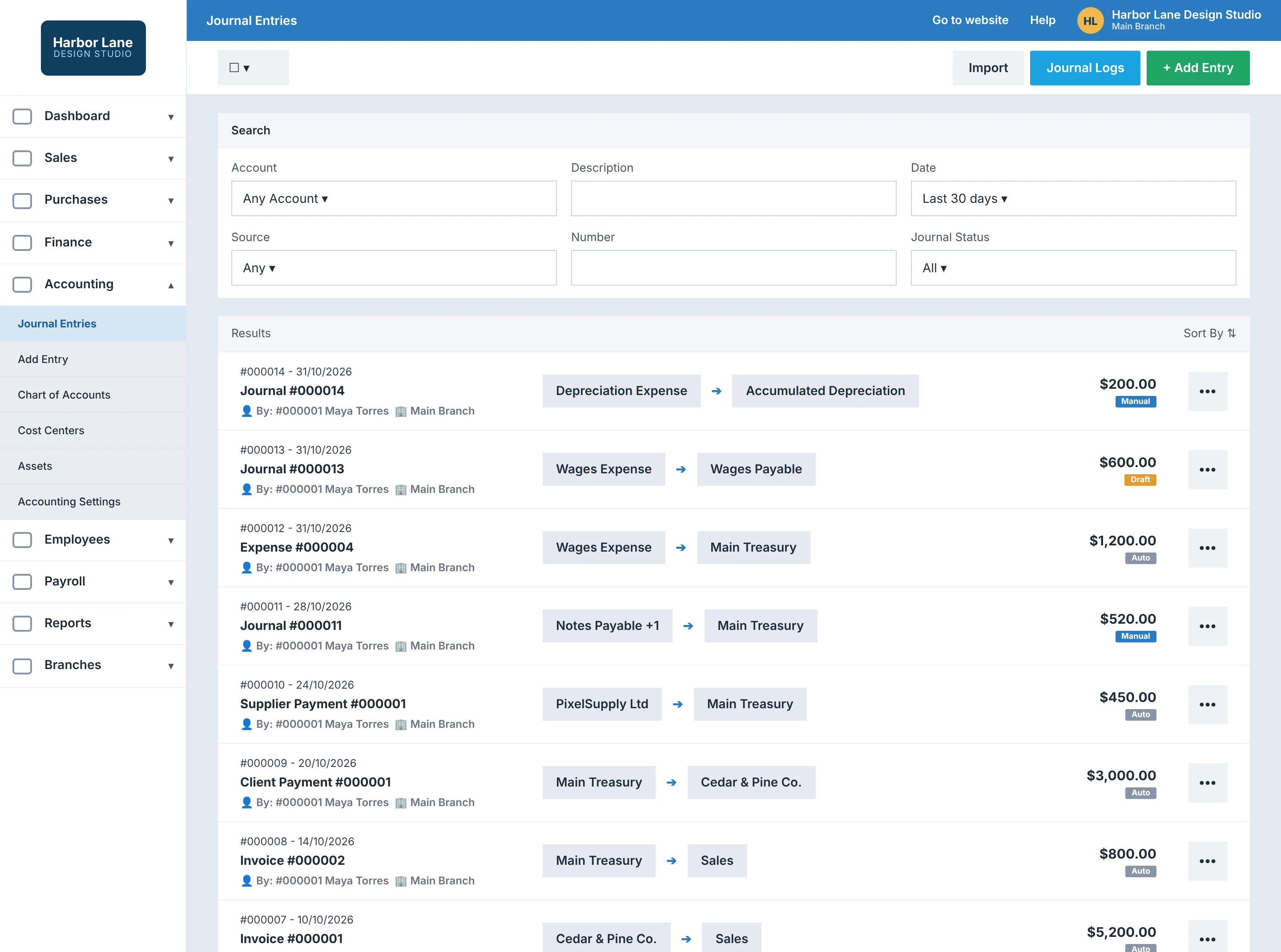
Invoices, expenses, client payments and supplier payments each create their own journal entry when you save them. The list marks them as Auto, so you can always tell which entries the system generated and which ones someone typed.
Sample data for a fictional business.
Manual Entries for Everything Else
Depreciation, accruals, corrections and loans go through the Add Entry form. Each line takes an account, a description, a cost center and a tax setting, with running debit and credit totals at the bottom. You can attach the source document and save a draft for review before posting.
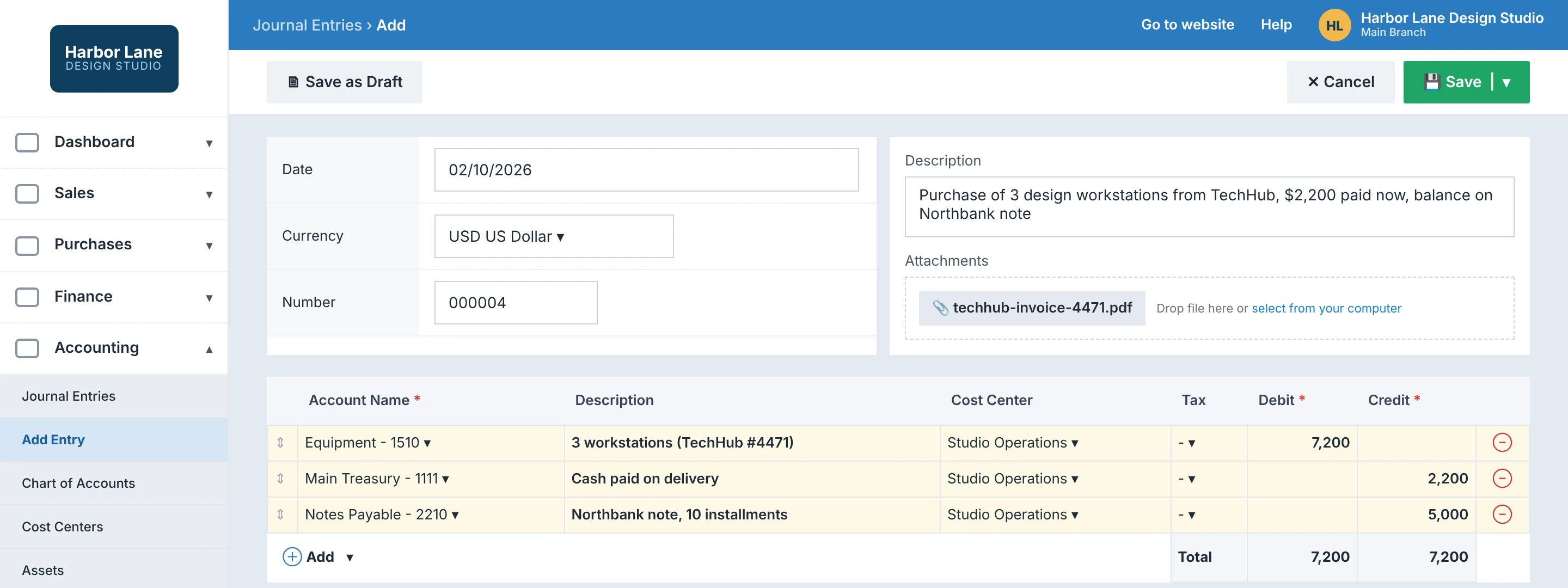
Sample data: Harbor Lane entry 2, the equipment purchase.
A Log of Every Line
Journal Logs record every line that was added, with the staff member, time, account, currency, and local debit and credit. When a balance looks wrong, you can see who posted what and when.
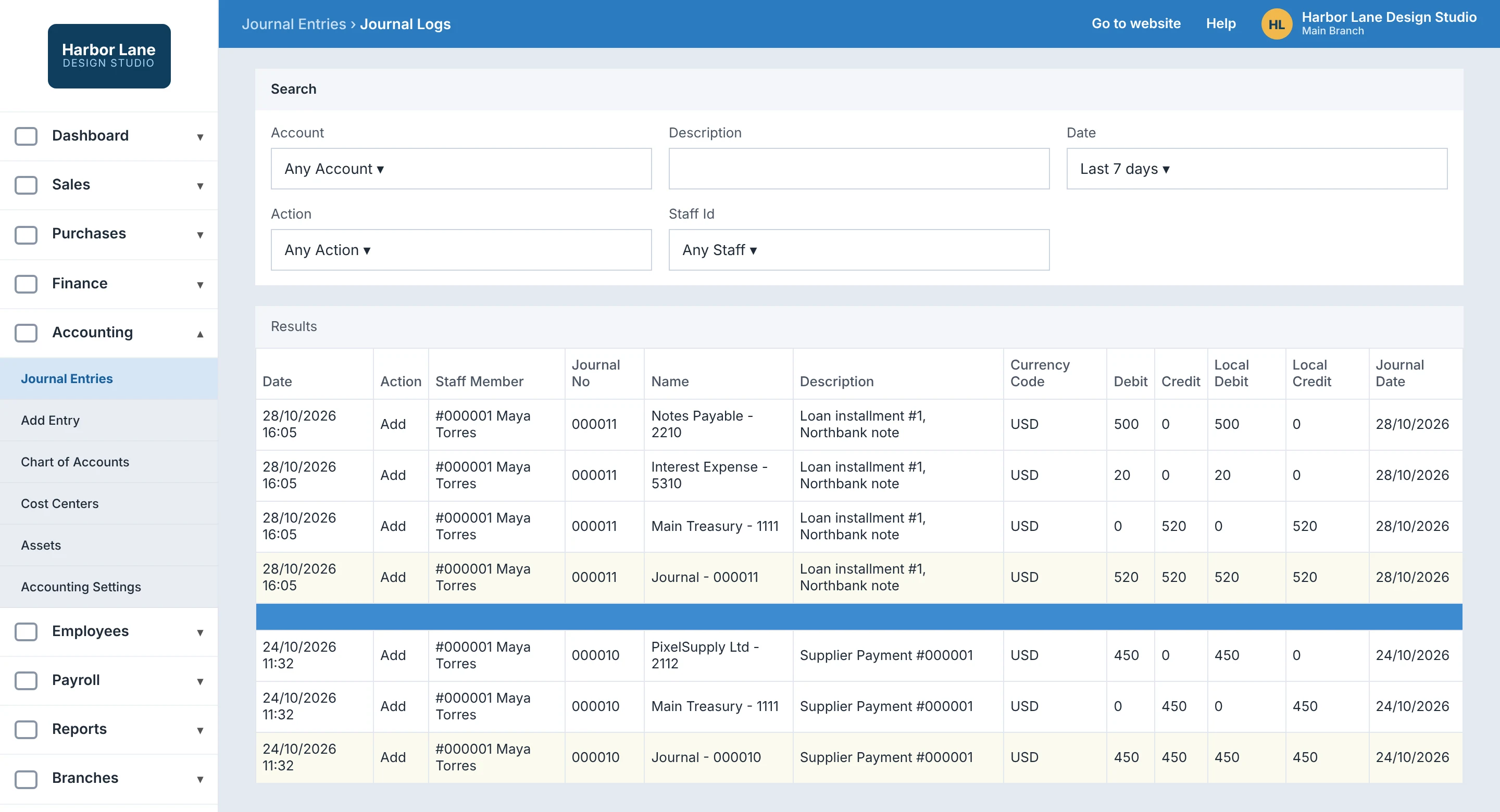
Sample data: Harbor Lane entry 9, the first loan installment.
Cost Centers for Projects and Branches
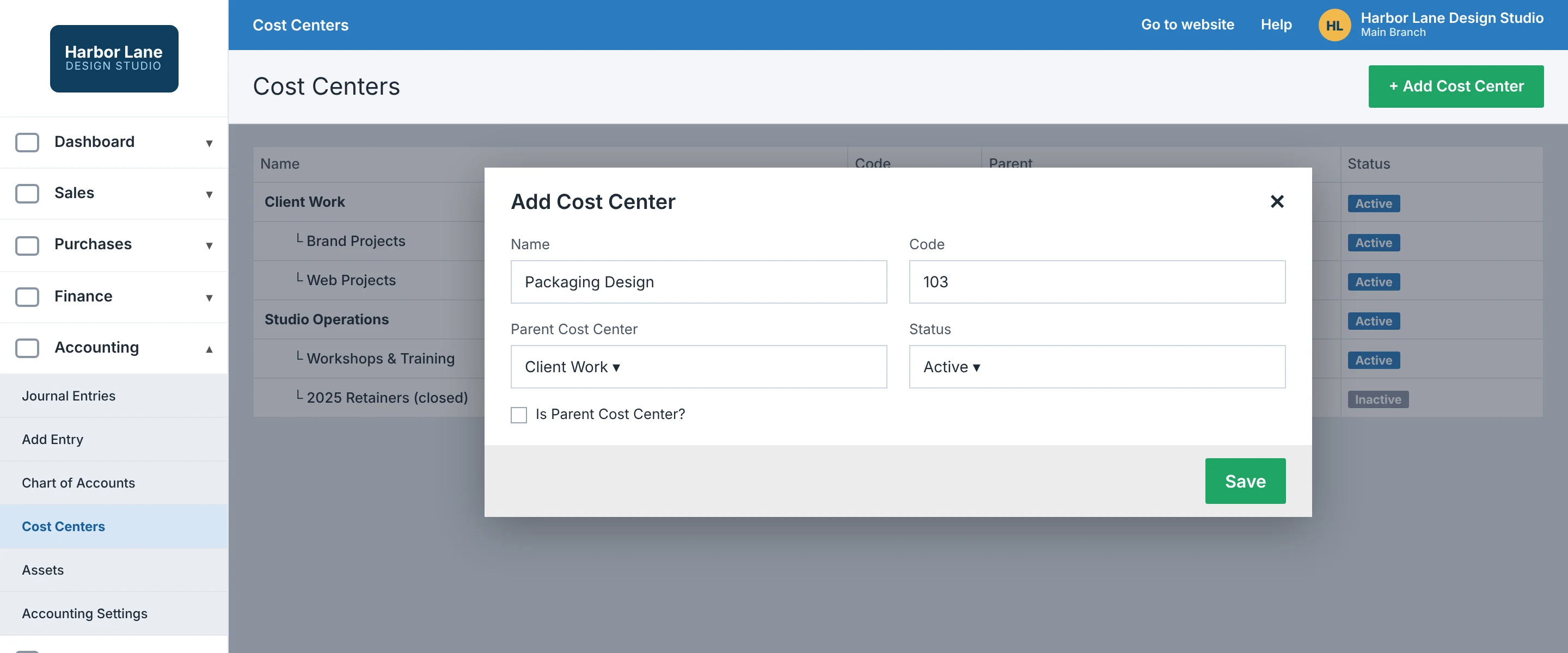
Cost centers tag each line to a project, department or branch, with parent and child levels. One rent entry can be split across two branches without creating a separate account for each.
Sample data for a fictional business.
Automate Your Journal Entries. Enerpize creates each entry as soon as a transaction happens, balances it, and carries it into your trial balance and financial statements.
No credit card required.
Key Takeaways
- A journal entry is the first record of a transaction, and total debits must equal total credits in every one.
- The four parts are the date, the debit account and amount, the credit account and amount, and the narration.
- Assets and expenses increase with a debit. Liabilities, equity and revenue increase with a credit.
- A compound entry, like Harbor Lane's $7,200 equipment purchase, can have one debit and two credits and still balance.
- In the worked month, 12 entries produced a trial balance of $31,300 on each side and $2,030 of profit.
- A trial balance difference divisible by 9, such as $2,700, usually points to swapped digits.
Frequently Asked Questions
What are the four parts of a journal entry?
The date, the account debited with its amount, the account credited with its amount, and a narration explaining the transaction. Most businesses also add a reference number and a link to the supporting document.
How many types of journal entries are there?
Many guides list six: opening, transfer, closing, adjusting, compound and reversing. In practice you will also meet correcting and recurring entries. By structure, every entry is either simple, with two accounts, or compound, with three or more.
What are the golden rules of accounting?
For personal accounts, debit the receiver and credit the giver. For real accounts, debit what comes in and credit what goes out. For nominal accounts, debit all expenses and losses and credit all incomes and gains.
What is the difference between a journal and a ledger?
The journal records each transaction once, in date order. The ledger sorts the same amounts by account, so you can see the balance of Cash or Rent Expense at a glance.
What are the four journals in accounting?
The four special journals are the sales journal, purchases journal, cash receipts journal and cash payments journal. Everything else goes in the general journal.
Can a journal entry have more than one debit?
Yes. That is a compound entry. A purchase paid partly in cash and partly on credit, or a loan payment split into principal and interest, has several lines on one side, as long as the totals still match.
How do you correct a wrong journal entry?
Post a new correcting entry that moves the amount to the right account, or reverse the wrong entry and record it again. Do not edit or delete a posted entry, because that breaks the audit trail.
Does accounting software create journal entries automatically?
Most does for everyday transactions such as invoices, bills and payments. You still record some entries by hand, usually depreciation, accruals, corrections and loans.
Back to that $3,000 from the client.
Now you know the entry: debit Cash, credit Accounts Receivable. The revenue was already counted when the invoice went out, so it is not counted again.
One correct line, written once, and your profit tells the truth.
About the Author
Omar El Bahr is a Senior Digital Growth Specialist at Enerpize, where he leads SEO, content strategy, and organic growth across international markets. He is a Forbes Communications Council contributor and has written for Entrepreneur on business communication and digital strategy.
Disclaimer: This article is for general information only and is not accounting, tax or legal advice. Record keeping rules differ by country, so confirm your obligations with a qualified accountant.

Related Articles
 Accounting
POS Payment: Importance & Best Solution
Read more Accounting
Sage ERP vs. Cloud Alternatives: Is Sage Still Worth It for Small Business in 2026?
Read more Accounting
What Is A Profit And Loss Statement In Business: A Complete Guide
Read more Accounting
What Are Intercompany Transactions Journal Entries
Read more Accounting
What is Financial Forecasting: A Comprehensive Guide
Read more Accounting


