

Posted on 8 July 2026
Free Painting Invoice Template Download: Excel, Word, PDF & Google Sheets and Docs
- Available in Word, Excel, PDF, Google Docs, and Google Sheets, free to download with no sign-up required
- Covers labor, materials, surface prep, and paint specification fields in one structured document
- Built with country-specific tax fields for GST (Australia), VAT (UK), HST (Canada), and sales tax (US) in one template
- Calculates labor subtotal, materials subtotal, and balance due automatically in Excel and Google Sheets
A painting invoice template is a pre-formatted billing document that records the labor hours, paint and materials, and prep work involved in a job, giving both the painter and the client a clear record of what was done and what is owed.


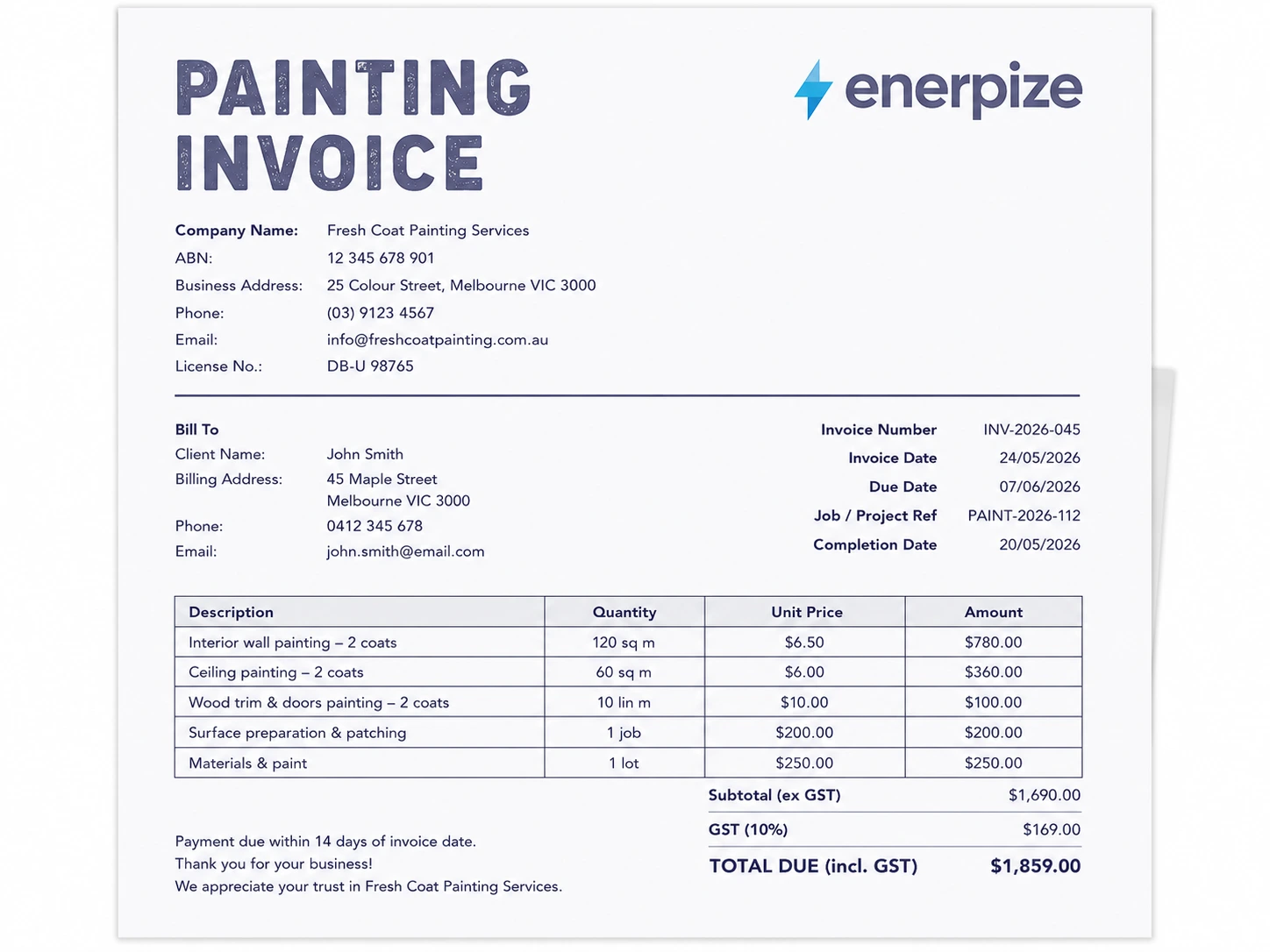
What Is a Painting Invoice?
A painting invoice is what you send once the job is done, or at agreed milestones, to collect payment for the work. It lists the surfaces painted, the paint and materials used, the hours or flat rate charged for labor, and any extras that came up along the way. Done properly, it also protects you. If a client comes back three months later asking what color was used in the hallway, or disputes whether two coats were applied, your invoice is the record that settles it.
Most painters learn the hard way that a vague invoice invites disputes and a detailed one prevents them. "Painting services, $2,400" tells the client nothing and gives you nothing to point to if they push back. Breaking that same amount into prep work, labor by room, materials with paint codes, and any extras turns your invoice into documentation, not just a bill.
Want to send professional painting invoices without building one from scratch every time? Start Free with Enerpize
What to Include in a Painting Invoice Template
A lot of free templates floating around online are built for generic services and get repurposed for painting without much thought. That shows up fast once you're on a real job. Here is what an invoice actually needs to hold up.
| Field | Why It Matters |
|---|---|
| Invoice Number | Sequential reference so you and the client can track it against the quote |
| Issue Date and Due Date | Sets when payment is expected and when late fees kick in |
| Job Site Address | The property being painted, often different from the billing address |
| Billing Address | Where the invoice goes, especially with property managers and landlords |
| Contractor License Number | Required in many US states and increasingly expected elsewhere |
| Lead-Safe Certification ID | Required for pre-1978 US homes under EPA rules, more on this below |
| Surface Prep | Scraping, sanding, caulking, masking, power washing, listed separately from painting labor |
| Labor | Hours or flat rate, broken down by room or surface |
| Paint Brand, Color Code, Sheen, Coats | The specification that prevents "which paint did you use again" disputes later |
| Materials | Paint, primer, brushes, rollers, tape, drop cloths |
| Extras / Change Orders | Anything added to the original scope, with approval noted |
| Deposit Received | Amount already paid, deducted from the balance |
| Tax | GST, VAT, HST, or sales tax depending on where you operate |
| Warranty Terms | How long workmanship is covered and what the touch-up policy is |
| Signature | Client sign-off, useful if a dispute ever comes up |
The two fields most templates skip entirely are the paint specification line and the job site versus billing address split. Both come up constantly in real jobs. A property manager gets billed at a head office address while the actual work happens at a rental unit three suburbs over. And six months after the job, someone asks what color the trim is. If that's not written down anywhere, you're guessing, or driving back out with a paint chip. If you're billing a mix of labor and hired-in specialists, such as a subcontractor handling a specific finish, the same job site versus billing address split shows up on our contractor invoice template, so the two documents stay consistent if you're issuing both on the same project.
What Enerpize Painting Invoice Template Includes
We built the Enerpize painting invoice template after going through the templates every major competitor offers and noticing the same gap over and over. Almost all of them treat painting like any other trade invoice: one description column, one amount column, done. That works for a plumber replacing a valve. It falls apart for a job where the client cares about the exact shade of Benjamin Moore on their living room wall.
Separate Surface Prep From Labor
Most templates lump prep and painting into one line. Ours splits them, because prep work is often invisible to the client but represents real hours. Scraping, sanding, caulking, and masking get their own section so the client sees what they're actually paying for before a single coat goes on.
Built-In Color and Finish Schedule
This is the one thing we didn't see done properly anywhere else. Our template has a dedicated Labor and Color Schedule section where you record the room or surface, the paint brand, the color code, the sheen, and the number of coats, all in one place. If a client ever asks what was used in a specific room, or wants a touch-up years later, the answer is sitting right there on the invoice you already gave them.
Job Site Address Kept Separate From Billing
Property managers, landlords, and commercial clients regularly need invoices sent to one address while the work happens at another. Our template treats these as two distinct fields from the start, not an afterthought squeezed into a notes box.
Deposit Tracking Built Into the Totals
A lot of painting jobs start with a deposit before materials are bought. Our totals section has a dedicated line that subtracts the deposit already received from the subtotal before tax is applied, so the balance due reflects reality rather than the full job value.
Extras and Change Orders as Their Own Section
Scope creep is common on painting jobs. A client asks for an extra coat, or you find water damage behind the wallpaper that needs addressing before you can paint. Our template gives this its own section with an approval field, so added work is documented rather than buried in a vague "additional charges" line.
Country-Specific Tax Fields
Whether you're charging GST in Australia, VAT in the UK, HST in Canada, or sales tax in the US, the template has a dedicated tax rate field that calculates correctly against your subtotal, and a registration ID field for whichever number applies in your country.
See how Enerpize handles invoicing, paint stock tracking, and crew performance in one system built for paint shops and painting contractors. Start Free with Enerpize
How to Use the Enerpize Painting Invoice Template
Step 1: Fill In the Header Details
Add your business name, address, phone, and email. Include your contractor license number and lead-safe certification ID if the job is in a pre-1978 US home. Assign a sequential invoice number and set the issue date and due date.
Step 2: Enter Client and Job Site Information
Fill in the billing contact separately from the job site address if they differ. Note any access instructions, useful for jobs where you're coordinating with a property manager rather than the person living there.
Step 3: Document Surface Prep
List scraping, sanding, caulking, masking, and any power washing separately from painting labor. Note hours and rate for each.
Step 4: Record Labor by Room or Surface
For each room or exterior surface, note the paint brand, color code, sheen, and number of coats. Enter square footage or hours and the rate applied.
Step 5: List Materials
Paint, primer, brushes, rollers, tape, and disposal costs each get their own line with quantity and unit cost.
Step 6: Add Any Extras
If the scope changed mid-job, list what was added, who approved it, and the cost. This is the section that protects your margin when a client tries to dispute an add-on after the fact.
Step 7: Apply the Deposit and Tax
Enter any deposit already received. The template subtracts this automatically in the Excel and Google Sheets versions before calculating tax and the final balance due. If you want to check whether a job's pricing actually left you with a healthy margin once materials and labor are accounted for, our net profit margin calculator runs that number directly from your invoice totals.
Step 8: Get It Signed
Have the client sign off on the completed invoice, particularly for larger jobs. It's a small step that gives you real protection if a disagreement comes up later.
Skip rebuilding this from scratch every job. Generate painting invoices directly inside Enerpize and track deposits, materials, and crew hours in the same place. Start Free with Enerpize
Painting Invoice vs. Painting Estimate
What Changes Between the Two
A painting estimate goes out before you pick up a brush. It tells the client what the job is likely to cost based on the scope you've walked through together, square footage, number of coats, prep work involved, materials you plan to use. It's a projection, not a bill. Nobody owes you money off the back of a painting estimate.
A painting invoice goes out during or after the work and asks to be paid for what was actually done. If the job matched the painting estimate exactly, the numbers might look identical. Most of the time they don't, because someone added a room, you found rot behind the trim that needed fixing first, or the client upgraded from flat to satin partway through.
The easiest way to keep this straight: a painting estimate is a conversation about what might happen. A painting invoice is a record of what did happen.
Why Painters Blur the Two
A lot of painters send a painting estimate, do the job exactly as scoped, and then just relabel the same document as the painting invoice. That's fine when nothing changes. It falls apart the moment scope shifts, because now you're trying to explain a higher number using a document that was never built to track changes in the first place.
This is where the extras and change orders section on your painting invoice earns its keep. The painting estimate sets the baseline. The painting invoice shows the baseline plus whatever got added, with each addition itemized rather than folded quietly into a bigger total the client has to take on faith.
How Enerpize Connects Painting Invoices to Your Business
A standalone invoice template answers one question: what does the client owe. It doesn't tell you whether the job was actually profitable once materials and labor are accounted for, whether your paint stock is running low, or which crew member closed out the job. Enerpize was built for paint shops and painting contractors who need those answers without stitching together three different tools.
Accounting and Invoicing for Painting Businesses
Enerpize lets you issue sale and purchase invoices with tax and discounts applied automatically, record revenue and expenses as they happen, and generate profit and loss reports over any period you choose. Instead of finding out at tax time whether a job was worth it, you see it while it's still fresh.
Tracking Painter and Crew Performance
If you're running more than one crew, Enerpize keeps activity logs per painter or crew lead and reports on individual performance. You can see which crews are hitting targets and which jobs took longer than quoted, information that's hard to reconstruct after the fact from a stack of invoices.
Paint and Materials Inventory Tracking
The materials line on your invoice is only as accurate as your stock records. Enerpize monitors stock movement in real time, sends low-stock alerts before you run out mid-job, automates stocktaking against what's actually on the shelf, and calculates expected profit per sale by comparing buy and sell rates on paint and supplies.
Barcode-Integrated Invoicing
For retail-facing paint shops, Enerpize supports barcoding paint cans and equipment so items can be scanned straight into an invoice rather than typed in manually. Useful both for shop sales and for contractors restocking materials before a job.
Expense and Wage Tracking
Rent, salaries, product costs, and recurring expenses all feed into the same profit and loss report, so the real cost behind a job, not just what was invoiced, is visible whenever you need it.
Painting Invoice Template for the United States
Lead-Safe Certification and the RRP Rule
If you're working on a home or child care facility built before 1978, the EPA's Renovation, Repair, and Painting Rule applies the moment your work disturbs more than six square feet of painted surface inside, or twenty square feet outside. Window replacement and demolition trigger the rule regardless of square footage. Under the rule, firms must be EPA-certified, and the work must be overseen by a certified renovator who has completed EPA-accredited training. This applies to sole proprietors too, not just larger firms.
Penalties for violations can run into the tens of thousands of dollars per infraction, so if you're painting anything built before 1978, your certification ID belongs right on the invoice, not just in a filing cabinet. Full detail on what triggers the rule and how certification works is on the EPA's RRP program page.
Sales Tax Varies by State
Unlike GST or VAT countries, the US has no federal sales tax. Whether you charge tax, and at what rate, depends on your state and sometimes your city or county. Some states tax labor and materials together, others only tax materials. Check your state's requirements before finalizing your invoice template's tax field.
Painting Invoice Template for Australia
GST Registration Threshold
In Australia, you're required to register for GST once your business turnover reaches $75,000 or more in any 12 month period, a threshold that has been unchanged since GST was introduced. This is measured on gross turnover, not profit, so a painter invoicing $80,000 across the year has to register even if their actual take home after materials and expenses is well under that. Once registered, GST gets added at 10% and shown as a separate line on your invoice. The ATO's guide to registering for GST walks through how turnover is calculated if you're close to the line.
ABN on Every Invoice
Regardless of whether you're GST-registered, your ABN needs to appear on invoices issued to other businesses. If you're not registered for GST, the invoice should state clearly that GST has not been charged.
Painting Invoice Template for the United Kingdom
VAT Registration Threshold
The UK VAT registration threshold sits at £90,000 in taxable turnover over any rolling 12 month period, a figure that has been unchanged since April 2024. Cross it and you have 30 days to register with HMRC. The threshold is measured on a rolling basis, not a fixed tax year, so it's worth checking your total every month rather than once a year. Full detail is on HMRC's VAT registration guidance.
CIS for Subcontractors
If you're a painter or decorator working under a contractor on commercial or new-build sites, you likely fall under the Construction Industry Scheme. The contractor deducts 20% from your payments and sends it to HMRC as an advance against your income tax. Many painters work both under CIS for commercial jobs and directly for homeowners outside the scheme, and the invoice fields don't change either way, but it's worth knowing which arrangement applies to a given job so your records line up at tax time.
Painting Invoice Template for Canada
GST/HST Small Supplier Threshold
In Canada, you're considered a small supplier and don't need to register for GST/HST as long as your worldwide taxable revenue stays at or under $30,000 over four consecutive calendar quarters. Cross that threshold, whether gradually or with a single large invoice, and you generally have 29 days to register. Once registered, you charge GST or HST depending on the province the work is performed in, since the combined HST rate applies in some provinces while others charge GST and a separate provincial sales tax. The CRA's guidance on small suppliers covers exactly how the threshold is calculated if you're a growing painting business getting close to it.
Provincial Rate Variation
Because the rate depends on the province where the job is performed, not where your business is registered, a painter doing jobs across provincial lines needs to check the applicable rate for each job site rather than applying one flat rate across every invoice.
Painting Invoices in Specialty Scenarios
Cabinet Refinishing
Cabinet jobs get priced and invoiced differently from wall painting. Most painters bill per door and drawer front rather than by square footage, since the labor involved in removing hardware, degreasing, sanding, and spraying each piece doesn't scale the same way a wall does.
Commercial and Multi-Unit Progress Billing
Larger commercial jobs, or multi-unit property work, often move to milestone billing rather than one invoice at completion. A deposit up front, a second invoice once prep and priming are done, and a final invoice on completion keeps cash flow steady on longer jobs and gives the client clear checkpoints tied to actual progress rather than a single lump sum at the end. If the commercial job also involves construction work alongside painting, such as a full unit renovation before repainting, our construction invoice template follows the same progress billing structure so both documents can be issued from the same numbering system.
Recurring Maintenance Contracts
Property managers and HOAs with ongoing touch-up or seasonal repainting needs are usually billed on a recurring schedule rather than job by job. The invoice fields stay the same, but the frequency and the reference to the maintenance contract number differ from a one-off residential job. Some property managers also ask for a delivery record when materials or equipment are dropped at a site ahead of a scheduled repaint, in which case our delivery note template covers that documentation separately from the invoice itself.
Key Takeaways
- A painting invoice needs to separate surface prep, labor, and materials, not lump them into one line, since that's what prevents disputes over what the client actually paid for.
- Paint brand, color code, sheen, and number of coats belong on the invoice itself, not just in your head, since clients come back asking about touch-ups long after the job is done.
- Job site address and billing address are often different, especially with property managers and landlords, and the invoice should treat them as separate fields from the start.
- In the US, any job disturbing painted surfaces in a pre-1978 home triggers the EPA's RRP rule, and your certification ID should appear on the invoice.
- Australia's GST threshold is $75,000, the UK's VAT threshold is £90,000, and Canada's small supplier threshold is $30,000, all measured on turnover, not profit.
- Deposits, extras, and change orders each need their own place on the invoice so scope changes are documented rather than folded quietly into a final number.
Frequently Asked Questions
What should a painting invoice include?
At minimum, your business details, the client's billing and job site addresses, an invoice number and dates, a breakdown of surface prep, labor, and materials, paint specifications including brand and color code, applicable tax, any deposit already received, and payment terms. Add your contractor license number and lead-safe certification ID if the job requires it.
Do I need to charge GST, VAT, or sales tax on a painting invoice?
It depends on your country and, in some cases, your state or province. Australia requires GST registration once turnover hits $75,000. The UK requires VAT registration at £90,000 turnover. Canada requires GST/HST registration once turnover crosses $30,000. In the US, sales tax rules vary by state and there's no federal equivalent, so check what applies where you operate.
What's the difference between a painting invoice and a painting estimate?
A painting estimate is sent before the work starts and gives the client an expected cost. A painting invoice is sent during or after the work and requests payment for what was actually completed. Many painters convert an approved estimate directly into the final invoice once the job wraps up, carrying over the same line items and adjusting for any changes along the way.
Do I need lead-safe certification to paint an older home?
If the home was built before 1978 and your work in the US disturbs more than six square feet of paint inside or twenty square feet outside, yes, the EPA's RRP rule requires your firm to be certified and the work overseen by a certified renovator. This applies to sole proprietors as well as larger firms. Window replacement and demolition trigger the rule regardless of the area disturbed.
How should I handle a deposit on a painting invoice?
Record the deposit as received when the client pays it, then subtract it from the final invoice total so the balance due is clear. This is one of the most common gaps in free templates, they often have nowhere to log a deposit at all, which leaves the client checking your math rather than seeing it laid out for them.
Should I invoice per job or use progress billing?
For smaller residential jobs, invoicing on completion is standard. For larger commercial jobs or multi-unit properties, progress billing at agreed milestones, deposit, mid-project, and completion, keeps cash flow steady and gives the client clear checkpoints tied to actual work completed.
What happens if a client disputes the paint color or finish used?
This is exactly why the color and finish schedule belongs on the invoice itself. If the brand, color code, sheen, and coat count are documented at the time of billing, there's a clear record to point back to rather than a memory-based disagreement months later.
About the Author
Omar El Bahr is Senior Digital Growth Specialist at Enerpize, a cloud ERP platform serving 40,000+ SMBs across Australia, Kenya, and global markets. He covers organic growth strategy, construction and trade invoicing systems, and SMB finance workflows. Forbes Communications Council contributor.
This content is for general informational purposes only and does not constitute legal, tax, or accounting advice. Tax thresholds, rates, and regulations vary by jurisdiction and change over time. Confirm current requirements with a qualified accountant or your local tax authority before relying on this information for your business.