

Posted on 13 August 2026
Petty Cash Reconciliation Form: Free Download Excel & Google Sheets
- Available in Excel and Google Sheets, free to download with no sign up required
- Covers the denomination count, receipts, VAT or GST split, and replenishment in one structured petty cash reconciliation form
- Built with compliance notes for the US Cash Over and Short account, the UK's simplified VAT threshold, Kenya's eTIMS gap, and Australia's GST tax invoice threshold
- Calculates the variance and flags Balanced, Over, or Short automatically in the Excel and Google Sheets versions
A petty cash reconciliation form is the document a custodian fills out to confirm that cash on hand plus every receipted disbursement adds up to the amount the float was supposed to have in it, before anyone signs their name to it.


What Is a Petty Cash Reconciliation Form?
Someone opens the cash box. Counts what's left. Now what?
That's the whole job of a petty cash reconciliation form. It takes three numbers, the float amount, the cash still sitting in the box, and everything that's been spent with a receipt to prove it, and checks that they actually add up. If they don't, something's missing, and the form is where that gets written down instead of quietly ignored.
Most people shorten it to petty cash reconciliation once they've said the full phrase a couple of times in a meeting. Some businesses call the underlying document a petty cash form instead, since the reconciliation step is really just the same form used to check the box rather than to spend from it. Accountants sometimes file it under the broader label cash account reconciliation too, since a petty cash float is just a small cash account that happens to live in a box instead of a bank. Call it a petty cash spreadsheet if that's what it is in your business, the name doesn't change what has to add up.
Here's the part most guides skip. A petty cash reconciliation form isn't really about the money. It's about the custodian. The moment you hand someone a fixed float and let them spend from it all week, you've created exactly one person whose word the rest of the business has to trust. The form is what turns that trust into something checkable.
Stop doing the variance math by hand every month. Start free with Enerpize
Petty Cash Reconciliation Form vs Bank Reconciliation vs Petty Cash Voucher vs Cash Count Sheet
Four documents that all touch money, and people mix them up constantly. Here's the difference without the jargon.
| Document | Purpose | Frequency & Sign-off |
|---|---|---|
| Petty Cash Reconciliation Form | Confirms cash plus receipts equal the float | Weekly to monthly, or at replenishment — custodian and supervisor |
| Bank Reconciliation | Matches the bank statement to internal records | Monthly — finance |
| Petty Cash Voucher | Records one disbursement as it happens | Per transaction — custodian and recipient |
| Cash Count Sheet | A denomination-level count, one step in a reconciliation | At time of count — whoever counts |
The voucher is the receipt for one purchase, and our petty cash template is built for exactly that single-transaction record. The count sheet is just the tally of bills and coins, some businesses call that piece alone a petty cash count sheet and stop there, which is only step three of the process below. Neither one on its own tells you whether the float is actually intact, that's what the reconciliation form does, since it's the only one of the four that compares what should be there against what actually is. If your business runs a much bigger cash account than a petty cash float, our cash reconciliation template and bank reconciliation template do the same job at a larger scale.
What to Include in a Petty Cash Reconciliation Form
That's the petty cash reconciliation explained in plain terms. Here's what actually has to be on the form.
A lot of free petty cash form templates and petty cash reconciliation form templates give you a denomination count, a receipts total, and a signature line. That covers a single small float with nobody watching the tax side of it. It falls apart the moment you're running the fund through a real bank account, tracking VAT or GST on receipts, or managing more than one float across branches. Here's what a complete petty cash reconciliation template actually needs.
| Field | Why It Matters |
|---|---|
| Fund or Location Name | Identifies which float this is, once you're running more than one |
| Custodian Name | Names who's accountable for the count |
| Authorized Float Amount | The fixed imprest amount everything else gets measured against |
| Cash on Hand by Denomination | A physical count, not an estimate |
| Gross Amount per Receipt | What was actually paid, always shown on the receipt |
| Tax (VAT or GST) per Receipt | Separates the recoverable tax from the net spend |
| GL Account Code | Routes each disbursement to the right expense category on replenishment |
| Advances Outstanding | Money issued against the float that hasn't been settled yet |
| Replenishments Submitted, Not Received | Requests already sent that shouldn't be counted twice |
| Bank Balance and Outstanding Cheques | Only if the float runs through a dedicated bank account |
| Variance | Cash on hand plus receipts minus the authorized amount, explained if it isn't zero |
| Custodian and Supervisor Signatures | The second signature is what catches a counting mistake the custodian missed |
What Enerpize's Petty Cash Reconciliation Template Includes
We pulled apart four real petty cash forms still in active use, a university's denomination count sheet, a corporate Smartsheet template, and a UK local authority's full annual financial certificate, alongside the SaaS blog guides everyone else is writing from. Here's what we found. Every one of them checks the cash. None of them check the tax, and only one of them even attempts to check the bank.
No tax split. Every guide we read explains VAT or GST recovery as a separate topic from petty cash entirely. Not one of the four real forms we reviewed has a column for it. Which means a business could be sitting on recoverable tax from every taxi receipt and coffee run in the box and never see it, because the form never asked.
No bank tie. Three of the four forms treat petty cash as a pure cash box with no connection to an actual bank account. The one form that did tie to a bank, a UK local authority's annual certificate, required a full page of unpresented cheque tracking and a specific submission deadline just to do it. Ours does the same check with four fields, not a page.
No replenishment in transit tracking. One of the real forms we reviewed explicitly warns that a replenishment already submitted but not yet received can get double counted if nobody tracks it separately, and then gives you nowhere to put it. Ours has a dedicated line for exactly that.
No live variance flag. Every form we reviewed calculates the variance as a static number someone has to read and interpret. Ours calculates it the moment the numbers are entered and marks the fund Balanced, Over, or Short before anyone signs.
That's the difference between a petty cash reconciliation form that gets filed once a month and one that actually catches a problem before the signature goes on it.
How to Use the Petty Cash Reconciliation Form
Here's how to reconcile petty cash step by step, from the first count to the final signature.
Step 1: Fill In the Fund Information
Name the fund, the custodian, the department, and the authorized float amount. If you're running more than one float, this is what tells them apart.
Step 2: Complete the Bank-Linked Section If It Applies
Skip this entirely for a pure cash float. If the fund is replenished through a dedicated bank account, enter the statement balance and list any cheques paid out that haven't cleared yet.
Step 3: Count the Cash on Hand
Count every bill and coin by denomination. Don't estimate, don't round, the subtotal calculates itself once the count is in.
Step 4: Log Every Receipt
One line per receipt. Enter the gross amount paid and the tax shown on it if there is any. Net calculates on its own. Mark whether the receipt is actually attached, not just remembered. If your team already logs purchases somewhere else first, our expense report template is where those receipts usually start their life before they ever reach a reconciliation.
Step 5: Add Advances and Replenishments in Transit
Anything issued against the float that hasn't been settled, and anything already submitted for replenishment that hasn't come back yet, goes here so it doesn't get counted twice.
Step 6: Check the Variance
Look at the Status cell. Anything other than Balanced needs an explanation written down before you move to sign off, not after.
Step 7: Sign and Route for Approval
The custodian signs first. A supervisor or department head signs separately. If the same person does both, you've removed the one check that catches a mistake the custodian didn't see.
Petty Cash Reconciliation Rules in the United States
There's no government form for this, since petty cash reconciliation is an internal control, not a filing. What US accounting actually requires is the discipline behind it. Under the imprest system, cash on hand plus receipted disbursements has to equal the fixed float every time it's counted, and any amount that can't be explained goes into a specific ledger account, Cash Over and Short, instead of getting buried in a miscellaneous expense line.
That account matters more than it sounds like it should. A recurring shortage sitting in Cash Over and Short is one of the cheapest, clearest signals of a control weakness an auditor can find, precisely because petty cash gets the least oversight of any cash account in the business. For a business that needs to substantiate these small purchases on its own return, the IRS's recordkeeping guidance sets the same expectation it sets everywhere else, the receipt has to actually support what's being claimed.
What to Add to Your Petty Cash Reconciliation Form (United States)
- A dedicated Cash Over and Short line rather than folding a shortage into miscellaneous expense
- A running variance history, so a one off two dollar shortage doesn't get treated the same as a forty dollar shortage that shows up every month
- A GL account field per receipt, so replenishment posts to the right expense category instead of one lump sum
Petty Cash Reconciliation Rules in the United Kingdom
Most petty cash receipts in the UK are small enough that HMRC doesn't require a full VAT invoice to reclaim the tax on them. HMRC's VAT rules allow a simplified VAT invoice, just four fields instead of the full set, for any retail supply of two hundred and fifty pounds or less including VAT. That covers most of what actually goes through a petty cash box, parking, stationery, a taxi fare. Go over that on a single item and the simplified receipt stops being good enough.
That threshold is exactly why petty cash reconciliation and VAT recovery are the same conversation in the UK, and almost nobody treats them that way. A reconciliation form that doesn't separate the VAT inclusive total from the recoverable VAT on each receipt is quietly leaving reclaimable tax sitting in the box.
What to Add to Your Petty Cash Reconciliation Form (United Kingdom)
- A VAT column on every disbursement over a few pounds, not just the large ones
- A flag for anything approaching the two hundred and fifty pound simplified invoice ceiling
- A six year retention note, matching HMRC's own record keeping window
Petty Cash Reconciliation Rules in Kenya
Kenya's eTIMS mandate covers electronic tax invoices, but a large share of genuine petty cash spending, market vendors, small transport, informal suppliers, never comes with an eTIMS invoice attached at all. KRA's own guidance treats supporting documentation like a signed petty cash voucher as part of what a VAT registered business needs on hand when it claims input VAT, precisely for the transactions that fall outside the electronic invoicing net.
Since KRA started validating declared expenses against eTIMS data more closely from January 2026, the gap between having a receipt and having an eTIMS matched receipt has become a real audit exposure, and petty cash is the account most likely to contain the purchases that will never have one.
What to Add to Your Petty Cash Reconciliation Form (Kenya)
- A field flagging whether each disbursement has a matching eTIMS invoice or not
- A separate note for cash purchases from unregistered suppliers, where no eTIMS invoice will ever exist
- The same currency and retention fields our Kenya-facing templates already use
Petty Cash Reconciliation Rules in Australia
Australia runs close to the mirror image of the UK's rule. The ATO's own guidance is that a formal tax invoice is only required to claim a GST credit on purchases over eighty two dollars fifty including GST. Below that, a normal receipt is enough, as long as it still shows the supplier's ABN and enough detail to support the claim. That figure isn't random either, it's exactly seventy five dollars plus ten percent GST.
Since most individual petty cash disbursements sit well under eighty two fifty, the majority of a typical Australian float can claim its GST back on an ordinary receipt, no formal tax invoice chase required, as long as the reconciliation form actually separates the GST component out in the first place.
What to Add to Your Petty Cash Reconciliation Form (Australia)
- A GST column on every line, not just the ones that look large enough to matter
- An eighty two dollar fifty threshold flag for the rare disbursement that crosses it and needs a real tax invoice instead of a receipt
- An ABN reference field for anything near that line
How Enerpize Handles Petty Cash Reconciliation
A petty cash reconciliation form answers one question. Does the cash on hand match what the books say it should be. It doesn't answer what happens to the variance once you find it, or where an advance against the float actually gets settled. That's where the spreadsheet stops and the rest of the system has to pick it up.
Expense Management
Enerpize's expense management software treats petty cash as its own tracked entity, not a shoebox. Set up treasuries and petty cash accounts per branch, department, or team, with spend limits attached, so no record sits off budget the way it can in a spreadsheet nobody's watching. The bank tie our template handles with a few manual fields, matching a statement balance against outstanding cheques, is something Enerpize automates directly. Set up the bank account or card, confirm statement amounts, and the system matches and reconciles expense records on its own. Receipts don't need typing either. Upload them in bulk and AI extracts the amount, date, vendor, and tax automatically, the same Gross, Tax, and Net split our template calculates by hand.
Payroll and Contracts
This is the connection most petty cash guides never make. Enerpize's payroll and contracts software consolidates petty cash, treasury, and company card settlements, along with travel and expense reimbursements, straight into payslips. The Advances Outstanding line on our form is a manual placeholder for something Enerpize automates end to end. Process and automate salary advances, set the amount and installment cycle, and choose whether the deduction comes off a future payslip or gets settled separately. Once a pay run happens, those transactions consolidate with bank statements and post straight to the right cost center, closing the loop between the petty cash box and the paycheck it eventually touches.
Stop reconciling petty cash by hand and chasing where an advance actually got settled. Enerpize tracks the float, matches the bank, and consolidates it straight into payroll. Start free with Enerpize.
Key Takeaways
- A petty cash reconciliation form confirms cash on hand plus receipts equals the authorized float, that's the entire job, nothing more
- The fields most free templates skip: a VAT or GST column, a bank tie for funds replenished through an account, and a live variance flag that catches a problem before sign off
- In the US, a shortage or overage goes into a dedicated Cash Over and Short account, not a miscellaneous expense line
- In the UK, HMRC's simplified VAT invoice threshold of two hundred and fifty pounds covers most of what actually sits in a petty cash box
- In Kenya, a petty cash reconciliation form closes the gap eTIMS alone can't cover for informal and unregistered suppliers
- In Australia, most petty cash disbursements fall under the ATO's eighty two dollar fifty tax invoice threshold, so an ordinary receipt is enough to claim the GST
- Two signatures, not one, custodian and supervisor, is what keeps a reconciliation form from becoming a single point of failure
FAQs
What is a petty cash reconciliation form?
A petty cash reconciliation form is a document a custodian fills out to confirm that cash on hand plus every receipted disbursement equals the authorized float amount. It's checked at regular intervals, or whenever the fund needs replenishing.
What is the petty cash reconciliation form used for?
It's used to catch shortages or overages before they compound, to support VAT or GST recovery on the receipts inside the float, and to create the paper trail an auditor looks for when petty cash gets reviewed.
How do you reconcile petty cash?
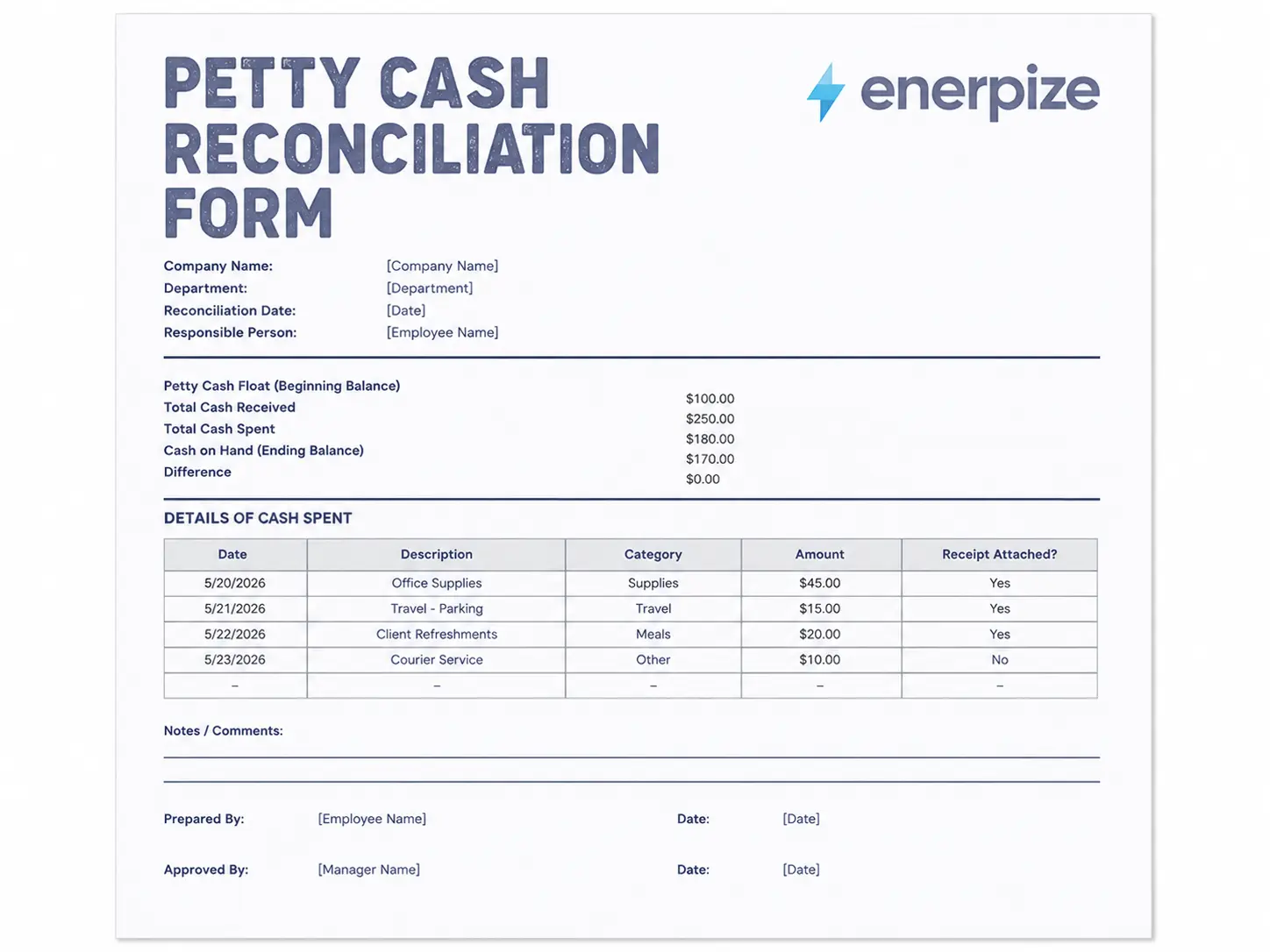
Count the cash on hand, total every receipt with proof attached, add in any advances or replenishments already submitted, and compare that total against the authorized float amount. Anything left over is the variance, and it needs an explanation before sign off. The sample line already filled into the template above works as a quick petty cash reconciliation example if you want to see the math before you start on your own numbers.
What happens if petty cash doesn't balance?
The difference gets investigated first, missing receipts, a counting error, or an unrecorded disbursement are the usual causes. Whatever's left after that investigation gets recorded as a shortage or overage, in the US that's the Cash Over and Short account specifically, rather than folded into a general expense line.
What is the difference between a petty cash reconciliation form and a petty cash voucher?
A voucher records one single disbursement the moment it happens. A reconciliation form is the periodic check that everything the vouchers say was spent, plus what's left in the box, actually adds up to the float amount.
Can I use a petty cash reconciliation template in Excel?
Yes, and it's the most practical format for this specific document, since the whole point is live calculation, not something to print and file. Ours is available as an Excel file with the variance, denomination count, and tax split all calculating automatically, alongside a Google Sheets version. If you've been searching for a petty cash reconciliation form pdf, a petty cash reconciliation form excel version, or an excel petty cash template generally, this is built to replace all three with one file that actually does the math for you.
How often should petty cash be reconciled?
Weekly for a high volume float, monthly at minimum for anything smaller, and always before requesting replenishment. A business reconciling daily might prefer our daily cash report template for the in-between days and save the full petty cash reconciliation form for the weekly or monthly check. The less frequently it's checked, the harder it gets to trace a discrepancy back to what actually caused it.
About the Author
Omar El Bahr is a Senior Digital Growth Specialist at Enerpize, where he leads SEO, content strategy, and organic growth across international markets. He is a Forbes Communications Council contributor and has written for Entrepreneur on business communication and digital strategy.