




Accounts payable is far more than just paying bills—it’s the engine behind nearly every non-payroll payment a business makes. From global corporations to small local businesses, how accounts payable is managed can make the difference between healthy cash flow and financial strain.
Whether managed by a dedicated department, a small finance team, or the business owner, accounts payable directly affects cash availability, financial accuracy, and the smooth flow of daily operations. When managed well, it brings clarity to expenses, strengthens cash flow control, reduces risk, and fosters reliable, long-term relationships with suppliers.
So, what exactly falls under accounts payable, and why is it so critical to a company’s financial success? In the sections ahead, we’ll explore the key types of accounts payable, their importance, and how effective management can support better financial decision-making.
Key Takeaways
- Accounts payable is a core financial function that directly impacts cash flow, liquidity, and supplier relationships.
- AP represents a current liability, not an asset or an expense, and must be managed accurately to maintain financial clarity.
- AP items include supplier invoices, utilities, services, subscriptions, leases, and logistics costs.
- Manual AP processes increase the risk of errors, delays, duplicate payments, and fraud.
- A structured AP process—covering invoice receipt, matching, approval, payment, and recording—is essential for financial control.
- AP automation improves efficiency by reducing processing time, enhancing accuracy, and providing real-time visibility into outstanding payables.
- With Enerpize, accounts payable is centralized within a single accounting platform, integrated with the general ledger, cost centers, and reporting.
- Automating accounts payable with Enerpize helps businesses optimize cash management, strengthen vendor relationships, and support scalable growth.
What is Accounts Payable?
Accounts payable (AP) refers to the obligations a business has to pay its vendors or suppliers for goods and services purchased on credit. These unpaid amounts are recorded as a liability on the company’s balance sheet, while changes in the total accounts payable balance over time are reflected in the cash flow statement.
Beyond recording what a company owes, accounts payable encompasses the whole process of managing vendor invoices—from verification and approval to timely payment—ensuring accuracy, compliance with financial controls, and protection of company cash.
As a core part of a company’s financial operations, accounts payable helps maintain strong supplier relationships, supports regulatory compliance, and provides clear visibility into short-term liabilities and payment schedules. When managed properly, it allows businesses to control expenses, avoid costly errors, and better understand how outgoing payments affect overall financial performance.
Read Also: What Is Accounts Receivable?
Is Accounts Payable A Liability?
Yes, accounts payable is considered a financial liability for a company. It represents the amount a business owes to its suppliers or vendors for goods or services received but not yet paid for.
Accounts payable are typically recorded under current liabilities on the balance sheet, as these are obligations that are usually due within a short period, generally less than one year.
Having a balance in accounts payable reflects the company’s current obligations to suppliers and helps assess short-term liquidity and working capital. Proper management of accounts payable ensures payments are made to accurate invoices on time, maintains good relationships with suppliers, and provides a clear view of the company’s financial obligations.
Explore more on this topic: What Are Accrued Liabilities? Definition & Examples
Accounts Payable Examples
Accounts payable includes a wide range of everyday business obligations that arise when goods or services are received before payment is made. These obligations typically arise from day-to-day operations and are recorded as current liabilities on the balance sheet, with related payments reflected in the cash flow statement under operating activities.
Below are some of the most common examples of accounts payable found in business operations:
1- Supplier invoices
These include amounts owed for raw materials, inventory, or merchandise purchased from suppliers on credit. Once the goods are received, the unpaid invoice is recorded in accounts payable until payment is made.
2- Transportation and logistics
Freight charges, customs fees, and delivery costs billed by carriers after goods are shipped or delivered are tracked in accounts payable to reflect the true cost of moving products.
3- Utilities
Monthly bills for electricity, water, fuel, internet, and phone services are recorded in accounts payable when received, since these services are used before payment is due.
4- Products and equipment
Purchases of machinery, office equipment, furniture, or employee devices with deferred payment terms are recorded in accounts payable once delivered.
5- Contractor and professional services
Invoices from contractors, subcontractors, and professional service providers—such as legal, consulting, accounting, maintenance, or IT support—are included in accounts payable until settled.
6- Subscriptions and licensing
Recurring software subscriptions, platform services, and licensing fees billed monthly or annually with payment terms are recorded in accounts payable to track ongoing obligations.
7- Leasing
Lease payments for equipment, vehicles, or property invoiced periodically are treated as accounts payable until payment is made, helping businesses avoid missed deadlines and late fees.
You might also find this helpful: Lease Accounting Journal Entries: Types and Calculating
Importance of Accounts Payable for Business
Accounts payable (AP) is a critical part of a company’s financial operations, responsible for managing money owed to vendors and suppliers for goods and services received.
The accounts payable department not only ensures that invoices are paid accurately and on time but also supports the organization’s overall financial health, cash flow management, and vendor relationships.
When managed effectively, AP goes beyond simply recording liabilities—it becomes a key tool for maintaining liquidity, controlling expenses, and enhancing operational efficiency, highlighting its key importance in overall financial management as follows:
Accurate and Timely Payments
The accounts payable team ensures that all vendor invoices are legitimate, properly coded, approved, and paid on time, preventing errors, fraud, or duplicate payments.
Cash Flow Management
By deciding when and how to pay invoices—whether to avoid late fees or to take advantage of early payment discounts—AP helps the organization control cash outflows and optimize working capital.
Vendor Relationship Management
A well-organized accounts payable process strengthens trust and collaboration with suppliers, ensuring smooth business operations and potentially better credit terms.
Cost Savings and Efficiency
Knowledgeable accounts payable teams, supported by automation, save time and reduce costs associated with manual invoice processing, check handling, and reconciliations.
Financial Oversight and Reporting
AP balances are recorded under current liabilities on the balance sheet and reflected in the cash flow statement, providing insights into short-term liquidity and overall financial health.
Support for Managerial Accounting and Analysis
Proper accounts payable management provides essential data for evaluating a company’s financial position, budgeting, and strategic planning.
Potential to Transform AP from A Cost to A Profit Center
With automation and strategic payment management, organizations can earn rebates, early-pay discounts, or other financial advantages, turning AP into a value-generating function.
By leveraging Enerpize’s automated payment management solutions, businesses can streamline approvals, optimize payment timing, and unlock these benefits with greater accuracy, control, and efficiency.
How to Record Accounts Payable?
In double-entry bookkeeping, every transaction must have a corresponding debit and credit to maintain balance in the general ledger. Accounts payable is a liability, so when a company receives goods or services on credit, the initial entry records an increase in assets or expenses and a corresponding increase in accounts payable.
Later, when the invoice is paid, the accounts payable balance is reduced, and cash is credited to reflect the outflow.
Initial entry (upon receiving goods or services):
- Debit: Expense or asset account (to reflect what was received)
- Credit: Accounts payable (to record the liability owed)
Payment entry (when settling the invoice):
- Debit: Accounts payable (to reduce the liability)
- Credit: Cash (to show the cash leaving the business)
Example:
A company purchases office furniture for $10,000 on credit, with payment due in 45 days.
- Step 1: Initial Recording
- Debit: Assets +$10,000 (records the furniture as an asset)
- Credit: Accounts Payable +$10,000 (records the liability to the supplier)
- Step 2: Payment Recording (after 45 days)
- Debit: Accounts Payable -$10,000 (removes the liability)
- Credit: Cash -$10,000 (reflects the cash payment)
| Description | Journal Entry | Accounts Payable Balance | Cash Balance |
| Record purchase of office furniture on credit ($10,000) | Debit Furniture / Fixed Assets 10,000 Credit Accounts Payable 10,000 | 10,000 | — |
| Pay the supplier after 45 days ($10,000) | Debit Accounts Payable 10,000 Credit Cash 10,000 | 0 | 10,000 |
This approach ensures that all transactions are accurately documented and that the company’s financial position remains clear and up to date.
Explore more on this topic: What are Journal Entries in Accounting: Examples and Types
How to Calculate Accounts Payable?
Accounts payable reflect the amount a business owes its suppliers for purchases made on credit. To calculate this balance for a specific period, follow the steps below:
1- Determine The Opening Accounts Payable Balance
Start with the accounts payable amount at the beginning of the period. This figure represents unpaid supplier invoices carried over from the previous period.
2- Add Credit Purchases for The Period
Identify the total value of goods and services purchased on credit during the current period. These transactions increase your accounts payable because payment has not yet been made.
3- Subtract Supplier Payments
Calculate the total payments made to suppliers during the period. These payments reduce your outstanding balance.
4- Calculate The Ending Accounts Payable
Apply the formula by adding credit purchases to the opening balance and subtracting supplier payments. The result is your ending accounts payable, showing the total amount owed to suppliers at the end of the period.
Accounts Payable Formula
Ending Accounts Payable = Opening Accounts Payable + Credit Purchases − Payments to Suppliers
Practical Example of Calculating Accounts Payable
Assume Company Y begins the month of March with an accounts payable balance of $18,500, representing unpaid invoices from suppliers recorded on the previous month’s balance sheet.
In March, the company purchased office equipment and inventory on credit totaling $11,200, increasing the amount owed to suppliers. Over the same period, Company Y pays $9,000 to vendors to reduce its outstanding obligations.
To calculate the ending accounts payable balance, the standard formula is applied:
Ending Accounts Payable = Beginning Accounts Payable + Credit Purchases − Payments to Suppliers
Ending Accounts Payable = 18,500 + 11,200 − 9,000
Ending Accounts Payable = $20,700
At the end of March, Company Y’s accounts payable balance is $20,700. This increase shows that the company made more purchases on credit than it paid off during the period. While this may support ongoing operations or growth, it also highlights the importance of monitoring cash flow to ensure supplier payments remain timely and relationships are maintained.
| Description | Journal Entry | Accounts Payable Balance | Cash/Bank Balance |
| Beginning balance (March 1) | — | 18,500 | — |
| Record credit purchases of office equipment and inventory ($11,200) | Debit Inventory / Equipment 11,200 Credit Accounts Payable 11,200 | 29,700 | — |
| Pay suppliers during the month ($9,000) | Debit Accounts Payable 9,000 Credit Cash (Bank) 9,000 | 20,700 | (9,000) |
| Ending balance (March 31) | — | 20,700 | (9,000) |
Explore Enerpize's easy-to-use Accounts Payable Template to simplify invoice tracking, stay on top of payment deadlines, and gain clear visibility into your outstanding liabilities.
Main Accounts Payable Performance Metrics
To gain deeper insight into payment behavior, cash flow management, and supplier relationships, businesses rely on accounts payable performance metrics. Two of the most widely used metrics are:
1- Accounts Payable Turnover Ratio
The accounts payable turnover ratio measures how many times a company pays its suppliers over a given period. It indicates how quickly a business settles its accounts payable and reflects payment efficiency.
Accounts Payable Turnover Ratio Formula:
Accounts Payable Turnover = Total Credit Purchases ÷ Average Accounts Payable
Where:
Average Accounts Payable = (Opening Accounts Payable + Ending Accounts Payable) ÷ 2
A higher accounts payable turnover ratio suggests that the company pays suppliers more frequently, while a lower ratio may indicate slower payments or extended credit terms.
2- Accounts Payable Days (Days Payable Outstanding – DPO)
Accounts payable days measure the average number of days a business takes to pay its suppliers. This metric translates the turnover ratio into a time-based measure that is easier to interpret.
Accounts Payable Days Formula:
Accounts Payable Days = (Average Accounts Payable ÷ Total Credit Purchases) × Number of Days in the Period
A higher number of days payable indicates the company is taking longer to pay suppliers, which may improve short-term cash flow but could strain supplier relationships. A lower number suggests faster payments and stronger supplier trust, though it may reduce available cash.
Together, the accounts payable turnover ratio and accounts payable days provide valuable insight into how effectively a business manages its supplier obligations, balances cash flow, and aligns payment practices with its financial strategy.
What is The Accounts Payable Process?
The accounts payable (AP) process is the complete workflow a company follows to manage and pay its obligations to vendors and suppliers. Here are the Steps in the Accounts Payable (AP) Process:
- Receive the Purchase Order (PO): The AP team receives the PO from the procurement department, which details the requested goods or services and the agreed-upon prices.
- Receive the Vendor Invoice: Collect the invoice from the supplier and verify that all details match the PO.
- Code the Invoice: Assign the correct account codes and cost centers to ensure accurate bookkeeping.
- Match the Invoice with the PO and Goods Receipt: Confirm quantities, prices, and received items through a 2-way or 3-way match.
- Approve the Invoice: Route the invoice to the appropriate manager or department for payment approval.
- Schedule Payment: Prepare the invoice for payment in accordance with supplier terms and company policies.
- Execute Payment to Vendors: Pay the supplier via electronic transfer, check, or other approved methods.
- Update Financial Records: Record all transactions in the general ledger to maintain accurate and reliable financial records.
Common Challenges in the AP Process
An outdated, manual accounts payable (AP) process can quietly drain an organization’s time, cash, and resources. Paper-based workflows, siloed systems, and heavy reliance on manual data entry not only slow operations but also increase the risk of errors, missed opportunities, and fraud.
Understanding where AP processes commonly break down is the first step toward building stronger controls and more efficient, automated workflows.
Below are some of the most common challenges organizations face across the accounts payable lifecycle:
1- Slow and Inefficient Processing
Manual invoice handling often leads to long approval cycles due to documents being passed between departments, misplaced, or delayed. These inefficiencies can result in late payments, late fees, and strained supplier relationships. Over time, consistently slow payments may even harm a company’s creditworthiness and limit its ability to negotiate favorable supplier terms.
2- Invoice Capture and Data Entry Errors
Paper invoices and manual data entry introduce a high risk of errors, including incorrect amounts, missing details, or duplicate records. Invoices can also be lost entirely, leading to unpaid liabilities that distort financial reporting and create friction with vendors.
Related reads you might find useful: What Is the Error of Commission in Accounting?
3- Matching Discrepancies and Exceptions
Accounts payable teams typically rely on three-way matching—comparing invoices with purchase orders and receiving documents—to ensure accuracy. When information is incomplete, inconsistent, or spread across multiple systems, mismatches are common. Resolving these exceptions often requires manual investigation and follow-up, consuming a significant portion of AP staff time.
4- Approval Bottlenecks
Without clearly defined approval workflows and accountability, invoices can sit unapproved for days or weeks. These delays not only push payments past their due dates but also increase the likelihood of rushed or incorrect approvals when deadlines approach.
5- Unauthorized or Non-compliant Purchases
Weak controls and manual oversight make it easier for unauthorized purchases to slip through, such as expenses without approved purchase orders or misuse of company credit cards. AP teams then spend valuable time investigating and correcting these transactions instead of focusing on higher-value work.
6- Fraud and Security Risks
Accounts payable is a common target for fraud, including check fraud and business email compromise (BEC) schemes. Fraudsters may impersonate vendors or executives to request payments, and without strong controls and verification processes, these fraudulent requests can be challenging to detect. Even a single incident can result in substantial financial losses.
7- Premature or Incorrect Payments
In busy AP environments, invoices may be paid upon receipt without verifying that goods or services were delivered as agreed. Paying too early can also reduce cash on hand, limiting liquidity and flexibility, even if discounts are not being captured.
8- Duplicate Payments
Duplicate or overpayments often stem from inconsistent supplier data, manual entry errors, or the use of multiple, disconnected financial systems. While small organizations may catch duplicates through close oversight, this approach does not scale and becomes increasingly risky as transaction volumes grow.
Together, these challenges underscore why modernizing the accounts payable process is critical. By identifying weak points and adopting automation, standardized workflows, and stronger controls, organizations can reduce errors, mitigate fraud risk, improve cash flow management, and allow AP teams to focus on more strategic, value-added activities.
What is Accounts Payable Automation?
Accounts payable automation is the use of digital accounting systems to manage the entire AP lifecycle, replacing manual, paper-based processes. It includes automated invoice capture, approval workflows, payment scheduling, and real-time tracking of outstanding payables.
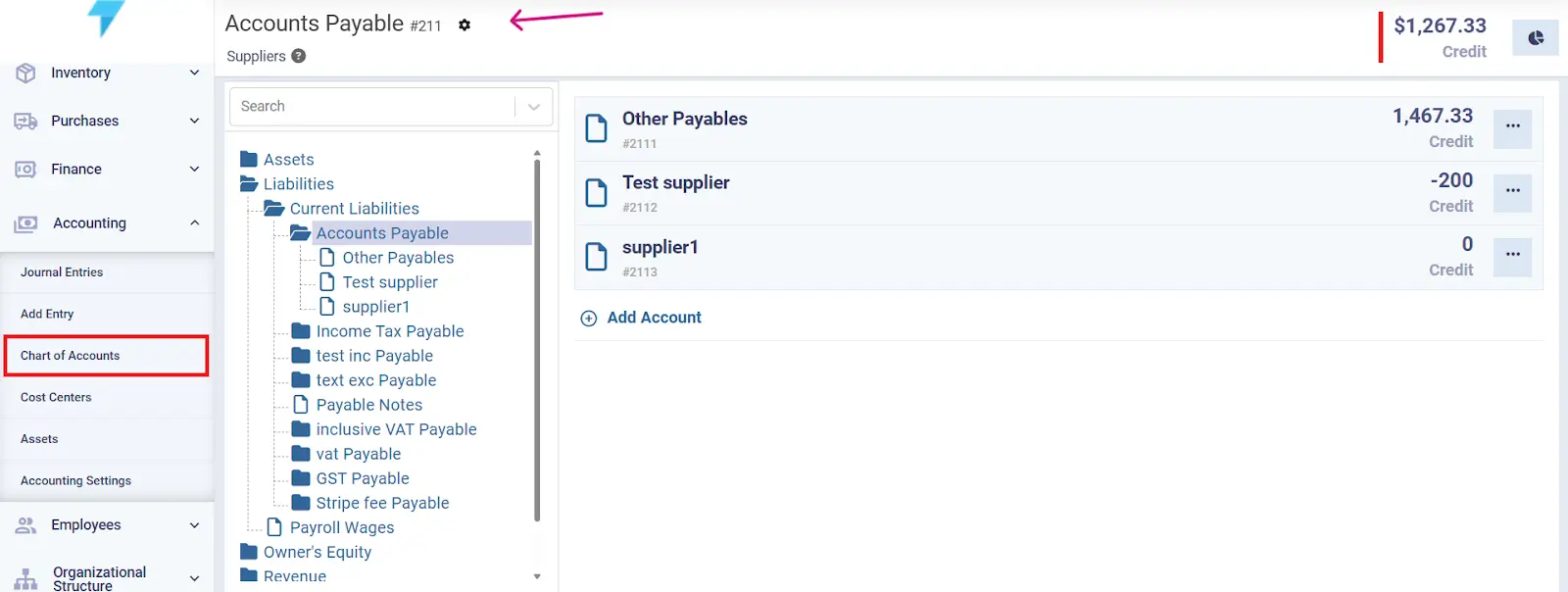
With Enerpize, AP automation ensures transactions are automatically recorded in the Chart of Accounts and General Ledger, linked to cost centers, and supported by real-time cash flow visibility—reducing errors, preventing duplicate or fraudulent payments, and improving overall efficiency and financial control.
How to Improve the Accounts Payable (AP) Process?
Improving the accounts payable process is critical for enhancing cash flow, minimizing liquidity risk, and increasing overall operational efficiency. Organizations can achieve this by moving away from manual, fragmented workflows and adopting smart automation solutions.
In fact, studies show that 78% of accounts payable teams report increased productivity after adopting digital AP tools, underscoring the direct impact of automation on efficiency and performance.
Key strategies to improve the accounts payable process include:
- Simplifying workflows by removing unnecessary steps, clarifying ownership, and standardizing procedures to reduce delays and bottlenecks.
- Reducing manual work through automation of invoice capture, data entry, and approval workflows to improve accuracy and processing speed.
- Eliminating paper invoices and shifting to electronic invoicing to enhance visibility, security, and efficiency.
- Automating invoice matching between invoices, purchase orders, and receiving documents to prevent errors, duplicate payments, and late fees.
- Standardizing invoice formats and payment terms to improve payment scheduling and cash flow predictability.
- Using electronic payment methods such as ACH transfers or virtual cards to streamline payments and lower operational costs.
- Centralizing document storage and data to improve transparency, reporting accuracy, and audit readiness.
- Strengthening vendor communication and relationships to resolve issues quickly and enable better payment terms.
Enerpize Accounting Software streamlines the entire AP lifecycle by automating invoice capture, approval workflows, and payment scheduling, ensuring accuracy and compliance at every step, with real-time visibility into outstanding payables and automated controls to reduce errors and fraudulent invoices.
How to Manage Accounts Payable Effectively? Accounts Payable Automation with Enerpize
Enerpize Online Accounting Software centralizes accounts payable on a single platform, enabling finance teams to manage supplier expenses, journal entries, and approvals with accuracy and control.
Every payable transaction is automatically recorded in the Chart of Accounts and reflected in the General Ledger, eliminating duplicate data entry and reducing reconciliation issues. With real-time cash flow tracking, businesses always know what they owe, when payments are due, and how payables affect overall liquidity.
Enerpize simplifies AP through automation that supports both daily operations and long-term financial planning. Expense and payable entries are logged instantly, assigned to the correct cost centers, and categorized by department, product, or project. This level of detail allows businesses to track spending patterns, measure profitability, and manage budgets with confidence.
Automated reporting ensures finance teams can generate accurate payables, expense, and profit-and-loss reports at any time—without manual consolidation. Built-in compliance and secure cloud infrastructure protect financial data, while seamless integrations with sales, inventory, HRM, and CRM systems provide a complete financial picture across the organization.
By automating accounts payable with Enerpize, businesses reduce processing time, avoid missed or duplicate payments, and gain clearer control over cash outflows. The result is a more efficient AP process that supports smarter decisions, healthier cash flow, and scalable growth—without adding complexity.
FAQs
Is accounts payable an asset?
No, accounts payable is not an asset. It is a liability that represents amounts a business owes to its suppliers for goods or services received but not yet paid. Accounts payable is recorded under current liabilities on the balance sheet.
Is accounts payable a debit or credit?
Accounts payable are a credit by nature.
- When goods or services are received on credit, accounts payable is credited to record the obligation.
- When the invoice is paid, accounts payable is debited to reduce the liability.
Is accounts payable an expense?
No, accounts payable is not an expense itself. It represents a liability that arises from an expense or asset that has already been recorded. The cost is recognized in the appropriate expense account, while accounts payable reflects the unpaid amount owed to the supplier.

Accounts payable plays a vital role in maintaining financial stability, controlling cash flow, and strengthening supplier relationships. When managed effectively, it goes beyond a routine accounting function to become a strategic driver of efficiency and informed decision-making.
By understanding the AP process, common challenges, and best practices—and by leveraging automation with Enerpize—businesses can reduce risk, improve accuracy, optimize cash outflows, and build a more scalable, resilient financial operation.

Related Articles
 Accounting
How To Create An Income Statement: 10 Steps
Read more Accounting
Payday Super 2026: Everything Australian Small Businesses Need to Know Before July 1 2026
Read more Accounting
30 Small Business Expense Categories You Have to Consider
Read more Accounting
How Can Enerpize Boost Your Business As Payment Management Software?
Read more Accounting
Omission Error in Accounting: Definition, Examples, And How To Avoid
Read more Accounting