

Posted on 24 June 2026
Free Bill of Lading Template Download: Excel, Word, PDF & Google Sheets and Docs
- Available in Word, Excel, PDF, Google Docs, and Google Sheets, free to download with no sign-up required
- Covers shipper details, consignee details, carrier information, commodity description, freight charge terms, and signature blocks in one structured document
- Built with country-specific fields for US interstate compliance (CFR Title 49), Canadian bilingual requirements, UK CMR cross-border freight, and international Incoterms in one template
Calculates package totals, weight totals, and grand totals automatically in Excel and Google Sheets
A bill of lading template is a pre-formatted shipping document that records what is being transported, who is moving it, and who receives it, giving every party in the freight chain a clear, signed record of the shipment from pickup to delivery


What Is a Bill of Lading?
Picture a truck driver pulling out of a warehouse at 5 AM. The goods are loaded, the doors are sealed, and the driver is about to cover 800 miles to a distribution center. One question decides whether this trip ends smoothly or in a legal dispute: does anyone have a signed record of what just left that dock?
That is the job of a bill of lading.
A bill of lading (abbreviated BOL or B/L) is a legally binding document that functions as three things at the same time. It is a contract of carriage between the shipper and the carrier. It is a receipt confirming the carrier has collected the goods. And it is a document of title, meaning the person holding it has the right to claim the cargo.
In American English, the term covers all transportation modes: road, rail, sea, and air. In British English, it traditionally referred only to sea freight, though the broader usage has become standard in international trade.
The three parties every BOL names are the shipper (the business sending the goods), the carrier (the trucking, shipping, or logistics company transporting them), and the consignee (the buyer or warehouse receiving the shipment). Some shipments also involve a freight forwarder, who arranges transport on the shipper's behalf, and a notify party, who gets updates on the shipment's progress without necessarily being the final recipient.
Get your freight documentation right from the first load and connect your shipping records directly to your invoicing and client accounts. Start for free.
What the Enerpize Bill of Lading Template Includes
Most free bill of lading templates online give you the basics: ship from, ship to, and a signature line. We looked at every major competitor and found the same pattern. The essential compliance fields are missing. The international fields are absent. And there is no space for the information that actually protects you if something goes wrong.
The Enerpize bill of lading template was built to close those gaps. Here is exactly what you get in every format.
Party Information Fields
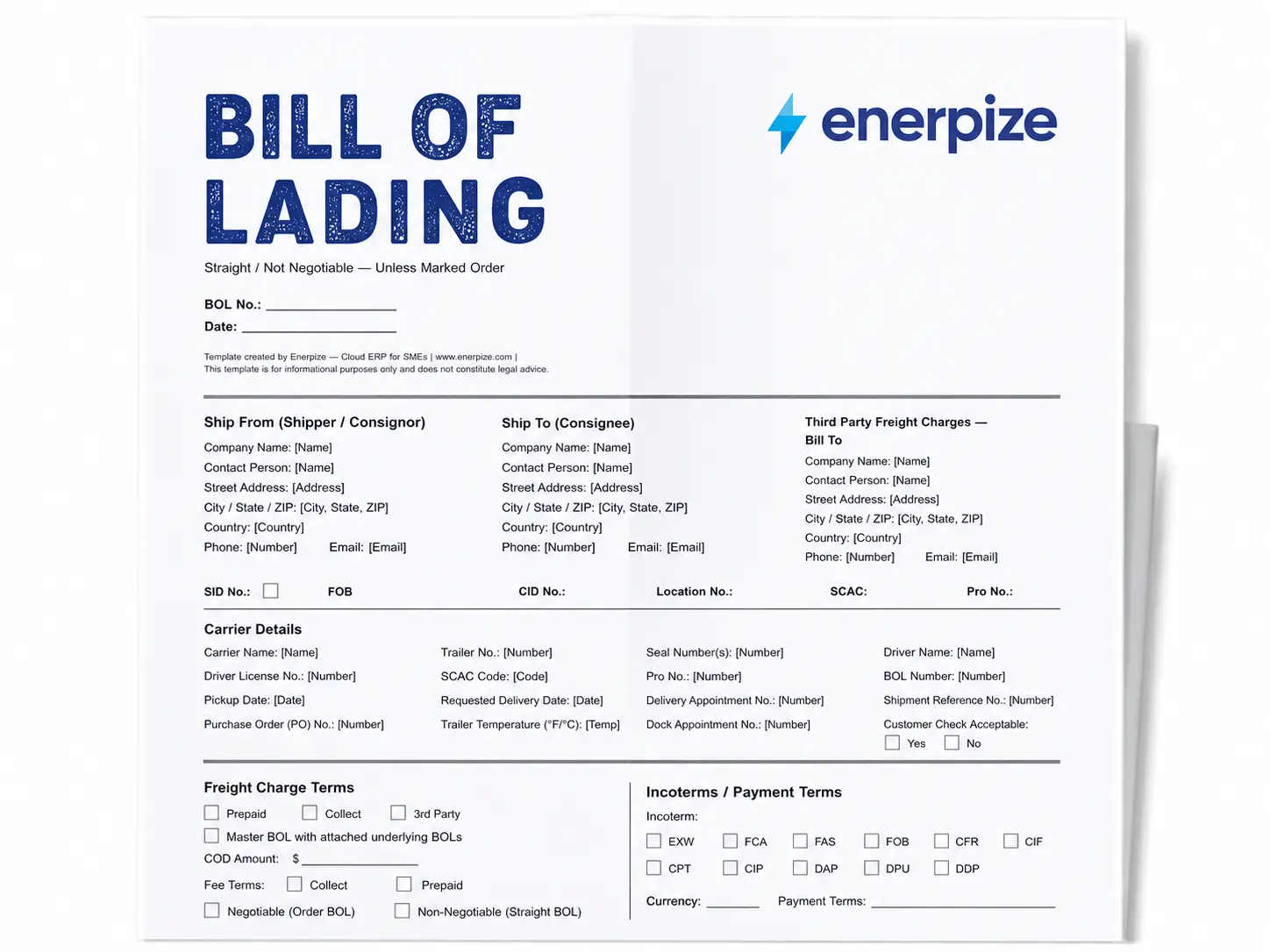
The template covers all three parties with full contact detail rows, not just a name and address. Each section includes company name, contact person name, street address, city, state and ZIP, country, phone, and email. This matters because generic BOL forms only capture the address. If a delivery dispute arises and you need to reach a specific person at the consignee's receiving dock, that information is already in the document.
The Ship From section also captures the SID (Shipper's Identification) number and a FOB checkbox. The Ship To section captures the CID (Consignee's Identification) number and location number. The Third Party Freight Charges section captures the SCAC code and pro number for the billing party.
Carrier and Shipment Detail Fields
This is where the Enerpize template separates itself most clearly from a generic blank form. The carrier section includes carrier name, trailer number, seal numbers, and driver name, but also driver license number, SCAC code, pro number, BOL number, pickup date, requested delivery date, delivery appointment number, shipment reference number, purchase order number, trailer temperature (for refrigerated freight), and dock appointment number.
A standard BOL template has roughly half of these. The others only appear when something goes wrong and you realize too late they were never captured.
Freight Charge Terms and Incoterms
The Enerpize template covers prepaid, collect, and third-party freight terms, plus the master BOL checkbox for consolidated shipments. It adds the full set of 11 Incoterms (EXW, FCA, FAS, FOB, CFR, CIF, CPT, CIP, DAP, DPU, DDP), a currency field, payment terms, and a negotiable versus non-negotiable designation. No competitor free template includes all 11 Incoterms in a single downloadable form.
International and Cross-Border Fields
Every import and export shipment needs fields that a domestic BOL template simply does not have. The Enerpize template includes country of origin, HS code (Harmonized System tariff code), customs reference number, export license number, port of loading, port of discharge, vessel or flight route, voyage or flight number, ISF filing number (required for US imports under CBP rules), CBP entry number, final destination, and place of delivery.
These fields are what a freight forwarder fills in before a shipment clears customs. Having them in your template means you are not scrambling to add them on a separate document.
Commodity Information Table
The commodity section captures handling unit quantity and type, package quantity and type, weight, hazmat designation (HM column), NMFC item number, freight class, package dimensions (length, width, height), and commodity description. The hazmat column includes a built-in warning note: hazardous materials must be listed first in the commodity description, ahead of all other line items. This is a DOT regulatory requirement under 49 CFR § 172.604, not a formatting preference.
The Excel and Google Sheets versions calculate package totals, weight totals, and the grand total automatically.
Hazardous Materials Section
The Enerpize template includes a dedicated hazmat section that most free templates skip entirely. It captures hazmat class and division, UN or NA number, packing group, proper shipping name, emergency contact name, 24-hour emergency contact phone number, placard number, and an ERP guidebook checkbox confirming the driver has the DOT Emergency Response Guidebook on board.
Under FMCSA regulations, carriers transporting hazardous materials must have emergency response information available. That requirement does not disappear because a template did not have a field for it.
Insurance and Liability Fields
The template captures declared value of shipment, carrier liability cap, insurance policy number, and insurer name. It also includes the standard liability limitation notice referencing 49 USC 14706(c)(1)(A) and (B). Most blank BOL forms include the statutory notice but leave no space to actually record the declared value or the carrier's liability cap, which are the two numbers that determine what happens if cargo is damaged or lost.
Signature Blocks
Three complete signature sections cover shipper, carrier, and the trailer loaded and freight counted checkboxes. Each signature block captures name (print), title or company, and date. The carrier acknowledgement statement is included at the bottom, confirming receipt of packages, required placards, and emergency response documentation.
How to Fill Out a Bill of Lading Template
Step 1: Enter Shipper Information
Fill in your company name, contact person, full address including country, phone, and email. Add your SID number if you have one. Check the FOB box if the freight terms make you responsible for the goods until they leave your facility.
Step 2: Enter Consignee Information
Fill in the recipient's company name, contact person, full address including country, phone, and email. Add the CID number and location number for the receiving dock. These details need to match the purchase order exactly. Any mismatch between the BOL and the PO can delay customs clearance on cross-border shipments.
Step 3: Complete Third-Party Billing If Applicable
If a third party is paying freight charges, fill in their company name, address, and contact details. Add the SCAC code and pro number for the billing carrier. Leave this section blank if freight charges are prepaid by the shipper or collect from the consignee.
Step 4: Enter Carrier Details
Fill in the carrier's name, trailer number, seal numbers, and driver information. Add the requested delivery date and any appointment numbers for the pickup dock and delivery dock. If the shipment is temperature-controlled, record the required trailer temperature.
Step 5: Set Freight Charge Terms and Incoterms
Check prepaid, collect, or third-party for freight charges. Select the applicable Incoterm and record the currency. Mark whether the BOL is negotiable (Order BOL) or non-negotiable (Straight BOL). For most domestic US shipments, non-negotiable straight BOL is the standard.
Step 6: Complete the Customer Order Section
Enter each customer order number with the corresponding number of packages and weight. The Excel and Google Sheets versions will calculate the grand total automatically. For palletized freight, check whether it is a pallet or slip sheet under the handling unit column.
Step 7: Describe the Commodity
List each commodity line item with handling unit quantity and type, package quantity and type, weight, NMFC item number, freight class, and dimensions. If any item is a hazardous material, list it first in the commodity description before all other items. Mark it with an X in the HM column.
Step 8: Complete the Hazmat Section If Required
Fill in the hazmat class, UN or NA number, packing group, and proper shipping name for any hazardous material in the shipment. Enter the 24-hour emergency contact name and phone number. Record the placard number and confirm the ERP guidebook is on board.
Step 9: Record the Declared Value and Insurance Information
Enter the declared value of the shipment and the carrier's liability cap. Record your insurance policy number and insurer name. These numbers are the reference point for any damage or loss claim. Without them, a claim becomes a negotiation with no baseline.
Step 10: Sign and Date All Blocks
The shipper signs and dates before the trailer is loaded. The carrier signs and dates at pickup, confirming receipt of the goods. Both parties should retain a copy of the signed BOL. The consignee signs at delivery to confirm the goods arrived in the described condition.
Enerpize connects your shipping records to your invoicing, purchase orders, and client accounts. Start for free.
Types of Bill of Lading Templates
Not every shipment uses the same form. The type of BOL you need depends on how the goods are moving, whether ownership can transfer during transit, and which regulatory framework applies.
| BOL Type | What It Does | When to Use It |
|---|---|---|
| Straight Bill of Lading | Non-negotiable. Goods go to the named consignee only. | Domestic US freight, pre-paid shipments, goods already paid for before shipping |
| Order Bill of Lading | Negotiable. Ownership can transfer by endorsement during transit. | International trade, letters of credit transactions, goods not yet paid for at shipment |
| Ocean Bill of Lading | Used for sea freight. Can be negotiable or non-negotiable. | Container shipments, international maritime transport |
| Inland Bill of Lading | Used for domestic road or rail freight. | Truck or rail transport within a country |
| Through Bill of Lading | Covers multiple transportation modes and carriers in one document. | Multi-leg shipments combining road, rail, and sea |
| Air Waybill | Non-negotiable. Used for air freight. Also called a consignment note. | Air cargo, express international shipments |
| House Bill of Lading | Issued by a freight forwarder to the shipper. | Consolidated shipments where a forwarder groups multiple shippers |
| Master Bill of Lading | Issued by the carrier to the freight forwarder. | Consolidated shipments at the carrier level |
| Clean Bill of Lading | Carrier confirms goods received in good condition. No damage noted. | Standard good-condition delivery confirmation |
| Claused Bill of Lading | Notes damage or discrepancy at the time of receipt. | Damaged packaging, quantity shortfall, visible cargo issues |
A quick note on a term that trips up a lot of SMB owners: a Bill of Lading and a Bill of Materials are two completely different documents. A Bill of Materials defines what goes into manufacturing a product. A Bill of Lading records what happens to the finished product after it leaves your facility.
Bill of Lading Requirements by Country
The BOL template looks similar across borders. The legal framework behind it does not.
United States Bill of Lading Requirements
The US has the most formalized BOL requirements of any English-speaking freight market, which is why 57% of all global searches for this keyword come from American shippers.
CFR Title 49 § 373.101 requires all common carriers engaged in interstate transportation by rail or water to issue a bill of lading. For trucking, the Uniform Straight Bill of Lading is the standard form accepted by all domestic carriers. It must include the names of the consignor and consignee, origin and destination points, number of packages, freight description, and weight or volume where applicable to freight rating.
Two fields that most free templates skip, and that the FMCSA treats as non-negotiable: the NMFC item number and hazardous materials identification. Under DOT regulations, hazardous materials must be listed first in the freight description, ahead of everything else. That is a federal compliance requirement, not a formatting suggestion.
For cross-border shipments entering or leaving the US, the CBP Truck Manifest: Bill of Lading Template outlines exactly what US Customs and Border Protection requires at the border. The Importer Security Filing (ISF) adds another layer: late filing triggers a standard $5,000 penalty per shipment under CBP rules, with maximum fines reaching $10,000 for errors or missing data.
Businesses shipping within construction, manufacturing, or trucking industries in the US can pair their BOL documentation with a construction invoice or trucking invoice to keep the full freight payment cycle in one place.
Canada Bill of Lading Requirements
Canada accounts for 16% of global search volume for this keyword, driven by one of the busiest cross-border freight corridors in the world: the Canada-US land border.
The Canadian BOL framework sits under the Canada Transportation Act, which governs interprovincial and international carriage of goods. The practical detail that catches shippers off-guard: any shipment moving between Canadian provinces, or crossing the Canada-US border, requires a bilingual BOL. All fields must appear in both English and French. Most free BOL templates downloaded from US-focused sites do not include the French translation. That creates processing friction at carrier check-in and at customs, and in some cases delays the shipment entirely.
The Business Development Bank of Canada publishes a government-endorsed BOL template for Canadian operations managers, built around the three core BOL functions: proof of contract, proof of receipt, and proof of title.
United Kingdom Bill of Lading Requirements
The UK represents 1% of global search volume for this keyword, but it is a market with a specific documentation requirement that a generic BOL template will not satisfy.
For domestic UK road freight, a standard consignment note serves the BOL function. For cross-border road freight moving between the UK and EU countries, the CMR (Convention on the Contract for the International Carriage of Goods by Road) consignment note applies. The CMR was retained in UK law after Brexit and remains active for cross-border EU road freight. Substituting a standard BOL for a CMR note on EU-bound road shipments creates customs clearance problems.
UK businesses should also understand the distinction between a BOL and a delivery note: the delivery note confirms receipt at the destination but carries no legal title function. The BOL is the title document. Both travel with the shipment, but they serve different legal purposes at different stages.
Bill of Lading vs. Packing Slip vs. Commercial Invoice
Three documents, three jobs. They often travel together on the same shipment, which is why people assume they are interchangeable. They are not.
| Document | Legal Function | Who Uses It | When It Is Created |
|---|---|---|---|
| Bill of Lading | Contract of carriage and document of title | Shipper and carrier | At pickup, before goods leave the origin |
| Packing Slip | Itemized list of shipment contents | Warehouse and receiving team | During packing, before shipment leaves |
| Commercial Invoice | Financial record and customs declaration | Seller and buyer | When the sale is invoiced, often before shipment |
The BOL says a carrier is legally responsible for getting the goods from A to B. The packing slip says what is in the boxes. The commercial invoice says what those boxes cost. All three are needed for international shipments. All three serve a different audience in the freight chain.
What Most Free Bill of Lading Templates Are Missing
Here is what the typical free template leaves out.
Contact Details Beyond the Address
Most templates capture company name and address. None capture contact person name, phone number, and email address for all three parties. In a dispute, you need to reach a specific person, not just mail something to a street address.
Driver Information
Driver name and license number are absent from virtually every free template. These fields matter for insurance claims and for confirming the right authorized driver collected the shipment.
Full Incoterms Selector
Most templates show a FOB checkbox. Only the Enerpize template includes all 11 Incoterms in a single document.
Package Dimensions
The commodity table on most templates captures weight and freight class but not dimensions. Dimensional weight pricing is now standard across LTL carriers. Without dimensions recorded at pickup, you have no reference point if a carrier bills you for a different weight than what was loaded.
A Dedicated Hazmat Section
The HM (hazardous materials) checkbox appears on most templates. A full hazmat section with UN number, packing group, proper shipping name, emergency contact details, and placard number does not. Federal regulations require this information to travel with the shipment. A checkbox is not a compliance solution.
Insurance and Liability Fields
The liability limitation notice referencing 49 USC 14706 appears on most US templates. Space to actually record the declared value, carrier liability cap, policy number, and insurer name does not.
International Fields
Country of origin, HS code, customs reference number, ISF filing number, CBP entry number, and CMR-specific fields for UK-EU road freight are absent from every generic free template reviewed.
Bilingual Fields for Canada
Not a single free BOL template in the top search results includes English-French bilingual fields for Canadian interprovincial and cross-border freight.
Ready to go beyond a static form? Enerpize connects your shipping documentation to your invoicing, purchase management, and client records. Start for free.
How Enerpize Connects Your Bill of Lading to Your Business Operations
A BOL template solves the paper problem. Enerpize solves the operational problem.
Most businesses that ship regularly face the same friction: the BOL is filled out on a form, the invoice is created in a separate tool, the supplier record is in a spreadsheet somewhere, and none of these talk to each other. By the time a payment dispute arises, you are searching three systems for the same information.
Here is how Enerpize closes that loop.
Shipping and Logistics Operations
Enerpize has a dedicated shipping and logistics management vertical. Logistics firms and shipping companies can create a file for each shipment with all details, revenue, shipping expenses, and stage-based status tracking, then pull net profit per shipment directly from the system. Customer shipment history, account statements, balance tracking, and document uploads including BOL copies all live inside the CRM module, giving clients a download portal for their own records.
Purchase Management Integration
When a BOL is signed at pickup, the corresponding purchase order in Enerpize can be converted from quote to payable supplier invoice in one step. The purchase management module includes AI Purchase Invoice Processing that extracts supplier name, invoice number, date, items, quantities, prices, and taxes automatically from uploaded documents. When inbound quantities are confirmed on delivery, the system updates requisitions automatically. No manual stock adjustment after a shipment closes.
Inventory Sync
The cargo description fields on a BOL (product type, quantity, weight, lot number, serial number, expiry date) map directly to Enerpize's inventory tracking types. When a shipment arrives and the BOL is countersigned, stock levels update in real time across warehouses. Warehouse managers can be assigned per location with granular permissions, matching the BOL's Ship To and Location Number fields to a specific Enerpize warehouse and responsible employee. Barcoded packing slips generated inside Enerpize can accompany the BOL in transit, allowing receiving staff to verify cargo against the BOL line items using the mobile app scanner.
Staff Management
Freight specialists, collectors, and drivers can be added with role-based authorizations. Client representatives can be allocated by geographic location. Driver and employee performance is tracked through the HRM reporting layer, directly relevant to freight operations where route efficiency and on-time delivery rates determine profitability.
Key Takeaways
- A bill of lading is legally binding as a contract of carriage, a cargo receipt, and a document of title at the same time. Losing it, mis-filing it, or using an incomplete template creates real legal exposure for both the shipper and the carrier.
- US shippers operating interstate are required by CFR Title 49 to use a Uniform Straight Bill of Lading. Using a template that omits the NMFC class or hazardous materials identification field is not just incomplete, it puts carriers out of compliance with federal DOT regulations.
- Canadian interprovincial and cross-border freight legally requires a bilingual BOL in English and French. Most free BOL templates available online do not include French fields.
- UK freight moving to EU countries under road transport requires a CMR consignment note, not a standard BOL. The two documents have different legal standing and are not interchangeable.
- The Enerpize bill of lading template covers all six required field groups (shipper, consignee, carrier, cargo, freight terms, signatures) plus 14 fields that most free templates skip entirely, including Incoterms, dimensions, hazmat, insurance, and international customs fields.
- Businesses using Enerpize can connect their BOL documentation directly to invoicing, purchase management, inventory, and client records, eliminating manual re-entry between shipping documents and accounting across the full freight billing cycle.
Frequently Asked Questions
What is a bill of lading and why is it required?
A bill of lading is a legally binding shipping document that serves simultaneously as a contract of carriage between the shipper and carrier, a receipt confirming the carrier collected the goods, and a document of title giving the holder the right to claim the cargo. Under CFR Title 49, common carriers engaged in interstate transportation in the US are required to issue a bill of lading for rail and water freight. For road freight, the Uniform Straight Bill of Lading is the industry standard across all domestic carriers.
What is the difference between a straight bill of lading and an order bill of lading?
A straight bill of lading is non-negotiable. The goods are assigned to a named consignee only and cannot be transferred to another party during transit. An order bill of lading is negotiable. Ownership of the goods can be transferred by endorsing the document to another party while the shipment is still in transit. Straight BOLs are standard for domestic US freight and pre-paid orders. Order BOLs are common in international trade and letters of credit transactions.
Who issues a bill of lading, the shipper or the carrier?
Technically the carrier issues the BOL, but in practice the shipper often fills out the form with all shipment details and hands it to the carrier at pickup. The carrier reviews the information, loads the goods, and then signs and issues the completed document. For consolidated shipments, a freight forwarder may issue a House Bill of Lading while the shipping line issues a Master Bill of Lading.
What is a bill of lading number and how is it formatted?
The bill of lading number is generated by the shipping company. It is a unique identifier for the shipment used for tracking, customs filing, and payment processing. The standard US format is four letters followed by an eight, ten, or twelve-digit numeric code, for example ABCD12345678. The exact format varies by carrier, and some carriers use proprietary numbering systems.
What is the penalty for late or incorrect bill of lading filing in the US?
For shipments entering the United States, late filing of the Importer Security Filing (ISF), which is linked to the BOL, carries a standard penalty of $5,000 per shipment under CBP rules. The maximum fine for errors or missing data can reach $10,000. First-time violations may be reduced on appeal. Repeat offenses can trigger cargo holds and additional inspections at the port of entry.
Is a bill of lading the same as a packing slip or commercial invoice?
No. A bill of lading is a contract and title document between the shipper and carrier. A packing slip lists the contents of the shipment for the warehouse and receiving team. A commercial invoice records the financial transaction between the buyer and seller and is used for customs valuation. All three documents often travel together on international shipments, but each one serves a different legal and operational purpose.
Can I use one bill of lading template for both domestic and international shipments?
The same template structure can be used for both, provided it includes the international fields required for cross-border freight: country of origin, HS code, customs reference number, ISF filing number, and the applicable Incoterm. The Enerpize bill of lading template includes a dedicated international section covering all of these fields so you do not need a separate document for domestic versus international shipments.
About the Author
Omar El Bahr is a Senior Digital Growth Specialist at Enerpize, where he leads SEO, content strategy, and organic growth across international markets. He is a Forbes Communications Council contributor and has written for Entrepreneur on business communication and digital strategy.
Disclaimer: This bill of lading template is provided for informational and operational reference purposes only. It does not constitute legal advice. Freight documentation requirements vary by country, carrier, commodity type, and regulatory framework. Consult a licensed freight professional, customs broker, or legal advisor before using this template for cross-border or regulated shipments. Enerpize is not responsible for any loss, damage, or regulatory penalty arising from the use of this template.