

Posted on 26 July 2026
Free Meeting Minutes Template Download: Word, PDF & Docs
- Available in Word, PDF, and Google Docs, free to download with no sign up required
- Covers attendance, quorum, motions, votes, and action items in one structured document
- Built with country specific governance fields for the US, UK, Australia, and Canada in one template
- Tracks who owns each action item and when it is due, with reminders built in when the minutes live inside Enerpize
A meeting minutes template is a pre formatted record of what was discussed, decided, and assigned during a meeting, so every attendee, and everyone who missed it, walks away with the same account of what happened.


What Is a Meeting Minutes Template?
Picture a Tuesday night board meeting. Twelve people in a room, a budget on the table, a vendor waiting on an answer. Somebody says "we'll pay Sarah for the catering," three people nod, and the meeting moves on. Two weeks later, nobody can agree on how much was approved, who seconded the motion, or whether Sarah was even paid from the right account.
That is the gap a meeting minutes template closes. It is not a transcript. Nobody needs a word for word account of who said what. It is a structured record of what got decided, who is responsible for the next step, and when that step is due. Strip away the formality and a set of minutes is really just a memory that the whole room can trust later, instead of twelve slightly different memories competing with each other.
Every serious organization, from a five person startup to a nonprofit board to a homeowners association, runs on the same principle. Decisions made out loud in a room disappear the moment the room empties, unless somebody writes them down in a format that holds up when questioned. That is true whether you are filling out a minutes of meeting template for a weekly team sync or a formal board meeting minutes template for a shareholder vote.
Stop rebuilding the same blank page every meeting. With Enerpize you can walk into your next meeting with the structure already in place. Start for free.
What to Include in a Meeting Minutes Template
Most free templates online hand you a blank text box and a signature line and call it done. That works for a five minute huddle. It falls apart the moment a decision gets questioned, a vote gets disputed, or an auditor asks to see the record. Here is what a complete meeting minutes template actually needs.
| Field | Why It Matters |
|---|---|
| Meeting Type | Regular, special, or emergency, since some organizations require different notice periods for each |
| Date, Time Called to Order, Time Adjourned | Anchors the record and confirms the meeting ran within any notice window required by your bylaws |
| Location or Platform | Physical address or video link, so absentees know where the discussion happened |
| Attendees | Full names and roles, distinguished from those attending remotely |
| Absentees | Listed separately from attendees, since a reader needs to know who was not there to catch up |
| Quorum Confirmation | A statement that quorum was met, checked against the number your bylaws actually require, not just a headcount |
| Approval of Previous Minutes | Confirms whether last meeting's minutes were reviewed and accepted, and by what vote |
| Declared Conflicts of Interest | Who has a financial or personal stake in an agenda item, and whether they left the room for that vote |
| Motions | Numbered, with who moved it and who seconded it |
| Vote Results | In favor, opposed, and abstentions, reconciled against the number of eligible voters |
| Action Items | Task, owner, and due date, never left as a vague "someone will handle it" |
| Next Meeting | Date, time, and location, plus any items carried forward |
| Signatures | Whoever recorded the minutes, and whoever will approve them at the next meeting |
The most commonly missing field, across nearly every free minutes of meeting template out there, is the conflict of interest line. If a member votes on a contract with a vendor they are personally connected to and nobody notes it, that vote can be challenged later. A single sentence at the top of the minutes closes that gap for good.
What the Enerpize Meeting Minutes Template Includes
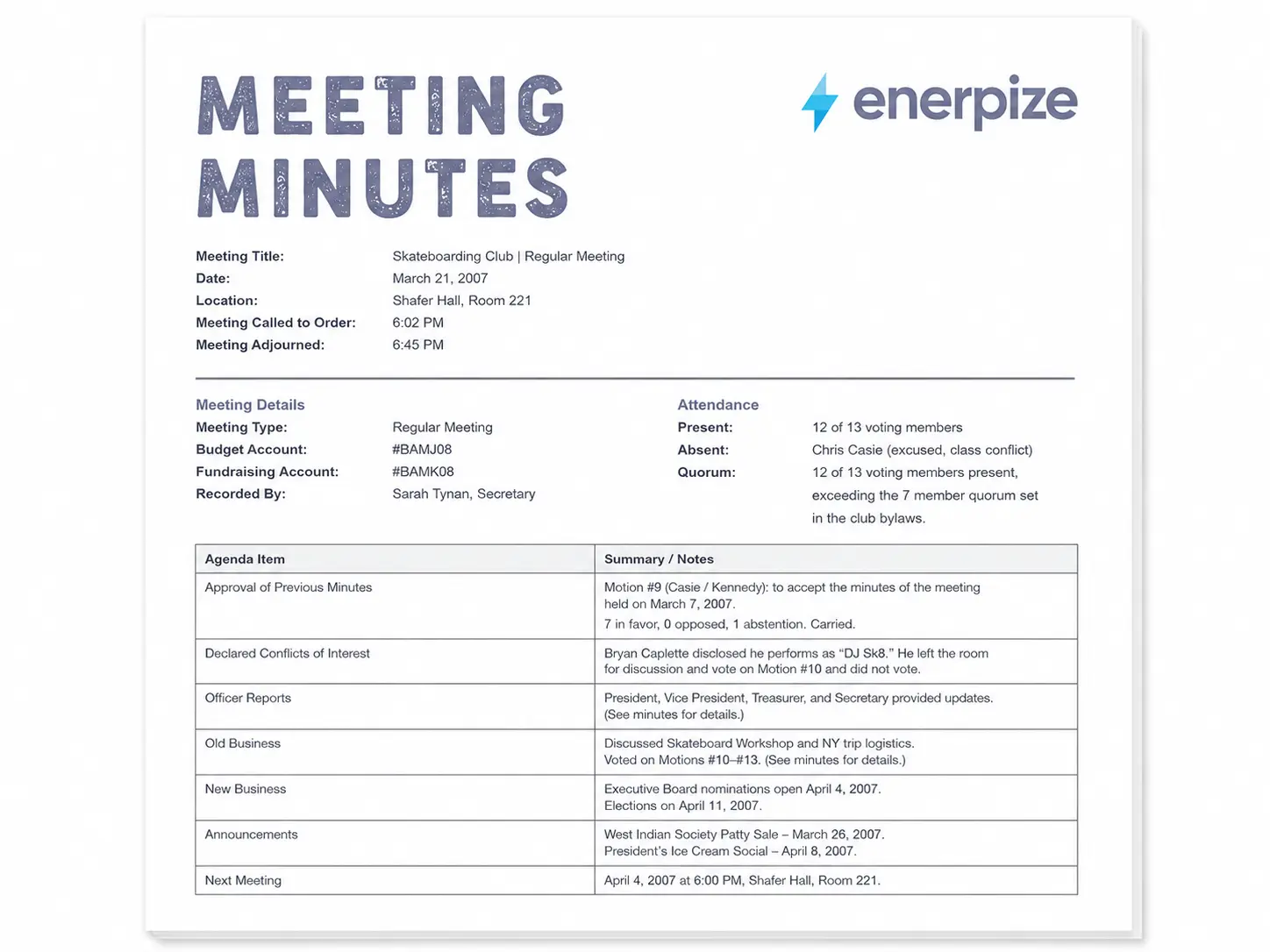
I built this template after reading through a stack of real, filled in club and board minutes, not just blank forms. And the pattern that kept showing up was not a missing field so much as a missing habit. People record what was said. They forget to record what it cost them, who was conflicted, and whether the math still adds up by the end of the meeting.
So the Enerpize meeting minutes template does three things most free templates skip entirely.
It separates attendance from quorum. A headcount is not the same thing as a quorum confirmation. Our template asks you to state the quorum threshold from your own bylaws and confirm it was met, not just list names in a column.
It reconciles votes against eligible voters, not total attendance. If someone recuses themselves from a vote because of a conflict of interest, the vote count should reflect that. A plain attendee list makes that kind of math impossible to check later. Ours does not.
It ties every motion with a financial impact back to the account balance reported earlier in the same meeting. If your treasurer opens with a balance and the board then approves three separate expenses, the minutes should show what is left when the meeting ends, not just what was true when it started. That single addition turns minutes from a narrative into an audit trail.
None of that requires more effort at the table. It just requires the template to ask the right question in the right order, which is exactly what ours is built to do.
A template gets your minutes structured. Enerpize takes it further, turning every motion your board approves into a tracked task, contract, or invoice without retyping a word. Start for free.
Meeting Minutes vs. Meeting Notes vs. Meeting Agenda
These three get mixed up constantly, and the mix up causes real problems when someone hands over "notes" that were supposed to be an official record.
| Document | Purpose | Formal Approval Required? | Distributed After Meeting? |
|---|---|---|---|
| Meeting Agenda | Plans what will be discussed, before the meeting happens | No | Sent before the meeting |
| Meeting Notes | Informal, personal record of key points | No | Rarely, mostly for the note taker's own use |
| Meeting Minutes | Official record of decisions, votes, and action items | Yes, at the next meeting | Yes, within a day or two |
An agenda looks forward. Minutes look backward. Notes sit somewhere in between and belong to whoever wrote them, not to the group. If your organization needs a legal or governance record, notes will not hold up the way minutes will, because minutes go through an approval step and notes never do.
How to Use the Meeting Minutes Template
An easy meeting minutes template only stays easy if you fill it out in the right order. Skip a step and you end up back where we started, twelve people arguing about what actually got approved.
Step 1: Fill in the header before the meeting starts
Meeting type, date, location, and the accounts or budgets involved. Do this before anyone walks in the room, not after.
Step 2: Record attendance and confirm quorum
List who is present and who is absent separately. Then check that number against the quorum your bylaws actually require, not against how many chairs are full.
Step 3: Approve the previous meeting's minutes
This should be the first item of business, not an afterthought. If last meeting's minutes have not been approved, this meeting's minutes cannot legally reference them as settled fact yet.
Step 4: Note any conflicts of interest before the related item comes up
If someone has a financial stake in an agenda item, record it before the discussion starts, and note whether they left the room for the vote.
Step 5: Record each motion, vote, and action item as it happens
Number every motion. Note who moved it, who seconded it, and the exact vote count. Assign every action item to one named person with one due date, never a group.
Step 6: Confirm the next meeting and get both signatures
Set the next meeting's date, time, and location before anyone leaves. Then have the person who recorded the minutes sign, with a second line for the chair to sign once the minutes are approved.
Ready to stop chasing people for signatures and due dates by email? Start free with Enerpize and let action items assign themselves to the right person with a reminder attached. Start for free.
Meeting Minutes Template for Businesses in the United States
US corporate law treats board minutes as part of the company's legal record, not a courtesy document. Most state corporate statutes require corporations to keep minutes of every board and shareholder meeting, and those minutes become the primary evidence a court looks at if a director's decision is ever challenged.
There is no single federal minutes law. Requirements sit inside state corporate codes, and LLCs generally face lighter recordkeeping rules than corporations, unless the operating agreement says otherwise.
Nonprofits carry an added layer. On IRS Form 990, the annual return most tax exempt organizations file, the governing body is asked whether its decisions were contemporaneously documented, which turns minutes into a compliance artifact, not just an internal note.
What to add to your minutes for US meetings. Use the corporate name exactly as filed with the Secretary of State, since trading names are not sufficient for the official minute book. State the quorum, usually a majority of directors under most bylaws, and confirm it before recording any vote as valid. Record the motion, second, and vote count separately from discussion, the same structure most US boards default to, drawn from Robert's Rules of Order even outside a strict parliamentary setting.
Store signed minutes with the corporate minute book, not in a shared folder mixed with other documents. If a corporate meeting minutes template is ever pulled during a dispute or audit, a clean, dated minute book is the fastest way to show the board acted properly.
Meeting Minutes Template for Businesses in the United Kingdom
UK company law is more specific than most jurisdictions about board records. Under the Companies Act 2006, companies must keep minutes of directors meetings and general meetings for at least ten years as part of their statutory records.
Companies House does not require minutes to be filed, but it expects them to exist and be produced on request during an investigation or dispute. A signed set of minutes carries real weight, since it can be the document that fixes the date a decision was made.
For charities and community groups, the Charity Commission expects trustee meeting minutes to record who was present, what was decided, and any declared conflicts of interest, since trustees carry personal fiduciary duties that minutes help evidence were properly handled.
What to add to your minutes for UK meetings. Use the registered company name and company number exactly as they appear on Companies House. Record directors present, directors absent with apologies, and any declared interest in an agenda item, since UK company law requires that disclosure to be minuted. Write out the exact wording of any resolution passed, since UK courts read board minutes literally when a decision is challenged.
Keep board minutes and general meeting minutes in separate registers. They serve different statutory purposes, and mixing them slows down every future audit or Companies House inspection.
Meeting Minutes Template for Businesses in Australia
Australian corporations law puts a specific number on minutes retention. Under the Corporations Act 2001, companies must record resolutions and proceedings of directors and members meetings within one month, and those minutes, once signed by the chair, serve as evidence that the meeting was properly held unless proven otherwise.
That single provision is why Australian company secretaries treat the chair's signature as the step that actually converts a draft into a legal record, not just a formality tacked on at the end.
Not for profits registered with the Australian Charities and Not for profits Commission face an added expectation. Because charities do not file minutes with the regulator directly, minutes become the internal evidence a charity relies on if a decision is ever questioned by ACNC or a member.
What to add to your minutes for Australian meetings. Include the ACN or ABN matching the company's official registration. Record the chair's signature and date, since this act gives Australian minutes their evidentiary status under the Corporations Act. Note any director who declared a material personal interest and left the room for that item, a governance requirement in Australia just as it is elsewhere.
Sign minutes at the next meeting if they cannot be signed immediately, and record the signing date separately from the meeting date. Reviews and disputes look at both.
Meeting Minutes Template for Businesses in Canada
Canadian corporate law splits between federal and provincial statutes, but the retention principle stays consistent everywhere. Corporations incorporated federally under the Canada Business Corporations Act, and nonprofits under the parallel Canada Not for profit Corporations Act, must keep minutes of directors and members meetings as part of their corporate records, available for inspection by directors and members.
Corporations Canada expects federally incorporated companies to retain meeting minutes as part of the records office file for the life of the corporation, not a fixed number of years. Provincially incorporated companies follow the equivalent provincial business corporations act, which is usually close to identical on the recordkeeping point.
The Canada Revenue Agency also has a stake here. For a corporation claiming certain deductions or working through a reorganization, the CRA can ask for board minutes as supporting evidence that a transaction was properly authorized, which makes minutes a tax document as much as a governance one.
What to add to your minutes for Canadian meetings. Record the corporate name and jurisdiction of incorporation, federal or a specific province, since retention rules differ slightly between them. Confirm directors present and quorum against the threshold set in the corporation's bylaws. Record resolutions in full, since Canadian corporate records offices expect the minute book to stand on its own without needing to cross reference other documents.
LLC Meeting Minutes
Most LLCs are not legally required to hold formal meetings or keep minutes the way a corporation is. That is exactly why so many single member and multi member LLCs skip minutes entirely, right up until a lender, investor, or court asks for proof that a major decision was made properly.
An llc meeting minutes template earns its keep the moment your operating agreement requires member approval for something specific, like taking on debt, adding a member, or distributing profits outside the normal schedule. Without a written record, that approval only exists as someone's memory, and memories do not hold up in a dispute.
Keep it simple. Date, members present, the decision being approved, and a signature line for each member who approved it. That is often all an LLC needs, but it needs to exist.
HOA Meeting Minutes
Homeowners associations sit in an unusual spot. Board decisions directly affect people's property values and monthly dues, yet an HOA meeting minutes template is often the most neglected paperwork in the entire association.
State laws vary, but most require HOA boards to keep minutes of every meeting where a vote occurs, and many require those minutes to be made available to homeowners on request. That means HOA minutes are not just an internal memory aid, they are a document homeowners have a right to see.
The line that gets missed most often is budget impact. If the board approves a special assessment or a maintenance contract, the minutes should show the account balance before and after that approval, not just the vote count. Homeowners paying into that account deserve to see exactly where the money is going, in the same document that records the vote that authorized it.
Meeting Minutes in Regulated and High Stakes Meetings
Board meetings, construction progress meetings, and nonprofit committee meetings all carry weight that a weekly team sync does not, and the minutes need to reflect that.
A board of directors meeting minutes template needs a signature block for both the person who recorded the minutes and the chair who will approve them at the next meeting, plus a clear line for declared conflicts of interest before any related vote.
A committee meeting minutes template inside a nonprofit should tie back to the board's overall minute book, since committee decisions often need board ratification before they take effect.
Construction meetings run differently again. Progress meeting minutes need to record what work was completed, what materials arrived on site, and what payment application that work supports. If your team is tracking billing periods against a schedule of values, our AIA style payment application template pairs directly with construction meeting minutes, since the completed work discussed in the meeting is exactly what feeds the next payment application.
Common Mistakes That Turn Minutes Into Fiction
Here is the pattern I keep seeing in real, filled in minutes, not the blank templates people download but never finish. A club approves a vendor payment, and it later turns out the person who moved the motion is the vendor. Nobody flagged it, because nobody was asked to. A treasurer reports a balance at the start of the meeting, three motions spend from that account before the meeting ends, and not one line in the minutes shows what is left. A meeting adjourns with no next meeting date, so three weeks later somebody is scrambling to figure out when the group is supposed to reconvene.
None of these are dramatic failures. They are small gaps that a good template closes automatically, just by asking the right question in the right place instead of leaving a blank line and hoping someone remembers to fill it in properly.
How Enerpize Turns Minutes Into Tracked Action
A signed PDF sitting in someone's inbox is not a system, it is a starting point. The moment a meeting ends, every action item inside those minutes needs an owner, a due date, and something that actually reminds that person when the date gets close.
From Action Item to Assigned Task
Inside Enerpize, an action item recorded during a meeting can become a task assigned to a specific team member with a due date attached, instead of a line in a document that nobody revisits until the next meeting rolls around.
From Approved Motion to Sent Document
If a motion approves a vendor quote, that approval can turn directly into a formal quotation sent to the client or supplier without retyping a single number. If the board approves a new hire or an officer appointment, that decision connects straight to an employee contract ready to send. And when an action item needs a purchase, it can become a requisition that routes to the right approver automatically.
From Decision to What Comes Next
The minutes still read the same. What changes is everything that happens after the meeting ends. If a decision approved in a meeting is meant to grow into a formal pitch or funding request, our business proposal template picks up exactly where the minutes leave off.
Want your action items to chase themselves instead of you chasing your team? Start free with Enerpize and turn every meeting into tracked work automatically. Start for free.
Key Takeaways
- A meeting minutes template records decisions, motions, and action items, not a word for word transcript of the conversation.
- Attendance and quorum are not the same thing. List absentees separately and check the number against your actual bylaws.
- Declare conflicts of interest before the related vote, and note if the conflicted member left the room.
- Reconcile vote counts against eligible voters, not total attendance, especially when someone recuses themselves.
- Tie every motion with a financial impact back to the account balance reported earlier in the same meeting.
- Retention rules differ by country. Ten years in the UK, seven years in Australia, and requirements tied to your corporation's life span in Canada and most US states.
Frequently Asked Questions
What should a basic meeting minutes template include?
At minimum, the date, attendees and absentees, quorum confirmation, motions with vote results, action items with named owners and due dates, and the next meeting's date and time.
Is a printable meeting minutes template different from a digital one?
Not in content, only in format. A printable meeting minutes template needs enough space for handwritten notes and signatures, while a digital version can include dropdowns and auto calculated fields, but both should capture the same information.
Do I need a lawyer to review my meeting minutes template?
Most organizations do not need legal review for routine minutes. Formal board minutes involving major financial decisions, mergers, or disputes are worth having reviewed, especially the first time your organization sets up its template for meeting minutes.
How long should I keep meeting minutes?
It depends on your jurisdiction. Ten years in the UK, at least seven years in Australia, and requirements tied to how long the corporation exists in most US states and in Canada. When in doubt, keep them permanently. Storage is cheap and a missing record is not.
Can one template work for both a quick team sync and a formal board meeting?
Not well. A quick sync needs speed, decisions and action items only. A formal board meeting minutes template needs quorum confirmation, motion wording, vote counts, and signatures. Use a lighter version of the same structure for informal meetings rather than forcing one format to do both jobs.
What is the difference between meeting minutes and a meeting agenda?
An agenda is written before the meeting and lists what will be discussed. Minutes are written during and after the meeting and record what was actually decided. They are opposite ends of the same meeting, not the same document.
About the Author
Omar El Bahr is a Senior Digital Growth Specialist at Enerpize, where he leads SEO, content strategy, and organic growth across international markets. He is a Forbes Communications Council contributor and has written for Entrepreneur on business communication and digital strategy.
Disclaimer: This article and template are provided for general informational purposes only and do not constitute legal or accounting advice. Recordkeeping and retention requirements vary by jurisdiction and organization type, so confirm specific obligations with a qualified professional or your governing bylaws before relying on this template for formal governance purposes.