

Posted on 26 July 2026
Free Business Plan Template Download: Word, PDF, Google Docs
- Available in Word, PDF, and Google Docs, free to download with no sign up required.
- Covers the executive summary, market research, SWOT analysis, operations, and a full financial plan with break even math in one document.
- Built with country specific guidance for the United States, the United Kingdom, Japan, and South Africa so the plan matches what lenders in each market actually expect to see.
- Calculates gross profit margin and break even units automatically in the Excel version, so you are not doing that math on a napkin at midnight.
A business plan template is a pre structured document that walks a founder through describing their business, sizing up the market, and proving the numbers work, so a lender, partner, or the founder themselves can tell in ten minutes whether the idea holds together.


What Is a Business Plan?
I have read a lot of business plans over the years. Some were sharp enough that you could feel the founder had thought through every angle. Others read like a Wikipedia article about a company that did not exist yet.
The difference was never the writing. It was whether the plan actually forced the founder to answer hard questions before a lender did it for them.
A business plan is a written document that lays out what your business does, who it sells to, how it makes money, and what it will cost to get there. It is not a pitch deck. It is not a mission statement on a wall. It is the working proof that your idea survives contact with numbers.
Lenders read it to decide if you are a good risk. Investors read it to decide if you understand your own market. And honestly, you should read it yourself six months after writing it, because that is when you find out if your assumptions were right.
Ready to put a plan into motion? Once your numbers are set, Enerpize helps you track them against reality instead of letting them sit in a drawer. Start for free.
What the Enerpize Business Plan Template Includes
I built this template after going through six different business plan formats used by government agencies, banks, and universities across four countries. Every single one of them stopped at the same place. They gave you a complete document to fill out once, and then left you on your own the day you actually opened for business.
That is the gap I wanted to close.
Everything a Traditional Plan Needs
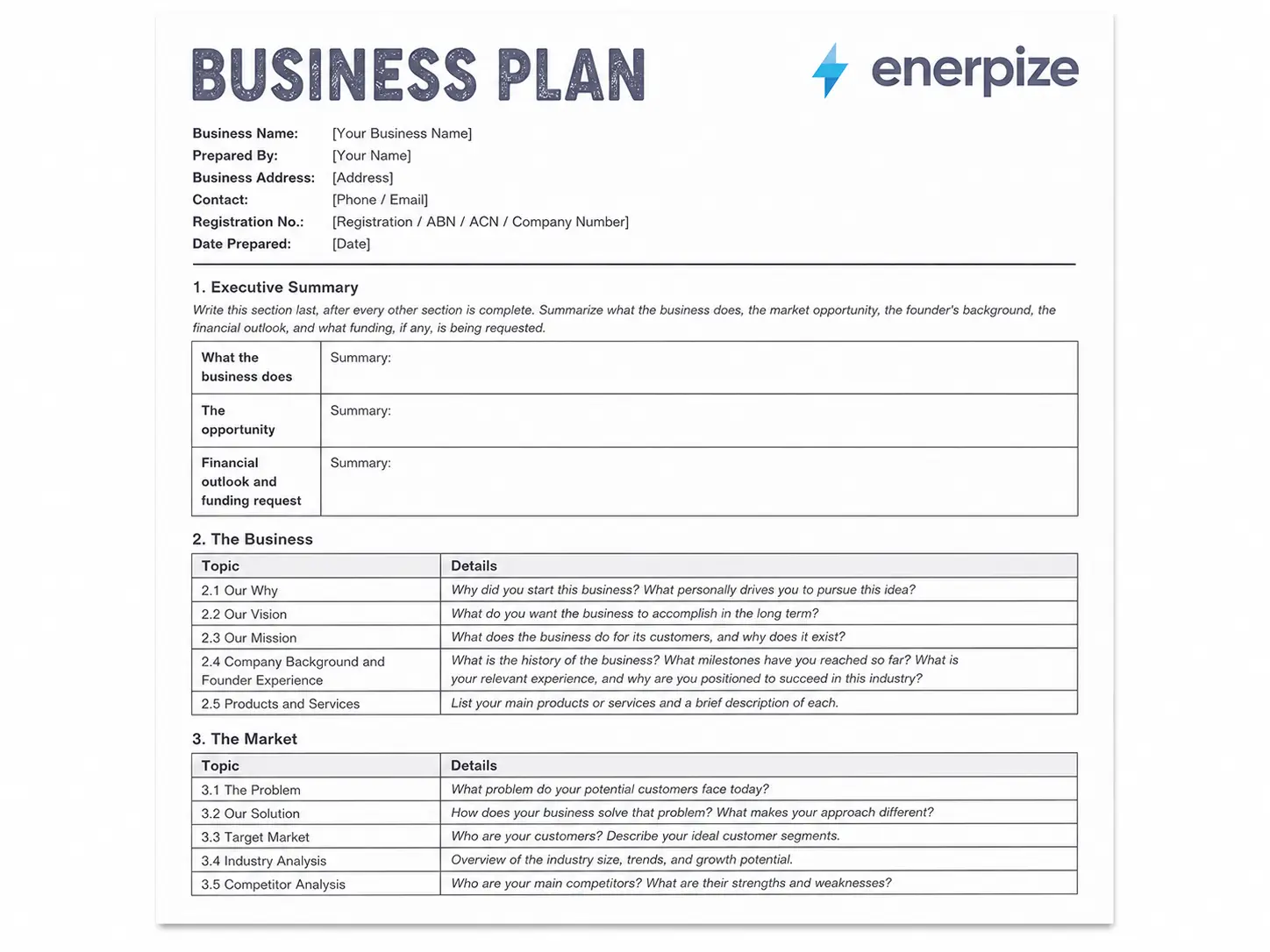
The Enerpize template has everything a traditional plan needs. Executive summary, company background, market research, competitor analysis, SWOT, operations, risk management, and a financial plan with start up costs, sales forecasts, cash flow, and break even math built in as live formulas in the Excel version.
The Section Almost Nobody Else Includes
But it also has something the others do not. A section called Tracking This Plan Against Reality. It is a short, practical schedule that tells you what to check every month, what to check every quarter, and what to check once a year, so the plan you spent hours writing does not become a document you never open again. Most plans are written once and then filed away. This one is built to be reopened.
Traditional and Lean, in One Document
The template also comes with a Traditional and Lean format built into the same document, so whether you are applying for a bank loan that wants forty pages or you just need a one page version to test an idea with a partner, you are not starting from a blank page either way.
Here Is What Is Inside
- A cover page and table of contents that make the document look and feel like something a bank would actually accept
- A key details section for registration, structure, and licensing that adapts to whatever country you are filing in
- An executive summary section, written last but placed first, the way every serious lender expects it
- A full market and competitor analysis section with a five competitor comparison table
- A SWOT analysis table that forces you to write down how you will fix each weakness and threat, not just list them
- A risk management section covering insurance, compliance, and succession planning
- A complete financial plan section with start up costs, monthly operating expenses, sales forecast, cost of goods sold, twelve month cash flow, profit and loss summary, and break even analysis
- The Tracking This Plan Against Reality section, which is the part almost nobody else includes
Want the financial section to do the math for you? Enerpize turns your break even numbers and cash flow forecast into a system you can check against your actual sales every month. Start for free.
Traditional Business Plan vs. Lean Business Plan
Not every business needs forty pages. Some need one.
A traditional business plan is the full document. Executive summary, market research, financial projections, appendices, the works. Banks and serious investors usually want this version because it shows you have thought through every part of the business, not just the parts that are fun to think about.
A lean business plan is a stripped down version. One page, sometimes two. It covers your value proposition, your target customer, your revenue model, and your key costs, and nothing else. It is built for speed. You use it to test an idea with a co-founder, pressure test your assumptions with a mentor, or get a first read from a potential partner before you commit hours to the full version.
The Enerpize template supports both. Use the full structure if you are applying for funding. Strip it down to the executive summary, the products and services section, and the financial plan if you just need something fast.
How to Use the Business Plan Template
Fill in your key details first
Start with your business name, registration number, structure, and contact information. This sounds obvious but it is the section people skip and then have to circle back to later, usually right before a submission deadline.
Write the executive summary last
Every credible source on business planning agrees on this one thing, and they are right. You cannot summarize a plan you have not finished writing. Fill in every other section first, then come back and write two pages that capture the opportunity, the market, and the numbers.
Work through the market and competitor sections
List at least three to five direct competitors. Be honest about their strengths. A plan that pretends it has no real competition is a plan nobody will trust, least of all a loan officer who has read five hundred of these.
Build your financial plan
Start up costs, monthly operating expenses, sales forecast, and cost of goods sold all feed into your cash flow and your break even number. If you are using the Excel version, these calculate automatically once you enter your inputs. If you are filling out the Word version by hand, work through them in that order, because each table depends on the one before it.
Set your tracking schedule
This is the step almost every template forgets to mention because most templates assume the plan ends once it is written. Decide right now, before you need the answer under pressure, what you will do if your actual sales fall short of your forecast for two months in a row. Write it down in the Tracking section. Future you will thank present you.
Attach your supporting documents
Registration documents, resumes, letters of intent, lease agreements. Whatever you reference in the plan should be attached, not just described.
Built your plan? Now build the business behind it. From your first invoice to your first year end statement, Enerpize keeps the numbers in your plan connected to the numbers in your business. Start for free.
Business Plan Template for the United States
The US Small Business Administration is the closest thing America has to an official word on what a lender wants to see in a business plan, and its guidance splits the process into two formats worth knowing before you write a word. A traditional plan is detailed and comprehensive, the kind lenders and investors commonly request, while a lean startup plan focuses on the most important points only and can take as little as an hour to put together, according to the SBA's guide to writing a business plan.
If you are seeking an SBA backed loan, expect the lender to want the traditional version. That means a real market analysis, not a paragraph that says "the market is growing." It means financial projections for three years, not one. And it means an executive summary that could stand on its own if that was the only page the loan officer had time to read.
One thing worth knowing about the American system specifically. Your NAICS code, the number that classifies your industry, feeds into everything from your market research to your insurance to your tax filing, so nailing that down early saves you from redoing sections later.
Business Plan Template for the United Kingdom
The UK government's own guidance on writing a business plan keeps the framing refreshingly simple. It describes the plan as a document that clarifies your business idea, helps you spot problems before they happen, sets out your goals, and lets you measure your progress against them, and it notes plainly that you will need one if you want to secure investment or a loan from a bank, according to gov.uk's guidance on writing a business plan.
What I would add from working with businesses that operate across the UK and Kenya and South Africa at the same time is this. UK lenders tend to scrutinize your cash flow forecast harder than your vision statement. They have seen a thousand inspiring visions. What they have not seen is whether you understand your own working capital cycle. Spend real time on the financial plan section, not just the parts that are enjoyable to write.
Business Plan Template for Japan
Japan is the market almost no English language business plan guide covers in any depth, and that gap is exactly why it is worth addressing here directly.
The Japan Finance Corporation, known as JFC, is the primary government backed lender supporting startups and small business owners in Japan, and it publishes English language guidance and support programs specifically for entrepreneurs preparing to apply for financing, according to the Japan Finance Corporation's English language resources.
If you are a foreign founder setting up in Japan, a few things about the local expectations are worth knowing upfront. Japanese banks tend to review new business applications carefully, and it is common for them to request supporting documents including a business plan alongside your registry certificate, company seal certificate, and identification. A business plan that is vague about revenue assumptions will slow that review down considerably. Be specific. Show your math. Japanese lenders are not looking for enthusiasm, they are looking for a plan that holds together on paper the same way it does out loud.
Business Plan Template for South Africa
The Small Enterprise Development Agency, known as Seda, is an agency of South Africa's Department of Small Business Development, and it exists specifically to provide non financial support to small enterprises and cooperatives through the country's largest network of business support offices, according to the Department of Small Business Development's page on Seda.
Seda can help you put a plan together, but it cannot register your business. That happens separately through the Companies and Intellectual Property Commission. Keep those two processes distinct in your head, because conflating them is one of the more common early mistakes I have seen founders make when starting up in South Africa.
For South African founders, the financial plan section deserves extra attention if you are hoping to access any form of government backed funding or support. Reviewers want to see that your break even math and your cash flow forecast are grounded in real supplier quotes and real market research, not optimistic guesses. A plan that shows its assumptions clearly will move through review faster than one that hides them.
Business Plan Template for Australia
Australia's own guidance splits the process the same way the US does, and for good reason. The Australian government's business planning resource offers a simple business plan tool for founders who just need to evaluate an idea or set goals for the year ahead, alongside a more detailed downloadable template for anyone seeking finance or wanting to go deeper on every section, according to business.gov.au's guidance on developing a business plan.
That split matters more than it sounds. A lot of founders default straight to the long version because it feels more serious, and then stall out halfway through a section they did not actually need yet. If you are still validating the idea, start with the short version. Move to the full template once you are actually seeking finance or bringing on a partner who wants to see the detail.
One thing worth flagging for Australian founders specifically. Your plan should reference your ABN and, if you are operating as a company, your ACN, early in the key details section. Lenders and accountants in Australia expect to see these front and center, not buried in an appendix, and having them ready from the start saves you a round of back and forth later.
How Enerpize Connects Your Business Plan to Daily Operations
Here is the part of the process nobody warns you about. You finish the plan. You get the loan, or you do not need one and you just start trading. And then the plan goes into a folder and you never open it again, because running the business is suddenly the only thing there is time for.
That is the exact moment the plan stops being useful, right when it should be starting to prove itself.
Your Financial Plan Needs a Reality Check
The financial plan you wrote covers your sales forecast, your operating expenses, and your break even point. Those numbers are only useful if you check them against what is actually happening in the business. Enerpize's financial plan template gives you a structured way to keep that forecast alongside your real numbers instead of two separate spreadsheets that drift apart within a month.
Turning Your Pricing Strategy Into Real Quotes
Your sales and marketing plan probably includes a pricing strategy and a first set of customers. When you are ready to bill them, a clean quotation template keeps your pricing consistent with what you promised in the plan, instead of every quote being negotiated from scratch.
Staffing Without Breaking Your Operating Expense Forecast
Your operations section likely includes hiring plans, even if it is just you and one part time person right now. Enerpize's guide on payroll software for small businesses walks through what to have in place before you make your first hire, so staffing does not become the thing that quietly breaks your operating expense forecast.
Sanity Checking Your Break Even Number
Your break even analysis in Section 6.7 is the number that tells you whether the business works at all. Enerpize's net profit margin calculator lets you sanity check that number against your actual margins as soon as you have a few months of real sales data, rather than waiting for year end to find out your assumptions were off.
Project Based Businesses Need Project Based Pricing
And if your business plan includes a construction, trades, or project based revenue stream, a construction quote template keeps your project pricing structured the same way your financial plan expects it to be, instead of every job being quoted differently.
None of this replaces the plan. It just means the plan stops being a document you wrote once and starts being a system you actually run the business on.
Turning the Plan Into a Proposal Someone Else Can Say Yes To
There is also a moment early on where the plan itself is not what you hand someone. A potential client, a partner, or an investor does not want your full business plan sitting on their desk. They want a clear, focused ask. Enerpize's business proposal template takes the parts of your plan that matter to that specific reader, the problem, your solution, the price, and the timeline, and turns them into something someone can actually approve in one sitting, instead of making them dig through forty pages to find the one answer they came for.
Key Takeaways
- A business plan is not a formality for lenders. It is the document that forces you to prove your own idea holds together before you spend real money finding out the hard way.
- The strongest plans separate a traditional format, the full document banks expect, from a lean format, the one page version you use to pressure test an idea quickly.
- Write your executive summary last. Every credible source on business planning agrees on this, and it is the one piece of universal advice worth following without argument.
- Your financial plan should include start up costs, operating expenses, sales forecast, cost of goods sold, cash flow, and a break even calculation, all connected to each other rather than sitting as separate disconnected numbers.
- Country specific expectations matter. What an SBA backed lender in the US wants to see is not identical to what Seda looks for in South Africa or what a Japanese bank requests through JFC.
- A plan that is never reopened after the day you write it is a forecast, not a management tool. Set a review schedule before you need one.
Frequently Asked Questions
What is the difference between a business plan and a business model?
A business plan is the full written document covering your market, your operations, and your financials. A business model is the specific mechanism by which you make money, like subscription, one time sale, or commission. Your business model is one section inside your business plan, not a replacement for it.
Do I need a business plan if I am not seeking funding?
Yes, though the version you need is shorter. Even without a lender involved, a business plan forces you to write down your assumptions about your market, your pricing, and your costs, which is the fastest way to find a flawed assumption before it costs you money.
How long should a business plan be?
A traditional business plan seeking funding usually runs fifteen to thirty pages once financials and appendices are included. A lean business plan built to test an idea quickly is typically one to two pages.
What financial statements does a business plan need?
At minimum, a sales forecast, an operating expenses forecast, a cash flow forecast for the first twelve months, and a profit and loss summary. A break even analysis is not always required but it is the single fastest way to tell if the business works on paper.
Can I use this template for an existing business, not just a startup?
Yes. Established businesses use the same structure, they simply fill the financial history sections with actual results instead of projections, and use the forward looking sections to plan the next phase of growth rather than the first year of operation.
How often should I update my business plan?
Review your numbers against your forecast monthly. Review your competitor analysis and SWOT every six months. Do a full revision of the entire plan once a year, or immediately after any major change to your market, your pricing, or your funding position.
About the Author
Omar El Bahr is a Senior Digital Growth Specialist at Enerpize, where he leads SEO, content strategy, and organic growth across international markets. He is a Forbes Communications Council contributor and has written for Entrepreneur on business communication and digital strategy.
Disclaimer: This template and article are provided for general informational purposes only and do not constitute legal, tax, or financial advice. Requirements vary by country, lender, and industry, so confirm current rules with a qualified advisor or the relevant government agency before submitting a business plan for funding.