

Posted on 22 July 2026
Free Business Proposal Template Download: Word, PDF, Google Docs
- Available in Word, PDF, and Google Docs, free to download with no sign up required
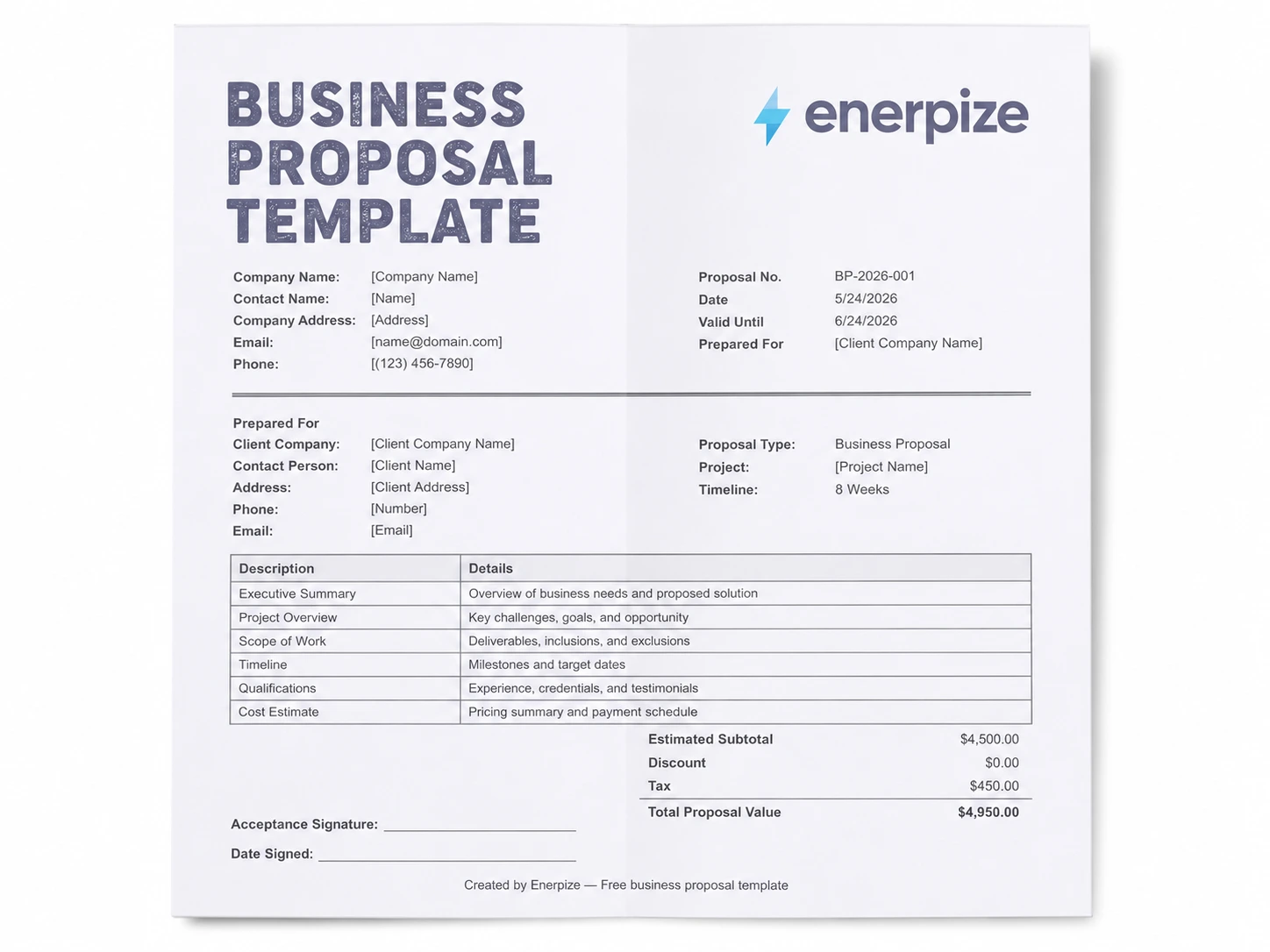
- Covers executive summary, scope of work, qualifications, milestone based pricing, and a signed agreement section in one structured document
- Built with a proposal to invoice workflow in mind, so what you promise a client on paper is what gets billed once they say yes
- Includes an out of scope field most free templates skip entirely, which is often the single line that prevents a dispute three weeks into a project
A business proposal template is a pre formatted document that lays out the problem you have identified, the solution you are offering, and the price you are asking for it, giving both you and your prospective client a shared, structured reference for what you are agreeing to.


What Is a Business Proposal?
A business proposal is not a business plan, and it is worth being clear about that before you write a word of one. A business plan is the internal roadmap for your company. It explains where you are headed, how you intend to get there, and it is the document a lender or investor asks for when they are deciding whether to back you. The SBA's guide to writing a business plan walks through exactly that kind of document, and it is a good reference if that is genuinely what you need.
A business proposal is a different animal entirely. It is external facing. You send it to one specific prospective client to win one specific piece of work. It does not need to explain your five year growth strategy or your organizational chart. It needs to convince the person reading it that you understand their problem and that you are the right business to solve it, at a price they are willing to pay.
People mix these two up constantly, and the mix up costs deals. If a client asks you for a proposal and you hand them a thirty page business plan, you have just told them you do not know the difference between talking about your business and talking about theirs. Keep the two separate.
A proposal also is not the same thing as a quote. A quote is a price. A proposal is the argument for why that price is worth paying, built around the problem, the solution, the qualifications, and only then the price.
Want to turn an accepted proposal straight into an invoice without retyping a single line item? Start for free.
What to Include in a Business Proposal Template
Most free templates online give you a title page and a pricing table. That gets you through the door, but it will not do the persuading for you. Here is every section a complete business proposal template needs, and why it earns its place.
| Section | Why It Matters |
|---|---|
| Title Page | First impression. Should name the client and the specific project, not just say "Business Proposal" |
| Table of Contents | Makes the document scannable, especially past five pages |
| Executive Summary | The only section some readers will get to. Has to sell the whole pitch in a paragraph |
| Project Overview | Shows the client you understand their pain point before you pitch your fix |
| Scope of Work, In Scope | Exactly what you are delivering, spelled out line by line |
| Scope of Work, Out of Scope | What you are explicitly not delivering. Prevents scope creep and disputes later |
| Challenges and Goals | Maps the client's stated problems directly to your objectives, side by side |
| Deliverables and Timeline | What gets delivered and when, with real dates, not vague phases |
| Qualifications | Your track record, credentials, and a client testimonial if you have one |
| Pricing Table | Line item costs, subtotal, discount, tax, and total, laid out clearly |
| Payment Schedule | Deposit, milestone payments, and final balance, each with its own due date |
| Terms and Conditions | The contract language covering timeline, review points, and payment terms |
| Agreement and Signature | Space for both parties to sign, which is what turns the proposal into a binding commitment |
The two fields most free templates leave out entirely are the out of scope list and the qualifications section. Skip the out of scope list and you are relying on memory and goodwill to keep a project from expanding past what you quoted. Skip qualifications and you are asking a client to trust you on faith alone, with nothing to back it up.
Ready to see what happens after the client signs? Enerpize turns an accepted proposal into an invoice in one click. Start Free with Enerpize
What the Enerpize Business Proposal Template Includes
Here is what we did differently.
A Milestone Based Pricing Table Instead of a Single Flat Total
A lot of proposal templates give you one price line and call it done. That works fine for a small one off job. It falls apart the moment you are running a project with a deposit up front, a payment at the midpoint, and a balance on completion, which is how most real service businesses actually get paid. Our template has that structure baked in from the start, not bolted on as an afterthought.
Out of Scope Treated as a First Class Section
We treat out of scope as a first class section, not a bullet buried under scope of work. This came directly from watching how disputes actually happen. They rarely start with "you didn't do what you promised." They start with "I assumed this was included." A dedicated out of scope list, sitting right next to the in scope list, closes that gap before it opens.
A Standalone Qualifications Section
We added a qualifications section that most competitors fold into the executive summary or skip outright. Your executive summary has one job, which is to hook the reader fast. Cramming your credentials, your certifications, and a client testimonial into the same paragraph dilutes both. We gave qualifications its own space so it can do its job properly.
Built With What Happens After Signing in Mind
And we built this with what happens after signing in mind. Once a client accepts a proposal built in Enerpize, that same scope, pricing, and payment schedule can flow straight into an invoice without you retyping a single line item. A signed proposal that just sits in someone's inbox is a missed opportunity. A signed proposal that becomes the first invoice automatically is a working system.
Business Proposal vs Business Plan vs Quote
People use these three terms interchangeably, and that is where confusion creeps in. Here is the difference laid out plainly.
| Document | Purpose | Includes Pricing? | Audience | Internal or External |
|---|---|---|---|---|
| Business Proposal | Wins a specific client or project | Yes | One prospective client | External |
| Business Plan | Guides company strategy, secures funding | Sometimes, as projections | Investors, lenders, internal team | Both |
| Quote | States a price for a defined job | Yes, price only | One prospective client | External |
The rule of thumb: a quote answers "how much." A proposal answers "how much, and why us." A business plan answers "where is this company headed." Sending the wrong one to the wrong audience is one of the fastest ways to lose a deal you might otherwise have won.
How to Use the Business Proposal Template
Step 1: Fill in the title page
Skip the generic "Business Proposal" title. Name the client and the project. "Website Redesign Proposal for [Client Company]" tells the reader in three seconds that this document was written for them, not copied and pasted from somewhere else.
Step 2: Write the executive summary last
I know it sits at the front of the document, but write it after everything else is finished. You cannot summarize a pitch you have not fully built yet. Introduce your company, your approach, and close with why you are the right fit. Keep it to a few tight paragraphs.
Step 3: Lay out the project overview
Show the client you understand their situation before you propose anything. Reference their specific pain points, using data where you have it. This is not the place to go deep on your solution yet. That comes next.
Step 4: Define scope, both in and out
List exactly what is included, line by line. Then list what is explicitly excluded. This single step prevents more disputes than any clause buried in your terms and conditions.
Step 5: Map challenges to goals
Put the client's stated challenges in one column and your objectives for solving each one in the column beside it. This makes your understanding of their problem visible at a glance.
Step 6: Set deliverables and real dates
Every deliverable needs an actual date attached, not a vague phase label like "Phase 2." Specific dates signal that you have actually planned this out rather than guessing.
Step 7: Add your qualifications
Back up your pitch with relevant experience, certifications, and a testimonial if you have one. This is where you earn the trust the rest of the document is asking for.
Step 8: Build the pricing table and payment schedule
Break the total into line items with a clear subtotal, discount, and tax. Then split the payment schedule into a deposit, a milestone payment, and a final balance, each tied to a due date.
Step 9: Write clear terms and conditions
Cover the project timeline, review dates, payment terms, and your cancellation or revision policy. If you are unsure about the legal language, get it checked. This section is, in effect, a contract.
Step 10: Close with the agreement and signatures
Leave clear signature lines for both parties, with printed names and dates. An unsigned proposal is a pitch. A signed one is a commitment.
Once the agreement is signed, the next step is turning it into billable work. Enerpize connects your proposal, your invoice, and your payment tracking in one place. Start Free with Enerpize
Business Proposal Template for Businesses in the United States
In the United States, the confusion between a business proposal and a business plan comes up constantly, especially with first time founders responding to their first request for proposal. If you are unsure which document a request is actually asking for, the SBA's guidance on writing a business plan is a useful way to see exactly what a plan covers, so you can spot when a request is actually asking for a proposal instead.
For US businesses, a signed proposal that includes clear terms and conditions carries real weight if a disagreement over scope or payment ever comes up. Keep a signed copy on file alongside the corresponding invoice for every client you work with. It is a small habit that makes a real difference if a dispute ever needs sorting out.
Business Proposal Template for Businesses in South Africa
Electronic signatures are recognized as legally binding in South Africa under the Electronic Communications and Transactions Act. The Act sets out two tiers, a standard electronic signature and an advanced electronic signature, and for most day to day business proposals, a standard electronic signature is enough to create a binding agreement, provided both parties clearly intend to be bound by it.
For South African businesses, that means you do not need to print, sign, scan, and email a proposal back and forth. A clear signature block with printed names and dates, agreed to electronically, is generally sufficient. What matters most under the Act is that both sides clearly show intent to be bound. Make that intent explicit in your terms and conditions section rather than leaving it implied.
Business Proposal Template for Businesses in Canada
Canada recognizes electronic signatures as legally equivalent to a handwritten one, both federally and at the provincial level. The Government of Canada's own guidance on electronic signatures confirms that most provinces and territories have adopted electronic commerce laws that treat a digital signature the same as one written in ink, provided the signer's intent is clear.
For Canadian businesses pitching across provinces, this means a proposal signed electronically by a client in Ontario carries the same weight as one signed on paper in Alberta. What still varies province to province is the underlying commercial contract law, so if a proposal is unusually large or long term, it is worth having someone familiar with your specific province review the terms and conditions section before you send it out.
Business Proposals for Specific Industries
The core structure of a proposal holds across industries, but a few sectors benefit from extra fields.
Construction proposals need a project site address and a named site contact, not just a company level contact. If you are proposing work covered by a formal construction quote first, make sure the figures in your proposal match the quote exactly, since a mismatch between the two documents is one of the most common reasons a client hesitates to sign.
Consulting proposals lean more heavily on the qualifications section, since the client is often buying expertise as much as a deliverable. If you regularly bill consulting engagements, pairing your proposal template with a matching consulting invoice template keeps the numbers consistent from pitch to payment.
Service businesses that already send quotes for smaller jobs will find that a proposal is simply the longer form version of the same document, built out with a project overview and qualifications section for bigger engagements that need more than a price to win.
Agencies and contractors who also handle staffing or subcontractor agreements alongside their client proposals may want to pair this template with an employee contract template to keep the client facing and staff facing paperwork consistent.
Key Takeaways
- A business proposal is not a business plan and is not a quote. It is a persuasive, external facing document built around a problem, a solution, and a price for one specific client.
- The two fields most free templates skip are an out of scope section and a standalone qualifications section, and both prevent real problems later in a project.
- A milestone based payment schedule, with a deposit, a midpoint payment, and a final balance, matches how most service businesses actually get paid.
- Electronic signatures are legally recognized in the United States, South Africa, and Canada, provided both parties clearly intend to be bound by the agreement.
- Write your executive summary last, after the rest of the proposal is complete, since you cannot summarize a pitch you have not fully built yet.
- A signed proposal should not be the end of the process. Connecting it to your invoicing keeps your pricing and scope consistent from pitch to payment.
FAQs
What is a business proposal template?
A business proposal template is a pre formatted document with sections for an executive summary, project overview, scope of work, pricing, and a signature block, built so you can fill in your own details rather than starting from a blank page each time.
What is the difference between a business proposal and a business plan?
A business proposal is external facing and pitches a specific solution to one prospective client. A business plan is a broader internal roadmap for the business itself, typically used to guide strategy or apply for funding. They serve different audiences and should not be used interchangeably.
How do I write a business proposal?
Start with a project overview that shows you understand the client's problem, define your scope of work clearly including what is out of scope, lay out your qualifications, break your pricing into a clear table, set a payment schedule, and close with terms and conditions and a signature block. Write your executive summary last, once the rest of the document is finished.
How long should a business proposal be?
Most business proposals run between five and ten pages. Shorter works for simple projects or existing client relationships. Longer, more complex engagements may need more, but padding a proposal with unnecessary detail rarely helps your case.
Can I use a business proposal template in Word or Google Docs?
Yes. Word and Google Docs are both practical formats for a business proposal, especially since most clients expect to receive and sign the document in one of those two formats. Download the Enerpize template in Word, Google Docs, or PDF, whichever fits your workflow.
Do I need a lawyer to write my terms and conditions?
Not always, but it depends on the size and complexity of the engagement. For a small, low risk project, a clear and specific terms and conditions section is often enough. For larger or longer term proposals, it is worth having someone review the language before you send it.
Is a signed business proposal legally binding?
Generally yes, provided both parties clearly agree to the terms and sign, whether on paper or electronically. In the United States, South Africa, and Canada, electronic signatures are recognized as legally valid, though the specific requirements vary slightly by jurisdiction.
What should I include in a small business proposal template?
The same core sections as any proposal: executive summary, project overview, scope of work, qualifications, pricing, payment schedule, terms and conditions, and a signature block. Small businesses do not need to shorten the structure, just the length of each section.
You have the template. When your next proposal gets signed, Enerpize turns it into an invoice, tracks the payment schedule, and keeps your project costs in one place. Start Free with Enerpize
About the Author
Omar El Bahr is a Senior Digital Growth Specialist at Enerpize, where he leads SEO, content strategy, and organic growth across international markets. He is a Forbes Communications Council contributor and has written for Entrepreneur on business communication and digital strategy.
Disclaimer: This template and article are provided for general informational purposes only and do not constitute legal or financial advice. Consult a qualified professional for guidance specific to your business and jurisdiction.