

Posted on 1 June 2026
Free Car Maintenance Invoice Template Download: Excel, Word, PDF & Google Sheets
- Tracks vehicle details, labor hours, parts used, and warranty terms for every service job.
- Separates labor and parts into distinct line items so customers see exactly what they are paying for.
- Keeps a service history record tied to the vehicle's VIN and odometer readings.
- The car maintenance invoice template is available in Excel, Word, PDF, Google Sheets, and Google Docs.
A car maintenance invoice template is a pre-structured billing document used by workshops, mechanics, and auto care businesses to record vehicle details, itemize labor and parts, and request payment from clients after a service job is completed.


What Is a Car Maintenance Invoice?
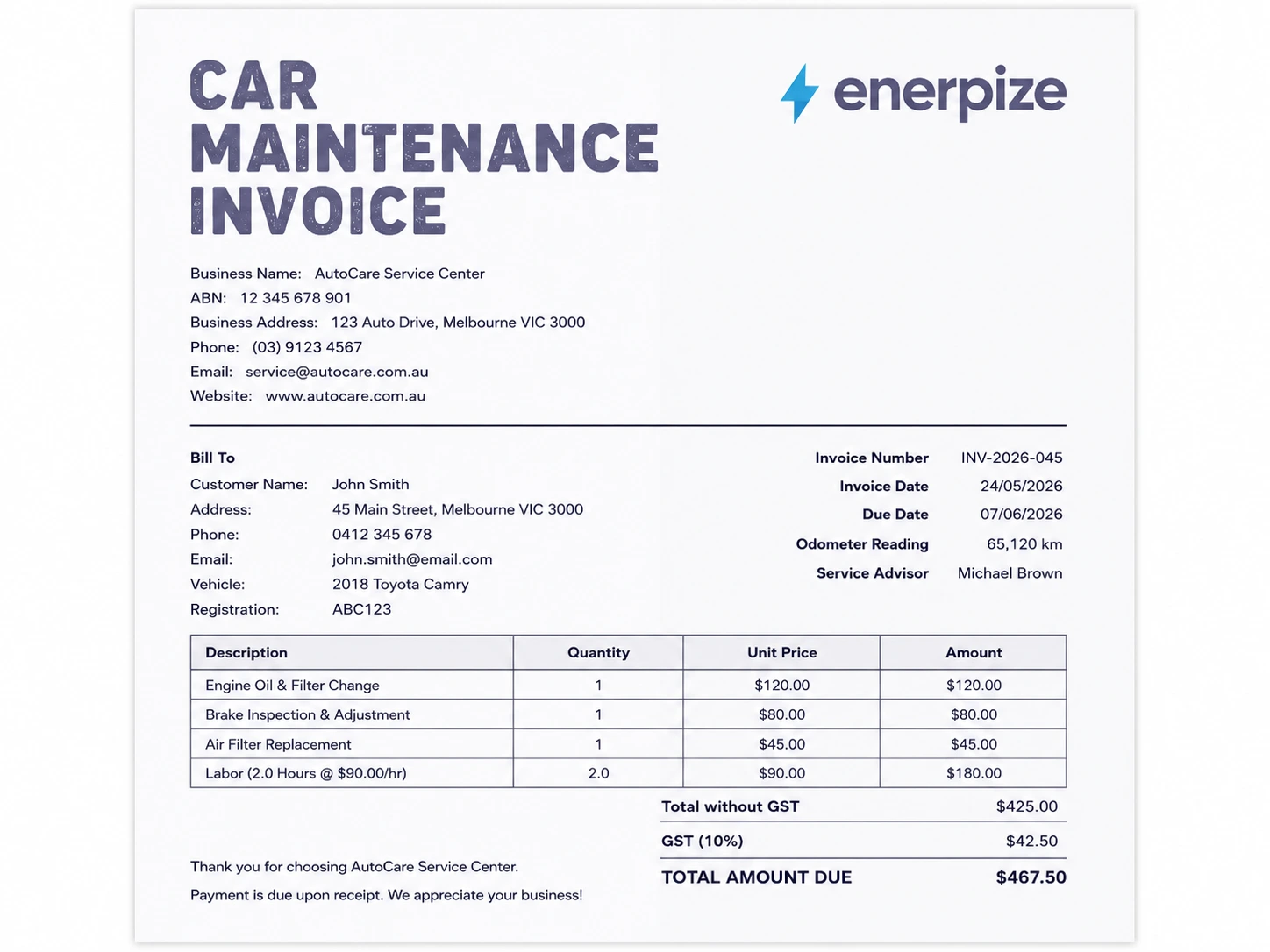
A car maintenance invoice is a billing document issued by a workshop, mechanic, or auto care business to a client after service work is completed. It records the vehicle serviced, the work performed, the parts used, the labor charged, and the total amount owed. Beyond payment collection, a car maintenance invoice creates a permanent service record tied to the vehicle — one that matters when warranty disputes arise, when the vehicle is resold, or when an insurer requests proof of maintenance history.
Get an auto-generated car maintenance invoice. Start for free.
What to Include on a Car Maintenance Invoice Template
Every competitor in this space publishes a bullet list of fields. The table below goes further — it tells you not just what to include but why each field earns its place on the document.
Field | Why It Matters |
|---|---|
| Auto shop name and license number | Required for licensed repairers in most markets; establishes legal identity of the billing party |
| Customer name, address, and contact | Ties the invoice to a specific client record for follow-up, collections, and service history |
| Vehicle year, make, model, and color | Links the service to the exact vehicle — critical when a workshop services multiple vehicles for one client |
| VIN and license plate number | The only truly unique vehicle identifier; required for warranty documentation and resale records |
| Odometer reading in and out | Documents mileage at the time of service; creates an indisputable timeline for mileage-based warranty claims |
| Invoice number and repair order number (RO#) | Enables tracking, payment follow-up, and dispute resolution without searching through files |
| Service date and payment due date | Sets clear payment expectations; the due date is what triggers late payment follow-up |
| Itemized labor — hours worked and hourly rate | Separating labor prevents the single biggest cause of invoice disputes: customers questioning a lump-sum total |
| Itemized parts — part number, quantity, unit price, amount | Part numbers allow the customer to verify what was installed; markup transparency reduces pushback |
| Shop supplies and disposal fees | Itemizing these prevents them from looking like padding; customers accept them when they are labeled clearly |
| Tax line | A legal requirement in most markets; must appear as a separate line, not buried in the subtotal |
| Warranty terms | Defines what is covered, for how long, and what is excluded — this is your primary protection against chargebacks |
| Payment terms and accepted methods | Reduces late payments; customers pay faster when they know exactly how and by when. State any late fee percentage and grace period explicitly rather than leaving it implied. |
| Technician name and certification | Adds accountability and supports warranty claims that require proof of qualified workmanship |
How to Fill Out a Car Maintenance Invoice — Step by Step
Step 1: Add your workshop details
Enter your shop name, license number, contact information, and tax ID at the top of the invoice. If you work as a mobile mechanic, use your registered business address. This section establishes who is issuing the invoice and gives the customer a point of contact for warranty claims.
Step 2: Enter the customer and vehicle information
Record the customer's name, address, and contact details. Then enter the vehicle year, make, model, color, VIN, license plate number, and odometer reading at drop-off. The odometer reading at drop-off is the figure that matters most — it is the reference point for every mileage-based warranty claim that follows.
Step 3: Document the repair using the 3 C's
Before filling in line items, record three things: the Concern (what the customer reported), the Cause (what you diagnosed), and the Correction (what you did to fix it). Most free templates skip this entirely. It takes two minutes and creates a defensible record if the repair is ever questioned by the customer, an insurer, or a warranty provider.
Step 4: Itemize labor and parts on separate lines
List each labor task with the time spent and your hourly rate. List each part with its part number, quantity, unit price, and line total. Never bundle labor and parts into a single line — this is the most common invoicing mistake that triggers disputes. If you use a flat-rate labor guide rather than actual clock hours, note which method you are using.
Step 5: Apply the tax line, record any deposit, and calculate the balance due
Add the applicable tax as a clearly labeled line item. If the customer paid a deposit, record it as a credit so the balance due reflects what is actually owed. Showing a balance higher than the customer expects because the deposit is not visible on the invoice is a fast way to lose trust at pickup.
Step 6: Set payment terms, add warranty terms, and record odometer out
Specify when payment is due and which methods you accept. Add your warranty terms — duration, scope, and exclusions. In many markets, consumer guarantees on repair services apply automatically regardless of what the invoice states, so documenting your terms clearly works in your favor, not against it.
The Hidden Cost of Using a Free Template for Your Workshop
Free templates are not free. They are subsidized by your time.
A typical independent workshop handles 30 to 50 invoices per month. A manual template workflow — open the file, type in the customer and vehicle details, fill in the labor lines, add the parts, calculate tax, save as PDF, email to the client, then chase payment separately — takes roughly 10 to 15 minutes per invoice.
That is 5 to 12 hours of admin work every month. At a workshop owner's time value of $50 per hour, that is $250 to $600 a month in unbillable hours. Per year: $3,000 to $7,200.
The parts inventory problem compounds this further. When a technician pulls parts for a job and the invoice is filled in manually at the end of the day, parts get missed. Those missed parts create stock discrepancies that only surface at month-end stocktaking — by which point no one remembers which job they belong to, and the cost is absorbed silently into your margin.
Enerpize generates the car maintenance invoice automatically from the completed work order. Parts usage is logged against inventory in real time as the job progresses. The invoice is ready to send before the customer arrives to pick up the vehicle, not after.
Stop building invoices manually. Enerpize generates them from your work order. Start for free.
Car Maintenance Invoice Templates vs. Enerpize: What Is the Difference?
Free Template (Excel / Word / PDF) | Enerpize | |
|---|---|---|
| Auto-calculates totals | Partial (Excel only) | Yes |
| Pulls data from work order | No | Yes |
| Logs parts against inventory | No | Yes |
| Sends payment link to client | No | Yes |
| Recurring invoices for fleet clients | No | Yes |
| Multi-branch support | No | Yes |
| Service history per vehicle | No | Yes |
| Formats available | Excel, Word, PDF | PDF, email, online |
A free template is the right starting point for a new or very small operation. As soon as you are handling more than 15 to 20 jobs per month, the admin overhead of manual templates starts costing more than the software would.
Who Uses a Car Maintenance Invoice Template?
The car maintenance invoice template works across the full range of automotive businesses — not just repair workshops.
Independent repair workshops are the primary users. Every job requires a documented invoice that separates labor and parts, records the vehicle details, and states warranty terms clearly. If you want to automate your auto repair shop management specifically, see Enerpize's auto repair shop management software.
Mobile mechanics need the same document with one addition: the trip or call-out fee must appear as a separate line item above the labor section. Bundling the call-out fee into the labor rate creates confusion when the customer reviews the total.
Car dealerships and showrooms use maintenance invoices for service work done on vehicles in inventory, for post-sale repairs, and for documenting pre-delivery inspections. Enerpize's car showroom and dealership management system connects service invoices to the buyer record and installment schedule.
Car rental companies issue maintenance and damage invoices against specific rental agreements. Enerpize's car rental management module handles recurring maintenance billing and links invoices to individual vehicle asset records.
Fleet managers handling maintenance across multiple vehicles for a single commercial client need a recurring invoice pattern, not a one-time template. A static template creates a new manual entry for each vehicle each month. A connected system creates it automatically.
Auto care and detailing businesses — covered by Enerpize's auto care services management platform — use maintenance invoices to document service packages, product used per job, and technician assignments.
How Enerpize Handles Car Maintenance Invoicing
Filling out a car maintenance invoice template manually works for a handful of jobs a week. It starts to break down when you are managing a full workshop bay schedule, tracking parts across multiple vehicles simultaneously, reconciling what was pulled from stock against what was billed, or trying to close your books without re-entering job data that already lives in your work orders.
Enerpize is built for automotive businesses that need the full picture in one system.
Work Order to Invoice in One Flow
Create the work order when the vehicle arrives, assign the technician, and log parts and labor as the job progresses. When the job is complete, generate the invoice directly from the work order — vehicle details, line items, and totals carry across automatically. No re-entry, no transcription errors, no invoices sitting half-finished at end of day.
Real-Time Parts and Inventory Logging
Every part logged against a work order is deducted from inventory automatically. When the invoice is generated, the stock record is already updated. Technicians pulling parts without logging them is the most common source of margin leakage in independent workshops — Enerpize closes that gap at the point of job creation, not at month-end stocktaking.
Recurring Invoices for Fleet and Commercial Clients
Fleet accounts and B2B maintenance contracts run on a schedule, not on demand. Enerpize supports recurring invoices so commercial clients receive their maintenance bill automatically at the agreed interval — monthly, quarterly, or mileage-based — without a manual trigger each cycle. The car rental management module extends this to vehicle asset tracking and rental contract billing in the same system.
Client and Vehicle Records in One Place
Every invoice is tied to a client profile and a vehicle record. Service history, past invoices, outstanding balances, and warranty documentation are accessible from a single view. When a client calls about a warranty claim six months after a repair, the full job record is there — parts used, technician assigned, odometer in and out, and the invoice that documented the work.
Invoicing Across Multiple Locations
Independent workshops with more than one branch, and dealerships managing both sales and service operations, need consistent invoicing across locations with consolidated reporting at the top. Car showroom and dealership management in Enerpize handles multi-location invoicing, buyer records, and installment tracking under one account without separate systems per branch.
What Is the Difference Between a Car Maintenance Invoice and a Repair Order?
A repair order (RO) is an internal document. It is opened before any work begins and authorizes the technician to perform specific tasks. It tracks parts pulled, time logged, and any change orders approved during the job.
A car maintenance invoice is the customer-facing billing document issued at completion. It presents the final charge based on what the repair order recorded.
The repair order is for the workshop. The invoice is for the customer. Best practice is to maintain both, linked by the same RO number — Enerpize connects them in a single job flow using the invoicing module so neither document is created twice and neither gets lost.
Key Takeaways
- A car maintenance invoice template must separate labor and parts into distinct line items with individual rates — bundling them is the most common cause of customer disputes
- The VIN, odometer in, and odometer out should appear on every invoice without exception — they create the service history record that protects both the workshop and the customer
- Documenting the 3 C's (Concern, Cause, Correction) on the invoice takes two minutes and creates a defensible record against warranty claims, chargebacks, and insurance disputes
- Manual template workflows cost the average workshop 5 to 12 hours of admin time per month — that time compounds into thousands of dollars in unbillable hours annually
- Static templates cannot handle recurring fleet billing, multi-branch operations, or real-time parts inventory logging — these require a connected system
- Enerpize generates car maintenance invoices directly from work orders, logs parts against inventory automatically, and supports recurring billing for fleet and commercial clients
Frequently Asked Questions
What should a car maintenance invoice template include?
A complete car maintenance invoice template includes the shop's name and license number, the customer's contact details, the vehicle's year, make, model, VIN, and odometer readings at drop-off and pickup, an itemized list of labor tasks with hours and rate, an itemized parts list with part numbers and unit prices, a separate tax line, warranty terms for parts and labor, and the payment due date with accepted methods. For businesses using vehicles as assets, a complete service record also supports vehicle expense documentation for tax purposes.
Is a car maintenance invoice the same as a car service invoice template?
They refer to the same document. "Car maintenance invoice" typically describes routine upkeep such as oil changes, tire rotations, and inspections. "Car service invoice template" is used more broadly to cover diagnostics and repair work as well. Both are structured identically — vehicle details, itemized labor and parts, tax, and payment terms.
How do I calculate labor costs on a car repair invoice?
Multiply the technician's hourly rate by the number of hours billed. Some workshops use flat-rate guide times from a labor manual rather than actual clock hours — either method is acceptable, but the invoice should state which one was used. The labor rate and total hours must appear as separate figures so the customer can verify the calculation.
Can I use Enerpize as a car maintenance billing system?
Yes. Enerpize's invoicing module connects directly to work orders, inventory records, and client profiles. You create the work order when the vehicle arrives, log parts and labor as the job progresses, and generate the invoice from the completed work order in one step. The invoice includes a payment link the client can use immediately. No manual data re-entry at any stage.
How do I handle parts warranty on a car maintenance invoice?
State the warranty duration in months or miles, specify which parts and labor are covered, list what is excluded, and note how the customer initiates a warranty claim. This language on the invoice creates a binding service record. Without it, the terms of coverage are undefined and disputes are harder to resolve in the workshop's favor.
What is the difference between a car maintenance bill and a receipt?
A car maintenance bill (invoice) is issued before or at the point of payment and states the amount owed. A receipt is issued after payment is confirmed and serves as proof that the balance was settled. Enerpize generates both from the same record — the invoice converts to a receipt automatically when payment is marked as received.
Do I need a separate invoice for parts and labor?
No. A single invoice covering both is standard. The requirement is that parts and labor appear as separate line items with individual rates — not bundled into a single total. Bundling is the most common mistake on free car repair invoice templates and the primary trigger for customer disputes at pickup.
Ready to automate your workshop invoicing? Enerpize connects your invoice to your inventory, work orders, and client records in one system. Start for free.
About the Author
Omar El Bahr is a Senior Digital Growth Specialist at Enerpize, where he leads SEO, content strategy, and organic growth across international markets. He is a member of the Forbes Communications Council and a contributor to Entrepreneur. His background spans SaaS, no-code platforms, and SME business management software.