

Posted on 3 June 2026
Free Freelance Invoice Template Download: PDF, Word, Excel & Google Sheets
- Creates itemized, professional invoices for any freelance service: consulting, design, writing, development, photography, and beyond
- Calculates subtotals, taxes, and balance due automatically in Excel and Google Sheets formats
- Includes fields for payment terms, late fee clauses, invoice number, and preferred payment method
- Available in PDF, Word, Excel, Google Docs, and Google Sheets, free to download with no sign-up required
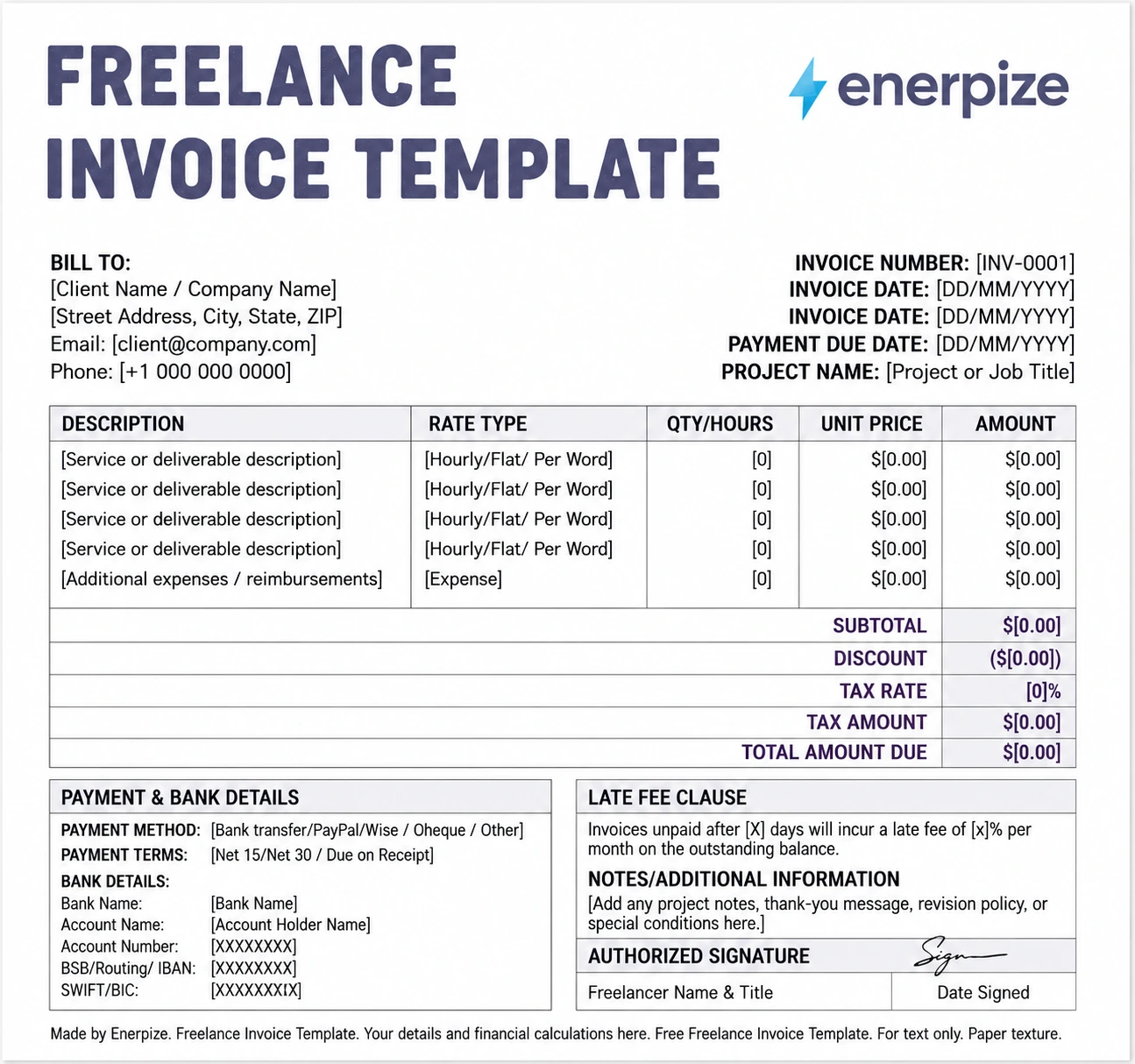
A freelance invoice template is a pre-structured billing document that records the services delivered, the rates agreed, and the payment terms owed, giving both the freelancer and the client a shared, professional record of the transaction.


What Is a Freelance Invoice Template?
Think about the last time you finished a project and felt that mix of relief and dread. Relief because the work is done. Dread because now you have to chase the money.
That is the moment an invoice template earns its keep.
A freelance invoice template is more than a blank document with placeholders. It is a legally defensible record. It proves the work happened, what it cost, and when payment was due. Courts, accountants, and tax agencies care about these details in ways that most clients never tell you upfront.
A blank Word document can technically hold all the same information. The difference is that a purpose-built template for invoice for freelance work already knows what fields to include, in what order, and how to structure line items so nothing gets lost. It removes the cognitive load of starting from zero every time a project closes.
And for freelancers managing five clients simultaneously? That cognitive load is not trivial.
Stop building invoices from scratch every time. Issue, track, and get paid directly in Enerpize, free to start, no credit card required. Start for free.
Self-Employed Invoice Template: Requirements by Country and Work Type
You finished the job. The client is happy. Now you need to get paid.
Whether you call yourself a freelancer, a sole trader, or simply self-employed, the invoice you send next does the same job regardless of the label. It records what was delivered, what it costs, and when payment is due. The template on this page works for all three.
A self-employed invoice template is a pre-built billing document designed for individuals who work for themselves rather than through an employer. No payroll. No company structure. Just you, your services, and a client who owes you money.
The fields are the same as any professional invoice. What changes is the context around them, specifically what your country requires you to include based on your registration status, your turnover, and whether you are VAT or GST registered.
Here is how that breaks down by market.
Self-Employed Invoice Requirements in the UK
In the UK, self-employed sole traders do not need to register a limited company to invoice clients. You bill under your own name or a trading name, and your invoice is legally valid from day one.
What HMRC requires on a self-employed invoice:
- Your name or trading name and address
- Your client's name and address
- A unique invoice number
- The date the invoice was issued
- A clear description of the services provided
- The amount charged, excluding VAT
- The total amount due
If your annual turnover crosses £90,000, you are required to register for VAT under Making Tax Digital rules. Once registered, every invoice above £250 must show your VAT registration number, the VAT rate applied, the VAT amount as a separate line item, and the VAT-inclusive total. Below the threshold, you invoice without VAT and do not need a VAT number on the document.
One thing UK sole traders frequently miss: you do not need a UTR number on your invoice. Your UTR is for your Self Assessment tax return, not your client billing. Including it is harmless but it is not a legal requirement and most accountants advise against it for privacy reasons.
Source: HMRC: Self-employed invoicing records
Self-Employed Invoice Requirements in the US
In the US, self-employed workers and freelancers are the same category for tax purposes: independent contractors. Your invoice structure is identical to any freelance invoice.
The number that matters is $2,000. Under the One Big Beautiful Bill Act, starting with payments made in 2026, clients who pay you more than $2,000 in a calendar year are required to file a Form 1099-NEC with the IRS reporting your income. Your invoice records, specifically the invoice numbers, amounts, and dates, are the documentation that needs to match that form when it arrives.
If your invoice records are clean and sequential, tax season is straightforward. If they are not, it becomes a reconciliation problem you could have avoided from the first job.
Source: IRS: Self-Employed Individuals Tax Center
Self-Employed Invoice Requirements in Australia
In Australia, self-employed sole traders and freelancers are the same legal category. The invoicing rules are clean until you cross the $75,000 AUD annual turnover threshold.
Below $75,000 AUD: you invoice without GST. Your ABN goes on every invoice above $82.50 AUD. No exceptions.
Above $75,000 AUD: you register for GST, charge 10% on every taxable supply, and issue a tax invoice for every sale above $82.50 AUD. A tax invoice in Australia must show your ABN, the words "Tax Invoice," a description of the goods or services, the GST amount as a separate line, and the GST-inclusive total.
Source: ATO: GST registration and thresholds
Self-Employed Hourly Invoice Template
If you bill by the hour rather than by project, your invoice needs one additional layer of structure.
Each row in your line items section should show the date the work was performed, a brief description of the task, the number of hours logged, your hourly rate, and the line total. Never consolidate multiple days or tasks into a single line that says "Consulting hours, 14 hours, $1,400." That is the invoice format that generates the most client questions.
Break it out. One task per row. The math is transparent, the hours are traceable, and disputes become structurally difficult because the client would have to contradict their own brief to challenge a specific line.
Self-Employed Cleaner Invoice Template
For cleaning businesses and sole trader cleaners, the invoice structure is the same but the line items reflect the nature of the work: location, frequency, hours or flat rate per visit, and any consumables charged separately.
If you charge for supplies on top of your labor rate, list them as a separate line item with a description. "Cleaning materials supplied: $45" is clean, professional, and prevents the conversation where a client questions why the total is higher than the hourly rate suggests.
For recurring clients, set your payment terms to Net 7 or Due on Receipt. Cleaning services are high-frequency, low-margin work. A Net 30 payment cycle on a weekly client compounds into a cash flow problem faster than almost any other freelance category.
What to Include on a Freelance Invoice
Most freelancers know the basics. Name, amount, done. But the basics are also the reason invoices get disputed, delayed, or quietly ignored. Here is everything a complete freelance invoice needs.
Your Business Details
Your full name or business name, street address, email address, phone number, and website. If you operate as a sole trader in Australia, you need your ABN on every invoice above AUD $82.50. If you are a US-based independent contractor, include your Tax ID if your client's accounts payable department requests it.
One line that surprises new freelancers: add your website. It signals permanence. Clients who are deciding whether to pay promptly or drag their feet treat a freelancer with a professional web presence differently from one who looks like they set up shop last Tuesday.
Client Details and PO Number
Your client's full name, company name, billing address, and email. If your client gave you a Purchase Order number at the start of the engagement, include it. Corporate clients cannot process invoices without a matching PO number in their system, and missing it is the single most common reason invoices sit in accounts payable for weeks.
Invoice Number and Invoice Date
Every invoice needs a unique number. Not because it feels official, but because your invoice number sequence is the primary audit trail that connects your billing records to your tax filings. For tax year 2025 and prior, the 1099-NEC filing threshold was $600. Starting with payments made in 2026, that threshold rose to $2,000 under the One Big Beautiful Bill Act. Either way, your invoice records are the documentation that supports every dollar on that form.
A simple system that works: use the client's initials plus a sequential number. ACME-001, ACME-002, and so on. If you work with multiple clients, you can prefix by year: 2026-ACME-001. Consistent, easy to search, impossible to accidentally duplicate.
Payment Due Date and Payment Terms
The due date is not optional. "I'll pay you when I can" is a complete sentence in the mind of a slow-paying client who never saw a due date on your invoice.
State your terms explicitly: Net 15, Net 30, or Due on Receipt. Net 15 is increasingly standard for freelance work, particularly for project-based engagements. Net 30 suits retainer arrangements where the client's finance team runs a monthly payment cycle.
Line Items: Services, Rates, and Quantities
Each service goes on its own line. Description, rate type (hourly, flat, per word, per deliverable), quantity or hours, unit price, and total. Never bundle everything into one line item that says "Web design services, $4,500." That is an invoice a client can question in its entirety. When your line items are broken out, a dispute over one element does not contaminate the rest.
More on this in the payment terms section below.
Tax (When It Applies)
Whether tax applies to your invoices depends on your registration status and your client's location. In the US, freelancers providing services are generally not required to charge sales tax, though some states apply sales tax to specific digital services. In Australia, you charge GST once your annual turnover crosses $75,000 AUD. For Australian freelancers invoicing without GST, the rules differ slightly. Our Australian GST invoice template covers both scenarios in detail.
When tax does apply, always list it as a separate line item. Never roll it into the project total without labeling it. Tax authorities and clients both expect to see it clearly separated.
Accepted Payment Methods
List every method you accept: bank transfer, PayPal, Wise, credit card, or cheque. Include your full bank details directly on the invoice if you accept bank transfers. IBAN and SWIFT codes for international clients. BSB and account number for Australian clients. Do not make your client send a follow-up email asking where to send the money.
Late Fee Clause: The One Field Everyone Skips
Here is the gap nobody talks about. Every invoicing guide tells you to include late fees. Almost nobody tells you what language actually makes them enforceable.
"Late fees may apply" is decorative text. A court will dismiss it because it specifies nothing: no rate, no trigger date, no calculation method.
Language that holds up looks like this: "Invoices unpaid after [X] days from the due date will accrue a late payment fee of [X]% per month on the outstanding balance, calculated from the due date until the date of full payment."
Specific. Measurable. Unambiguous. That is the difference between a clause that gets respected and one that gets ignored.
How to Write a Freelance Invoice Step by Step
Step 1: Assign an Invoice Number Before You Start Writing
Open your numbering log, not a blank document. Assign the next number in your sequence before you type anything else. This prevents gaps in your records if you start a draft and abandon it.
Step 2: Fill in Your Business Details
Name, address, email, phone, website, and Tax ID or ABN where required. If you have a logo, add it here. A branded invoice is not vanity. It signals that you take your business seriously enough to present it consistently.
Step 3: Add Your Client's Full Information
Name, company, billing address, email, and PO number if one was issued. Double-check the company name. Billing the wrong legal entity is one of the messier invoicing mistakes to unwind.
Step 4: Set the Invoice Date and Payment Due Date
Invoice date is today. Due date is today plus your payment terms. Write both out in full: June 3, 2026, not 06/03/26. Avoid numeric-only dates for international clients, as date format conventions vary by country and a misread due date is a real source of payment delays.
Step 5: List Your Services as Line Items
One service per line. Description, rate type, quantity, unit price, total. Be specific in the description field. "Brand identity design: initial concept, two revision rounds, final files" is better than "Design work." The description field is your first line of defense if a client disputes a line item.
Step 6: Calculate Subtotal, Tax, and Total
Subtotal first, then any discounts, then tax, then total amount due. In Excel and Google Sheets, use formulas so the math is never manual. A calculation error on an invoice is embarrassing in a way that no other business document quite matches.
Step 7: State Your Payment Method and Send
List your accepted methods and include all the details your client needs to pay you. Then send. Do not wait until Monday, do not let the invoice sit in your drafts folder, and do not send it without a subject line that includes the invoice number and project name.
Freelance Invoice Template Formats: Which One to Use
Not all formats work equally well for every situation. Here is how to choose.
| Format | Best For | Limitation |
|---|---|---|
| Word / Google Docs | Full layout control, custom branding | Manual math, easy to accidentally edit before sending |
| Excel / Google Sheets | Hourly billing with multiple line items, auto-calculating totals | Less visual control over layout |
| Sending to clients, final locked version | Not editable after export without a PDF editor |
Word and Google Docs
The most flexible starting point. You control every element of the layout, can add your logo, adjust fonts and spacing, and create something that feels like a professional branded document rather than a spreadsheet. The trade-off is that every calculation is manual. If you change one number, you update the totals yourself.
Use Word or Google Docs as your template source. Export to PDF before you send.
Excel and Google Sheets
The right tool the moment you are billing by the hour across multiple tasks. Formulas handle the arithmetic, which eliminates the most common invoicing error. Set up your template once with working subtotal and tax formulas and you will never do invoice math by hand again.
The freelance invoice template Excel format is especially useful for consultants and developers billing hourly across multiple work streams in a single engagement.
The only format to send to a client. A PDF locks the layout, prevents accidental edits, and renders consistently on every device. Generate your invoice in Word or Excel, then export to PDF. Every time. No exceptions.
Types of Freelance Invoices (and When to Use Each)
Standard Invoice
The workhorse. You deliver the work, you send the invoice, you get paid. Used for any completed project or service where full payment is due upon delivery.
Hourly Invoice
Built around a timesheet. Each row is a task, a date, the hours logged, your hourly rate, and the total. If you bill hourly, build this into your template from day one. Clients who pay hourly rates expect to see the hours broken out, and a vague total invites questions.
Recurring Invoice
For retainer clients or ongoing service agreements. The invoice content stays largely the same each billing cycle; only the date and invoice number change. If you manage three retainer clients and send each a monthly invoice, set up a recurring template and schedule it. Any decent invoicing tool handles this automatically so you are not manually sending the same document twelve times a year.
Pro-Forma Invoice
Sent before work begins, not after. It is an estimate in invoice format: here is what this project will cost, here are the line items, here are my payment terms. Pro-forma invoices are particularly useful for large projects where you want the client to pre-approve the scope and cost before you start.
Past-Due Invoice
When a payment is overdue, issue a past-due or memo invoice. It restates the original invoice, adds the accrued late fee calculated at the rate specified in your payment terms, and gives the client a new total. Send it with a short, professional note. Not angry. Not apologetic. Simply factual.
Milestone Retainage Invoice
This one is underused by freelancers and worth understanding. In construction and large project management, retainage is a percentage of each payment that the client withholds until final delivery is confirmed. Our AIA G702/G703 template covers this in depth for the construction context.
Freelancers, particularly in consulting and long-form design projects, are increasingly seeing clients request a similar structure. Clients hold back 10% to 15% of each milestone payment until the final deliverable is approved. If your contract includes this, your invoice needs a line item that reflects it: "Retainage withheld this period: $[X]" and "Cumulative retainage held: $[X]." When the project closes and retainage is released, issue a final retainage invoice for the full held amount.
Ready to move beyond templates? Create, send, and track every freelance invoice in Enerpize, no spreadsheet maintenance, no manual follow-up. Start for free.
Self-Employed vs. Freelancer: Does the Label Change Your Invoice?
Short answer: in most countries, no. Longer answer: the label affects your tax obligations, which affect what your invoice needs to include.
In the United States, both freelancers and self-employed workers are independent contractors for tax purposes. Your invoice structure is the same. What matters is whether your client pays you more than $600 in a calendar year, because at that threshold they are required to file a Form 1099-NEC with the IRS reporting your income. Your invoice records are the documentation that supports the accuracy of that form. If your invoice numbers, amounts, and dates do not add up cleanly, tax season becomes a problem you could have avoided with better record-keeping from month one. The IRS Self-Employed Individuals Tax Center covers your filing obligations in full.
In Australia, sole traders and freelancers are the same legal category. The invoicing difference shows up at the $75,000 AUD annual turnover threshold: cross it and you are required to register for GST and add it to every invoice. If you are a sole trader in Australia, you need your ABN on every invoice you issue. If you are registered for GST, you are also required to issue a formal tax invoice for any sale above $82.50 (GST-inclusive). The Australian Taxation Office GST page has the full registration and threshold rules.
Healthcare freelancers, including independent nurses, allied health practitioners, and NDIS support workers, have additional invoicing requirements. Our medical invoice template covers the specific fields required for healthcare billing.
Freelance Invoice Payment Terms: How to Actually Set Them
Choosing the right payment terms is less about what feels fair and more about what matches your client's actual payment cycle.
Net 15 works well for small, one-off projects. You deliver, the client has two weeks, the project is closed. Tight enough to maintain cash flow without feeling aggressive.
Net 30 is standard for retainer clients and corporate accounts. Most company finance teams run monthly payment cycles, and asking for Net 15 from a client whose AP department processes payments on the 15th of every month will just result in a polite email asking you to extend to Net 30 anyway.
Due on Receipt is appropriate for clients who have delayed payment before, for very small invoices where a 30-day wait is disproportionate, and for new clients until you have established a relationship.
The dispute-proofing problem is separate from timing, and it matters more. When a client disputes a line item, the description field on your invoice is your evidence. Compare these two versions:
Version A: "Copywriting services, June 2026. $3,500."
Version B: "Website copy: 8 pages (Home, About, Services x5, Contact) at $400 per page. Includes one round of revisions per page as per contract dated April 15, 2026. $3,200. Rush delivery surcharge, agreed by email May 28, 2026: $300. Total: $3,500."
Version B cannot be disputed without the client contradicting their own written agreement. Version A is an invitation to renegotiate after the work is done.
When to Send a Freelance Invoice
The timing question comes up more than you would expect, and the answer depends almost entirely on project type.
| Project Type | Best Invoice Timing |
|---|---|
| Small one-off project | Immediately on delivery |
| Large standalone project | 50% deposit upfront, balance on delivery |
| Monthly retainer | First of every month, recurring |
| Long multi-phase project | At each milestone completion |
| Hourly consulting | Weekly, or at agreed intervals |
One thing every experienced freelancer eventually learns: send the invoice the same day you deliver the work. Not tomorrow. Not "once I've had a chance to double-check." The moment the work leaves your hands is the moment your client is most likely to say yes to everything. That goodwill has a half-life measured in hours, not days.
For recurring clients, consider setting up automated invoice reminders so overdue invoices do not require manual follow-up. Your client follow-up module can handle this if you manage multiple client accounts in Enerpize.
Invoicing for International Freelance Clients
Cross-border invoicing sounds complicated. In practice, it comes down to three decisions: which currency, how to get paid, and what extra fields your invoice needs.
Which currency to invoice in. Invoice in your own currency whenever your contract allows it. Currency risk is real, and a project quoted in USD that the client pays in their local currency three weeks later may arrive worth less than you expected. If your client insists on their local currency, build a small exchange rate buffer into your rate and note the currency clearly on the invoice: "All amounts in USD."
How to get paid. Wire transfer via your bank's SWIFT/IBAN details is the most universal method. Include your full bank details on the invoice: bank name, account holder name, account number, IBAN (for European clients), and SWIFT/BIC code. If you receive payments via PayPal, Stripe, or similar platforms, be aware that the IRS requires these platforms to issue a Form 1099-K once your transactions exceed $20,000 and 200 transactions in a calendar year, under current rules as of 2026. Keep your invoice records clean enough to cross-reference against that form if it arrives.
Extra fields. For clients in VAT-registered countries, you may need to include a VAT exemption note. A simple line like "Services delivered by a non-VAT-registered provider. VAT not applicable." covers most cases. Ask your client's accounts payable team what they need before you send the first invoice. One email upfront saves a lot of back-and-forth later.
The Invoice Field That Protects You From AI Disputes in 2026
This one is new territory. And it matters more than most freelancers realize.
In 2025 and 2026, clients in creative and knowledge work are increasingly adding contract clauses around AI use. Some prohibit it outright. Some require disclosure. A growing number ask for a breakdown of AI-assisted versus human-created components in the delivered work.
When a dispute arises and your invoice says "Article writing, 5,000 words, $500," you have no protection. You cannot prove what was done, how, or at what skill level.
A simple addition to your description field solves this: "Content creation: research, structural planning, and drafting performed by [Your Name]. AI tools used for: initial outline drafting only. Final content reviewed, rewritten, and edited to client specifications. 5,000 words. $500."
This is not an admission of anything that lowers your rate. It is a statement of process. It documents that human expertise was applied, and it pre-empts the specific dispute clients are increasingly raising. Your invoice description field is not just a billing record. In 2026, it is also your work methodology disclosure.
How Enerpize Handles Freelance Invoicing
A template gets you started. But as your client roster grows, the manual overhead of template management starts to compound in ways that are easy to underestimate until you are chasing three overdue invoices, reconciling a retainer payment, and trying to remember whether you invoiced that rush job from two weeks ago.
Enerpize is built for this transition.
You can create fully customized invoices within the Enerpize invoicing module, adding your logo, payment terms, late fee language, and line item structure as a reusable setup you never rebuild from scratch. You can set up installment and milestone payment schedules within a single invoice, so a multi-phase project is tracked in one place rather than across a folder of separate documents. You can configure recurring invoices for retainer clients so they go out on schedule without manual intervention each month.
The Enerpize invoicing module also connects to your client accounts, so when a payment comes in, it is matched and recorded without a separate bookkeeping step. And as your freelance practice grows into a small business with employees, the same system scales with you: team-based project invoicing, payroll management, and expense tracking available within one account.
Key Takeaways
- A complete freelance invoice template includes your business details, client details, a unique invoice number, an itemized service breakdown, payment terms, and a specific late fee clause with a rate, trigger date, and calculation method.
- Your invoice number sequence is your primary audit trail for tax filings. In the US, it supports your 1099-NEC documentation. Build a consistent numbering system from your first invoice, not your fiftieth.
- Net 15 suits small project invoices. Net 30 suits retainer clients whose finance teams run monthly payment cycles. Due on Receipt is appropriate for new clients and small amounts.
- The description field on each line item is your dispute protection. Vague line items invite renegotiation after delivery. Specific line items referenced to your contract make disputes structurally very difficult.
- For international clients, invoice in your own currency where the contract allows, include full SWIFT/IBAN bank details, and add a one-line VAT exemption note if invoicing into VAT-registered countries.
- In 2026, freelancers doing creative or knowledge work should consider adding a brief process disclosure to their description fields to pre-empt AI-use disputes before they are raised.
- Self-employed and freelance invoice templates are the same document. What changes by country is whether your ABN, VAT number, or Tax ID is required, which depends on your registration status and annual turnover, not the label you use for your work
Frequently Asked Questions
Do I need to register a business to send a freelance invoice?
No. You can send a freelance invoice as an individual using your personal name and contact details. In most countries, a formal business registration is not required to invoice for services. In Australia, you need an ABN on invoices above $82.50 AUD, which you can obtain as a sole trader without registering a company. In the US, you can invoice using your personal name and provide your Social Security Number or Individual Taxpayer Identification Number if your client requests it for 1099-NEC filing purposes.
How do I number my freelance invoices?
Use a system that is simple, sequential, and searchable. A client prefix plus a sequential number works well for most freelancers: ACME-001, ACME-002, and so on. If you want to add a year, prefix it: 2026-ACME-001. Never reuse or skip invoice numbers. Gaps in your numbering sequence are a flag in a tax audit, and duplicates create confusion in accounts payable systems. For more on building an invoice tracking system, see the IRS guidance on self-employed record keeping.
What is the difference between a freelance invoice and a receipt?
An invoice is a request for payment. It is sent before the money arrives and specifies what is owed, by when, and how. A receipt is confirmation that payment was received. It is issued after the money arrives. Never substitute one for the other. Issuing a receipt before payment is received implies the money has already been paid, which creates a records problem for both parties.
Can I charge a late fee on a freelance invoice?
Yes, provided your late fee clause specifies the rate, trigger date, and calculation method in your original invoice payment terms. A clause that says "late fees may apply" is generally not enforceable because it does not define what the fee is. A clause that states "invoices unpaid after 15 days of the due date will accrue a fee of 1.5% per month on the outstanding balance, calculated from the due date" is specific enough to hold up in most jurisdictions. Check your local laws, as maximum late fee rates vary by state and country.
How do I invoice a client in a different country?
Specify the currency clearly at the top of your invoice. Include your full bank details for wire transfer: bank name, account holder name, account number, IBAN for European clients, and SWIFT/BIC code. Add a note about your VAT or tax status if relevant. If you are not VAT-registered and invoicing a client in a VAT country, a line noting "Services provided by a non-VAT-registered freelancer" prevents confusion in their accounts payable system. Refer to the IRS Form 1099-NEC guidance if your client is US-based and ask whether they require a W-9 form for their records.
What happens if a client disputes a line item on my invoice?
Start by reviewing whether your description field was specific enough to reference the contract or agreed scope. If your line item describes exactly what was delivered, references the agreement, and matches the rate your client approved in writing, you have a strong position. Send a calm, factual reply that points to the specific contract language or email where the scope and rate were agreed. If the dispute persists, a formal demand letter is the next step in most jurisdictions before small claims proceedings. The best prevention is a description field that leaves nothing open to interpretation at the time you write the invoice, not after a dispute arises.
Is a freelance invoice template the same as a self-employed invoice template?
Yes. The terms describe the same document. Freelancer and self-employed both refer to individuals who work independently rather than as employees. The invoice fields are identical: your details, your client's details, a unique invoice number, an itemized service description, your payment terms, and the total amount due. The only differences are country-specific requirements around tax registration, VAT or GST numbers, and ABN inclusion, which vary based on your turnover and location rather than what you call yourself.
Do self-employed people need to include a tax number on their invoice?
It depends on your country and registration status. In Australia, your ABN is required on every invoice above $82.50 AUD regardless of turnover. In the UK, your VAT registration number is required on invoices only if you are VAT-registered, which becomes mandatory above £90,000 annual turnover. In the US, your Tax ID is not required on invoices by default, though some corporate clients will request it for their 1099-NEC filing records. Your UTR number in the UK is never required on invoices.
What should a self-employed invoice include in the UK?
Your name or trading name, your address, your client's name and address, a unique invoice number, the invoice date, a description of the services delivered, the amount charged, and the total due. If you are VAT-registered, add your VAT number, the VAT rate, the VAT amount as a separate line, and the VAT-inclusive total. HMRC does not require you to include your UTR number on client invoices.
Create professional freelance invoices in Enerpize. Start for free.
About the Author
Omar El Bahr is a Senior Digital Growth Specialist at Enerpize, where he leads SEO, content strategy, and organic growth across international markets. He is a Forbes Communications Council contributor and has written for Entrepreneur on mobile apps, business communication, and digital strategy.
Disclaimer: This content is provided for informational purposes only and does not constitute legal, tax, or accounting advice. Invoice requirements, tax thresholds, and payment term enforceability vary by jurisdiction. Consult a qualified legal or tax professional for advice specific to your business and location.