

Posted on 15 June 2026
Free Kenya Invoice Template Download (Word, Excel, PDF, Google Docs & Sheets and Docs)
- Available in Word, Excel, PDF, Google Docs, and Google Sheets, free to download with no sign-up required
- Covers seller PIN, buyer PIN, VAT at 16%, item codes, unit of measure, eTIMS reference field, and sequential invoice numbering in one structured document
- Built with Kenya-specific tax compliance fields aligned with KRA requirements under the VAT Act 2013
- Calculates VAT amount, line totals, subtotal, and balance due automatically in the Excel and Google Sheets versions
A Kenya invoice template is a pre-formatted billing document that records goods or services delivered, rates charged, and applicable VAT, giving both the business and the client a clear, KRA-compliant record of every transaction.


What Is a Kenya Invoice Template?
Most businesses in Kenya start billing with whatever they can cobble together fast. A PDF exported from a word processor, a screenshot of a spreadsheet, sometimes just a typed WhatsApp message with a total at the bottom. It works, until it does not.
A Kenya invoice template solves that. It is a ready-to-use billing document pre-structured with every field the Kenya Revenue Authority requires on a valid invoice: your business name and KRA PIN, your client's details and PIN, a sequential invoice number, a clear description of goods or services, applicable VAT rates, and a grand total in Kenyan Shillings.
The difference between a proper invoice and a rough payment request is not just presentation. In Kenya, a valid invoice is the document your client uses to claim VAT input tax credits with the KRA. If your invoice is missing the required fields, your client cannot make that claim, and that becomes your problem to fix, not theirs.
Ready to send KRA-compliant invoices without the back-and-forth? Start for free.
When Does a Kenyan Business Need to Issue an Invoice?
Every time a sale happens. Whether you are a freelance consultant, a goods supplier, a cleaning company, or a logistics firm, the obligation to issue a billing document exists regardless of business size. For VAT-registered businesses with annual taxable turnover above KES 5 million, that document must be a formal tax invoice meeting KRA requirements under the VAT Act 2013. For businesses below that threshold, issuing a professional invoice is still good practice and a legal record of the transaction.
The KRA introduced the Electronic Tax Invoice Management System (eTIMS) in 2022, and since October 2022 all VAT-registered businesses have been required to generate and transmit invoices electronically in real time through the KRA's system. That means accuracy is no longer just about professionalism. It is a compliance obligation with a paper trail going directly to the KRA.
Standard Invoice vs. KRA Tax Invoice: What Is the Difference?
Not every Kenyan business needs to issue a KRA tax invoice. The distinction matters.
A standard invoice is a billing document any business can issue. It records what was sold, the price, and when payment is due. There is no legal requirement to include VAT if your business is not VAT-registered.
A KRA tax invoice is a specific legal document required from VAT-registered businesses. It must include your KRA PIN, your client's KRA PIN (for B2B transactions where the client will claim input tax credits), a clearly stated VAT rate and amount, and, since the eTIMS rollout, an electronic validation reference generated through the KRA's system. Without these fields, the document is not a valid tax invoice under Kenyan law, regardless of how professional it looks.
The Enerpize Kenya invoice template covers both scenarios. Non-VAT businesses can use it as a clean, professional invoice. VAT-registered businesses can fill in the dedicated PIN, VAT, and eTIMS fields and have a document that meets KRA requirements from the first line to the total.
What Is a Fee Note in Kenya?
You will see this term used constantly in Kenyan professional services circles, particularly in law firms, accounting practices, and consultancies. A fee note is a billing document issued for professional services rendered. It functions identically to a standard invoice and must meet the same KRA compliance requirements if the issuing business is VAT-registered.
The terminology difference is professional convention, not a legal distinction. If your fee note does not include your PIN, your client's PIN, and a properly calculated VAT amount, it has the same compliance gaps as any other non-compliant invoice. The Enerpize Kenya invoice template can be used as either a standard invoice or a fee note depending on your industry, with no restructuring needed.
What the Enerpize Kenya Invoice Template Includes
Most free invoice templates you find online were built for the US or UK market and then lightly edited for Kenya. Swap "USD" for "KES," add a VAT line, maybe mention the KRA in a footer, and call it localised. That is not what this is.
The Enerpize Kenya invoice template was built specifically for the Kenyan compliance environment, with fields that reflect what the KRA actually requires on a valid tax invoice, not what a generic billing document happens to include.
Here is what is inside:
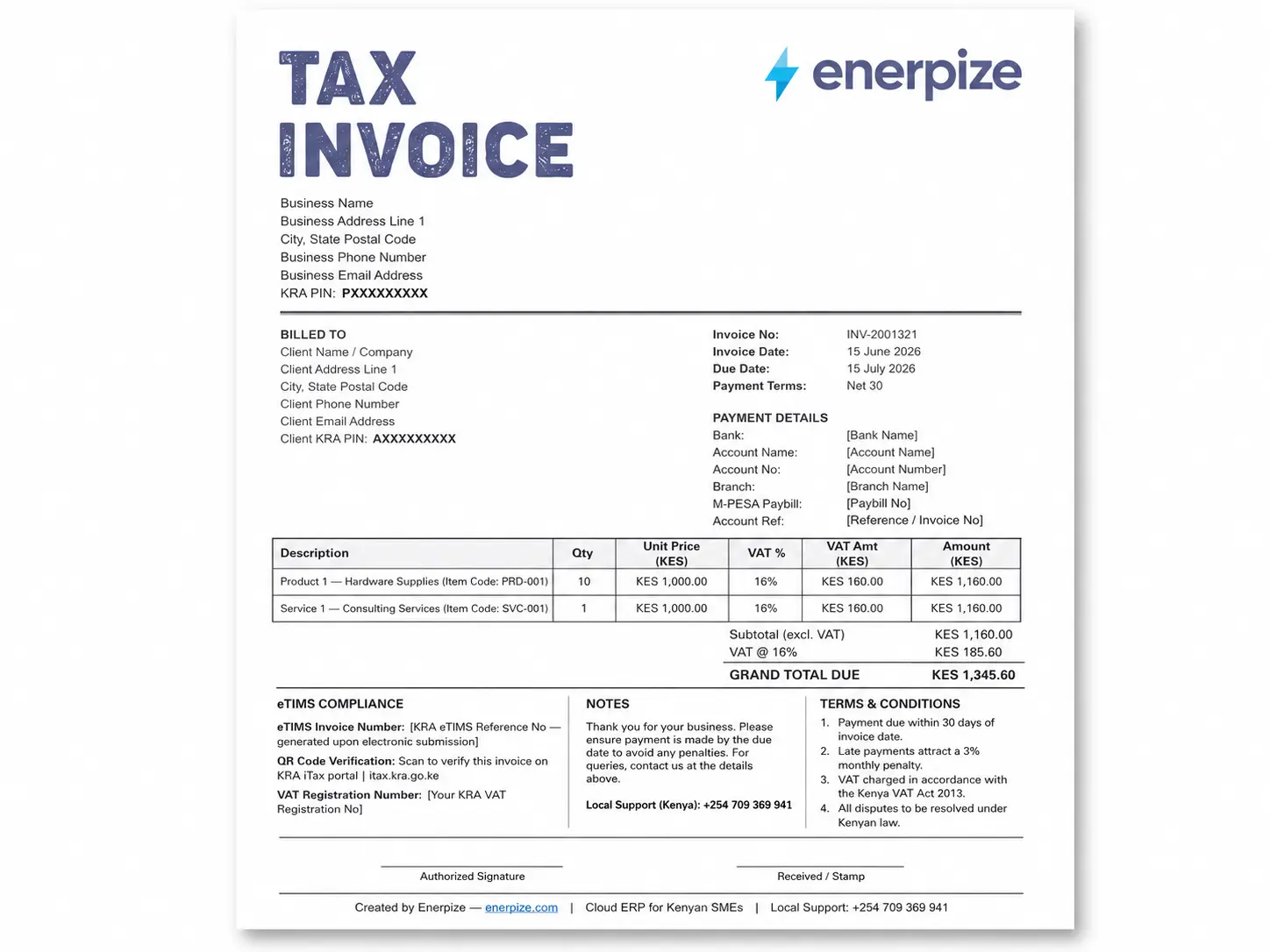
Header block: Business name, address, phone, email, and a dedicated KRA PIN field pre-labeled and formatted for a Kenyan taxpayer identification number.
Invoice metadata: Sequential invoice number (following KRA record-keeping requirements), invoice date, due date, and payment terms.
Client block: Client name, address, contact details, and a separate field for the client's KRA PIN, which is required for any B2B transaction where the buyer will claim input VAT.
Line item table: Description, item code, quantity, unit of measure, unit price in KES, VAT percentage per line, VAT amount per line, and line total. Each field is a separate column because the KRA eTIMS format requires that level of granularity.
Totals section: Subtotal excluding VAT, total VAT at 16%, and grand total due in KES. In the Excel and Google Sheets versions, all three calculate automatically when you enter quantities and unit prices.
eTIMS compliance block: Dedicated fields for the eTIMS electronic reference number, QR code verification reference, and KRA VAT registration number. These are the fields your accountant or tax advisor will ask you about.
Payment details: Bank name, account name, account number, branch, M-PESA Paybill number, and reference field. Kenya runs on M-PESA for a significant share of SME payments, and this template is built to reflect that.
Terms and conditions: Four standard clauses covering payment period, late payment penalty, VAT compliance reference to the Kenya VAT Act 2013, and jurisdiction.
Signature lines: Authorized signatory and received stamp sections for physical documentation.
Footer: "Created by Enerpize" with a live link and local Kenya support number +254 709 369 941.
What makes this different from a generic template is the eTIMS block, the dual PIN fields, the M-PESA payment section, and the VAT calculation at line level rather than as a single afterthought at the bottom. Those four things are the difference between a document that works in Kenya and one that needs to be redone before your client will accept it.
Stop rebuilding invoices from scratch. Start for free.
KRA Tax Invoice Requirements in Kenya
The Kenya Revenue Authority sets out exactly what a valid tax invoice must contain. These requirements come from the VAT Act 2013 and the more recent eTIMS regulations. Miss any of them and the document your client receives cannot be used for VAT input credit claims, which means they will come back to you.
VAT Registration Threshold: KES 5 Million
VAT registration in Kenya is mandatory for any business whose annual taxable turnover exceeds KES 5 million. Below that threshold, registration is voluntary. Once registered, your invoices must meet KRA tax invoice requirements on every transaction, not just the large ones.
Businesses that are not VAT-registered issue standard invoices without a VAT charge. But if your turnover is approaching that threshold, it is worth structuring your invoices correctly now. The KRA does not give a grace period for the billing format once you cross the registration trigger.
Mandatory Fields on Every KRA Tax Invoice
According to the KRA eTIMS portal, a valid Kenyan tax invoice must include:
- The words "Tax Invoice" clearly displayed at the top
- Seller's full business name, address, and KRA PIN
- Buyer's name, address, and KRA PIN (for B2B transactions)
- Invoice date and a unique sequential invoice number
- Description of each item or service with quantity and unit of measure
- Unit price and net amount per line item
- VAT rate applied per line (16% standard, 8% for petroleum products)
- VAT amount per line and total VAT amount
- Grand total payable in KES
- eTIMS validation reference number and QR code (for VAT-registered businesses transmitting via eTIMS)
Every one of these fields has a dedicated cell in the Enerpize Kenya invoice template. You are not guessing what to include. It is already there, pre-labeled.
eTIMS: Electronic Tax Invoice Management System Explained
eTIMS is the KRA's platform for real-time electronic invoice submission. It replaced the earlier Electronic Tax Register (ETR) system and has been mandatory for all VAT-registered businesses since October 2022. The system requires that every VAT invoice be transmitted to the KRA electronically at the time of the transaction, not at the end of the month when you file your VAT return.
The KRA eTIMS system is accessible via USSD by dialing *222# and selecting option 5 for KRA services, via the eTIMS mobile app on Android and iOS, via the eTIMS web portal, and via a standalone desktop ePOS solution for businesses with point-of-sale setups. The software is provided free of charge by the KRA.
The practical implication for the Kenya invoice template you use is that your invoice data must be eTIMS-ready before you submit it electronically. That means item codes, units of measure, and accurate VAT calculations at the line level, not estimated totals entered manually. The Enerpize template is structured to match the eTIMS data format so that the information you fill in transfers cleanly.
What Happens If You Invoice Without a PIN?
Your invoice gets rejected. Not metaphorically, practically. A VAT-registered business in Kenya that issues a tax invoice without the required PIN fields cannot have that invoice validated through eTIMS. Your client cannot claim input VAT on it. And if the KRA conducts an audit, uninvoiced or improperly invoiced transactions are treated as compliance failures.
The penalty under the VAT Act 2013 for non-compliant invoicing is significant. The KRA can impose fines and, in serious or repeated cases, refer the matter for prosecution. That is a consequence that no business in Kenya, at any size, should be taking risks with.
Kenya VAT Rates: What to Apply on Your Invoice
VAT in Kenya is governed by the VAT Act 2013 and administered by the KRA. The rate you apply depends on what you are selling, not where you are selling it.
Standard Rate (16%)
16% is the number most Kenyan businesses will type into the VAT column on every invoice they ever send. It applies to the majority of taxable goods and services, and it is pre-filled as the default VAT rate in the Enerpize Kenya invoice template. If you are VAT-registered and your supply does not fall into a reduced, zero-rated, or exempt category, 16% is your rate. No calculation needed beyond that.
Petroleum Products (8%)
The Finance Act 2023 introduced a reduced VAT rate of 8% specifically for petroleum products. If your business operates in fuel supply, logistics, or any trade where petroleum is a line item on your invoice, that line gets 8%, not 16%. The Enerpize Kenya invoice template supports different VAT rates per line item, so you can apply 8% to a fuel surcharge and 16% to everything else in the same invoice without creating a separate document.
Zero-Rated and Exempt Supplies
This is where a lot of Kenyan businesses get tripped up, because zero-rated and exempt sound like the same thing. They are not.
Zero-rated supplies attract 0% VAT, but the business issuing them can still claim input VAT on its own purchases. Exports fall here, along with certain agricultural inputs and specific financial services. Exempt supplies also carry no VAT charge, but the business cannot claim input VAT on related costs. Basic food items, medical services, and educational services sit in this category.
The practical difference shows up in your cost base and your cash flow. If you are misclassifying exempt supplies as zero-rated, you are claiming input credits you are not entitled to, which is a KRA audit risk. Record the correct rate in the VAT column and make the supply category clear in the invoice description. Your accountant will thank you at filing time.
How to Create a Kenya Invoice with Enerpize
Step 1: Set Up Your Business Profile with KRA PIN
Start with your business name, full address, phone number, email, and KRA PIN in the header block. Do not skip the PIN field or leave it as a placeholder when you send the invoice. The KRA uses your PIN to match every eTIMS submission to your tax record on iTax, and an invoice that goes out without it is an invoice your VAT-registered client cannot use.
Step 2: Add Client Details and Buyer PIN
Fill in your client's business name, address, contact details, and their KRA PIN. For B2B transactions this is not optional. Your client needs their PIN on the invoice to claim input VAT, and if it is missing they will send the invoice back. For consumer-facing businesses where the buyer is an individual, use their personal KRA PIN if you have it. If you do not, note that in the client details field and keep a record of the transaction separately.
Step 3: Add Line Items with Item Code, Unit, and VAT Rate
Be specific in the description column. Vague line items like "services rendered" or "supply of goods" are the fastest way to trigger a query from either your client's accounts team or the KRA. Add the item code, quantity, unit of measure (pieces, hours, kilograms, liters), and unit price in KES. Apply 16% VAT for standard supplies or 8% for petroleum products. The Excel and Google Sheets versions handle the VAT calculation and line total automatically once you enter the quantity and unit price.
Step 4: Apply Discount or Retention if Applicable
Construction companies, property managers, and large project contractors will often need to show a retention deduction or a negotiated discount before the grand total. Add those in the totals section as separate labeled lines. For everyone else, leave those fields blank. The grand total calculates directly from the line items without any additional input.
Step 5: Fill in the eTIMS Block and Payment Details
Once you have submitted the invoice through the KRA eTIMS portal and received your electronic reference number, add it to the dedicated eTIMS block on the template. Then fill in your bank details and M-PESA Paybill number in the payment section. Send the completed invoice as a PDF by email or WhatsApp. If you are already on Enerpize, none of this is a separate step. The invoice generates, the client record updates, the payment status tracks, and the accounting entry posts, all from the same place.
Kenya Invoice Templates for Specific Industries
Kenya's SME landscape is as varied as its geography, and a one-size-fits-all template only takes you so far. Here are the most common use cases and what the invoice should reflect for each.
Freelance Invoice Kenya
Nairobi's freelance economy is not a side hustle phenomenon anymore. It is a primary income stream for thousands of designers, developers, writers, and consultants who are billing clients across Nairobi, Lagos, London, and beyond, sometimes in the same week. A freelance invoice template for a Kenyan freelancer needs to cover the service description, hourly or project rate, VAT if you are registered, and payment terms that reflect how Kenyan freelance work actually gets paid, which usually means a partial upfront deposit before the job starts.
For cross-border work billed in USD or EUR, either note the agreed exchange rate on the invoice or specify that payment should be received in the invoiced currency. That one line saves a lot of arguments at settlement.
Construction Invoice Kenya
Kenyan construction projects are rarely straightforward. Retention clauses, phased billing, LPO references for government and parastatal work, disputes over what qualifies as completion. A construction invoice template for Kenya needs to separate the current period billing from the cumulative amount billed to date, and show the retention deduction as its own line item. That structure keeps the record clean and gives both contractor and client something they can point to without ambiguity.
For public sector or parastatal projects, include the Local Purchase Order (LPO) number on the face of the invoice. Without it, your invoice will sit in someone's accounts payable queue indefinitely.
Consulting Invoice Kenya
Consulting clients in Kenya, especially corporates, NGOs, and government agencies, run structured invoice approval workflows. Your invoice needs to survive three levels of sign-off before payment is released. A consulting invoice template that clearly references the engagement name, the signed proposal or contract number, and separates time from expenses gives your invoice a much better chance of clearing that process on the first submission rather than coming back marked "insufficient detail."
Cleaning Services Invoice Kenya
Cleaning companies in Nairobi's commercial and residential estates mostly operate on recurring monthly contracts, which means the invoice is predictable but the details still matter. Cover scheduled visits, square footage serviced, cleaning products used as reimbursable materials, and any call-out surcharges for deep-clean or emergency requests as separate line items. If the contract has a reference number, put it on the invoice. It is how your client matches your invoice to the right purchase order, and it is how you get paid on time instead of chasing.
Trucking and Logistics Invoice Kenya
A trucking invoice template for a Kenyan logistics company is not just a billing document. It is a trip record. Capture the vehicle registration number, the route with origin and destination, cargo weight or volume, the trip date, and the agreed rate whether that is per kilometer or per load. Fuel surcharges and waiting time fees go on separate lines. Bundling them into the transport total is how disputes start, and it is also how a KRA audit gets complicated.
Rental Invoice Kenya
Landlords and property managers need to treat the rental invoice as more than a payment request. Include the property address, the rental period covered, the monthly rent in KES, any service charge or maintenance levy, and the late payment penalty clause if one exists in the tenancy agreement. For residential landlords with annual rental income above KES 288,000, rental income is subject to Monthly Rental Income (MRI) tax at 7.5% of gross rent, due to the KRA by the 20th of the following month. A rental invoice template that records the full gross rent amount gives you the number your accountant needs to calculate MRI accurately without going back to chase bank statements.
What Enerpize Does Beyond the Template
Downloading a Kenya invoice template is a start. It solves today's billing problem. But every business eventually reaches the point where managing invoices in a downloaded file stops being practical. Clients pile up. Payment statuses blur. VAT calculations across dozens of invoices become a spreadsheet exercise nobody wants to do at month-end.
That is where Enerpize comes in. Enerpize is a cloud ERP built for SMEs, and 40,000+ businesses across the Enerpize ecosystem use it to manage their invoicing, accounting, inventory, payroll, HR, CRM, and operations from a single dashboard.
For Kenyan businesses specifically, Enerpize offers invoicing and billing with automatic VAT calculations, recurring invoice generation for subscription and retainer clients, payment tracking across bank transfers and M-PESA, and a quotation template that converts directly into an invoice without retyping anything.
The platform is cloud-based, accessible from any device, and backed by a local support team in Kenya reachable at +254 709 369 941. If you have ever tried resolving a billing software issue through a global chat queue at midnight when you have a client chasing an invoice, having a local number you can actually call is not a small thing.
Enerpize also integrates invoicing with accounting. Your invoice does not just go to your client, it posts to your general ledger, updates your accounts receivable, and feeds into your monthly financial reports automatically. By the time your accountant asks for the numbers, they are already there.
Enerpize positions itself as the option that does not require a technical implementation team, a six-month rollout, or an enterprise budget. You sign up, set up your business profile, and start invoicing the same day, that's why Enerpize can be considered in the conversation of the best ERP software in Kenya.
Key Takeaways
- Any VAT-registered Kenyan business with annual taxable turnover above KES 5 million must include the seller's KRA PIN, buyer's KRA PIN, VAT rate and amount per line, and a sequential invoice number on every tax invoice, as required under the VAT Act 2013.
- Since October 2022, VAT-registered businesses in Kenya must transmit invoices electronically through the KRA's eTIMS platform in real time. The system is free and accessible via USSD, mobile app, web portal, and desktop ePOS.
- A "fee note" is a professional services billing document widely used by Kenyan consultants, lawyers, and accountants. It must meet the same KRA compliance requirements as a standard tax invoice if the issuer is VAT-registered.
- The Enerpize Kenya invoice template includes dual PIN fields, a VAT calculation column at the line level, an eTIMS reference block, M-PESA payment details, and a terms and conditions section, making it one of the most complete Kenya-specific templates available for free download.
- Enerpize goes beyond the template. Registered users get recurring invoicing, automatic VAT calculations, payment tracking, general ledger integration, and local Kenya support at +254 709 369 941, all from one cloud dashboard.
- The standard VAT rate in Kenya is 16% for most goods and services, with a reduced rate of 8% applying to petroleum products, under the Finance Act 2023. Zero-rated and exempt categories apply to exports, basic food items, medical services, and educational services.
Frequently Asked Questions
Is the Enerpize Kenya invoice template free to download?
Yes. The template is free to download in Excel, Word, and PDF formats. No account, no sign-up, no credit card. If you want to use Enerpize as your invoicing software rather than a downloaded file, the free 14-day trial covers the full platform with no setup required.
Does the template comply with KRA invoicing requirements?
Yes. It includes all mandatory fields under the KRA VAT Act 2013: seller PIN, buyer PIN, sequential invoice number, item description with item code and unit of measure, VAT rate per line at 16%, VAT amount per line, subtotal excluding VAT, total VAT, and grand total in KES. The eTIMS reference block is also pre-built for VAT-registered businesses submitting electronically.
What is eTIMS and do I need it for this template?
eTIMS is the Kenya Revenue Authority's Electronic Tax Invoice Management System, mandatory for VAT-registered businesses since October 2022. The KRA eTIMS platform requires invoices to be transmitted electronically in real time. The Enerpize template helps you prepare accurate invoice data with the correct fields before submission through eTIMS, reducing errors at the point of electronic filing.
What VAT rate should I apply on a Kenya invoice?
The standard VAT rate is 16% for most goods and services. Petroleum products attract a reduced rate of 8% under the Finance Act 2023. Certain supplies are zero-rated (exports, specific agricultural inputs) or exempt (basic foods, medical services, education). If your business is not VAT-registered, no VAT is charged and the VAT fields on the invoice remain blank.
Can I add M-PESA as a payment method on the invoice?
Yes. The template includes a dedicated payment details section with fields for bank account, M-PESA Paybill number, and payment reference. Kenya's SME payment environment is heavily M-PESA driven, and having the Paybill number clearly on the invoice reduces the back-and-forth of clients asking where to send payment.
What is a fee note in Kenya and is it the same as an invoice?
A fee note is a billing document used in Kenyan professional services, primarily by law firms, auditors, consultants, and financial advisors. It functions identically to a standard invoice and must include the same KRA-required fields if the issuing business is VAT-registered. The terminology is industry convention, not a legal distinction. The Enerpize Kenya invoice template can serve as a fee note without any structural changes.
Can Enerpize send invoices directly to Kenyan clients?
Yes. Registered Enerpize users can generate invoices from their dashboard and send them via email, WhatsApp, or SMS directly to clients. The platform also supports automatic payment reminders and real-time payment status tracking across Paid, Partially Paid, and Unpaid states.
Does Enerpize support recurring invoices for Kenya businesses?
Yes. Enerpize supports recurring invoicing with custom intervals, useful for subscription businesses, monthly retainer consultants, service maintenance contracts, and residential landlords issuing regular rental invoices. Recurring invoices are generated and sent automatically without manual input each cycle.
About the Author
Omar El Bahr is a Senior Digital Growth Specialist at Enerpize, where he leads SEO, content strategy, and organic growth across international markets. He is a Forbes Communications Council contributor and has written for Entrepreneur on mobile apps, business communication, and digital strategy.
Disclaimer: This template and the information on this page are provided for general reference purposes only. Tax rates, compliance requirements, and KRA regulations are subject to change. Always verify current requirements with the Kenya Revenue Authority at kra.go.ke or consult a licensed tax advisor before issuing invoices for commercial use.