

Posted on 17 December 2025
Weekly Sales Report Template Excel & Word
- The weekly sales report template is available in Excel, Google Sheets, Word, and Google Docs.
- It tracks sales activities, conversions, and revenue in one consolidated weekly view.
- Compares actual sales revenue against targets to reveal performance gaps immediately.
- Ideal for sales teams, managers, and business owners who need fast, actionable insight.


What is the Weekly Sales Report Template?
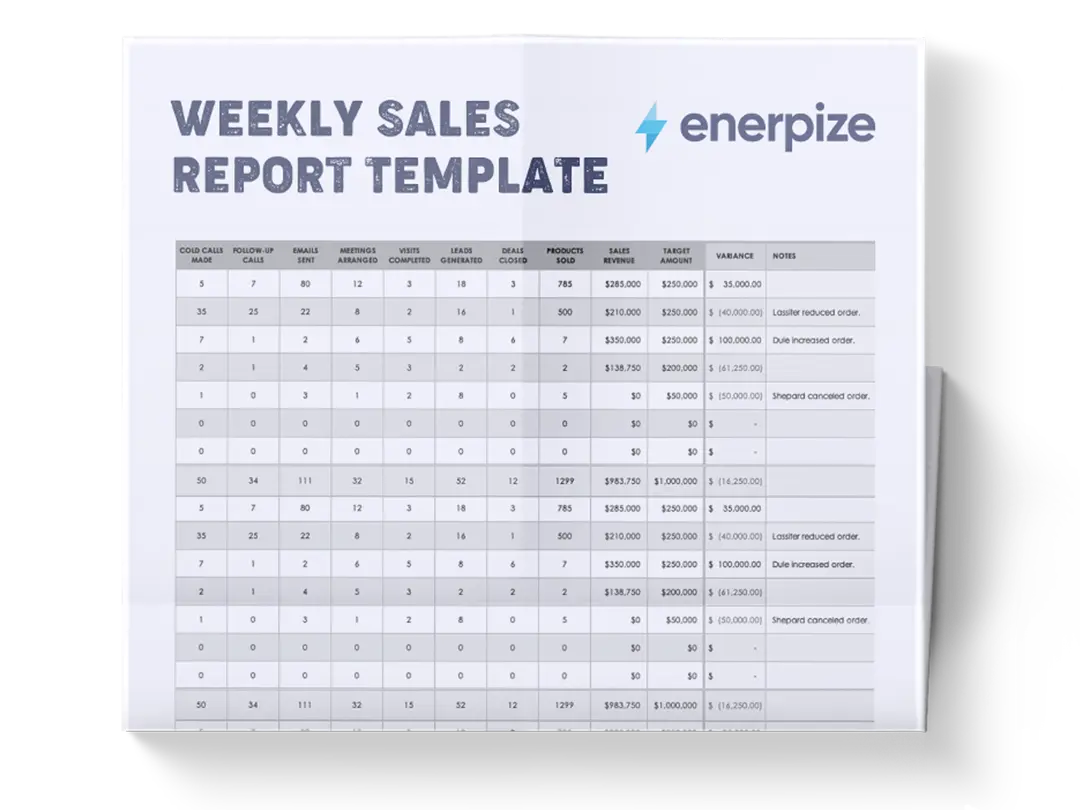
A weekly sales report template captures and evaluates sales performance over a defined one-week period. It consolidates frontline sales activities alongside outcome metrics like products sold, total revenue, target amounts, and variance.
By presenting both effort-based inputs and revenue-based outputs in a single table, the template allows users to quickly assess productivity, efficiency, and goal alignment without relying on fragmented reports or subjective updates.
What Does the Weekly Sales Report Template Contain?
Cold Calls Made
Records the total number of outbound cold calls completed during the week, reflecting initial prospecting effort.
Follow-Up Calls
Tracks calls made to existing leads or prospects as part of ongoing conversations.
Emails Sent
Captures the number of sales-related emails sent, indicating written outreach volume.
Meetings Arranged
Logs the total number of sales meetings scheduled during the reporting period.
Visits Completed
Documents in-person or virtual sales visits that were actually conducted.
Leads Generated
Shows the number of new leads created during the week from all activities.
Deals Closed
Counts successfully closed deals, representing completed sales outcomes.
Products Sold
Records the total number of products or units sold.
Sales Revenue
Displays the monetary value of sales closed during the week.
Target Amount
Specifies the sales revenue goal set for the same period.
Variance
Shows the difference between actual sales revenue and the target amount.
Notes
Provides space for qualitative context, explanations, or observations related to performance.
How to Use the Weekly Sales Report Template
1- Start With Activity Metrics
Begin by entering weekly totals for cold calls made, follow-up calls, and emails sent. These fields establish the volume of outreach activity that feeds the rest of the sales funnel.
2- Record Engagement Outcomes
Next, fill in meetings arranged and visits completed to reflect how outreach translated into direct sales interactions.
3- Log Lead And Deal Progression
Enter the number of leads generated and deals closed to show movement through the pipeline.
4- Capture Sales Output
Record products sold and sales revenue to quantify tangible results from the week’s efforts.
5- Set The Benchmark
Input the target amount for the same reporting period. This provides the reference point for performance evaluation.
6- Review Variance
Calculate and enter the variance to immediately see whether performance exceeded, met, or fell below expectations.
7- Add Contextual Notes
Use the notes column to explain anomalies, highlight wins, or flag issues that numbers alone cannot convey.
8- Repeat For Each Entry Row
Each row represents a distinct reporting entry—such as an individual salesperson, team, account, or week—depending on how the template is applied.
Related Templates
Importance of the Weekly Sales Report Template
Creates Immediate Performance Visibility
At a weekly level, sales performance often gets distorted by surface-level activity metrics—such as high call volume or email output—that feel productive but may not generate real revenue impact. This template solves that problem by placing activity indicators (calls, follow-ups, emails, meetings, visits) directly alongside outcome metrics (leads generated, deals closed, products sold, and sales revenue). When these figures are reviewed together in a single row, patterns become immediately visible.
For example, a salesperson may show strong outbound effort but low deals closed, signaling inefficiencies in qualification, messaging, or closing rather than effort. Conversely, modest activity paired with strong revenue highlights effective targeting or high-quality accounts. This alignment forces an honest evaluation of performance by tying effort to results, eliminating guesswork and reducing reliance on anecdotal explanations during weekly reviews.
Enforces Consistent Weekly Reporting
Inconsistent reporting structures are one of the biggest obstacles to meaningful sales analysis. When teams report different metrics each week—or use varying definitions for the same metrics—trend analysis becomes unreliable.
The weekly sales report template eliminates this issue by enforcing a fixed structure that is reused week after week. Each column represents a non-negotiable data point, ensuring that every reporting period captures the same dimensions of performance.
Over time, this consistency allows managers and leadership to compare weeks accurately, identify seasonal fluctuations, detect early signs of slowdown or acceleration, and measure the impact of strategy changes. It also reduces reporting friction for sales teams, since the expectations never change. Once the structure is learned, reporting becomes faster, cleaner, and more dependable.
Highlights Conversion Bottlenecks
Because the template captures the full progression from outreach to revenue, it makes conversion breakdowns impossible to ignore. Large gaps between cold calls made and meetings arranged may indicate poor targeting or weak opening scripts.
Strong meeting numbers paired with low deals closed can point to pricing objections, qualification issues, or ineffective closing techniques. Similarly, healthy leads generated with low products sold may reveal pipeline stagnation or delayed decision-making on the buyer side.
The power of this template lies in its ability to expose exactly where momentum is lost. Instead of diagnosing problems based on intuition, teams can trace performance issues to specific stages of the sales process and address them systematically.
Supports Data-Driven Coaching
Effective sales coaching depends on specificity. General feedback, such as “you need to push harder” or “close better,” rarely leads to improvement.
This template equips managers with concrete data that supports focused, actionable coaching conversations. For example, if a representative shows strong activity but weak conversion from meetings to deals, coaching can center on objection handling or proposal delivery.
If follow-up calls are low relative to leads generated, time management or prioritization may be the issue. Because the template captures both behavior and results, coaching discussions shift from subjective opinions to measurable facts. Over time, this creates a culture of accountability and continuous improvement grounded in data rather than pressure.
Aligns Teams With Revenue Targets
Revenue goals often feel abstract when they are reviewed monthly or quarterly. By embedding TARGET AMOUNT and VARIANCE directly into the weekly report, the template keeps revenue expectations visible at all times.
Each week becomes a checkpoint rather than a surprise at the end of the month. Positive variance reinforces what is working and builds momentum, while negative variance prompts early intervention before gaps widen.
This weekly alignment helps teams understand how daily activities contribute to broader revenue goals and reinforces shared responsibility for hitting targets. It also supports more realistic forecasting, as trends in weekly variance can signal whether targets are achievable under current conditions.
Who Can Use the Weekly Sales Report Template?
Sales Representatives
For individual sales reps, the template serves as a personal performance mirror. It provides a clear, unbiased snapshot of how effort, engagement, and results connect within a single week. Reps can quickly identify whether they are relying too heavily on activity without results or underutilizing outreach opportunities.
The notes column also allows them to document contextual factors—such as stalled deals or paused clients—that explain short-term dips. Over time, this self-visibility encourages better planning, sharper prioritization, and greater ownership of outcomes.
Sales Managers
Sales managers benefit from a standardized view of team performance without needing to interpret scattered reports or verbal updates. The template allows managers to compare performance across reps, identify top performers, and spot underperformance early.
Because the data is structured uniformly, weekly reviews become more efficient and more objective. Managers can quickly see where coaching is needed, where processes are breaking down, and where best practices can be replicated across the team.
Business Owners
For business owners, the Weekly Sales Report Template provides fast insight into revenue health without the complexity of dashboards or CRM analytics. In a single table, owners can see whether sales activity supports growth goals, whether targets are being met, and where risks may be emerging.
This high-level visibility supports faster decision-making around hiring, incentives, pricing adjustments, or strategy changes—without requiring deep involvement in day-to-day sales operations.
Revenue Operations Teams
Revenue operations teams can use the template to enforce reporting discipline and standardization across multiple teams or regions. Because the structure is fixed and metric-driven, it supports aggregation, comparison, and downstream analysis.
Ops teams can use the data to identify systemic issues, refine performance benchmarks, and support forecasting efforts—all while maintaining alignment between frontline activity and revenue outcomes.